1.5 Earthwork
Sydney found the pattern just after midnight. Personnel had delivered six archive boxes to his office, each filled with the records of…
1.5 Earthwork
Sydney found the pattern just after midnight. Personnel had delivered six archive boxes to his office, each filled with the records of senior engineers who had resigned over the previous year. By two o’clock the floor had disappeared beneath neat stacks of folders. Marcus White had long since abandoned his own office and taken over the conference table, where he was slowly building columns of reports according to discipline, date, and location.
For nearly three hours they found nothing. One engineer had specialized in bridge design. Another had spent his career maintaining hydroelectric facilities in northern Maine. A third had worked almost exclusively on railway construction. Their personnel evaluations were all excellent. They lived in different cities, answered to different departments, and had almost never worked together. Sydney leaned back and rubbed his eyes. He sat cross-legged on the floor with another file spread across his knees, pencil tapping lightly against the margin as he reread a page for the third time. Marcus watched him for another moment. “You’ve looked at that report four times.”
“I know.”
“Why?”
“It bothers me.”
Marcus stood and crossed the room. “What bothers you?”
Sydney handed him the file. Near the back, tucked between reimbursement forms and engineering certifications, sat a single travel authorization. Marcus frowned. “What am I looking at?”
“Read it.”
Marcus did. “Local travel request.”
“Keep going.”
“Purpose…” Marcus paused. “‘Personal business.’” He looked up. “So?”
Sydney reached behind him and picked up another file. “Read that one.”
Marcus scanned the page. Another travel authorization. The same destination. This one was also marked “personal business.” His expression changed slightly. Sydney handed him a third. Then a fourth. Then a fifth. Marcus spread the papers across the table. For several seconds neither man spoke. “They all went to the same place.”
Sydney nodded. “They all went to the same address.”
Marcus checked the dates. “They weren’t together.”
“No.”
“Months apart.”
“Yes.”
Marcus looked at the address once more. “I’ve never heard of it.”
Sydney walked over to the city map covering the far wall. Thousands of streets covered the parchment in a dense web of black lines. Districts had been colored according to utility zones, transit routes, and engineering jurisdictions. Sydney traced a finger across the northern districts before moving lower, into the oldest sections of First Haven. Finally he stopped.
“There.”
Marcus joined him. “The Earthwork.”
Neither of them spoke for a moment. The Earthwork occupied the oldest ground in First Haven. Before the city had grown into the clouds, it had spread across the frozen earth. As newer towers rose above it, wealth climbed with them, leaving the original streets trapped permanently in shadow. Over the decades the district had become a city beneath the city, crowded with forgotten apartment blocks, abandoned infrastructure, and people who no longer seemed to belong anywhere else. Few residents of First Haven had ever walked there. Even fewer admitted to wanting to.
Among the wealthy, the Earthwork had once become a grotesque form of entertainment. Armored vehicles carrying curious socialites would descend into the district with hired guides, creeping through its narrow streets while their passengers watched the lives unfolding outside reinforced glass as though observing animals in the wild. The practice ended after the Roth incident. The son of one of First Haven’s wealthiest industrialists insisted on entering the neighborhood without a guide, convinced the stories had been exaggerated. He was found three days later so badly beaten that his own family reportedly failed to recognize him. Publicly, the family claimed he had died. Privately, rumors insisted he still lived somewhere inside the Earthwork, unrecognizable to everyone except those who had never known him before.
Marcus folded the travel forms. “I don’t like this.”
Sydney continued studying the map. “I didn’t expect you to.”
Marcus walked back toward the desk. “If these engineers were involved with something down there…” He hesitated. “…maybe we’re better off not knowing.”
The Earthwork had become something larger than a neighborhood. It was an idea. Parents warned children about it. Politicians referenced it whenever crime statistics were discussed. Newspapers treated it as though it existed beyond the Collective’s reach. Most people who spoke about the Earthwork had never seen it.
Sydney rolled the map closed. “I don’t think the people there are our problem.”
Marcus raised an eyebrow. “No?”
“They’re poor.”
“They’re dangerous.”
“They’re poor,” Sydney repeated. “There’s a difference.”
Marcus folded his arms. “You really believe that?”
“I think people resent being treated like exhibits.”
Marcus didn’t answer. Sydney picked up his coat from the back of the chair. “They didn’t attack those tourists because they were wealthy.”
He buttoned the coat against the cold. “They attacked them because they behaved as though they were visiting a zoo.”
Marcus watched him gather the travel authorizations into a leather folder. “So we’re going.”
Sydney looked up. “We’re going.”
Marcus sighed heavily. “When?”
Sydney checked the clock. It was nearly three in the morning. He slipped the folder beneath his arm. “We leave after breakfast.”
Marcus nodded reluctantly. Outside the office windows, thunder rolled somewhere beyond the western mountains. It was distant enough to be mistaken for freight trains crossing elevated bridges, but Sydney knew the difference. He stepped to the glass and looked toward the horizon. A dark wall of cloud had begun climbing over the mountains. Winter storms arrived quickly in the Collective. This one looked determined.
The higher residences built over the Earthwork still glowed with electric light, hidden behind balconies and rows of narrow windows. The first several stories of nearly every building stood dark. Doors had been welded shut. Elevator shafts had been sealed with steel plates. Stairwells ended behind concrete walls. The people who lived above entered their homes from elevated walkways that connected the upper floors from building to building, never needing to descend to the streets below.
On the ground, another city had grown in the shadows. The streets remained crowded despite the cold. The district was poor, but it was far from lifeless. Everywhere Sydney looked, people were trading, and arguing. Marcus noticed different things. His eyes lingered on the broken windows, the burned-out storefronts, and the groups of young men standing with their backs against brick walls, watching strangers pass. He noticed that nearly everyone looked at Sydney and him for a second longer than felt comfortable. He noticed how quickly conversations stopped whenever they entered a new street.
“I still don’t like this,” he muttered.
Sydney adjusted the worn canvas bag slung over his shoulder. “I know.”
“They tell government employees not to come here without security.”
“We aren’t dressed like government employees.”
Marcus glanced down at his own coat. They had both chosen heavy canvas jackets instead of the tailored wool overcoats common in First Haven. Their boots were scuffed. Their gloves had been repaired more than once. Sydney had even left behind the brass lapel pin identifying him as a Head Engineer. Apart from the quality of their posture, there was little to distinguish them from the laborers surrounding them.
Marcus still looked uncomfortable. “You don’t seem worried.”
Sydney slowed as a little girl hurried across the street carrying a basket nearly as large as herself. An elderly man immediately stepped forward to help her lift it onto a cart before continuing on his own way without waiting for thanks. “I don’t think these people are interested in us.”
Marcus frowned. “They’re staring.”
“So would you.”
“Why?”
Sydney nodded toward a bakery whose windows had been boarded with reclaimed timber. Fresh bread cooled on racks outside while customers waited patiently in the snow. “How many people from the Conservatory do you think have walked down this street?”
Marcus looked around. “I doubt many.”
“I doubt any.”
They continued walking in silence for another block. The neighborhood grew older with every intersection. Concrete gradually gave way to brick. Steel storefronts became patched wooden facades. Entire buildings leaned slightly where frozen foundations had shifted over the decades. Above them, the upper levels disappeared into low clouds, their elevated bridges vanishing into the gray like streets suspended in the sky.
Marcus finally spoke again. “I’ve always wondered why they never rebuilt this district.”
Sydney smiled faintly. “They did.”
Marcus looked confused. “This is rebuilt?”
Sydney pointed upward. “They rebuilt everything above us.”
Marcus followed his gaze. The elevated walkways stretched between residential towers like another city entirely, bright with electric lamps and enclosed against the weather. From below, the people crossing them appeared only as silhouettes passing behind frosted glass.
“They rebuilt a city,” Sydney said quietly. “They just didn’t rebuild this one.”
Marcus had no reply. The address eventually led them to one of the oldest sections of the Earthwork, where the streets narrowed until delivery trucks could barely pass. Here, most of the ground-floor windows had been covered with corrugated steel or salvaged lumber. Rusted pipes ran openly across the walls, dripping warm water that immediately froze where it reached the pavement. A man sitting beneath an improvised shelter of sheet metal noticed them before they reached the corner. He sprang to his feet so quickly that Marcus instinctively stopped walking. The man was wrapped in several mismatched coats tied together with rope. His beard had grown long enough to disappear into the collar of his jacket, and his eyes darted constantly from one end of the street to the other as though expecting someone to emerge at any moment.
“You lost?” he asked.
Sydney shook his head. “We’re looking for an address.”
The man’s shoulders relaxed only slightly. “Most people looking for addresses don’t come down here.”
Sydney removed one of the travel authorizations from his bag and unfolded it carefully. “I’m trying to find this building.”
The man glanced at the paper. For an instant, nothing happened.
Then, the man’s eyes widened. He looked from the address to Sydney, then back toward the street behind them as though making certain they had not been followed. “Where’d you get that?”
“It belonged to someone who worked in First Haven.”
The man’s breathing quickened. He kept staring at Sydney. “Who sent you?”
“No one.”
“You come alone?”
“Just the two of us.”
The man studied them for another long moment before lowering his voice. “That building isn’t there anymore.”
Sydney looked at the address again. “What do you mean?”
“It fell.”
Marcus frowned. “Fell?”
The man nodded. “Couple years back.”
“How does a building just fall?”
“It shouldn’t.” The answer came so quickly that it sounded rehearsed. “It shouldn’t have happened.”
Sydney folded the paper. “Can you take us there?”
The man immediately shook his head. “No.”
“We’ll pay you.”
“I don’t want your money.”
Sydney waited. The wind picked up suddenly, carrying with it the first distant rumble of thunder. Everyone on the street seemed to notice at once. Shopkeepers began pulling canvas awnings tighter while several vendors hurried to cover their merchandise against the coming storm.
The man looked toward the darkening sky before turning back to Sydney. “You picked a bad day.”
“We’re aware.”
“No.” He spoke more quietly this time. “You aren’t.”
He looked once more at the address in Sydney’s hand. After several seconds, he sighed. “I’ll take you.”
Marcus looked at Sydney in disbelief. Sydney simply nodded. “Thank you.”
The man pulled his hood over his head and stepped into the street without another word. Sydney followed. Marcus hesitated only a moment before falling in behind them, glancing uneasily at the clouds gathering over the western edge of the city. The thunder sounded closer this time.
The man led them west without asking whether they were following. He moved quickly through the Earthwork, taking turns that seemed to have little relationship to the original street grid. Twice he cut through alleys so narrow that Sydney had to turn sideways to avoid scraping his bag against the walls. Another time he disappeared through the burned shell of an old storefront and emerged through a loading entrance on the opposite side. Marcus stayed close enough behind Sydney that the three of them might have been mistaken for a single group, though he continued glancing over his shoulder whenever footsteps approached from behind.
The deeper they went, the less of First Haven remained visible. The enormous towers were still there, but from these streets they appeared only in pieces. A hundred floors of apartments might rise above them while the first five stood empty and black, separated from everything overhead by concrete barriers and sealed elevator shafts. Enclosed bridges connected the inhabited levels far above the street, allowing residents to move between buildings without ever descending into the neighborhood beneath them. Every few minutes Sydney caught sight of someone crossing one of those bridges, little more than a dark figure moving through warm light hundreds of feet overhead.
Down here, the city had been left to improvise. Electrical cables crossed between windows in tangled bundles. Water pipes had been patched with mismatched sections of copper and steel. Someone had built an entire heating system from old radiator coils mounted beneath a storefront awning, and a row of elderly men sat beneath it playing cards while steam rose from their coats. The farther Sydney walked, the more fascinated he became by the repairs. Almost none would have passed an inspection in the central districts, but most of them worked.
Ahead, the man abruptly turned beneath an elevated railway and waited for them to catch up. The tracks overhead were old enough that rust fell from the supports whenever a train passed. None did now. The storm warning had apparently begun affecting service, and the usual electric hum from the line had disappeared.
The man looked toward the sky. “You hear that?”
Thunder rolled somewhere beyond the buildings. It was louder than before, deep enough that Sydney felt a faint vibration through the pavement. Sydney checked the time. They had been walking for almost an hour. “How much farther?” he asked.
The man started forward again. The streets were now empty, and Sydney noticed that the temperature had dropped. The change was subtle but unmistakable. Wind pushed between the buildings with enough force to send loose snow skittering across the pavement. Far above them, the clouds had thickened until the elevated residences disappeared completely. Even the lights of the upper city were gone.
Their guide turned down another street. Then he stopped. “There.”
Sydney followed his gaze. At first he thought they had reached an empty lot. A wide opening interrupted the otherwise continuous line of buildings. Snow covered most of it, forming uneven hills between slabs of broken concrete and twisted steel. Several enormous sections of wall lay half-buried beneath the drifts. Rusted reinforcing bars protruded from them like exposed bone. Only the front portion remained standing. It was perhaps twenty yards wide and three stories tall at its highest point, though the upper floors had been torn open by the collapse. Windows stared blankly onto the street. Part of the original entrance remained beneath a cracked concrete overhang, and a pair of heavy doors hung crookedly from their hinges.
Marcus stopped walking. “That’s it?”
The man nodded. Sydney looked at the paper in his hand and then at the faded numbers still bolted beside the entrance. The address matched. “When did it collapse?”
“Four years ago.”
Sydney stepped closer. “What caused it?”
The man laughed once. Nobody else joined him. “That’s the question.”
Sydney looked upward. The building beside it was older and appeared considerably less stable. Rust covered the exterior supports. Several windows had been replaced with wooden panels. Yet it still stood.
“What did the investigation find?”
“Nothing.”
Marcus frowned. “There had to be an investigation.”
“There was.”
“And?”
The man shrugged. “Ground was good. Foundation was good. Steel was good. Weather was clear.”
Sydney’s attention sharpened. “Structural failure?”
“They said no.”
“Explosion?”
“No.”
“Fire?”
“No.”
“Then what happened?”
The man’s nervous eyes settled on the ruins. “It fell.”
The simplicity of the answer bothered Sydney. Buildings did not simply fall. The Collective had built badly before. Bridges had failed. Dams had cracked. Transmission towers had folded under ice. Engineering was an imperfect profession practiced by imperfect people, and Sydney had never believed otherwise. But buildings did not collapse without leaving a reason behind.
“Was anyone killed?” Sydney asked.
The man nodded. “Thirty-eight.”
That quieted both of them. The wind moved through the exposed structure, producing a low whistle somewhere inside. The man shoved his hands deeper into his pockets. “Only building that’s ever done it.”
Marcus looked at the ruins again with considerably less enthusiasm than before.
“What happened to the people who lived here?”
“Some died. Some moved.”
“And the survivors?”
The man shrugged. “Wouldn’t come back.”
Another roll of thunder moved across the district. Closer again. The man began backing toward the street. “This is where I leave you.”
Sydney turned. “You aren’t coming inside?”
“No.”
“You brought us this far.”
“That’s far enough.”
Marcus looked at him. “Why?”
The man’s eyes shifted toward the broken windows. “People don’t go in there.”
Sydney glanced at the entrance. “Why not?”
For the first time, their guide looked embarrassed. “People say things.”
“What things?”
The man apparently decided that explanation was sufficient. “Nobody sleeps there. Nobody takes the metal. Nobody even steals the furniture.”
Sydney looked through one of the broken windows. He could make out overturned tables and several chairs inside. In the Earthwork, where almost everything eventually found another use, an abandoned building containing usable material was unusual.
“People think it’s cursed?” Sydney asked.
The man gave him an irritated look. “I didn’t say I believed it.”
“You just won’t go inside.”
“I also don’t stand under cranes.”
Sydney smiled faintly. “Fair enough.”
The man turned to leave, then stopped. “If you’re staying until dark, stay until morning.”
Marcus immediately looked at Sydney. “We’re not staying until dark.”
The man ignored him. “Storm’s coming from the west. Once it hits, streets won’t be good. Water comes down from the upper city and floods the low blocks.”
He nodded toward the building. “First floor stays dry enough near the front.”
Marcus looked incredulous. “You just told us the building was cursed.”
“I said people think it’s cursed.”
“And you’re recommending we sleep in it?”
“I’m recommending you don’t walk around the Earthwork in a flood.”
Marcus opened his mouth, apparently unable to decide which part of the advice offended him more. Sydney thanked the man. Their guide gave the ruined building one final glance before disappearing the way they had come. Within seconds he was gone behind the neighboring structures.
Marcus watched the empty street. “We should follow him.”
“We came here for a reason.”
“We found the building.”
A gust of wind pushed through the street, carrying fine grains of snow against his coat.
“Sydney.”
Sydney stopped beneath the cracked overhang. “What?”
Marcus pointed upward. The sky had become almost black.
“We have maybe two hours.”
Sydney looked at the clouds. “Then we’d better not waste them.”
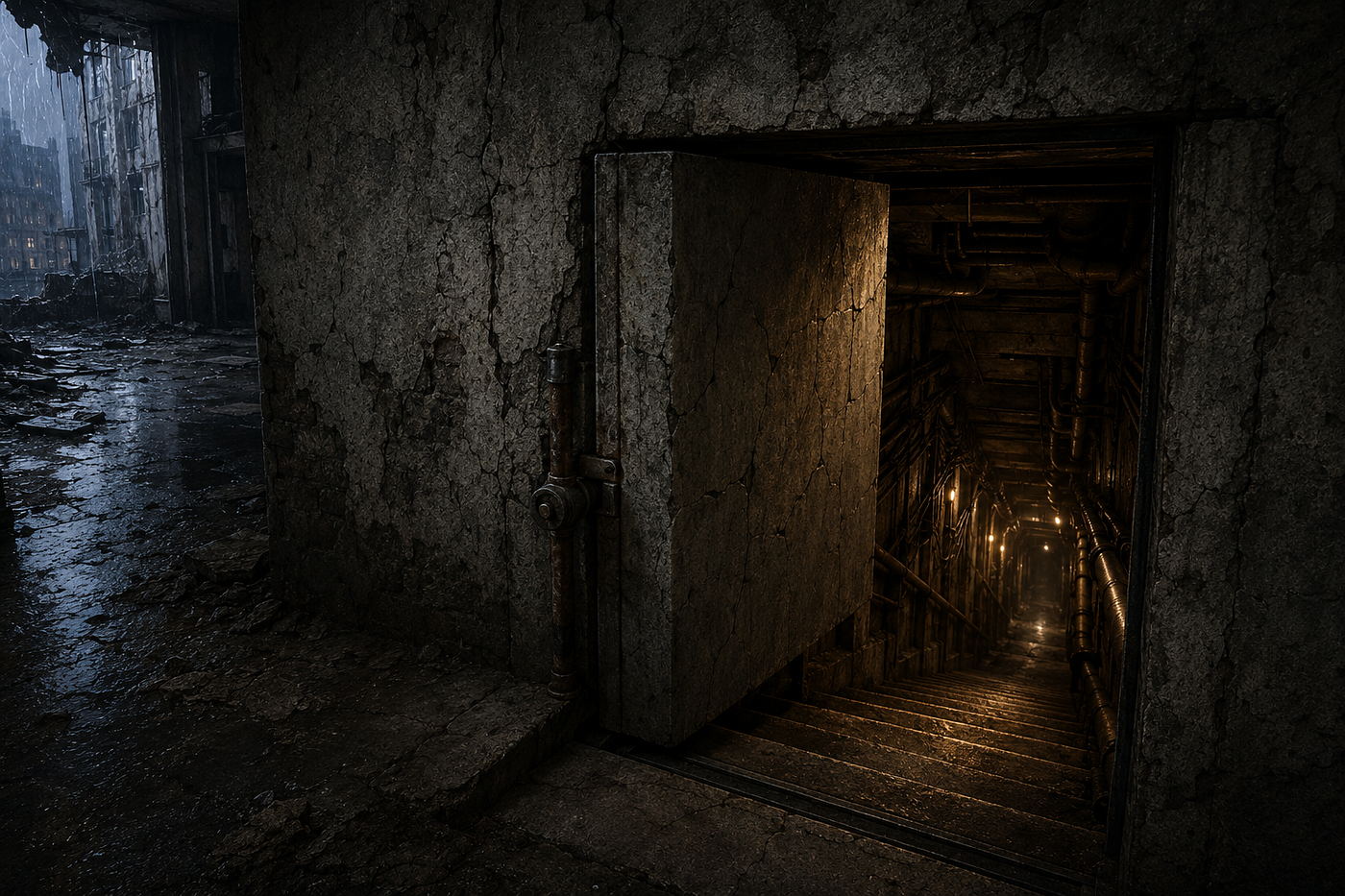
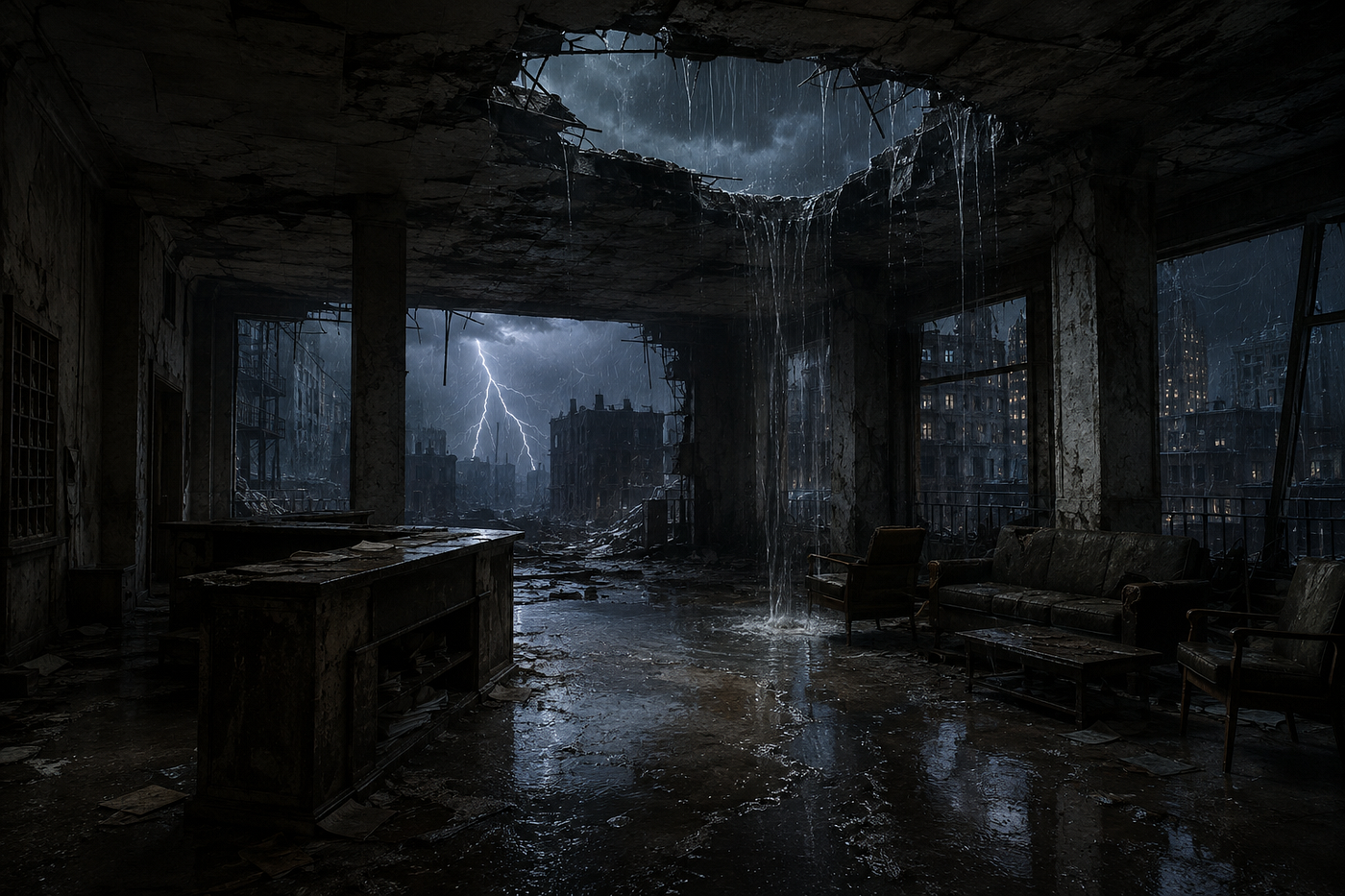
He pushed one of the doors open. The hinges groaned loudly enough to echo through the ruins. Inside, the first floor was surprisingly intact. A broad lobby stretched ahead of them beneath a ceiling fractured in several places but still supported by thick concrete columns. Dust covered everything. Old couches remained arranged around low tables. A reception desk stood against one wall with papers still scattered across its surface. Farther back, a corridor disappeared beneath a section of collapsed ceiling.
Marcus entered reluctantly. His boots left clear prints in the dust. Sydney walked to the reception desk and ran one finger across its surface. The dust was thick enough to coat his glove. “Nobody’s been here in a while.”
Sydney glanced at him. “You’d prefer company?”
“I’d prefer daylight.”
They began searching. Most of the rooms contained nothing useful. Offices had been abandoned exactly as they were after the collapse. Filing cabinets stood open and empty. Desks remained overturned. In one room, a calendar still hung on the wall displaying the month the building had fallen. Another contained a row of chairs facing a cracked projection screen. Sydney searched for anything connected to the engineers. Names. Documents. Electrical diagrams. Evidence that Carmen Reyes or Ellis Walsh had stood here. He found nothing. Nearly an hour passed. The light outside faded faster than it should have. Rain began tapping against the broken windows.
Marcus noticed first. “We need to leave.”
Sydney stood in what had once been a conference room, examining a hole in the ceiling where a section of concrete had fallen through. “We haven’t checked the basement.”
Marcus stared at him. “The basement is underneath a collapsed building.”
Lightning flashed beyond the windows. For a fraction of a second, the entire ruined lobby turned white. Thunder followed almost immediately. The sound shook dust from the ceiling. Marcus looked upward. “No.”
Sydney glanced toward him. “No what?”
“We’re not going into the basement.”
Sydney listened to the rain. It was no longer tapping against the windows. It was pounding. Water began dripping through several cracks overhead, striking the dusty floor in slow, dark circles. Sydney walked toward the entrance and looked outside. The street had almost disappeared behind the rain. Water already rushed along the gutters, carrying trash, ice, and pieces of wood downhill. Another flash illuminated the buildings across the street. Thunder exploded overhead. Marcus joined him.
“We can still make it.”
Sydney watched the water rising along the curb. “No.”
“Sydney — “
“Look at the street.”
Marcus looked. The answer was obvious. They had spent too long searching. The storm had arrived. Sydney stepped back inside and pulled the damaged door as close to shut as its twisted hinges allowed. “We leave in the morning.”
Marcus stared at him. “You’re suggesting we spend the night here.”
“We’re dry.”
Water dripped through the ceiling behind them. Marcus looked at it. Sydney corrected himself. “Mostly dry.”
Marcus turned slowly and surveyed the abandoned lobby. The overturned furniture. The dark corridors. The fractured ceiling. The building that had somehow become the only structure in the history of the Collective to collapse without explanation. Another bolt of lightning filled the windows. The thunder arrived hard enough to make the floor tremble beneath their boots. Marcus looked at Sydney. “I hate this place.”
They chose the old reception area for the night because it appeared to be the safest part of the building. Four concrete columns supported the ceiling, and the floor above remained mostly intact. The broken windows were far enough away that the wind reached them only as a cold draft, and one corner stayed reasonably dry despite the rain beginning to find its way through cracks overhead. Sydney dragged two old couches away from the windows while Marcus inspected the ceiling with increasing suspicion.
“That crack wasn’t there before.”
Sydney looked up. “Which one?”
Marcus pointed. “The long one.”
Sydney studied it for a moment. “It’s old.”
“How can you tell?”
Marcus continued staring upward. Sydney dropped his bag beside one of the couches. “If it opened tonight, the concrete inside would be clean.” Sydney sat down and began unlacing his boots.
Marcus watched him. “You’re actually going to sleep.”
“That’s generally what people do at night.”
“In abandoned buildings?”
“When necessary.”
“Collapsed abandoned buildings?”
Sydney looked around. “This part hasn’t collapsed.”
Marcus stared at him. “Yet.”
Another flash of lightning filled the lobby with white light. The thunder arrived almost immediately, striking with enough force to rattle the broken windows and send a fine stream of dust drifting from somewhere in the darkness above. Marcus looked up. Sydney did not. He removed his wet socks and hung them across the arm of the couch. The storm had become considerably worse during the half hour since they had decided to stay. Rain no longer fell against the building so much as struck it. Wind screamed through the missing upper floors, occasionally producing a deep metallic groan as something loose shifted somewhere inside the ruins. Water poured through several holes in the ceiling and collected in spreading pools across the lobby floor.
Sydney watched one of them creep toward the reception desk.
“We should move the files.”
Marcus looked at him. “What files?”
Sydney pointed toward the leather folder containing the travel authorizations.
Marcus grabbed it immediately and placed it on the highest shelf behind the desk. The lights of the Earthwork had almost completely disappeared beyond the windows. Whatever electricity the lower streets normally managed to steal or generate had begun failing as the storm intensified. One building went dark, then another. Within minutes the only illumination came from a handful of distant windows high above the district and the repeated flashes of lightning moving across the sky.
The Earthwork became strangely quiet beneath the storm. Sydney had expected shouting from the streets or the sound of people rushing for shelter. Instead, everyone seemed to have disappeared. Doors had been barred. Windows had been covered. Even the improvised street lamps had gone dark. For the first time since entering the neighborhood, Sydney understood why Marcus had found it unsettling.
The storm had emptied an entire district. Marcus sat on the opposite couch and removed his coat, though he kept his boots on. Marcus looked toward the black corridor behind them. A tremendous crack of thunder exploded directly overhead. Sydney pulled his coat over himself and stretched out along the couch. Marcus remained sitting upright. For several minutes neither spoke. Rain hammered the ruins. Every few seconds lightning illuminated the lobby, turning the furniture, columns, and hanging sections of ceiling into sharp black silhouettes. Between flashes, the darkness seemed deeper than before.
Marcus finally broke the silence. “Thirty-eight people.”
Sydney opened his eyes. “What?”
“Thirty-eight people died here.”
“I remember.”
“And nobody knows why the building fell.”
“Apparently.”
Marcus looked upward again. “And we’re sleeping underneath what’s left of it.”
Sydney shifted beneath his coat.
“We’re sitting underneath what’s left of it. You don’t appear interested in sleeping.”
“I’m not.”
“You should try.”
Sydney closed his eyes again. The storm continued. His exhaustion was finally beginning to overpower the noise. The trip to Ash Valley, the investigation with Marcus, and the journey into the Earthwork had blurred into several days without enough sleep between them. His body had begun demanding something his mind could no longer negotiate away. Marcus, however, seemed to become more awake with every thunderclap.
“Did you hear that?”
Sydney opened one eye. “Thunder?”
“No.”
“Rain?”
“No.”
“Wind?”
Marcus looked toward the corridor. “Something upstairs.”
Sydney listened. The building groaned. Water splashed somewhere in the darkness. Nothing else. “There’s barely an upstairs,” Sydney said.
“That’s not helpful.”
Sydney closed his eyes. “Go to sleep.”
Another bolt of lightning flashed. Marcus watched the ceiling.
Sydney sighed. “Marcus.”
“What?”
“If the building collapses, being awake won’t improve your chances.”
The thunder rolled away into the distance, and for several minutes the storm seemed to weaken. The rain continued, but the intervals between lightning grew longer. Sydney’s breathing slowed. Then the wind changed. It struck the exposed upper floors from the west with a deep roar. Somewhere above them metal tore loose with a shriek. Something enormous crashed against the ruins and fell through several levels before striking the ground outside.
Sydney listened. Nothing followed. The rain began pouring through a new hole near the center of the lobby. A narrow waterfall struck the floor, washing years of dust toward the entrance. Within minutes several inches of water had collected in the lowest portion of the room. Sydney watched it without much concern. The floor sloped toward the street. It would drain. Another flash illuminated the lobby. Something caught his attention. Sydney opened his eyes fully. Darkness returned. He stared toward the far side of the room.
Marcus noticed. “What?”
Sydney didn’t answer. He waited. Lightning flashed again. For a fraction of a second the lobby became perfectly visible. Across the dusty floor beyond the reception desk, Sydney saw footprints, as clear as day. Sydney sat up slowly. They began near one of the interior corridors and crossed the lobby toward the far wall. They were wet. Fresh enough that water still glistened inside them. Sydney looked toward his own boots. Then Marcus’s. Their tracks were obvious near the entrance and throughout the rooms they had searched. These were different. Bare feet. Someone had walked across the lobby without shoes.
Marcus followed Sydney’s gaze but the darkness returned before he could see anything. “What are you looking at?”
“Nothing.”
Marcus frowned. “That’s not true.”
Sydney waited for another flash. Several seconds passed. Then lightning illuminated the room again. The footprints were still there. They crossed the floor in a straight line. Then stopped at the wall. Sydney studied the concrete. No door. No corridor. No opening. Just a solid wall. Darkness returned.
Marcus shifted on the couch. “Sydney?”
Sydney continued staring. He considered getting up. He considered taking the lantern from his bag. He considered waking himself completely and examining the prints while they were still wet. Then his exhaustion answered for him. Morning would be better. Daylight would be better. And whatever had made the footprints had already gone somewhere he could not immediately follow. Sydney lowered himself onto the couch again.
“What did you see?” Marcus asked.
Sydney pulled the coat over his shoulders. “Something I want to look at in the morning.”
Marcus stared through the darkness. “That is an extremely unpleasant thing to say right now.”
Sydney smiled faintly. “Then forget I said it.”
Thunder shook the building again. Marcus remained sitting upright, eyes fixed on the dark corridor and listening to every groan that traveled through the ruins. Across from him, Sydney’s breathing gradually became slow and steady despite the storm. Within minutes he was asleep.
Outside, lightning tore across the sky above the Earthwork while rain poured through the broken remains of the only building in the Collective that had ever fallen. Inside, the water continued spreading across the dusty floor. And beside the far wall, the wet footprints slowly disappeared beneath it.
메타데이터
- post_id
- f1785a22f2f1
- slug
- 1-5-earthwork-f1785a22f2f1
- url
- https://medium.com/@heatwav3/1-5-earthwork-f1785a22f2f1
- canonical_url
- https://medium.com/@heatwav3/1-5-earthwork-f1785a22f2f1
- author_url
- https://medium.com/@heatwav3
- status
- ok
- fetched_at
- 2026-08-08 21:44:17