The Simple Process Mapping Tool That Can Save Organizations Thousands of Hours
Most business problems are not caused by a lack of effort.
The Simple Process Mapping Tool That Can Save Organizations Thousands of Hours
Most business problems are not caused by a lack of effort.
They are caused by confusion.
Confusion about who provides information, who performs the work, what inputs are required, what outputs are expected, and who ultimately receives the result.
Over the years, I have observed that many organizations struggle with delays, rework, communication gaps, and quality issues not because employees lack skills, but because the process itself is not clearly understood.
This is where one of the simplest yet most powerful process improvement tools becomes valuable: the SIPOC Diagram.
What Is SIPOC?
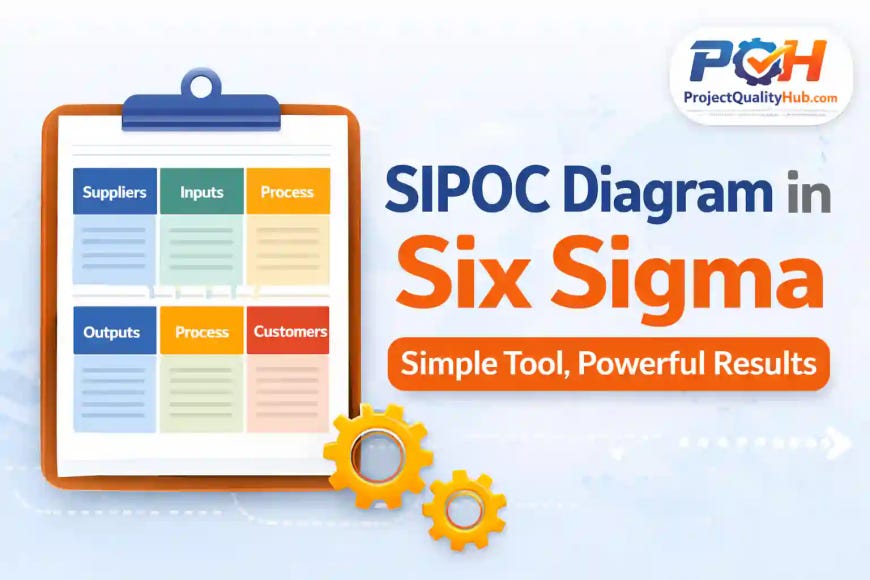
SIPOC stands for:
- Suppliers
- Inputs
- Process
- Outputs
- Customers
It is a high-level process mapping tool widely used in Six Sigma and business improvement initiatives.
Rather than diving immediately into detailed procedures, SIPOC helps teams understand the complete process from beginning to end.
Think of it as a helicopter view of how work flows through an organization.
Why Most Teams Skip This Step
When organizations face a problem, they often rush directly into finding solutions.
For example:
- Production delays
- Customer complaints
- Quality defects
- Project overruns
The immediate response is usually:
“Let’s fix the problem.”
However, many teams never stop to ask:
- Where does the process start?
- Who supplies the required inputs?
- What information is needed?
- What exactly should be delivered?
- Who receives the final output?
Without answering these questions, improvement efforts frequently target symptoms rather than causes.
A Real-World Example
Imagine a construction project where equipment installation is consistently delayed.
At first glance, the issue appears to be poor contractor performance.
After creating a SIPOC diagram, the team discovers:
Supplier
Engineering department
Input
Approved construction drawings
Process
Site execution and equipment installation
Output
Installed equipment ready for commissioning
Customer
Project owner
Further investigation reveals that drawing approvals are arriving late.
The installation team is not the root cause.
The real problem exists much earlier in the process.
Without a SIPOC analysis, the organization might have continued blaming contractors while ignoring the actual bottleneck.
Benefits of Using SIPOC
Organizations that use SIPOC diagrams often experience significant improvements.
Better Process Understanding
Everyone gains a common understanding of how work flows through the organization.
Improved Communication
Departments understand their responsibilities and dependencies more clearly.
Faster Problem Solving
Teams identify process gaps before investing time and money in corrective actions.
Reduced Rework
Clarifying inputs and outputs reduces misunderstandings and prevents mistakes.
Stronger Customer Focus
The customer becomes a visible part of the process rather than an afterthought.
Where SIPOC Works Best
SIPOC can be applied in almost any industry:
Construction Projects
- Procurement processes
- Material approval workflows
- Contractor management
Manufacturing
- Production planning
- Quality control
- Maintenance management
Service Industries
- Customer onboarding
- Complaint handling
- Document approval processes
Project Management
- Change management
- Progress reporting
- Risk management
Common Mistakes When Creating SIPOC Diagrams
Many teams make SIPOC diagrams unnecessarily complicated.
The goal is not to document every detail.
The goal is to provide a clear overview.
Avoid:
- Excessive process steps
- Technical jargon
- Department-specific language
- Overcomplicated workflows
A good SIPOC diagram should be understandable within a few minutes.
Why Leaders Should Care
Executives often invest significant resources in software, automation, and process improvement initiatives.
However, technology alone cannot fix a process that nobody fully understands.
Before improving a process, organizations must first understand how the process currently works.
That is exactly what SIPOC helps achieve.
Final Thoughts
The most effective improvement projects often begin with a simple question:
“How does the process actually work?”
A SIPOC diagram provides a structured way to answer that question.
It helps organizations identify gaps, improve communication, reduce inefficiencies, and focus improvement efforts where they will have the greatest impact.
For professionals interested in Six Sigma tools, process improvement methods, and practical SIPOC examples, I found this detailed guide particularly useful:
https://projectqualityhub.com/sipoc-diagram-in-six-sigma
Sometimes the simplest tools create the biggest improvements.
메타데이터
- post_id
- f18f0dd69e89
- slug
- the-simple-process-mapping-tool-that-can-save-organizations-thousands-of-hours-f18f0dd69e89
- url
- https://medium.com/@projectqualityhub/the-simple-process-mapping-tool-that-can-save-organizations-thousands-of-hours-f18f0dd69e89
- canonical_url
- https://medium.com/@projectqualityhub/the-simple-process-mapping-tool-that-can-save-organizations-thousands-of-hours-f18f0dd69e89
- author_url
- https://medium.com/@projectqualityhub
- status
- ok
- fetched_at
- 2026-08-07 10:43:16



