The Async Screening Framework That’s Rewriting Early-Stage Hiring for Recruitment Agencies
The average unstructured phone screen produces three problems at once: bias, inconsistency, and wasted time. A recruiter forms an…
The Async Screening Framework That’s Rewriting Early-Stage Hiring for Recruitment Agencies
The average unstructured phone screen produces three problems at once: bias, inconsistency, and wasted time. A recruiter forms an impression in the first 30 seconds based on a candidate’s name, accent, or conversational style.
Two candidates who answer the same question differently get assessed through different lenses because the recruiter’s mood changed between calls. And the recruiter spends three hours a week on calls that a 90-second async response could have replaced.
That’s the cost of hiring in the resume-and-phone-screen model.
According to LinkedIn’s Global Talent Trends research, 92% of talent professionals say soft skills matter as much as or more than hard skills when hiring. Resumes capture none of them. The result is that recruiters spend hours on early-stage phone screens trying to get a read on communication, problem-solving, and cultural fit that a well-designed async question could surface in minutes.
The solution is no longer to ask for better phone screen protocols. It’s to stop using unstructured phone screens for early-stage assessment entirely.
Recruitment agencies and HR recruiters are now using structured async screening — video responses, audio clips, file uploads of actual work, and written answers to role-specific scenarios — to replace the early-stage phone screen. This approach doesn’t just save time. It reduces first-impression bias while delivering richer candidate insight before any live interview is scheduled.
If you’re a recruitment agency still stuck in the resume-and-phone-screen cycle, you’re not just wasting time. You’re hiring slower, hiring less fairly, and missing the candidates who communicate well but undersell themselves on paper.
The Bias Problem in Phone Screens
Unstructured phone screens are one of the most biased stages in hiring. A recruiter forms an impression based on name, accent, tone, or conversational energy in the first 30 seconds. That impression colors the rest of the conversation regardless of what the candidate actually says.
This bias operates in at least four ways:
- Name-based bias: A candidate’s name signals ethnicity, gender, or background before they say a word. A recruiter who unconsciously associates certain names with lower quality will assess the same answer differently than they would for a candidate with a different name.
- Accent-based bias: A candidate with a non-native accent or regional dialect may be assessed as less competent regardless of the quality of their answer. The bias is about pronunciation, not knowledge.
- Appearance-based bias: Even in video calls, a candidate’s workspace, lighting, or background reflects their environment, not their ability. A candidate applying from a shared apartment produces lower-quality video than someone in a home office, but the difference is about their living situation, not their job skills.
- Personality-based bias: A candidate who is naturally quieter or more cautious may be assessed as less engaged than a more extroverted candidate who gives the same answer with more energy. The bias is about delivery style, not quality of thought.
Structured async screening reduces these biases by standardizing the assessment. Every candidate answers the same questions in the same format. The recruiter reviews responses without the pressure of a live conversation and without the first-impression signals that dominate phone screens.
File uploads and written responses are the most neutral in terms of presence-based signals. Audio responses reduce appearance bias. The key is consistency: asking every candidate the same questions in the same format.
The Four Formats That Replace Phone Screens
Four formats surface what phone screens measure poorly: video, audio, file uploads, and written responses. They are not replacements for live interviews. They are replacements for unstructured early-stage phone screens.
Video Responses: Communication and Presence
Video is the richest format for async candidate assessment. It combines verbal communication, tone, pacing, and non-verbal cues in a way no other format replicates. For customer-facing roles, leadership positions, or any position where presence and communication style affect team or client outcomes, video is the best filter.
What video reveals that phone screens measure poorly:
- Whether a candidate can organize their thoughts under mild time pressure
- How they present themselves in a professional context
- Whether their communication style matches the team’s culture
- Energy level and genuine engagement with the role
A candidate who struggles to articulate ideas in a phone screen may be distracted by the pressure of a live conversation. A video response recorded on their own schedule produces more reliable signal about their actual communication ability.
Example question that works well in video format: “Tell us about a time a project didn’t go as planned. What happened, and what did you do differently afterward?”
A phone screen answer produces structured text delivered under pressure. A video answer shows pacing, self-awareness, and how the candidate handles a moment of vulnerability in a professional context.
Audio Responses: Verbal Clarity Without Appearance Signals
Video is not always the right format. For some roles and some candidates, requiring a camera introduces friction that filters out good people for the wrong reasons. A backend engineer applying for a remote role may find video requirements invasive or irrelevant to the job. A candidate applying from a shared workspace may produce low-quality video that reflects their environment, not their ability. Neurodiverse candidates sometimes find video format more cognitively demanding in ways unrelated to job performance.
Audio-only responses are a powerful alternative. They reveal verbal communication clarity, vocabulary, tone, confidence, and composure without the additional cognitive load of camera presence.
Audio responses are also easier to review in bulk. A recruiter can listen to a set of audio responses during a commute or between tasks in a way that video does not easily allow.
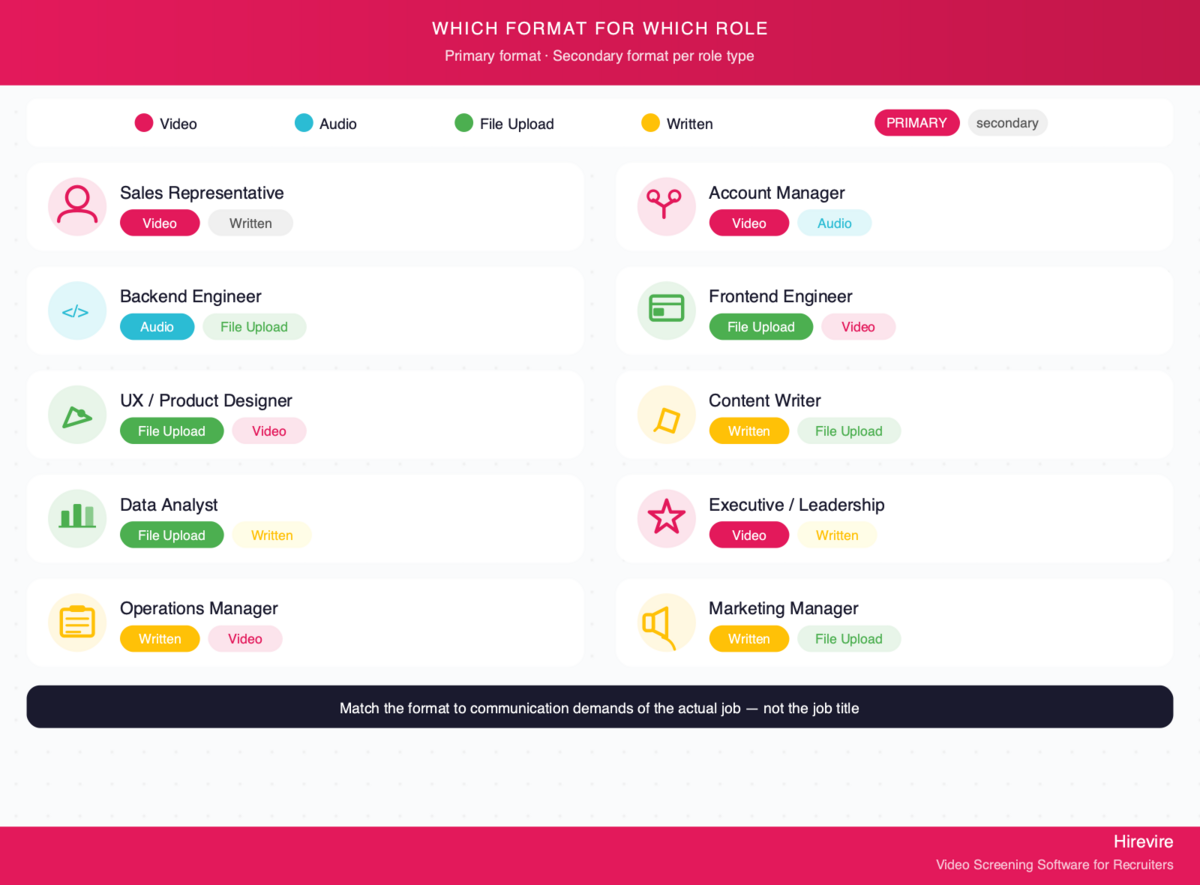
Best for: Writing-heavy roles, backend or data-focused technical roles where presence isn’t a job requirement, roles where the candidate pool may skew toward privacy-conscious applicants, and organizations that want to reduce potential appearance-based bias in early screening.
File Uploads: Actual Work, Not Claims of Work
The most direct way to assess whether a candidate can do a job is to look at work they have already done. File uploads make that possible at scale, without a portfolio review process that requires back-and-forth email.
Traditional portfolio review requires a recruiter to email candidates, wait for responses, follow up on incomplete submissions, and then manually organize what arrives. An async file upload question at the screening stage consolidates all of that into a single structured response.
Best for: Design roles (UX, graphic design, brand), writing and content roles (samples, published work, case studies), engineering roles (code samples, GitHub links, architecture diagrams), finance and analytics roles (sanitized models, reports, dashboards), and any role where past work is more predictive than interview performance.
What file uploads replace: Email chains, follow-up requests, manual organization, and the uncertainty of whether a candidate can actually do the work.
Written Responses: Thinking on Paper
Written responses strip away vocal delivery and presence, focusing entirely on how a candidate structures and expresses their thinking. For some roles, that is exactly the right filter. A strategist who cannot write a clear recommendation memo is going to struggle regardless of how well they interview in person. A customer success manager whose written responses are disorganized or full of errors will create problems in client communication down the line.
Best for: Strategy and analytical roles, operations roles with heavy documentation requirements, any position where async written communication is core to the job (remote teams, distributed organizations), and roles where grammar, clarity, or precision in writing matters professionally.
What written responses reveal: How a candidate organizes and prioritizes information, vocabulary and precision, whether their thinking is clear enough to put in writing, and attention to detail (typos, formatting, completeness of answer).
Why Agencies Need This Now
Volume hiring demands consistency. A recruitment agency that screens 50 candidates a week for multiple roles cannot maintain consistency with unstructured phone screens. The recruiter’s mood changes between calls. The questions drift. The assessment criteria shift.
Multi-format async screening solves this problem at scale. Every candidate answers the same questions in the same format. The assessment is standardized. The recruiter can review responses in bulk without calendar coordination.
This approach accelerates hiring speed. A recruiter can review 20 video responses in the time they would spend on three phone screens. The decision to schedule a live interview is faster and more confident because the recruiter enters the interview with context about the candidate’s communication style and work.
Real agency example: ElevateClients reported that async screening “cuts down my hiring process by at least 75% and made it sooo much easier to see/feel who the candidates were before having to hop on a call with them.”
That’s the agency value proposition: faster decisions, less churn, and more consistent hiring across multiple roles and multiple recruiters.
How Hirevire Makes It Work
The practical challenge with multi-format screening is logistics. Collecting video responses through one tool, written answers through another, and work samples via email creates fragmentation that slows down the process and makes it hard to compare candidates.
Hirevire collects all four response formats in a single screening link. A recruiter builds a question set — one video question, one written question, one file upload request — and candidates complete everything in one session from any device, without creating an account.
What this means in practice:
- Candidates submit everything in one pass, reducing drop-off from multi-step processes
- Recruiters review all responses for a candidate in one place, making comparison straightforward
- Teams can share response links with hiring managers without needing them to log in to a separate system
- AI-generated transcripts (available in 90+ languages) make video and audio responses searchable and reviewable in text form for reviewers who prefer reading to watching
- ATS integration via webhooks and Zapier means screening responses can be automatically tied to candidate records without manual data entry
For recruitment agencies, Hirevire offers a white-label Agency plan: up to 20 active roles, custom branding, and pricing at $199/month billed yearly. The plan eliminates per-candidate fees within limits and removes the need for candidate logins.
Hirevire is built for HR recruiters and recruitment agencies who want to cut phone screens, hire faster, and see/feel who candidates are before hopping on a call.
Starting at $39/month billed yearly for single roles, it fits into hiring workflows at small businesses, growing startups, and agencies handling volume recruiting alike. For agencies managing up to 20 active roles, the white-label Agency plan at $199/month billed yearly is designed for multi-role volume hiring.
“I really like how easy it is to use. The platform helps me collect video, audio, and text answers from candidates without needing to call or meet them first. It saves me a lot of time and keeps everything organised in one place.” — Muhamad Hariz M., G2
“It cuts down my hiring process by at least 75% and made it sooo much easier to see/feel who the candidates were before having to hop on a call with them.” — ElevateClients, AppSumo
Still using phone screens? You’re biased, slow, and missing talent. Try Hirevire today and start seeing what resumes hide.
Read More: How Candidates Showcase Skills and Personality Beyond the Resume
메타데이터
- post_id
- f19461e1735e
- slug
- the-async-screening-framework-thats-rewriting-early-stage-hiring-for-recruitment-agencies-f19461e1735e
- url
- https://medium.com/hirevire/the-async-screening-framework-thats-rewriting-early-stage-hiring-for-recruitment-agencies-f19461e1735e
- canonical_url
- https://medium.com/hirevire/the-async-screening-framework-thats-rewriting-early-stage-hiring-for-recruitment-agencies-f19461e1735e
- author_url
- https://medium.com/@hsanat
- status
- ok
- fetched_at
- 2026-07-09 13:13:48