Book Brief: The Accidental Network
How a Small Company Sparked a Global Broadband Transformation
Book Brief: The Accidental Network
How a Small Company Sparked a Global Broadband Transformation
Brief Summary
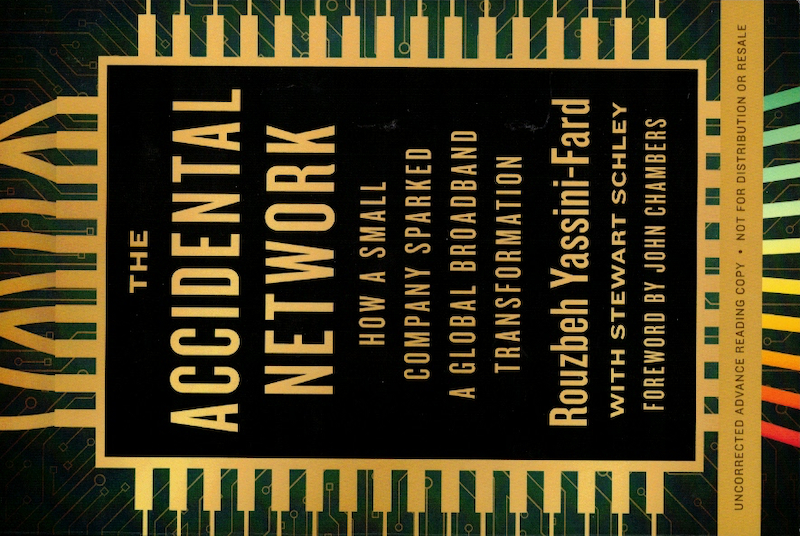
Title:** The Accidental Network: How a Small Company Sparked a Global Broadband Transformation Authors: Rouzbeh Yassini-Fard with Stewart Schley Published: 2025 by West Virginia University Press What It Teaches: The Accidental Network tells the story of the invention and commercial launch of the first cable modem (and the man and company behind it). In the telling, we learn about the challenges of keeping a startup alive, overcoming technical challenges, and the importance of relationships. When To Use It:* The Accidental Network *is an inspirational story of one man’s commitment to a vision and a team’s ability to bring that vision to reality. The stories are decades old, so the value is more timeless than timely — providing inspiration and example for innovators on similar challenging journeys.
Brief Review
The publicists supporting The Accidental Network kindly provided an advance copy of the book for my review.
I really enjoyed reading The Accidental Network. Its content is almost a perfect fit for my interests. Given my interests in technology and entrepreneurship, it’s not surprising that I’ve always enjoyed reading the stories of scrappy companies bringing new technologies to life. The fact that the author’s story lines up chronologically with my own first technology startup makes the book even more fascinating to me.
Others may not appreciate as much as I do how significant the author (and his company)’s accomplishments were, so let me take a few minutes to set the context.
Today we can hardly remember a time when the Internet wasn’t central to our lives. It was only thirty years ago that most people experienced the Internet for the first time as the (relatively new at the time) World Wide Web burst onto the world stage. I like to tell people that on January 1, 1995 very few businesspeople had an e-mail address on their business card. By December 31, 1995 almost every businessperson knew they needed to have an e-mail on their business card. (The fact that many of you don’t appreciate the importance of business cards is another indication of how much the Internet has changed our lives.)
In my personal story, my first startup emerged from a December 1994 meeting with the man soon to be CEO of the company I worked for. He looked at a list of initiatives I was managing and said “That Internet stuff — shut it down. The Internet’s a toy. Businesses will never pay for it.” That wasn’t a crazy statement, it simply reflected the uncertainty surrounding the future of the Internet at that point in time.
In The Accidental Network, the author references an early 1995 meeting between Glenn Britt, the CEO of Time Warner Cable, and executives from Intel. Britt was no dummy and his company would soon become a leader in launching broadband Internet services, but the author quotes Britt from a Time Warner Cable history book recalling that meeting: “We literally said: ‘What’s the Internet?’ We had no idea. We had never heard of it.”
Those that were aware of the Internet in the mid-1990s were experiencing something very different from what you and I think of as the Internet today. To use the Internet you needed a PC. (Remember the iPhone wasn’t introduced until 2007.) The book references one study that showed that in 1994 only 40 percent of homes had a PC. You also needed a modem, connected to a phone line. When you wanted to use the Internet (or America Online or Prodigy or Compuserve or a private bulletin board system), you hit “connect” and the modem dialed a phone number and began a dialog of tones and pings of various frequencies with the modem on the other end, trying to establish a connection. If all went well, within a couple of minutes, you were connected and cruising the “information superhighway” at a whopping 28.8 kbps. For context, 100 Mbps is fairly common for broadband today — which is 3500x faster than that dialup connection. Downloading a 5 MB file takes less than a second today, but would take more than 20 minutes over dialup in 1995.
Given that context, it is amazing to me that Rouzbeh Yassini-Ford (the author) had the vision in 1987 for connecting the world with high speed links built using the cable TV providers’ co-axial wires, and by doing so, enable telemedicine, distance education, remote work, and a drop in fossil fuel consumption, all of which would make the world a better place for future generations. Even more amazing is that he (with a talented team supporting him) made that vision a reality — delivering their first working cable modem in 1992 and in 1995 delivering a version that was priced and designed for every American home.
Even more amazing is the technical hurdles the team had to overcome and the fortuitous technology decisions they made along the way. For example, although Token Ring was the rising star amongst local area networking technologies in the late 1980s, Rouzbeh and team chose Ethernet, which would become the globally preferred standard. The LANcity team also made design choices along the way that provided flexibility and future-proofing unusual for a startup struggling to reach first-product revenues before running out of cash.
But it’s when we consider the state of the Cable industry in the early 1990s that the technology achievements truly shine. The industry was born as a way for homes with poor TV reception to share access to a well placed antenna in order to pick up the (not so) local ABC, CBS, and NBC stations. By the mid-1980s, most cable operators offered up to 40 channels of programming including nascent offerings like ESPN, CNN, HBO, and MTV. The entire model and infrastructure was designed to deliver analog television signals from a “headend” down the coax cables to people’s TVs. It was all analog and it was all one-way. The cable companies made their money from delivering reliable TV signals and nothing else.
Using this same infrastructure, Rouzbeh envisioned sending digital data both ways — down to personal computers and back up into the network. To make it work, these signals had to be carried in the same 6MHz analog signals that otherwise would carry a TV channel. And most importantly, it couldn’t cause any interference to impact the TV channel on either side of the data slot. The book goes into great detail about the challenges in how these TV networks were architected and how that caused problems for LANcity’s early attempts to provide a data connection.
Again fortuitously the cable operators made changes in their networks in the early 1990s that made the challenges easier to solve — first to be able to carry more TV channels, and then to provide interactive services. The systems started naturally supporting two-way traffic and they became increasingly digital (less analog).
As you’ve probably guessed, the book tells all of this as a story in the form of a series of challenges encountered and overcome. It is an engaging story, well told. To keep different aspects of the story (technology, business, partnerships, etc.) intact, the story doesn’t flow in a purely chronological fashion, and sometimes this can be a little confusing, but enough dates are provided to make it reasonably easy to figure out how the storylines intersect.
For me, the greatest value in books like The Accidental Network lies in describing decision making. Looking back to see how entrepreneurs and companies approached specific challenges and how they made critical decisions (and how those choices played out) is instructive for anyone facing similar challenges and decisions today. The Accidental Network delivers on this front, as we get to watch this scrappy, under-funded startup survive several existential crises.
Bottom Line: The Accidental Network is a joy to read. Perhaps my personal connection to the revolution being described colors my opinion, but it is an exciting story told well. Since it is a story that is 30+ years old, some may struggle to connect with it, but the benefit of the distant rear-view perspective is that we can now see and appreciate the impact that the technology, the company, and the author have had on the world around us today. I do believe that today’s entrepreneurs will also be able to resonate with the kinds of challenges (even if the technologies and names have changed) that Rouzbeh and his team faced and overcame.
Overall, I strongly recommend the book to anyone who appreciates stories of startups, technology progress, and visionaries.
메타데이터
- post_id
- f19aafdca9fe
- slug
- book-brief-the-accidental-network-f19aafdca9fe
- url
- https://clearpurpose.media/book-brief-the-accidental-network-f19aafdca9fe
- canonical_url
- https://clearpurpose.media/book-brief-the-accidental-network-f19aafdca9fe
- author_url
- https://medium.com/@russ_13760
- status
- ok
- fetched_at
- 2026-06-09 14:34:10