Microbial Succession: How Invisible Communities Build, Change, and Replace Themselves
A step-by-step look at colonization, succession, and how microbes reshape environments after disturbance.
Microbial Succession: How Invisible Communities Build, Change, and Replace Themselves
INTRODUCTION
Microbial life is never static.
The moment a surface is exposed; whether it is soil, plant tissue, animal skin, or even a piece of organic matter, an invisible process begins immediately.
Microorganisms arrive.
- They settle.
- They compete.
And over time, they replace one another in a highly organized sequence known as microbial succession.
This is not random.
It is one of nature’s most structured and predictable biological processes.
What is Colonization?
Before succession begins, there must be colonization.
Colonization happens when microorganisms:
- arrive at a new environment
- survive the conditions there
- and begin to multiply
The first organisms to arrive are called pioneer organisms.
They are the first settlers of a previously unoccupied or disturbed environment.
But their presence does more than just establish life.
They begin to change the environment itself.
Succession: The Natural Replacement of Microbial Communities
Once pioneer organisms establish themselves, they begin to modify their surroundings by:
- consuming nutrients
- releasing metabolic byproducts
- altering pH and oxygen levels
- breaking down complex materials
As the environment changes, it becomes more in suitable for other organisms and less suitable for the pioneers.
This leads to a key ecological process:
One microbial community gradually replaces another.
This is called succession.
It is a continuous, dynamic process driven by environmental change and microbial interaction.
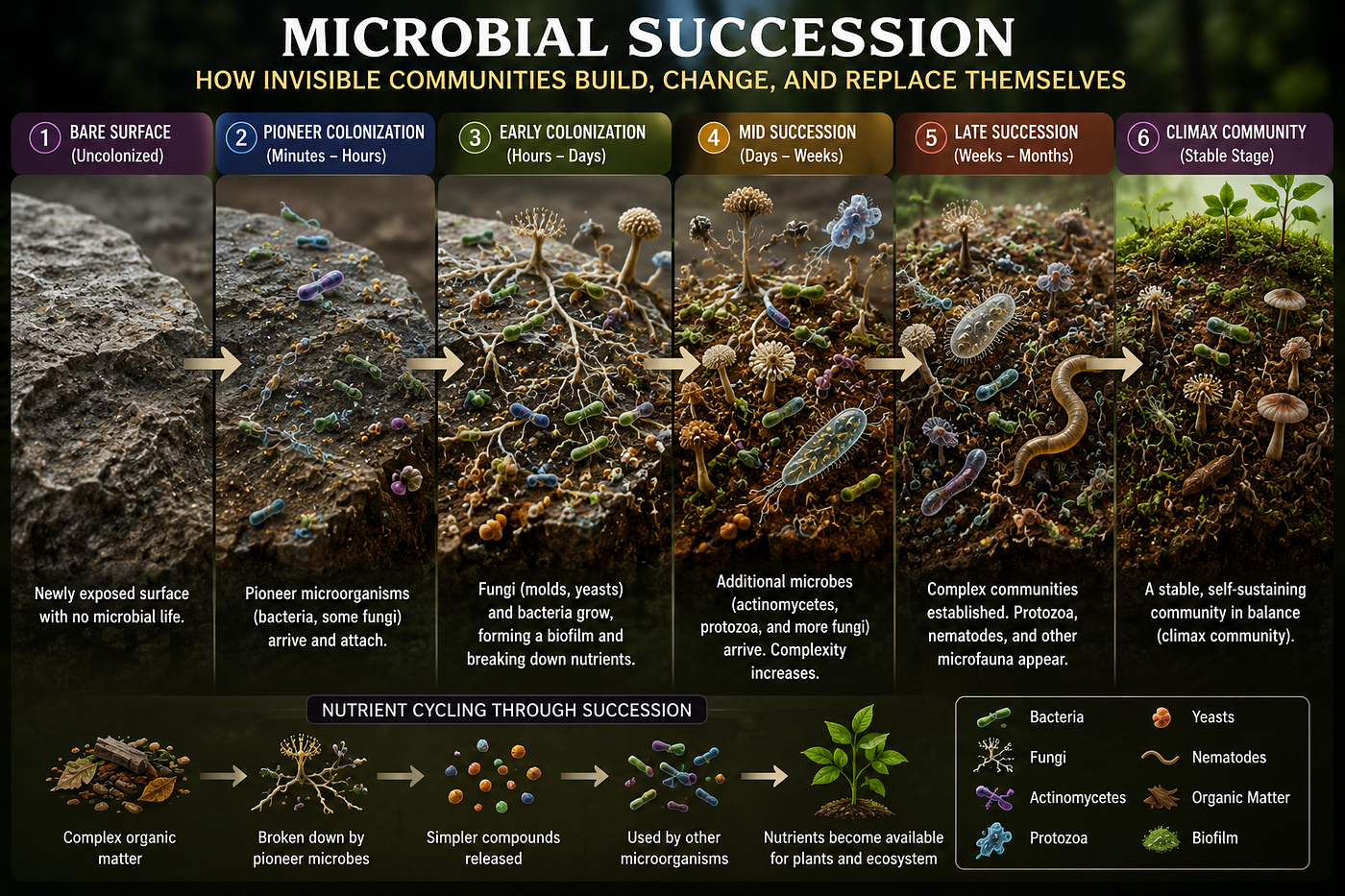
How invisible communities build, change and
The Climax Community: When Balance is Reached
Succession does not continue forever.
At a certain stage, the system reaches a relatively stable state called the climax community.
In this stage:
- species composition becomes relatively stable
- microbial death is balanced by reproduction
- the environment and organisms reach dynamic equilibrium
However, this stability does not mean inactivity.
It simply means:
change is happening, but in balance.
If a disturbance occurs, such as pollution or physical disruption, the system can temporarily collapse and later recover, returning to its original structure.
A Classic Example: Cellophane Decomposition
One of the best illustrations of microbial succession is the breakdown of cellophane (cellulose-based material) in soil.
🌱 Stage 1: Fungal pioneers
The first colonizers are fungi, especially cellulolytic species such as:
- Rhizoctonia
- Chaetomium
- Humicola
These fungi:
- attach to the surface
- produce cellulase enzymes
- begin breaking down cellulose
Some spread rapidly through the material, while others colonize localized points and expand outward.
At this stage, bacteria are relatively rare.
🧫 Stage 2: Bacterial dominance
As fungal activity breaks down the substrate:
- nutrients become more available
- fungal structures begin to senesce
Now bacteria increase rapidly, feeding on:
- breakdown products
- fungal remains
- dissolved organic compounds
🐛 Stage 3: Higher organisms join
As decomposition continues, larger organisms appear:
- protozoa
- nematodes
- mites
- springtails
These organisms feed on microbes and organic debris, accelerating decomposition further.
What was once a solid substrate becomes a fully transformed ecosystem.
💩 Succession in Dung: A Natural Time Sequence
Dung provides another powerful example of microbial succession.
When fresh dung is exposed, fungi appear in a predictable order:
- Zygomycetes – early colonizers
- Ascomycetes – cellulose degraders
- Basidiomycetes – lignin utilizers
Initially, this sequence was thought to be driven purely by nutrient availability.
However, research showed something more interesting:
👉 the order is also influenced by developmental timing, not just nutrition.
Each group requires a certain time before fruiting bodies appear, which contributes to the observed sequence.
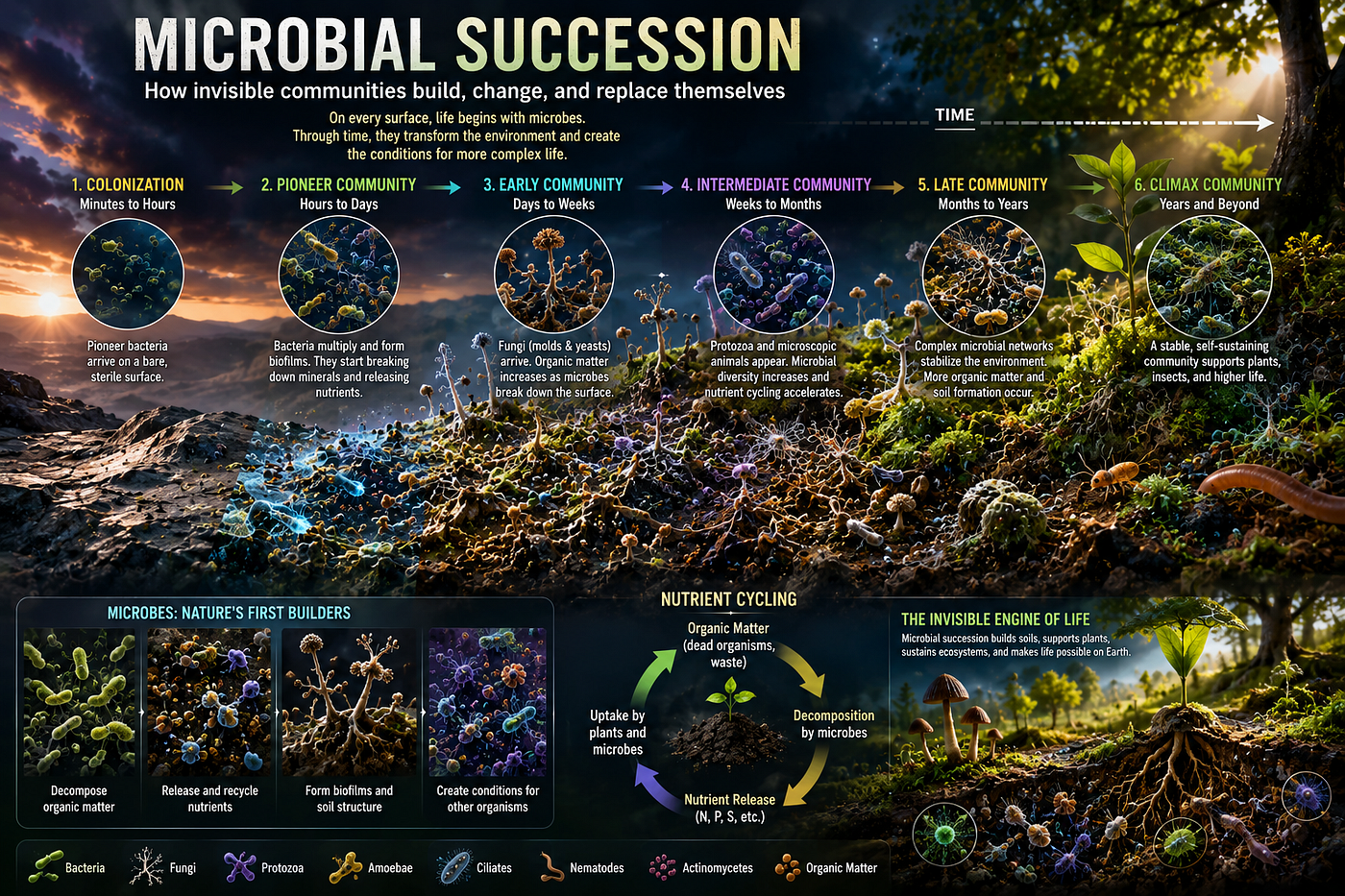
Microbial Succession
Succession on Human Hair
Sterile human hair placed in soil undergoes a clear succession pattern:
🌱 Early colonizers:
- Fusarium
- Penicillium
- Mucorales
👉 They utilize simple sugars.
🌿 Intermediate colonizers:
- Chaetomium
- Humicola
- Gliocladium
- Penicillium species
👉 These organisms break down cellulose and complex polysaccharides.
🧬 Late colonizers:
keratin-degrading fungi (Gymnoascaceae group)
👉 These specialize in breaking down keratin, the toughest component of hair.
This stage shows a clear ecological principle:
the most resistant materials are degraded last, by highly specialized organisms.
⚙️ What Drives Microbial Succession?
Succession is not random, it is driven by multiple interacting forces:
1. Nutrient transformation
Pioneer organisms release nutrients that support later species.
2. Waste accumulation
Metabolic byproducts become food sources for new organisms.
3. Substrate modification
Physical and chemical changes expose new materials.
4. Autointoxication
Some microbes produce substances that eventually inhibit or kill themselves.
5. Environmental disturbance
Physical removal or disruption of organisms changes community structure.
6. Biological interactions
- competition
- predation
- immune responses (in hosts)
7. Environmental changes
- temperature shifts
- light availability
🌍 Why Succession Matters in Microbiology
Microbial succession explains:
- how organic matter decomposes
- how ecosystems regenerate after disturbance
- how infections develop and evolve
- how nutrient cycles are maintained in nature
It reveals a powerful truth:
Microbial ecosystems are not fixed, they are constantly rebuilding themselves.
Final Insight
From soil to dung to human tissues, microbial communities follow a structured path of colonization, transformation, and replacement.
What begins as a blank or sterile surface becomes a fully functioning ecosystem shaped entirely by microbial activity.
And at every stage, invisible organisms are silently driving the balance of life on Earth.
메타데이터
- post_id
- f1c0d369c6de
- slug
- microbial-succession-how-invisible-communities-build-change-and-replace-themselves-f1c0d369c6de
- url
- https://medium.com/@samedet245/microbial-succession-how-invisible-communities-build-change-and-replace-themselves-f1c0d369c6de
- canonical_url
- https://medium.com/@samedet245/microbial-succession-how-invisible-communities-build-change-and-replace-themselves-f1c0d369c6de
- author_url
- https://medium.com/@samedet245
- status
- ok
- fetched_at
- 2026-06-15 20:49:13