The Future of Search is AI: How GEO (Generative Engine Optimization) and WebMCP Are Transforming…
Discover how GEO and WebMCP are redefining search. Read the full guide here or watch our quick breakdown on Instagram!
The Future of Search is AI: How GEO (Generative Engine Optimization) and WebMCP Are Transforming Digital Visibility
https://www.instagram.com/p/DbV2mn2N8wZ/
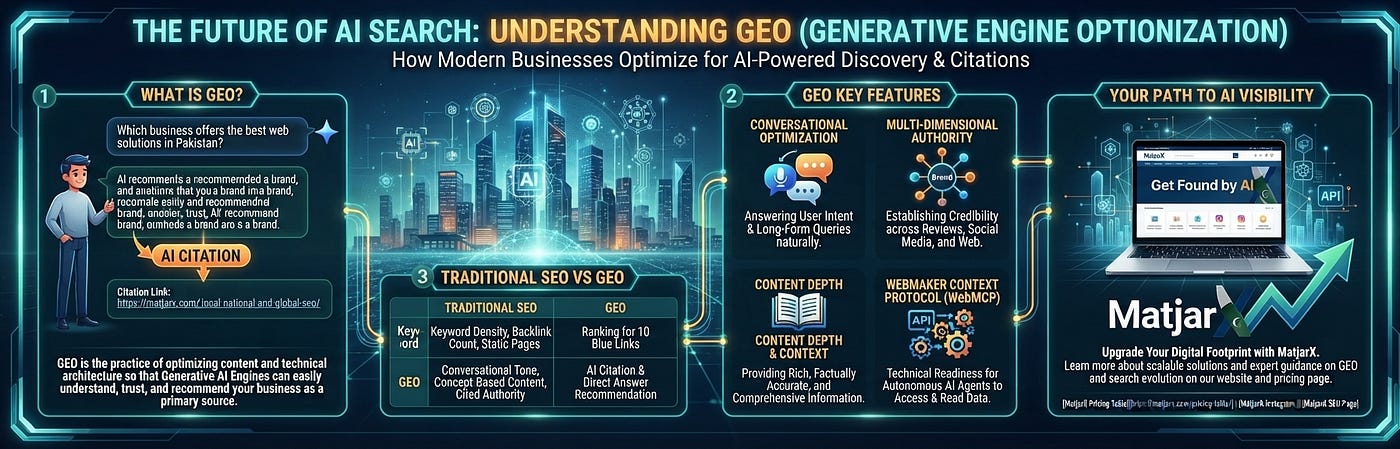
The Future of AI Search: Understanding GEO (Generative Engine Optimization). This informative visual breaks down how modern businesses optimize their digital presence for AI-powered discovery, direct citations, and conversational search engines, featuring MatjarX.
Mastering the Future of Search: How GEO (Generative Engine Optimization) and WebMCP Are Redefining Digital Visibility for Businesses
Introduction: The Paradigm Shift from Traditional SEO to AI-Driven Discovery
For over two decades, digital marketing and online visibility were governed by a single, familiar monarch: Search Engine Optimization (SEO). Business owners, marketers, and web developers spent countless hours researching keywords, optimizing meta tags, building backlinks, and trying to appease rigid search engine crawlers. The ultimate goal was simple yet fiercely competitive — secure the coveted number-one spot on Google’s search results page.
However, the ground beneath our digital feet has shifted dramatically. Today, users don’t just type keywords into a search box and scroll through a list of ten blue links. Instead, they interact with sophisticated artificial intelligence models, conversational chat assistants, and generative search engines that synthesize answers directly. When a user asks an AI assistant for the best service provider, local software solution, or e-commerce platform, they receive a single, direct, and conversational answer — not a laundry list of websites.
This monumental evolution has given birth to a brand-new digital marketing discipline: Generative Engine Optimization (GEO). Concurrently, technical protocols like WebMCP (Web Machine Context Protocol) are emerging to help machines understand website architectures with unprecedented precision. For businesses in Pakistan and across the globe, adapting to this AI-first reality is no longer optional; it is the ultimate prerequisite for survival and growth.
In this comprehensive, two-part blog, we will explore what GEO and WebMCP mean for modern enterprises, why traditional SEO alone is no longer enough, and how platforms like MatjarX are helping businesses future-proof their digital footprint.
Chapter 1: Understanding GEO (Generative Engine Optimization)
To understand Generative Engine Optimization, we must first look at how generative AI engines (such as ChatGPT, Google Gemini, Perplexity, and Claude) process information. Unlike traditional search engines that rank web pages based on keyword density and link authority, generative engines construct answers dynamically by reading, summarizing, and synthesizing content from multiple sources across the web.
1. From Ranking for Keywords to Answering User Intent
In traditional SEO, your success depended on targeting specific search terms like “best e-commerce builder in Pakistan.” In the world of GEO, the AI engine looks at the intent behind the user’s query and evaluates which brand or platform offers the most authoritative, contextually rich, and verifiable solution. If an AI engine recommends your business, it does so because your content provides deep contextual answers rather than superficial keyword stuffing.
2. The Mechanics of Generative Citations
When a generative engine answers a complex query, it often provides citations or references to back up its statements. GEO focuses heavily on positioning your brand as the primary, authoritative source that AI models reference. This requires a shift in content strategy:
- Conversational Context: Writing in a natural, authoritative tone that matches how human users converse with AI.
- Structured Data and Entity Authority: Ensuring that search engines and AI models clearly recognize who you are, what you do, and why you are an industry leader.
- Comprehensive Depth: Providing deep, insightful, and factual information that AI models can safely parse and summarize without misinterpretation.
Chapter 2: What is WebMCP and Why Does It Matter?
While GEO focuses on the content and context that AI engines consume, WebMCP (Web Machine Context Protocol) addresses the technical layer of how websites communicate with autonomous AI agents and machine-readable crawlers.
As the internet transitions from human-centric browsing to agentic AI — where software agents execute tasks, compare prices, and book services on behalf of users — websites need a standardized way to expose their data to machines.
1. Bridging the Gap Between Human UI and Machine Agents
Traditionally, websites are designed for human eyes: beautiful banners, intuitive menus, and responsive design layouts. However, an AI agent or automated crawler does not care about visual aesthetics; it cares about structured logic, clear data hierarchies, and instant programmatic access to APIs and product catalogs. WebMCP provides the structural framework that allows AI models to effortlessly read, comprehend, and interact with a website’s core offerings.
2. Seamless Integration with Modern Platforms
For forward-thinking digital ecosystems like MatjarX, integrating modern protocols ensures that businesses hosted on their infrastructure remain fully optimized not just for human shoppers, but for the next generation of AI search agents. Whether a business is looking for standard search visibility or advanced AI-readiness, understanding these protocols is critical. To explore how comprehensive search visibility strategies are implemented across various business tiers, you can review the structured solutions outlined on the MatjarX Pricing Table.

Traditional Web Architecture vs. AI-Ready Web Architecture. This illustration highlights the transition from human-browsing static link networks to WebMCP-compliant, structured machine-readable architectures designed for autonomous AI agents, powered by MatjarX.
Chapter 3: Why Traditional SEO Alone Is Falling Short
Does this mean traditional SEO is dead? Not entirely, but traditional SEO has been fundamentally transformed and subsumed by GEO. Relying solely on keyword optimization is akin to driving a car using only the rearview mirror while navigating a futuristic highway.
1. The Decline of Click-Through Rates (CTR)
With generative search features providing direct answers at the top of search engine result pages, users increasingly get what they need without clicking through to individual websites. If your website is merely listed as a footnote or ignored by the generative model, your organic traffic will plummet, even if you ranked well under older algorithms.
2. The Need for Multi-Dimensional Authority
AI engines cross-reference information across multiple digital touchpoints, including social media platforms, reviews, blog networks, and technical documentation. If your brand lacks a unified digital presence across these channels, generative models will perceive your business as low-authority and bypass you in favor of competitors with robust, interconnected digital footprints.
To watch a quick, engaging breakdown of how modern digital visibility and marketing strategies adapt to these rapid technological changes, you can check out our informative MatjarX Instagram Video which highlights key insights for modern entrepreneurs.
Chapter 4: Tactical Implementation — How Businesses Can Optimize for GEO
Transitioning your digital strategy from traditional SEO to Generative Engine Optimization requires a complete shift in mindset. You are no longer optimizing for a simple software crawler algorithm; you are teaching artificial intelligence models why your brand is the absolute best recommendation for human users.
1. Shift from Keywords to Natural Language and Concepts
AI engines parse human language in context. Instead of stuffing your web pages with repetitive, rigid keywords like “best web developer Pakistan,” focus on answering the actual underlying questions your customers are asking.
- Write detailed FAQs that address common customer pain points.
- Structure your content around problem-solving scenarios rather than dry product lists.
- Use clear semantic headings (
H1,H2,H3) to help AI parsers categorize your expertise accurately.
2. Building Multi-Platform Digital Authority
Generative engines verify facts by cross-referencing multiple trustworthy sources across the internet. If an AI model sees consistent, positive data about your business across your official website, social media channels, local directories, and review platforms, its confidence score for your brand increases. To see how modern businesses leverage comprehensive visibility tools and structured search optimization frameworks, you can explore the specialized solutions detailed on the MatjarX Pricing Page.
Chapter 5: The Synergy Between GEO, WebMCP, and Comprehensive SEO
While GEO and WebMCP represent the cutting edge of AI-driven discovery, they do not replace foundational search engine optimization — they elevate it. Think of traditional SEO as the strong foundation of a building, while GEO and WebMCP are the advanced architectural smart systems installed on top of it.
1. Combining Technical Precision with Content Depth
- The SEO Foundation: Ensures your website is technically sound, loads instantly, has secure SSL certificates, and is easily indexed by standard web crawlers.
- The WebMCP Layer: Organizes your product inventories, service structures, and data APIs so that autonomous AI agents can read and process your catalog seamlessly.
- The GEO Content Layer: Delivers authoritative, context-rich, and conversational answers that generative engines love to cite when responding to users.
For a quick, dynamic look at how modern marketing tactics and digital strategies are evolving to meet these exact standards, make sure to watch our visual breakdown on the MatjarX Instagram Video.
Chapter 6: Future-Proofing Your Business in the Age of AI
As artificial intelligence continues to reshape how humanity searches, communicates, and shops, businesses that cling solely to outdated marketing tactics risk becoming invisible. The shift toward AI-first discovery is happening faster than many realize, and early adopters will capture the lion’s share of high-intent digital traffic.
Actionable Steps for Business Owners Today:
- Audit Your Digital Footprint: Ensure your business details, services, and pricing are clearly stated across your web properties.
- Upgrade Your Infrastructure: Partner with forward-thinking platforms like MatjarX that understand modern technical protocols and search evolution. You can review our flexible options and scalable solutions directly on the MatjarX.
- Focus on Quality and Trust: Build an online presence rooted in genuine customer satisfaction, transparent pricing, and authoritative content that AI models can reference with absolute confidence.
Conclusion: Embracing the Next Generation of Search
The emergence of Generative Engine Optimization (GEO) and WebMCP marks one of the most exciting eras in digital marketing history. By moving beyond rigid keyword targeting and embracing AI-ready architectures, businesses can position themselves at the very forefront of digital innovation.
Whether you are launching your first online store or scaling an established brand, staying ahead of the curve is the key to long-term success. Explore transparent packaging, expert guidance, and robust optimization frameworks today via the MatjarX Pricing Table and take your rightful place at the top of the AI-driven future!
메타데이터
- post_id
- f1c4bedea55f
- slug
- the-future-of-search-is-ai-how-geo-generative-engine-optimization-and-webmcp-are-transforming-f1c4bedea55f
- url
- https://medium.com/@matjarx.io/the-future-of-search-is-ai-how-geo-generative-engine-optimization-and-webmcp-are-transforming-f1c4bedea55f
- canonical_url
- https://medium.com/@matjarx.io/the-future-of-search-is-ai-how-geo-generative-engine-optimization-and-webmcp-are-transforming-f1c4bedea55f
- author_url
- https://medium.com/@matjarx.io
- status
- ok
- fetched_at
- 2026-08-21 07:50:16