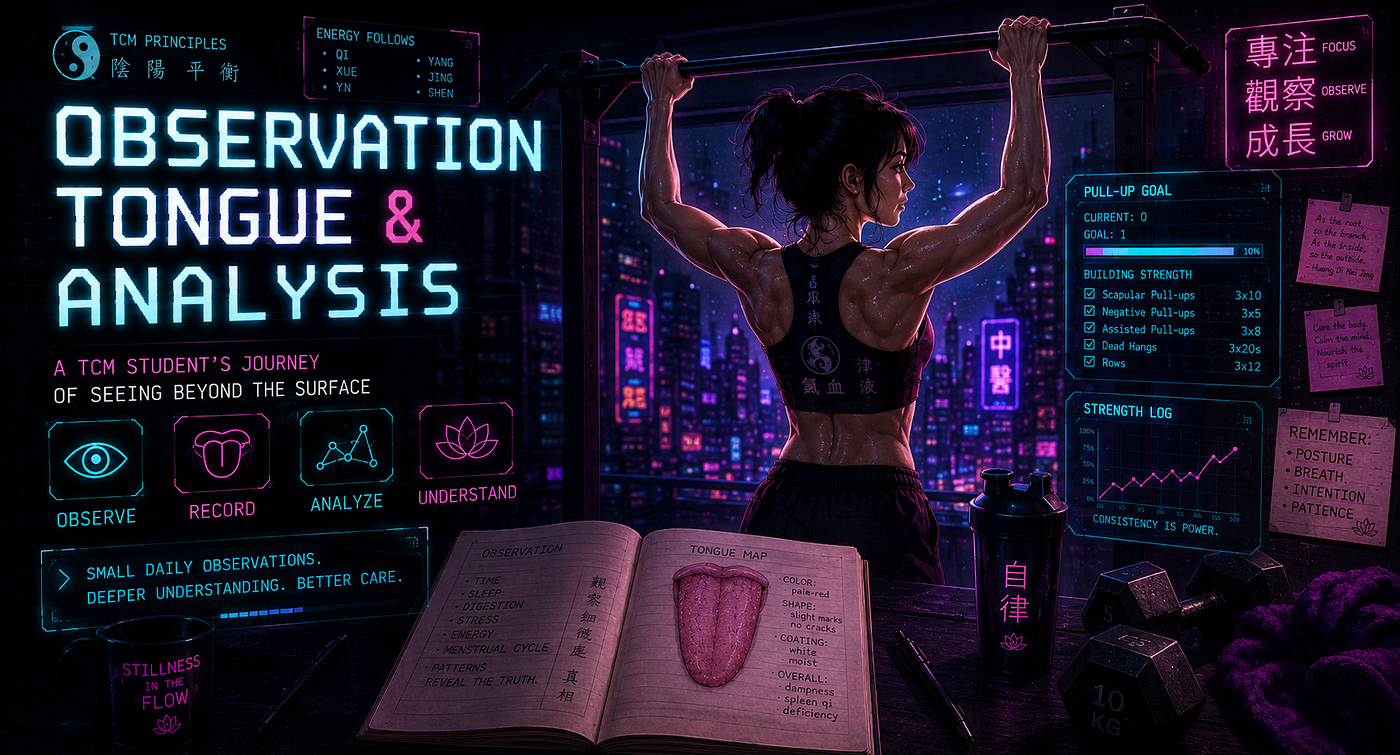
Seeing Cancer Through the Lens of Traditional Chinese Medicine
This article reflects my personal experience and educational journey while studying Traditional Chinese Medicine (TCM). Herbal medicine is…
Seeing Cancer Through the Lens of Traditional Chinese Medicine

This article reflects my personal experience and educational journey while studying Traditional Chinese Medicine (TCM). Herbal medicine is highly individualized, especially for people living with chronic illness such as Multiple Sclerosis (MS). Please consult a qualified practitioner before using herbal formulas or attempting similar approaches.
🔗 **https://www.nccaom.org/find-a-practitioner**
Cancer is a bitch
Western medicine explains cancer through cells, genetics, mutations, immune surveillance, inflammation, and treatment protocols. Traditional Chinese Medicine, or TCM, looks through a different lens. It does not replace oncology, and it should never be used as a substitute for cancer treatment. But it can offer a meaningful way to understand patterns in the body, especially when we are looking at stress, constitution, immunity, recovery, and the way illness develops over time.
This article is not medical advice. It is an educational reflection on how a TCM student might think about cancer, chemotherapy, immune weakness, and recovery from a pattern-based perspective.
Cancer Is Not Random in TCM
In TCM, disease is rarely seen as something that appears out of nowhere. Instead, practitioners ask:
What was the person’s constitution?
What emotional patterns were present?
Was there chronic stress?
Was the body depleted?
Was there Heat, Dampness, Phlegm, Blood Stasis, or toxicity?
From a TCM perspective, cancer is often understood as the result of long-term imbalance. That does not mean the person caused their illness. It does not mean they failed emotionally, spiritually, or physically. It simply means the body may have been under pressure for a long time before the disease became visible.
Chronic Stress and Liver Qi Stagnation
One major pattern TCM looks at is Liver Qi stagnation.
The Liver, in Chinese medicine, is responsible for the smooth flow of Qi throughout the body. Qi can be thought of as movement, function, and energetic circulation. When someone experiences long-term emotional pressure, perfectionism, frustration, anger, or internalized stress, the Liver can become constrained.
This may show up as:
tension
irritability
tightness in the chest or ribs
headaches
PMS
digestive changes
sighing
mood swings
feeling stuck
When Liver Qi remains stagnant for a long time, it can transform into Heat.
In TCM language, this is often described as:
Liver Qi stagnation transforming into Fire.
When Heat becomes intense or prolonged, it may affect the Blood level. In some traditional frameworks, Blood Heat, toxicity, and Blood Stasis are patterns practitioners may consider when thinking about serious blood-related disorders.
This is not the same as saying stress “causes cancer.” That would be too simplistic and medically irresponsible. But from a TCM perspective, chronic emotional constraint can be one factor that contributes to an internal environment of imbalance.
Blood Heat, Blood Stasis, and Toxicity
Cancer is often discussed in TCM through patterns such as:
Blood Stasis
Phlegm accumulation
Toxic Heat
Damp-Heat
Qi stagnation
constitutional deficiency
Blood Stasis means that circulation is impaired or blocked. Phlegm in TCM does not only refer to mucus; it can also refer to abnormal accumulations, masses, nodules, or thickened pathological substances in the body. Toxic Heat refers to intense inflammatory or destructive processes.
When we think about cancer from this lens, the question becomes:
What allowed abnormal accumulation, heat, toxicity, or stagnation to develop?
Again, this is not about blame. It is about pattern recognition.
The Role of Kidney Essence
Another important idea in TCM is Kidney Essence, or Jing.
Jing is associated with growth, development, reproduction, bone marrow, vitality, and constitutional strength. In modern language, people often loosely compare it to deep reserves or inherited vitality, though it is not exactly the same as any single Western medical concept.
When someone is young, growing, under pressure, not sleeping enough, emotionally strained, or physically depleted, TCM may look at whether Kidney Essence is being taxed.
This matters because the Kidneys are connected to marrow in TCM theory. Marrow is not just bone marrow in the biomedical sense, but the overlap is one reason TCM discussions of blood cancers often include Kidney Essence, Blood, and marrow-related patterns.
A practitioner might ask:
Is the person constitutionally weak?
Are they exhausted?
Are they burning through reserves?
Is the body producing enough healthy Qi and Blood?
Is there a deeper deficiency underneath the visible symptoms?
Chemotherapy Through a TCM Lens
Chemotherapy can be lifesaving. It is powerful, necessary, and often central to cancer treatment.
At the same time, TCM would describe chemotherapy as extremely taxing on the body.
From a TCM perspective, chemotherapy may damage or deplete:
Spleen Qi
Kidney Essence
Qi and Blood
Wei Qi
Yin
Yang
The Spleen in TCM is responsible for digestion, transformation, and the production of Qi and Blood. When Spleen Qi is weak, a person may experience fatigue, poor appetite, nausea, loose stools, weakness, bruising, or difficulty rebuilding strength.
The Kidneys represent deeper reserves. When Kidney Essence is depleted, recovery can feel slow and profound.
Wei Qi is the body’s defensive Qi. It is often compared to immune protection. When Wei Qi is weak, the body becomes more vulnerable to external pathogens.
This is why, from a TCM point of view, post-chemo recovery is not only about killing cancer cells. It is also about rebuilding the person.
Wei Qi and Vulnerability to Infection
One of the most important TCM concepts for understanding post-treatment weakness is Wei Qi.
Wei Qi is the protective energy that circulates near the surface of the body. It helps defend against external pathogens such as Wind, Cold, Heat, Dampness, and toxins.
When Wei Qi is strong, the body has better resilience.
When Wei Qi is weak, the body may become vulnerable.
After chemotherapy, radiation, surgery, severe illness, or prolonged stress, Wei Qi may be depleted. In that state, even a small exposure can become serious because the body’s defenses are not functioning at full strength.
In Western medicine, we might talk about immune suppression, low white blood cell counts, infection risk, and vulnerability after treatment.
In TCM, we might say:
The Spleen is weakened.
The Kidneys are depleted.
Qi and Blood are damaged.
Wei Qi is insufficient.
The exterior is not secure.
Different language. Similar concern.
The body needs protection, nourishment, and time.
What TCM Can Offer During Cancer Care
TCM should not be presented as a cure for cancer. That is not responsible.
But TCM may support patients in other important ways when used appropriately alongside conventional oncology care.
Depending on the patient, diagnosis, treatment stage, and medical supervision, TCM may help support:
nausea
fatigue
appetite
sleep
anxiety
pain
digestion
dryness
neuropathy
emotional regulation
rebuilding strength after treatment
immune recovery support
quality of life
A responsible TCM practitioner does not work against oncology. They work alongside it, respecting the seriousness of the disease and the treatment plan already in place.
The goal is not to replace chemotherapy, radiation, surgery, immunotherapy, or targeted treatment.
The goal is to support the person going through them.
The Emotional Side of Cancer
Cancer is not only cellular. It is emotional.
It affects the person diagnosed, the family, the caregivers, and the community around them. TCM recognizes that emotions and the body are connected.
Grief affects the Lung.
Fear affects the Kidney.
Anger and frustration affect the Liver.
Overthinking affects the Spleen.
Shock and emotional trauma can disturb the Heart.
This does not mean emotions cause disease in a direct or simplistic way. It means that emotional life matters. The body does not separate experience into neat categories. What we feel, endure, suppress, and carry can influence how we function.
That is one of the reasons I find TCM so meaningful.
It gives language to the parts of illness that often feel invisible.
A More Compassionate Way to Understand Illness
One of the most important lessons in TCM is that illness is not a moral failure.
A person is not sick because they were weak.
They are not sick because they were negative.
They are not sick because they failed to heal themselves.
Illness happens through a complex web of constitution, environment, stress, exposure, genetics, timing, emotion, lifestyle, and circumstance.
TCM gives us a way to look at that web.
It asks us to notice patterns.
It asks us to treat the person, not just the disease.
It asks us to care about the terrain of the body, not only the name of the diagnosis.
Why This Matters
For general audiences, TCM can sometimes seem mysterious or abstract. But at its core, it is a system of observation.
It asks:
Where is the body stuck?
Where is it depleted?
Where is there Heat?
Where is there Cold?
Where is there Dampness?
Where is there stagnation?
Where is the person losing strength?
Where does the body need support?
When we look at cancer through this lens, we are not trying to oversimplify it. We are trying to understand the person experiencing it more fully.
Cancer requires medical treatment.
But healing also requires care, nourishment, rest, emotional support, protection, and rebuilding.
That is where TCM can offer a beautiful and deeply human perspective.
Not as a replacement for oncology.
Not as a promise.
But as a way of seeing the whole person.
And sometimes, being seen as a whole person is part of healing too.
Cancer is one of the most emotionally charged topics in medicine. Even the word itself can bring fear, grief, confusion, and questions that do not have easy answers. The point is no matter what you have to find some sort of way to relief stress or to let go of things so you don't put yourself through everything that comes with cancer.
메타데이터
- post_id
- f1dc1aa3f50f
- slug
- seeing-cancer-through-the-lens-of-traditional-chinese-medicine-f1dc1aa3f50f
- url
- https://medium.com/stillness-in-the-flow/seeing-cancer-through-the-lens-of-traditional-chinese-medicine-f1dc1aa3f50f
- canonical_url
- https://medium.com/stillness-in-the-flow/seeing-cancer-through-the-lens-of-traditional-chinese-medicine-f1dc1aa3f50f
- author_url
- https://medium.com/@grrracelee
- status
- ok
- fetched_at
- 2026-06-09 15:37:30