AI Agent Payment — Stablecoin Use Cases (2)
How the future AI Agent economy makes payment will reshape our entire payment industry
AI Agent Payment — Stablecoin Use Cases (2)
How the future AI Agent economy makes payment will reshape our entire payment industry
Introduction
This is the second installment of the Stablecoin Use Cases series, turning the spotlight on one of today’s hottest topics: AI. Artificial intelligence and autonomous agents have become deeply embedded in how we work and live, and the Agent economy is primed for explosive growth in the years ahead. **Statista projects that the number of active AI agents deployed across businesses worldwide will surge from 28.6 million to over 2.2 billion** by 2030 — and that figure only accounts for the corporate world. The total population of AI agents is on track to surpass humanity itself before long.
When you consider that each agent operates as an autonomous entity executing tasks at extraordinary frequency, the sheer volume of payments flowing through agents becomes staggering to imagine. Like any thriving economy, this one demands a fast and cost-efficient way to move value — which is precisely why AI Agent payment infrastructure has become so critical. Major players across the industry are already jockeying for position in this rapidly emerging space.
3 AI Agent Payment Scenarios
Defining the problem space and business context is always essential before jumping to solutions. AI Agent payment is a new and complex domain, and having a proper framework in place before diving into the details makes all the difference. With that in mind, the AI payment space can be broken down into three distinct scenarios: Agent-to-Merchant (A2M), Agent-to-Service (A2S), and Agent-to-Agent (A2A) — each with its own unique characteristics, which we’ll unpack in turn.
A2M — Agent to Merchant
A2M most closely resembles the payment models we know today. In this scenario, an Agent makes purchases from merchants on behalf of a human — acquiring goods or services intended for human consumption. Picture a user asking an Agent to plan a vacation: rather than simply drafting an itinerary, the Agent goes a step further by booking flights and hotels directly and handling payment to the relevant providers — all in a single seamless flow. Below is an example from Booked.ai that packages an AI assistant with a smooth travel planning and booking experience.
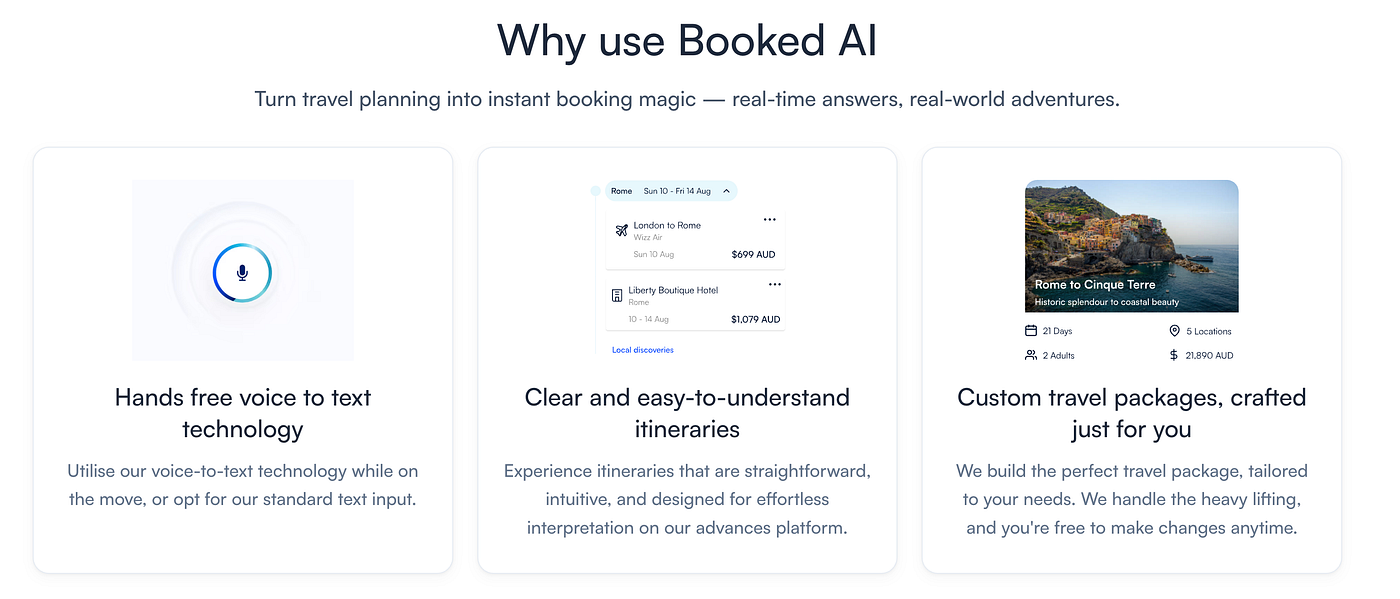
Booked.ai marketing message
These payment tasks are typically set in motion by a human instruction, and the resulting purchase behavior — in terms of both transaction frequency and ticket size — closely resembles that of a human buyer.
A2S — Agent to Service
A2S is a relatively newer concept. Agents frequently depend on external infrastructure and services to carry out their tasks — which means paying for digital services purpose-built to support agent workflows specifically. Take an Agent tasked with continuously monitoring stock market data: to compile reports and trigger follow-up actions, it may need to pay for access to data APIs or model inference services on an ongoing basis. Circle Agent Marketplace is a good example here: agents can browse, pay, and use the services designed for them.

Circle Agent Marketplace landing page
Unlike A2M, these payment tasks are largely identified and orchestrated by the Agents themselves, with minimal human involvement. Transactions tend to be small in value but high in frequency — a combination that makes cost efficiency absolutely critical. Hence, this category is also commonly referred to as micropayments.
A2A — Agent to Agent
A2A is the AI equivalent of peer-to-peer payments. In this scenario, one Agent compensates other Agents in exchange for completing a task or delivering a service. A common example is an orchestrator Agent that breaks a complex project into subtasks, delegates them to specialized Agents, and settles payment with each upon successful delivery. The screenshot below shows OpenClaw Careers, a platform that enables you to monetize your Agent by offering its capabilities to other Agents and tasks.

Tagline from OpenClow Careers
The payment behavior shares similarities with A2S, but A2A introduces additional complexity — it requires proper service agreements to be established upfront. Transaction amounts can range from modest to substantial depending on the use case, and the process may involve multiple rounds of negotiation over payment terms before a final settlement is reached between Agents.
Key Characteristics for each Payment Scenario
As the definitions and examples above illustrate, these three scenarios differ considerably in their context, dynamics, and interaction patterns. Below is the summary table of these scenarios and their key characteristics:

Key Characteristics for each Payment Scenario
How to conduct AI Agent payment
With that context established, we’re now better equipped to evaluate the technical solutions available in the market and how well they serve each of these scenarios.
There are two distinct technical layers worth examining. The Communication Layer facilitates the passing of information between buyer and seller — aligning on checkout flow, payment order details, etc. The Payment Product Layer handles the authorization of payment actions to confirm the value transfer from buyer to seller. With this framework in mind, we can now look at the technical solutions available in the market to power each of these layers.
Communication Layer — Browser-based Interaction
The most straightforward way for an Agent to exchange payment information with a seller is to leverage existing seller infrastructure — such as an e-commerce website. Today’s Agents are capable of interacting with merchant sites using headless or standard browsers to navigate and complete a checkout flow.
The limitations of this approach are fairly apparent. It requires the merchant to have a functional website, and since the interaction is driven by a browser interface designed for humans, it is inherently fragile and error-prone — often necessitating human intervention to recover. Payment credential handling under this model also demands particular care, as the exposure of sensitive information through a human-facing interface introduces non-trivial security risks.
Communication Layer — Conventional HTTP Endpoints
Dedicated HTTP endpoints offer a more agent-native alternative here, addressing many of its inherent limitations. The straightforward approach is to abstract the merchant catalog and payment information into structured endpoints that agents can access programmatically.
This does, however, introduce additional integration overhead. To reduce that complexity and drive adoption of a common standard between buyer and seller, various types of MCP services have emerged — providing a shared interface that simplifies how agents discover and interact with merchant systems.
Communication Layer — HTTP Endpoints — x402
Another popular approach is x402 — a protocol built on the standard HTTP 402 status code, repurposed as a structured messaging layer for exchanging payment information between buyer and seller. What distinguishes x402 from conventional HTTP endpoints is that authorization and payment are negotiated at runtime, introducing minimal integration overhead.
The basic version of the x402 usually includes payment initiation, price quotation, and final confirmation, bringing greater structure and precision while improving efficiency and reducing payment errors. Building on this foundation, a second layer introduces more sophisticated payment flows. Stripe, for example, extended the communication layer to develop the **Merchant Payment Protocol (MPP).** What sets MPP apart is its ability to manage the full lifecycle of a so-called payment intent within sessions, enabling more advanced capabilities such as payment method changes, refunds, and chargebacks.
Communication Layer — Direct Agent Interaction
This category refers to private channels that connect Agents directly with each other — such as instant messaging platforms with embedded Agent bots, or any non-public communication tool that facilitates information exchange between buyer and seller.
Payment information in these channels is most often passed in an unstructured format. While this approach demands little in the way of technical setup, it comes with a notable trade-off: the lack of structure raises the risk of messages being misinterpreted, which can in turn lead to payment errors and disputes.
Payment Product Layer — Tokenized Card
The two dominant card networks have each extended their infrastructure to support agent-initiated transactions. Mastercard launched **Agent Pay in April 2025, introducing Agentic Tokens — a new credential primitive built on its existing tokenization capabilities across mobile, card-on-file, and Payment Passkeys. Visa followed with [Intelligent Commerce](https://www.visa.com/en-us/solutions/intelligent-commerce)**, combining scoped tokenized credentials issued directly to agents, machine-optimized authentication, and integrations with major LLM platforms including Anthropic, OpenAI, and Microsoft.
We won’t go deep into the mechanics here, as our focus remains on stablecoin use cases — though this is certainly a topic worth exploring in its own right. The core concept, however, is straightforward: the card network issues virtual tokens to registered Agents and ties them to the user’s existing card account, allowing Agents to transact using the user’s balance without exposing the underlying card number, and within limits set by both the user and the issuer.
The strengths of this payment product layer include:
- Seamless compatibility with existing merchant card acquiring infrastructure worldwide, requiring little changes on the merchant side
- Minimal uplift required on the issuing side, as card tokenization is a mature technology that many issuers can adopt at reasonable cost
- A well-balanced approach that enables Agents to pay conveniently with user funds while maintaining proper account segregation, spending limits, and risk controls
- Relatively easy to manage refund and chargeback resolution, since every Agent is ultimately tied to a real cardholder account
That said, this approach carries some notable limitations:
- Card network coverage remains uneven, particularly for unbanked populations and underserved markets
- Merchant Discount Rates (MDR) for card transactions typically run between 2–3%, and may include minimum per-transaction fees
- Settlement times mirror those of standard card transactions, with sellers typically waiting a minimum of one to two business days to receive their funds
Payment Product Layer — Stablecoin Payment
Stablecoins were designed from day one as a form of stored value, and blockchain nowadays enables them to be transferred seamlessly between parties. The sending and receiving process is relatively straightforward, especially for machines. Here are the key benefits of this approach:
- Blockchain accounts are inherently easy for AI to integrate and manage. At their core, they consist of nothing more than a private and public key pair — purely mathematical and programmable by nature. Any AI Agent can create and manage such accounts permissionlessly and efficiently, with minimal setup required.
- On-chain stablecoin settlements are fast and inexpensive. Take Base as an example: transaction costs currently sit at around $0.01, with settlement finality in approximately 1–2 seconds. Newly developed payment-focused chains such as Stripe’s Tempo and Circle’s Arc are pushing these metrics even further.
That said, this method comes with its own set of drawbacks:
- Infrastructure on the receiver side for fund aggregation and order reconciliation remains underdeveloped. As noted in the Stablecoin Acquiring article, this is still an emerging trend — and one that carries significant integration costs for PSPs and merchants alike.
- On/off-ramping remains a significant friction point. Available channels are still limited in terms of geographic coverage and supported payment methods, and the process often involves numerous manual steps that make for a poor user experience.
- Compliance and privacy on-chain demand considerable effort to implement and sustain, and the industry has yet to converge on a standardized approach. Blockchain was originally designed for permissionless value transfer, and retrofitting the compliance and privacy requirements of the traditional financial world into on-chain transactions remains an unsolved challenge.
Finding the right payment products
As the analysis above makes clear, there is no single payment product that fits all AI Agent payment scenarios. Each approach carries its own strengths and trade-offs depending on the context in which it operates. With that in mind, the diagram below consolidates these insights into a unified view:

Finding the right communication and payment products for each scenario
Starting with A2M, the space will likely be best served by Browser-based Interaction paired with Tokenized Card in the near term. This is the most natural evolution for existing buyers and sellers — a modest enhancement on top of established card network infrastructure to accommodate agent-initiated transactions. It also reflects how the general public engages with agent payments today, typically through a conversational interface.
Over the longer term, Conventional HTTP Endpoints paired with Tokenized Card will likely emerge as the dominant model, given its higher efficiency and accuracy, and the improved end-consumer experience that comes with minimal human intervention. x402 can deliver a comparable experience, but runtime pricing and payment negotiation offer limited incremental value in the A2M context — making it more of a viable market alternative than a natural default.
That said, there remains a meaningful opportunity to combine the above communication layers with Stablecoin Payment for A2M scenarios, given its advantages in transaction fees and settlement speed — as explored in the **Stablecoin Acquiring **article. The prerequisite, however, is a merchant network that has already embraced stablecoin as a payment method before agent adoption takes off, which remains an open question.
In the A2S space, the market will most likely gravitate toward x402 paired with Stablecoin Payment. Services in this category are purpose-built for AI agents from the ground up, making it entirely reasonable for providers to adopt both standards from the outset and enable full end-to-end automation. Introducing dependencies on card scheme API integrations or manually provisioned token accounts would add unnecessary friction to what should be a seamless, autonomous process.
A2A is relatively straightforward. Most transactions in this space are well-suited to Direct Agent Interaction paired with Stablecoin Payment — agents negotiate terms in natural language and settle directly over stablecoin rails, offering full automation at low cost and near-instant finality. For more sophisticated use cases — and to eliminate ambiguity in payment details — agents can expose structured payment endpoints via x402, enabling cleaner transaction management and unlocking advanced transaction types such as auth-capture and escrow.
Market Landscape

Market Landscape for Agent Payment
Before wrapping up, it is worth taking a quick look at the market landscape to better understand the dynamics and business potential of each space.
The A2M space will likely be dominated by incumbent payment providers — major card schemes and key acquiring infrastructure players like Stripe. It’s worth noting that this is far from an exhaustive list; many other players (including digital payment methods) are actively vying for a share of the A2M market, such as American Express with its **Agentic Commerce Experiences (ACE)™ Developer Kit, PayPal with its [Agent Toolkit MCP Server](https://developer.paypal.com/community/blog/accelerating-agentic-payments/)**, etc.
A2S is where things get more interesting, as it represents genuinely new territory — which is reflected in the diverse mix of competitors entering the space. Mastercard has extended its Agent Pay service with **Agent Pay for Machine, competing on both the buyer and seller side of the equation. Meanwhile, newer entrants like Circle and Coinbase are leveraging their strong on-chain infrastructure to stake their claim in this emerging market. Circle in particular has been especially ambitious, launching a comprehensive [Agent Stack](https://www.circle.com/agent-stack)** that spans Agent Wallet for the buying side, Agent Marketplace for the selling side, and nanopayment capabilities to enable efficient microtransactions on-chain.
A2A remains the least structured of the three, with most transactions still relying on simple Agent-to-Agent transfers — making it largely the domain of native crypto players for now. Established crypto wallet providers such as **MetaMask and [Trust Wallet](https://trustwallet.com/blog/announcements/introducing-the-trust-wallet-agent-kit-twak-your-ai-agent-can-now-act-on-crypto)** are eager to capture this market, though their offerings remain at an early stage. Looking ahead, I believe A2A will need a more structured approach to payment information management in order to scale. This could involve adopting x402 in a light form that is accessible through direct communication channels — such as WhatsApp or Telegram — to bring greater accuracy and efficiency to payment interactions between Agents.
Conclusion
Stepping back to look at the full picture, the landscape of AI Agent payment scenarios comes into sharper focus. In the near term, A2M is likely to be the first to gain significant traction — and the payment opportunities it generates will largely be captured by existing payment providers, the card schemes in particular, given the maturity and ubiquity of their underlying infrastructure.
Looking further ahead, I believe stablecoin payment will emerge as the dominant force in both A2S and A2A. These markets are still nascent today, but their scale could grow exponentially when you consider the sheer number of agents that will exist in the near future — over 2.2 billion by 2030. This will give rise to an entirely new economy, one that has no precedent in human history, operating at a speed and volume we have never witnessed before. It is precisely for this reason that I have strong conviction that stablecoins for agent payment are uniquely positioned to capture this opportunity — and to demonstrate their transformative value in the years ahead.
메타데이터
- post_id
- f1df26e24d8c
- slug
- ai-agent-payment-stablecoin-use-cases-2-f1df26e24d8c
- url
- https://medium.com/@jiadongzzzz/ai-agent-payment-stablecoin-use-cases-2-f1df26e24d8c
- canonical_url
- https://medium.com/@jiadongzzzz/ai-agent-payment-stablecoin-use-cases-2-f1df26e24d8c
- author_url
- https://medium.com/@jiadongzzzz
- status
- ok
- fetched_at
- 2026-06-28 14:26:31



