The Fate of Ophelia
When we think of Shakespeare’s Hamlet, we frequently focus on the Prince — his existential despair, revenge plot, and famous soliloquies on…
The Fate of Ophelia
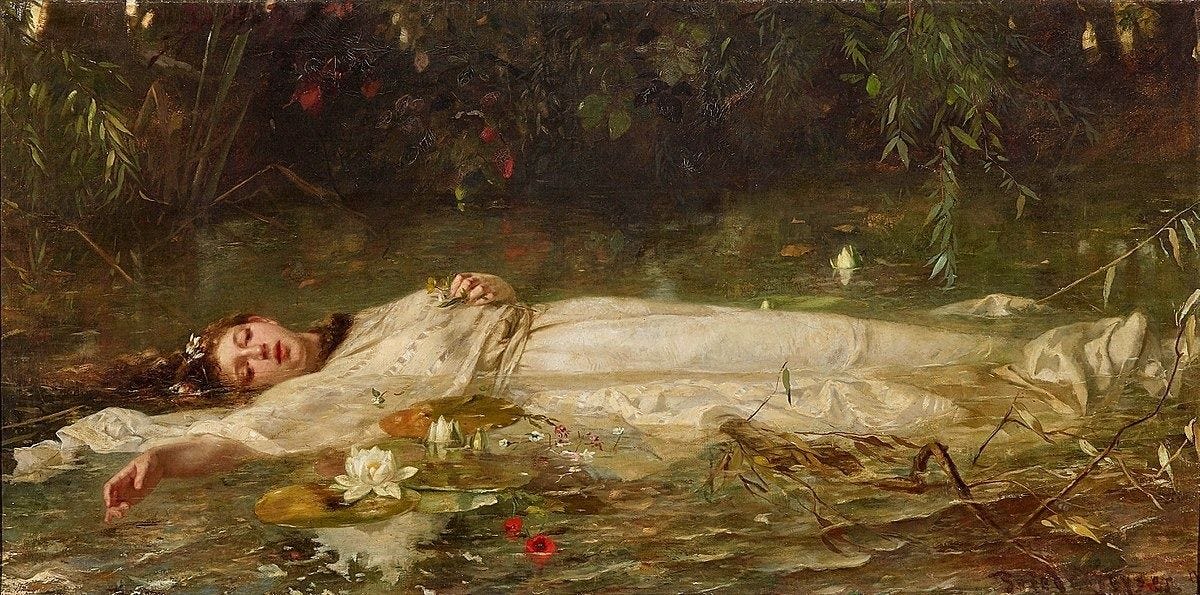
When we think of Shakespeare’s Hamlet, we frequently focus on the Prince — his existential despair, revenge plot, and famous soliloquies on existence and madness. But there is another character whose mental deterioration is far more tragic, permanent, and underappreciated: Ophelia. While Hamlet’s madness is (arguably) an act, a deliberate ruse to conceal his plotting, Ophelia’s descent into genuine psychological collapse is real, observable, and ultimately fatal. And, unlike Hamlet, who can rage against the dying light, Ophelia drowns in silence.
A Pawn in Everyone’s Game.
Ophelia enters the play as a young woman torn between three men who claim to love her: her father Polonius, her brother Laertes, and Hamlet. But “love” in Hamlet is a dangerous thing, as Ophelia discovers the hard way. She is not allowed to think for herself or make her own decisions. Instead, she is treated as property, to be controlled, examined, and eventually sacrificed for others’ ambitions.
When Hamlet begins his intentional descent into “madness,” he is cruel to Ophelia. He tells her, “Get thee to a nunnery” a contemptuous phrase. He accuses her of betrayal, conspiracy against him, and complicity in the rot that has infested the court. Ophelia is unaware that Hamlet’s cruelty is part of his performance, or protection mechanism. But she interprets it as genuine rejection by the person she loves. The irony is devastating: Hamlet hurts her to protect her, but in the process, he destroys her.
The Weight of Unspoken Grief
Both Hamlet and Ophelia suffer from overwhelming grief and emotion, but the play treats them very differently. Hamlet’s grief drives his rage, determination, and action. He turns his pain into a revenge plot. He has agency, even if it results in catastrophe.
Ophelia, on the other hand, lacks access to such an outlet. She is expected to maintain silence, obedience, and emotional control. When her father dies, murdered by Hamlet in a fit of rage, she suffers a double loss: the rejection of her beloved, followed by the murder of her parent. The play gives her very little time to process either event.
How did she respond? Songs. Songs are fragmented and haunting, with sexual imagery and themes of loss. Shakespeare gives Ophelia some of the most moving lines in the play, but she delivers them in a state of fractured madness that the other characters dismiss as mere “derangement.” They don’t listen to what she’s saying. They simply monitor her deterioration with concern or annoyance.
The True Tragedy: Agency vs. Madness
The paradox is that Ophelia’s insanity is portrayed in the play as merely broken, whereas Hamlet’s is clever and a tool under his control. However, Hamlet maintains his autonomy; he makes decisions and lives. In quick succession, Ophelia loses her father, her lover, her family, and her social status. She loses all of her support networks in the play.
She is deprived of agency even in death. Gertrude describes it as “something that happened to her” rather than a decision. It’s lovely, but dehumanizing, that she drowns while surrounded by flowers.
A Mechanism Designed to Destroy Her
What the play ignores: Ophelia is simultaneously experiencing emotional abuse, depression, and psychosis brought on by grief. She requires assistance. She must be given a voice. Rather, she is watched, talked about, and managed. Instead of being understood, she is pitied when she breaks.
Speeches are given to Hamlet. He has the opportunity to defend himself, get angry, and think. Ophelia’s last words are fragments of songs that no one cares to interpret, and she receives flowers and a wet grave.
The No-Escape Trap
Ophelia is confined by her gender, the men in her life, and a court where she is powerless. She loses what she valued when she complies. Nobody pays attention when she reaches out. She is unable to survive when she tries.
Her narrative illustrates how society fails those who are most vulnerable. How love turns into a weapon. How protection is concealed by control. How silence kills more people than poison.
She is portrayed in the play as a supporting character who is only identified by her interactions with men. What would happen, though, if we listened to those broken songs? What if we believed that, similar to Hamlet, her insanity was a reaction to an intolerable circumstance?
Ophelia deserves to be more than a footnote. She deserves to be recognized as the victim of a system that offered her no escape, no voice, and no hope. And perhaps, in recognizing her tragedy with clarity, we can do better.
[embed]
메타데이터
- post_id
- f1f085d7b789
- slug
- the-fate-of-ophelia-f1f085d7b789
- url
- https://medium.com/@nazarcelik./the-fate-of-ophelia-f1f085d7b789
- canonical_url
- https://medium.com/@nazarcelik./the-fate-of-ophelia-f1f085d7b789
- author_url
- https://medium.com/@nazarcelik.
- status
- ok
- fetched_at
- 2026-07-10 00:10:16