Hyperliquid vs GMX — Same Perp DEX. Completely Different Architecture.
Both are on-chain perpetual exchanges. But the mechanics couldn’t be more different. Here’s why that gap exists, what risks each protocol…
Hyperliquid vs GMX — Same Perp DEX. Completely Different Architecture.
Both are on-chain perpetual exchanges. But the mechanics couldn’t be more different. Here’s why that gap exists, what risks each protocol is holding, and what it actually means.
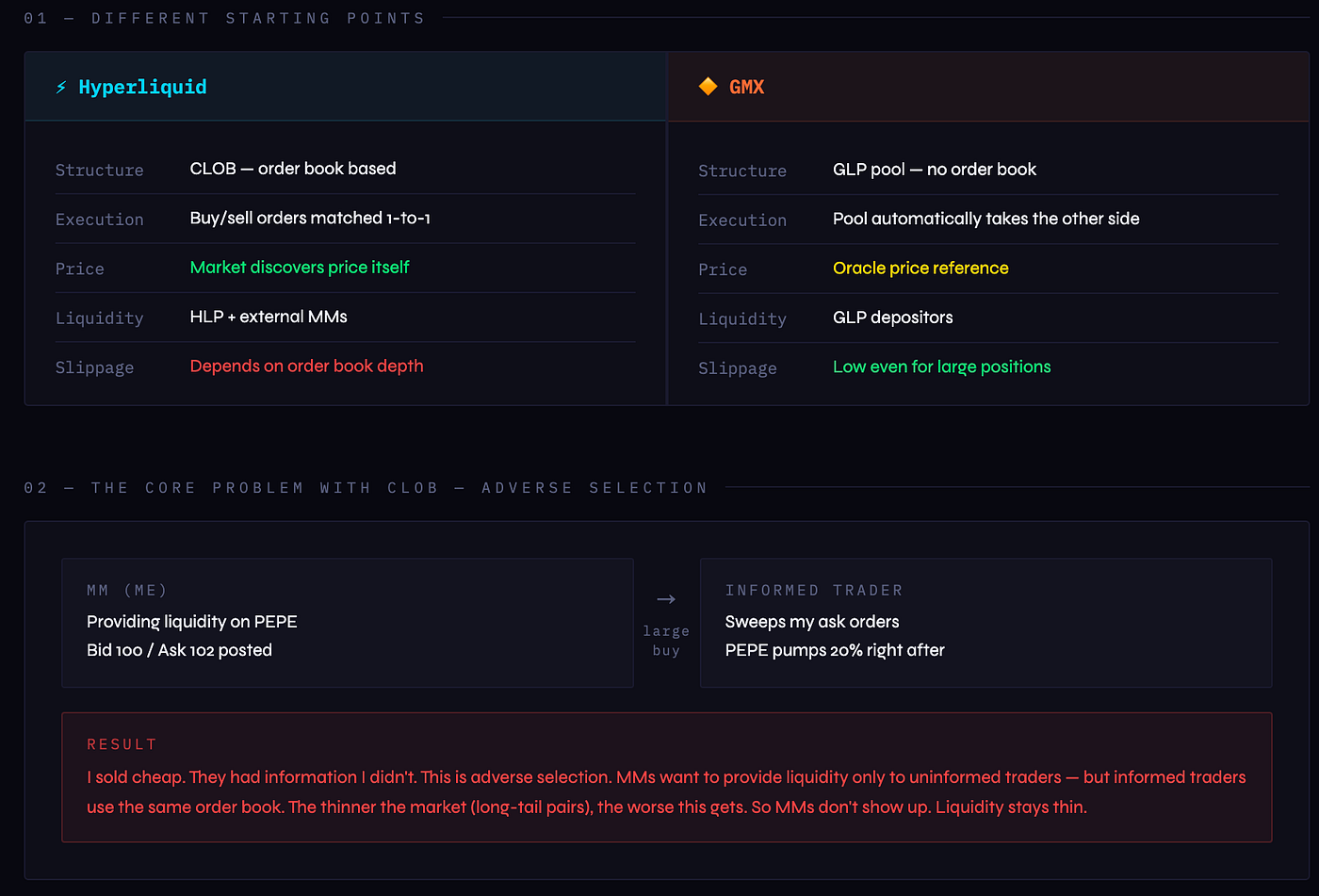
1/ They started from different problems
Hyperliquid = CLOB. Real orders stack in an order book. Buy and sell get matched 1-to-1. Same mechanism as traditional finance — except everything is recorded on-chain.
GMX = no order book. The GLP pool automatically becomes your counterparty. Open an ETH long and the pool takes the other side. You win, money leaves the pool. You lose, money enters the pool.
Same category. Completely different architecture. Because each protocol was trying to solve a different problem first.
2/ The core problem with CLOB — adverse selection
Think from the MM’s perspective.
I’m providing liquidity on PEPE. Bid 100, ask 102 posted. Someone comes in with a massive buy and sweeps my asks. Right after — PEPE pumps 20%.
I sold cheap. They had information I didn’t.
That’s adverse selection. MMs want to provide liquidity only to uninformed traders — but informed traders use the same order book. The thinner the market, the worse this gets. So MMs don’t show up. Liquidity stays thin.
3/ How GMX solved it

Reference oracle prices. Execution always happens near fair value.
MMs don’t get picked off as easily. Adverse selection risk drops.
But there’s a tradeoff. If the oracle is slow — real market price has already moved but oracle hasn’t updated yet — informed traders exploit that gap. Oracle latency attack.
And from the GLP depositor’s side: if traders are collectively profitable, GLP loses even after collecting fees. Token incentives have to compensate — cut those incentives and liquidity leaves. Mercenary liquidity.

4/ What Hyperliquid chose instead
Accurate price discovery over adverse selection protection.
CLOB means the market finds price itself. No oracle latency risk. But when market price diverges from oracle price, basis risk emerges. Arbitrageurs close the gap — and HLP can get caught in that process.
That’s why liquidation triggers use mark price — a blend of CLOB market price and oracle. Prevents whales from manipulating the order book to force liquidations.
5/ Bootstrapping — where they really diverge
GMX flooded GLP depositors with token incentives. TVL stacked fast. But the structural weakness followed: cut the incentives, liquidity exits. Mercenary.
Hyperliquid was different. Jeff Yan is an ex-Alameda trader. Raised zero VC. Used his own capital to run the MM himself for two years. Distributed points to attract early traders. Volume came in, fees generated, HLP yield appeared, external liquidity followed, bigger traders arrived.
HLP yield comes from trading fees. Not token emissions. That’s the difference — and that’s why it’s sustainable.
6/ Same problems. Different tradeoffs.

Adverse selection, slippage, bootstrapping — every perp DEX faces these. What differs is what each protocol chose to sacrifice.
GMX → reduced adverse selection, eliminated slippage. Took on oracle risk and mercenary liquidity. Hyperliquid → kept accurate price discovery, built sustainable liquidity. Took on basis risk and a harder bootstrapping problem.
There is no right answer. Only tradeoffs.
메타데이터
- post_id
- f1f2c43892e6
- slug
- hyperliquid-vs-gmx-same-perp-dex-completely-different-architecture-f1f2c43892e6
- url
- https://medium.com/blockchain-dyor/hyperliquid-vs-gmx-same-perp-dex-completely-different-architecture-f1f2c43892e6
- canonical_url
- https://medium.com/blockchain-dyor/hyperliquid-vs-gmx-same-perp-dex-completely-different-architecture-f1f2c43892e6
- author_url
- https://medium.com/@0x365home
- status
- ok
- fetched_at
- 2026-06-22 00:13:37