Data Governance Frameworks Explained
Two teams pull revenue numbers from the same warehouse table and get two different answers. Nobody can say why. That’s usually the moment a…
Data Governance Frameworks Explained
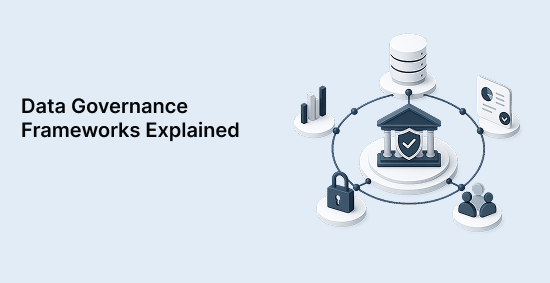
Two teams pull revenue numbers from the same warehouse table and get two different answers. Nobody can say why. That’s usually the moment a data governance framework stops being a nice-to-have and becomes the thing standing between your data team and a very uncomfortable meeting.
Before that moment, governance is whatever the most senior person in the room remembers from the last audit. It holds up fine. Right up until two teams touch the same table with different assumptions about what “clean” means, and then ownership is the first thing that goes missing.
This is where we get into what actually makes a framework work: the components, the ownership model, how DAMA-DMBOK, DCAM, and COBIT differ from the custom builds most enterprises land on, and a real starting point if you’re building from zero. Whether you’re the executive asking why the numbers don’t match or the person on the hook for fixing it, the answer’s in here somewhere.
What Is a Data Governance Framework?
A data governance framework is the structure that ties data ownership, policies, quality standards, and accountability into one operating model. It defines who owns which data, what rules apply to it, how quality gets measured, and who answers for it when something breaks.
It’s not a tool you buy. It’s not a document that sits in a shared drive after the kickoff meeting. It’s the thing that makes governance something a company actually does, day to day, instead of something it talks about doing once a year during audit season.
Most companies don’t build a data governance framework because they want to. They build one because the alternative already cost them something. A compliance fine. A decision made on numbers nobody verified. A merger that stalled because two systems couldn’t agree on what “customer” meant. We’ve seen clients arrive at this point after their third failed audit, not their first.
Data governance is not the same as data management. Data management is the doing. It’s moving data, storing it, processing it, building the pipelines. Governance is the deciding: who’s allowed to touch what, what “good” data looks like, and who’s accountable when it isn’t. You can have excellent data management and zero governance. Plenty of companies do, right up until two departments disagree on a number in a board meeting.
A working data governance strategy is built around a few clear goals:
- Make ownership explicit, so “who owns this table” has a one-word answer, not a Slack thread.
- Keep data consistent enough that teams stop re-verifying each other’s numbers before every meeting.
- Meet compliance obligations without a fire drill every time an auditor asks a question.
- Give the business, and the AI systems now sitting on top of that data, something reliable to run on.
Get these right, and governance stops being a project with an end date. It becomes how the company runs.
Why Data Governance Frameworks Matter More Than Ever
AI Depends on Trustworthy Data
AI systems don’t catch bad data. They amplify it. A model trained on inconsistent, duplicated, or poorly labeled data doesn’t fail loudly, it just makes confidently wrong decisions that look reasonable until someone checks the source. Governance is what stands between an AI initiative and that outcome.
The numbers back this up. 97% of organizations that had an AI-related security incident lacked proper AI access controls, and 63% had no AI governance policies in place at all to manage AI or prevent shadow AI, according to IBM’s Data Breach Report. Before a team runs an AI readiness audit to check whether their infrastructure can support this, the data governance strategy underneath it needs to be solid first. Otherwise the audit just confirms a problem nobody’s fixed yet.
Increasing Regulatory Requirements
Regulatory pressure on data isn’t slowing down. GDPR set the baseline in Europe, India’s DPDP Act is now active and applies to any company handling Indian users’ personal data, and sector-specific rules keep stacking on top for healthcare, finance, and fintech companies. A data governance framework isn’t optional anymore. It’s the mechanism that keeps a company from finding out about a violation from a regulator instead of from its own audit.
Data Spread Across Cloud Platforms
Most companies don’t run on one system anymore. Data lives in a warehouse, a lake, a handful of SaaS tools, and at least one cloud platform, often more than one. A team running Databricks for data engineering and Snowflake for analytics has to govern both consistently, or the two platforms drift into two different versions of the truth. Every additional platform is another place data can get duplicated or lose its lineage entirely. Governance is what keeps a single source of truth possible when the data itself is scattered across six different places.
Better Analytics and Business Decisions
A dashboard is only as trustworthy as the data behind it. Without governance, two teams pulling from the same source can land on two different numbers, and nobody can say which one is right without a manual audit. With it, the business stops re-verifying its own reports and starts acting on them.
Reduced Operational Risk
The global average cost of a data breach in 2025 was $4.4 million, a 9% decrease from the year before, driven largely by faster identification and containment. That drop didn’t happen by accident. Organizations with mature data governance find and contain incidents faster because they already know what data they have, where it lives, and who’s responsible for it. Governance doesn’t just reduce the chance of a breach. It shortens how long one stays open.
The Core Components of a Data Governance Framework
Data Ownership and Accountability
Every dataset needs a named owner, not a team, not a department, an actual person accountable for its accuracy and use. Without this, “who’s responsible for this table” turns into a Slack thread that goes nowhere. Ownership means someone signs off on changes, answers for quality issues, and has the authority to enforce policy on that data.
Policies and Standards
Policies define what’s allowed: who can access what, how data gets classified, how long it’s retained, and what “acceptable use” actually means in practice. Standards are the specifics underneath the policy, like naming conventions, required fields, and format rules. Without both, every team ends up inventing its own version of “good enough.”
Data Quality Management
Bad data doesn’t announce itself. It sits in a report looking exactly as credible as good data until someone downstream makes a decision on it. Data quality management is the ongoing discipline of checking for accuracy, completeness, consistency, and duplication before that happens, not after. Running a data quality assessment on your existing datasets is usually the fastest way to find out how deep the problem actually goes before building policy around it.
Metadata Management
Metadata is data about your data: where it came from, when it was last updated, who touched it, and what it means in business terms. Without it, even accurate data is hard to trust, because nobody can verify its lineage or confirm what a field actually represents. Metadata management is what makes a dataset explainable instead of a black box.
Data Stewardship
A data steward is the person who does the day-to-day work that ownership requires. Owners are accountable at a high level. Stewards are the ones actually enforcing standards, fixing quality issues, and answering the specific questions that come up when someone else tries to use the data. Most frameworks fail at this layer, not because the policy was wrong, but because nobody was assigned to actually carry it out.
Security, Privacy, and Compliance
This component controls who can access data, how personal information gets protected, and how the company meets obligations like GDPR or the DPDP Act. It overlaps with policy, but it deserves its own place in the framework because a security gap doesn’t just break a rule, it exposes the company to real financial and legal risk.
Governance Processes
None of the components above work without a process that ties them together: how new data gets classified, how policy exceptions get approved, how quality issues get escalated and resolved. A framework without process is just a list of good intentions. The process is what turns governance from a document into something the company actually runs on.
Common Data Governance Frameworks
Most companies don’t build a governance framework from a blank page. They start from one of a handful of established models, then adapt it to fit how their teams actually work. Here’s what the major ones actually offer, and where each one tends to fall short.
메타데이터
- post_id
- f200dc519da7
- slug
- data-governance-frameworks-explained-f200dc519da7
- url
- https://medium.com/@Brilworks/data-governance-frameworks-explained-f200dc519da7
- canonical_url
- https://medium.com/@Brilworks/data-governance-frameworks-explained-f200dc519da7
- author_url
- https://medium.com/@Brilworks
- status
- ok
- fetched_at
- 2026-07-13 06:23:13