Brownian Bridges and the Bitcoin Question
On the Geometry of Knowing the Future
Brownian Bridges and the Bitcoin Question
On the Geometry of Knowing the Future
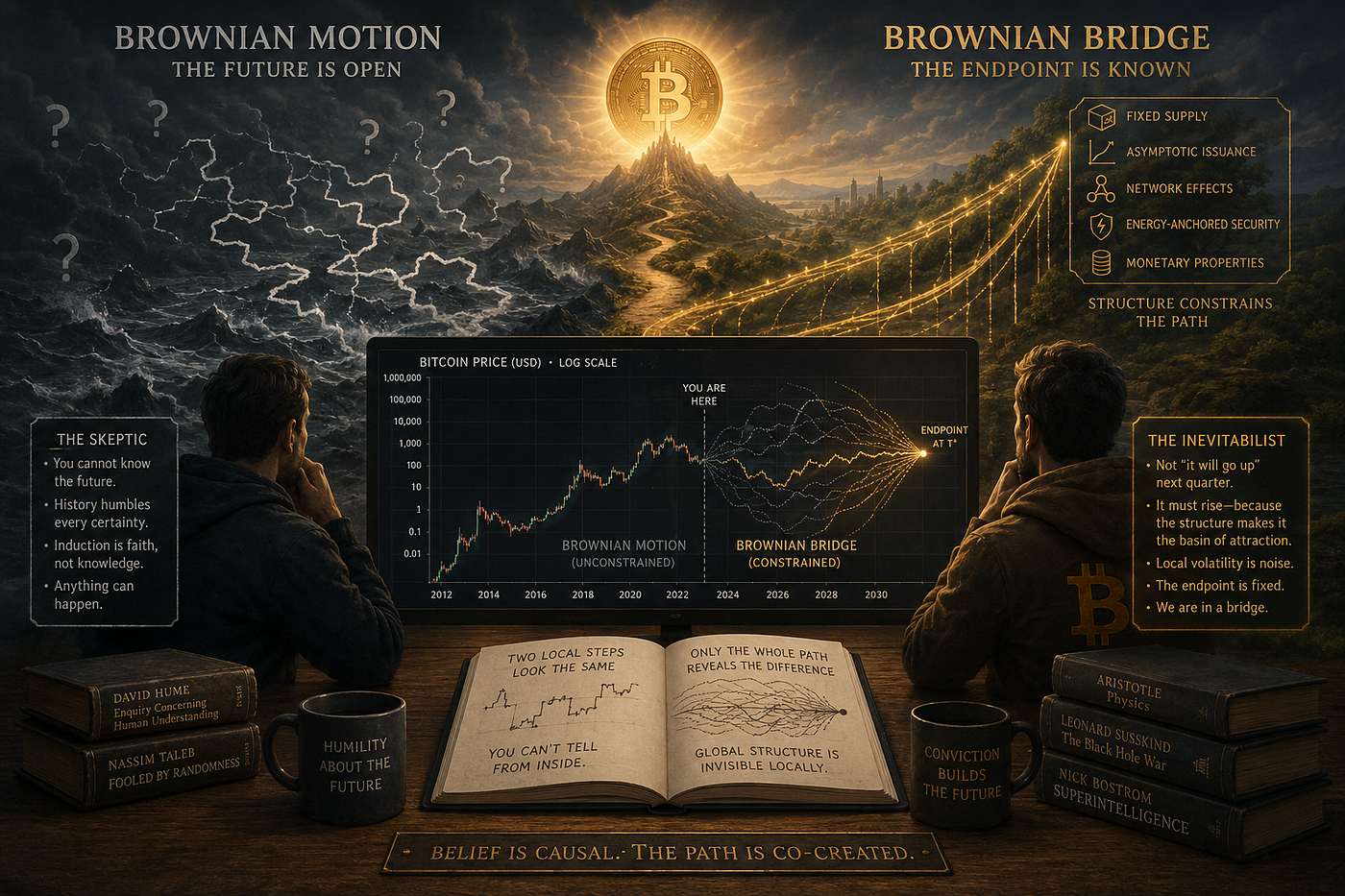
Two people look at the same Bitcoin price chart. One sees a destiny unfolding — turbulent, sometimes violent, but ultimately bound for a particular endpoint. The other sees noise. Both have access to the same information. Both watch the same line move. And yet they are looking at different objects.
This is not a disagreement about facts. It is a disagreement about the shape of reality.
To understand it properly, we have to start with two mathematical structures that look almost identical from up close but differ in a way that turns out to matter far beyond finance.
The Two Walks
Brownian motion is the canonical model of random wandering. A particle moves in tiny independent increments, drifting through space with no memory and no destination. Its expected position at any future time is simply where it is now. The future is genuinely open — any trajectory consistent with the local rules is, in principle, possible.
A Brownian bridge looks the same locally but is structured very differently. The particle still moves randomly, but under a constraint: it must arrive at a specific point at a specific future time. The conditioning is global. From inside the path, motion still feels random. The next step is uncertain. But the space of admissible trajectories has been narrowed. Paths that wander too far in the wrong direction are not impossible — they are simply inconsistent with the endpoint, and so they do not appear in the conditional distribution at all.
The strange thing is that you cannot, in general, distinguish these two processes from inside a short window of observation. Local behavior looks similar. The bridge does not announce itself. Only over long timescales, or with privileged knowledge of the endpoint, does the difference become visible.
This matters because every confident claim about the future implicitly takes a position on which kind of process the speaker thinks they are inside.
The Inevitabilist
There is a strain of Bitcoin thought — call it inevitabilism — that talks about price the way physicists talk about thermodynamic equilibria. Not “I predict it will rise,” but “it will rise, because it must.” The argument is structural: a fixed supply schedule, an asymptotic issuance curve, monetary properties that dominate alternatives along specific axes, network effects that strengthen with adoption, and an energy-anchored security model that becomes harder to displace as it scales. Under this framing, Bitcoin is less an asset and more a basin of attraction in monetary state-space — a configuration toward which any sufficiently networked civilization with digital coordination problems will tend to drift.
This is, importantly, not the same as saying “the chart will go up next quarter.” Inevitabilists are usually quite comfortable with brutal local volatility. Eighty-percent drawdowns are absorbed without ideological injury. What is preserved is the long arc — the claim that the endpoint is fixed even when the path is wild. This is precisely the disposition of someone who believes they are inside a Brownian bridge.
Notice what the inevitabilist is doing epistemically. They are not forecasting in the ordinary sense. Forecasting projects past patterns forward and accepts the inductive risk. The inevitabilist makes a structural argument: given certain features of the system, certain endpoints are favored regardless of path. This is closer to Aristotelian final causation than to modern statistical prediction. The acorn becomes an oak not because we have watched many acorns and observed that they tend to, but because of what an acorn is. Inevitabilism makes the same kind of move about Bitcoin.
The Skeptic
The skeptic answers: you cannot know the future. This is not a casual position. It has a serious philosophical lineage.
Hume’s problem of induction sits at its foundation. We have no non-circular justification for the assumption that the future will resemble the past. Every empirical generalization is, strictly speaking, an act of faith in the uniformity of nature. The skeptic takes this seriously and refuses to dress probabilistic guesses as structural certainties.
Beyond Hume, the skeptic has empirical ammunition. Every monetary system in history has eventually been displaced. Every “new paradigm” technology has eventually been supplanted, refined, or absorbed. Markets price in information rapidly; if Bitcoin’s eventual ascent were truly knowable, much of it would already be priced. Regulatory regimes can suffocate networks. Better protocols may emerge. Cryptographic assumptions may erode. The list of ways a fixed-endpoint thesis could fail is long, and history is unkind to those who mistake favored paths for inevitable ones.
The skeptic, on this reading, is modeling the world as Brownian motion. The next step is uncertain, the long run is doubly so, and confident endpoint claims are category errors dressed in confidence.
What Kind of Claim Is Inevitabilism?
The deeper question is not whether the inevitabilist or the skeptic is right about Bitcoin. It is what kind of claim inevitabilism is even making.
There are at least three readings.
The weakest is rhetorical. “Bitcoin is inevitable” functions as a tribal marker, a price-suppression mechanism for would-be sellers, and a self-soothing device during drawdowns. On this reading, the claim is not really making a knowledge assertion; it is a piece of communal rhetoric. Unflattering, but not entirely wrong about a portion of the discourse.
The middle reading is structural-probabilistic. Here, “inevitable” really means “strongly favored across most plausible trajectories the world could take.” This is a defensible position if the structural arguments are sound. It is not knowledge of the future in the strong sense; it is a claim that the conditional distribution over futures concentrates near a particular outcome. This is, in fact, the closest thing to a Brownian bridge claim that a careful person can rigorously make. It does not assert that the endpoint is metaphysically fixed. It asserts that the geometry of the problem makes most paths converge.
The strongest reading is metaphysical. Bitcoin is genuinely the endpoint of a constrained trajectory in some deeper sense — the way an acorn is teleologically directed at being an oak. This reading is harder to defend but is what some inevitabilists, when pressed, actually mean. It rhymes with the block-universe view in physics, in which “future” and “past” are not ontologically distinct and the entire trajectory exists as one object. If reality is structured that way, then “the future shapes the present” becomes less mystical and more geometric. The path is a single thing, and asking whether the endpoint causes the middle is like asking whether the middle of a line causes the end.
The skeptic’s standard objection — “you cannot know the future” — has different force against each reading. It demolishes the rhetorical reading. It legitimately challenges, but does not defeat, the structural-probabilistic reading; here the disagreement becomes empirical, about whether the structural arguments are actually sound. Against the metaphysical reading, the skeptic’s objection misses entirely, because the metaphysical claim is not about prediction at all. It is about what kind of object the world is.
Most arguments between inevitabilists and skeptics fail because the two sides are operating on different readings without realizing it. The inevitabilist defends the strong reading and the skeptic attacks the weak one, or vice versa, and both leave the conversation convinced the other is unserious.
The Self-Reflexive Twist
There is one feature of the Bitcoin case that distinguishes it from purely natural phenomena and complicates both positions.
Bitcoin’s value is not independent of belief in Bitcoin. An eclipse will happen whether or not anyone predicts it; the moon does not consult the audience. But a monetary network is partly constituted by the conviction of its participants. If enough people are confident that Bitcoin is the endpoint, capital and attention and labor flow toward it, security compounds, liquidity deepens, network effects strengthen, and the endpoint becomes more probable. If conviction collapses, so does the network.
This means inevitabilism is not merely a description of the path; it is part of the path. The Brownian bridge, in this case, is partly drawn by the people who believe in the endpoint. Belief is causal, not merely descriptive.
This creates a peculiar situation. The skeptic’s position, though epistemically humble, is also slightly self-undermining when the asset is reflexive: by withholding conviction and capital, the skeptic helps produce the world in which Bitcoin remains uncertain. The inevitabilist’s position, though epistemically overconfident, is partially self-fulfilling: by acting as if the endpoint is fixed, they help fix it. Neither position is purely about prediction. Both are partially about constitution.
This does not vindicate inevitabilism. Plenty of self-fulfilling enthusiasms have collapsed under their own weight; belief is necessary but not sufficient. Tulip bulbs, railway companies, internet stocks, countless ICOs — confidence alone has never been enough to manifest a new monetary equilibrium. But it does mean that the standard skeptical move — treating the future as a fact about which one should be humble — slightly misdescribes a system in which belief is part of the mechanism that determines what is true.
What the Bridge Cannot Tell You
Here is the hardest part. From inside, you cannot tell whether you are walking a Brownian bridge or wandering Brownian motion.
The local behavior is the same. Volatility, drawdowns, rallies, ruptures — all of these are compatible with both processes. A ninety-percent drop does not refute a fixed endpoint, because the bridge tolerates large excursions if they remain consistent with eventually arriving. A thousand-fold rally does not confirm one, because Brownian motion can spike anywhere. The two processes are pointwise indistinguishable; only the global structure differs, and global structure is exactly the thing the inhabitant of the path does not have access to.
This is the genuine epistemic situation. Both the inevitabilist and the skeptic are making claims about a property of the path that they cannot, from their position, directly observe. They are inferring it from arguments — structural for the inevitabilist, inductive for the skeptic — and the real question is which kind of argument is more trustworthy in this domain.
This is also why the debate so rarely resolves. Each side accuses the other of a category error. The skeptic says: you are claiming knowledge you cannot have. The inevitabilist says: you are applying naive induction to a system whose structure makes induction misleading. They are not actually disagreeing about the chart. They are disagreeing about which mathematical object the chart is a sample from.
Living Inside the Question
The honest position, perhaps, is this: from inside the system, no one can demonstrate which kind of process generates the path. This is not the same as saying no one knows. Knowledge does not require the ability to convince skeptics, only that one’s belief be true and well-formed. Someone who has reasoned carefully about the structure and landed on the right answer knows, even if they cannot prove it to anyone else. The difficulty is that, from the outside, the person who has correctly inferred a Brownian bridge looks identical to the person who is merely overconfident about Brownian motion. Both speak with conviction. Only one is tracking reality. The path itself eventually adjudicates — but until it does, observers cannot tell the cases apart, and the people who are right have no way to distinguish themselves from the people who merely sound like them.
Whether monetary coordination is the kind of system shaped by endpoints is a real question with a real answer. The structural arguments are stronger than the skeptic typically grants and weaker than the inevitabilist typically claims, but somewhere in the population of people thinking about this, some have it right.
What the Brownian bridge framing offers is not a settlement of the dispute but a clarification of its shape. The Bitcoin debate is not really about price. It is about whether you believe certain configurations of human coordination are attractors — whether civilization, given enough time and pressure, tends toward particular monetary geometries the way water tends toward the lowest available basin.
If you believe that, then you are reasoning under a Brownian bridge. Local turbulence is noise around a global constraint. Drawdowns are not evidence against the endpoint; they are paths.
If you do not, then you are reasoning under Brownian motion. There is no privileged endpoint, no destiny in the geometry, only a sequence of contingent events whose only honest description is that they happened.
The deepest irony is that you have to choose without being able to verify which world you are in. The skeptic, in claiming you cannot know the future, has stated something true at the level of pointwise observation but possibly false at the level of structure. The inevitabilist, in claiming you can, has stated something false at the level of certainty but possibly true at the level of geometry. Each is half right in a way that makes them talk past each other.
And the choice itself — whether to act as if the path is constrained or as if it is open — is not a passive forecast. It is a contribution to the path. In a reflexive system, the act of betting on a Brownian bridge is one of the things that makes the bridge real.
Free will, on this reading, is not the absence of structure. It is what it feels like to walk a constrained trajectory from inside — choosing each step in genuine local uncertainty, while contributing, in ways no individual can fully see, to whether the endpoint everyone is arguing about turns out to have been there all along.
메타데이터
- post_id
- f207a8e5e2de
- slug
- brownian-bridges-and-the-bitcoin-question-f207a8e5e2de
- url
- https://medium.com/@bitcoinfellowship/brownian-bridges-and-the-bitcoin-question-f207a8e5e2de
- canonical_url
- https://medium.com/@bitcoinfellowship/brownian-bridges-and-the-bitcoin-question-f207a8e5e2de
- author_url
- https://medium.com/@bitcoinfellowship
- status
- ok
- fetched_at
- 2026-06-27 18:20:27



