5 Jito MEV-Safe Tactics for Fairer Solana Trades
Practical ways to reduce sandwich risk, protect execution, and trade Solana with less “invisible tax” — using Jito-aware routing and…
5 Jito MEV-Safe Tactics for Fairer Solana Trades
Practical ways to reduce sandwich risk, protect execution, and trade Solana with less “invisible tax” — using Jito-aware routing and smarter transaction design.
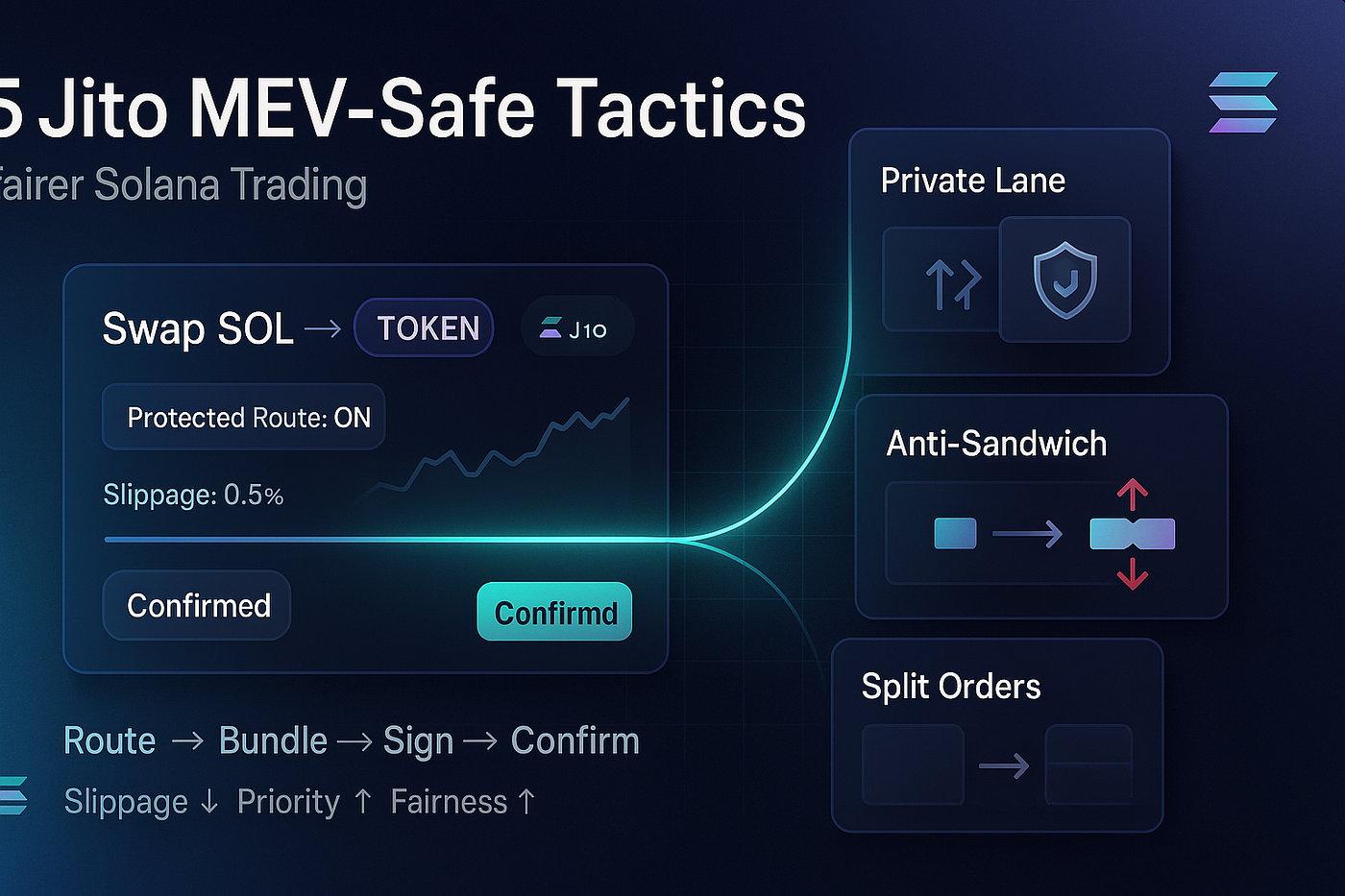
Top 5 Jito MEV-safe tactics for fairer Solana trading — private execution, bundles, slippage strategy, priority fees, and order sizing to reduce sandwiches.
Let’s be real: on fast chains, “instant” can still be expensive — just not in the way you expect. You click swap, you get filled… and somehow the price looks a little worse than it should. That gap? Often MEV.
MEV (maximal extractable value) isn’t a villain with a hoodie. It’s a set of incentives. And on Solana, it tends to show up as sandwiching, backrunning, and “priority games” around your transaction. Jito sits right in the center of this conversation because it’s one of the biggest pieces of Solana’s block-building and MEV infrastructure — and, used thoughtfully, it can help normal traders get fairer execution.
Here are five tactics I’d actually use (and recommend) if you want to be MEV-aware without turning trading into a second job.
1) Prefer private execution paths, not public “shouts”
Why it matters
A public mempool-style broadcast is like announcing your order on a megaphone. Even if Solana’s design isn’t identical to Ethereum’s mempool dynamics, the concept holds: the more visible and predictable your swap is, the more likely it becomes a target for opportunistic reordering or backrunning.
What “MEV-safe” looks like with Jito in mind
You want a path where your transaction can be handled with reduced exposure, often via Jito-aware infrastructure (wallets, RPCs, relayers, aggregators) that routes orderflow through more controlled lanes.
Think of it like choosing:
- Public freeway (everyone sees you merge)
- vs toll express lane (fewer cars, less jockeying)
Architecture sketch
Trader → Wallet / App
   → (private / protected route)
      → Jito-aware relay / block engine lane
         → Validator / block builder
            → DEX program execution
Practical move: If your wallet or trading app offers a “protected” or “MEV-aware” send option, test it on small sizes first. The best protection is the one you’ll actually use consistently.
2) Bundle the trade with the right constraints (and skip “naked swaps”)
The core idea
A “naked swap” (simple swap tx with wide slippage) can be easy to exploit because it’s a clean, single intent: buy token X with Y.
A more MEV-resistant approach is packaging intent with constraints — often through bundling behavior where the transaction is treated as a unit and you reduce the wiggle room for adversarial ordering.
What to optimize
- Atomicity: Keep the critical steps together.
- Tight slippage: Don’t leave free money on the table.
- Determinism: Use quotes that won’t drift wildly.
A simple analogy
Imagine you’re exchanging currency at an airport kiosk. If you tell the clerk, “I’ll accept any rate within 5%,” congratulations — you just negotiated against yourself.
Bundled, constraint-aware execution is basically: “I’ll do this trade only if the rate stays within my tolerance.”
3) Treat slippage like a security setting, not a convenience slider
The hidden truth
Slippage isn’t only about volatility. It’s also the “profit budget” you accidentally offer to sandwichers.
If you set slippage at 3% for a thin token, you’ve effectively told the market:
“Feel free to move me around within this range.”
The MEV-safe slippage playbook
Use dynamic slippage, not static
- High-liquidity pairs: keep it tight (often fractions of a percent).
- Low-liquidity or long-tail tokens: consider splitting orders instead of inflating slippage.
Watch for price impact vs. slippage mismatch
If your quoted price impact is already meaningful, high slippage turns “expected loss” into “invited loss.”
Quick rule of thumb
- If you wouldn’t tolerate the same slippage in a limit order, don’t tolerate it in a swap.
- If execution fails often, don’t immediately raise slippage — first try tactic #4 and #5.
4) Use priority fees strategically to avoid getting “stuck in the middle”
The problem
On Solana, execution quality often correlates with when you land in a block and how your transaction competes for compute and inclusion. If you underpay priority fees during congestion, you can end up delayed — right where volatility and MEV strategies love to play.
But you also don’t want to blindly overpay. MEV-safe doesn’t mean “always pay more.” It means pay just enough to avoid being predictable prey.
Working snippet: adding priority fee + compute cap (TypeScript)
This doesn’t “solve MEV” by itself, but it reduces failure and delay — two conditions that tend to worsen execution.
import {
  Connection,
  Transaction,
  ComputeBudgetProgram,
  sendAndConfirmTransaction,
  Keypair,
} from "@solana/web3.js";

async function sendWithPriority({
  connection,
  tx,
  payer,
  microLamportsPerCU = 10_000, // tune based on congestion
  computeUnitLimit = 200_000,  // tune to your program needs
}: {
  connection: Connection;
  tx: Transaction;
  payer: Keypair;
  microLamportsPerCU?: number;
  computeUnitLimit?: number;
}) {
  tx.instructions.unshift(
    ComputeBudgetProgram.setComputeUnitLimit({ units: computeUnitLimit }),
    ComputeBudgetProgram.setComputeUnitPrice({ microLamports: microLamportsPerCU })
  );

  const sig = await sendAndConfirmTransaction(connection, tx, [payer], {
    skipPreflight: false,
    commitment: "confirmed",
  });

  return sig;
}
Why this is “MEV-safe adjacent”
You’re reducing the chance your transaction becomes a slow, visible target drifting across slots. In practice, fewer retries + faster inclusion often equals cleaner fills.
5) Size and time your orders like someone is watching (because someone might be)
The uncomfortable reality
Large, single-shot market buys on thin liquidity are basically MEV catnip. Even if you’re using Jito-aware lanes, your own trade size can create the very volatility you get punished by.
Two tactics that consistently help
Split orders (micro-batching)
Instead of 1 trade of 10, do 5 trades of 2 with slightly staggered timing. You reduce:
- sudden price impact
- predictability
- “one big sandwich” opportunities
Use limit-style execution where possible
Many aggregators and venues offer limit orders or RFQ-style routes. If you’re buying size, a limit-like constraint is the difference between:
- “Fill me at whatever” and
- “Fill me only if it’s fair.”
A timing sketch
Single-shot market swap:
  [ BIG ORDER ] → big impact → easy to target

Split execution:
  [2] [2] [2] [2] [2]
   ↓   ↓   ↓   ↓   ↓
 smaller impact, less predictable
You might be wondering: doesn’t splitting increase fees? Sometimes, yes. But the math is often brutal: a small extra fee can be cheaper than a big execution haircut.
Putting it together: the “fair execution” checklist
Before you hit swap, ask:
- Am I routing through a protected / private path when available?
- Are my constraints tight enough (slippage, quote freshness)?
- Am I paying a sensible priority fee to avoid delay?
- Is my order size likely to move the market?
- Can I split or use limit-style execution instead?
This isn’t paranoia. It’s just modern trading hygiene.
Conclusion: MEV-safe is a habit, not a feature
Jito won’t magically make every trade “fair,” because fairness is upstream of infrastructure — it’s incentives, competition, and market structure. But Jito-aware routing, bundled execution patterns, and smarter transaction design can absolutely reduce the invisible tax you pay on Solana.
Start with one change today: tighten slippage and stop doing single-shot size swaps on thin liquidity. Then graduate into protected routes and bundle-style execution as your comfort grows.
If you’ve been sandwiched (or you suspect you were), drop a comment with what token/pair and what settings you used. I’ll suggest one concrete adjustment. Follow for more Solana trading mechanics that actually help.
메타데이터
- post_id
- f23f32b424df
- slug
- 5-jito-mev-safe-tactics-for-fairer-solana-trades-f23f32b424df
- url
- https://medium.com/@connect.hashblock/5-jito-mev-safe-tactics-for-fairer-solana-trades-f23f32b424df
- canonical_url
- https://medium.com/@connect.hashblock/5-jito-mev-safe-tactics-for-fairer-solana-trades-f23f32b424df
- author_url
- https://medium.com/@connect.hashblock
- status
- ok
- fetched_at
- 2026-06-17 16:37:43