On Parshat Lech Lecha
Bereshit (Genesis) 12:1–17:27
On Parshat Lech Lecha
Bereshit (Genesis) 12:1–17:27
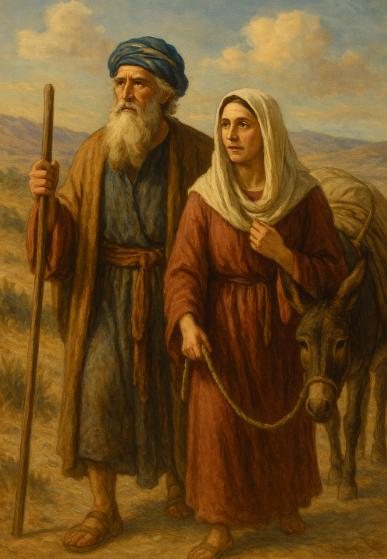
G‑d spoke to Abram: “Go you from your land, from your birthplace and from your father’s house, to the land which I will show you.”
The Journey of Abram and Sarai
As the parsha opens, Abram is 75 years old and obediently “goes forth” from Ur of the Chaldeans. He travels with his wife Sarai and all their household until God leads them to Bethel and Hebron, where Abram builds altars and calls on Hashem’s Name. A famine forces them to Egypt, then he rescues Lot, then comes the dramatic moment (Bereshit 15) when God appears to Abram in a vision and foretells the 400 year exile in Egypt followed by redemption with great wealth. Abram asks, “How will I know that I will possess it?” and then God assures Abram that the Promised Land from the river of Egypt to the great river, the River Euphrates will become his descendant’s eternal possession.
And He said to Abram: “Know surely that your descendants shall be a stranger in a land that is not theirs, and they will be enslaved to them, and they will afflict them four hundred years.
“And also that nation whom they shall serve will I judge; and afterwards they shall come out with great wealth….”
…On that day G‑d made a covenant with Abram, saying: “To your seed I have given this land, from the river of Egypt to the great river, the River Euphrates.”
All of this sets the stage for the final act of the parsha. Just as Abram had given up all hope of ever fathering any children with Sarai, God appears again and gives both of them hope: “Look toward heaven and count the stars; so shall your offspring be.”
He took him outside, and said: “Look now toward heaven and count the stars, if you be able to count them. . . . So shall be your offspring.”
At that moment God reaffirms His covenant of giving them descendants. Abram’s faith and obedience are on the line. God’s first words to him in this encounter are, “Walk before Me and be perfect.” Rashi explains that “walk before Me” refers to the commandment of brit milah, circumcision, and “be perfect” means that by it Abram will be made perfect in God’s eyes. Until that point, as Rashi notes, “as long as the foreskin is on you, you are incomplete before Me.” Abram immediately obeys and circumcises himself at age 99. Then God introduces the name changes and says, “I am God Almighty… I will multiply you exceedingly… and your name shall be Avraham.” God’s covenant is renewed. Avraham will be the father of multitudes, kings will descend from him, and Sarai (now Sarah) will bear the son of promise. Indeed a year later, as God promised, Sarah conceives and gives birth to Yitzchak (Isaac).
“No longer shall your name be called Abram. Your name shall be Abraham (‘Father of Multitudes’), for I have made you a father of a multitude of nations. . . . As for Sarai your wife, you shall no longer call her name Sarai, but Sarah shall be her name.”
This narrative shows a pattern of faith tested by uncertainty. Abram/Avraham experiences trials such as famine, persecution, and doubt of having heirs, yet God’s plan unfolds with perfect timing. Abraham’s journey from his birthplace to Canaan, from Abram to Avraham, teaches us that we should trust in God’s promises even when we don’t yet see their fulfillment.
Becoming Avraham and Sarah
The heart of this essay is the renaming of Avraham and Sarah. Why did God even bother to change just one letter in each of their names? Chazal tell us that in Hebrew every single name has a deep meaning. Abram comes from “Av ram” which means “exalted father,” or as Chizkuni explains, it is a contraction of “father of Aram,” which indicates that he was only prominent in his homeland of Aram, or Mesopotamia. Sarai means “my princess,” the princess for me, or for Abram alone. In effect, their old names were kind of limited in scope, the father of a local region and a personal princess. But God’s plan was global.
God announces, “Avraham shall be your name.” The name is now Avraham, which the verse explains as “Av hamon goyim” which means the father of a multitude of nations. It is actually an acronymic play on words, as Rashi points out, with the added letter Hey and Vav, his name spells out Avraham, and a verse in Jeremiah even uses the letters to hint at “I have made you a father of a multitude of nations.” The resh (“ר”) that was in Abram is understood as “Aram,” and it remains, “for even the resh that was there originally was not moved from its place.” This teaches us that Abram did not abandon his past but rather expanded from it. The new Hey (ה) opens the name to include ha-manim, which means the multitudes.
Similarly, Sarai’s name is changed to Sarah, which means Princess. Rashi, citing Bereishit Rabbah, elaborates on this: “You shall not call her Sarai (‘my princess’), for ‘Sarah’ is her name.” “Sarai, meaning ‘for me’ and not for others,” says Rashi. “Sarah, simply Sarah, shall be her name, that she shall be a princess over all.” This means that Sarah’s role is now universal, she is no longer just Abram’s private jewel. This connects to the promise that from Sarah will come kings of nations. Their new names declare their destiny and their partnership in God’s mission.
What does this teach us about names and identity? In Hebrew thought, a name is not just a label but the essence or life-force of the person. The Hebrew letters themselves have divine energies. By adding a Hey, Abram and Sarai are infused with a whole new potential.
In fact, a Chassidic teaching points out that when God tells Abraham of the impending birth of Isaac, “Abram” and “Sarai” have become spiritually ready. It says that Abraham looked at the stars and saw that he and Sarai themselves could not have children. God replies, “Yes, Abram cannot bear a son, and Sarai cannot give birth, but Avraham and Sarah will [give birth].” This Midrash beautifully illustrates that when one’s name changes, it is as if a new person has stepped forward, one that is even capable of miracles. The name change is a signal that God’s plan is proceeding into a new phase.
Final Thoughts
As we reflect on Lech Lecha, I am reminded that our identity as Jews is tied to promise and potential. When Hashem called Abram to leave his past behind, He was also giving him and Sarai a brave new future. There is something deeply hopeful in that message. No matter where we come from or what we have done, God can give us a new name and a new purpose. Just as Abram and Sarai did not despair in exile or barrenness but were strengthened by their covenant, so we too can trust that God fulfills His word even when the circumstances seem bleak.
For me, this parsha has always reminded me to be hopeful. Our forefathers’ names teach us that change is possible through partnership with the Divine. Avraham and Sarah show us that being chosen does not mean living small; it actually means expanding compassion and leadership to the entire world. In our own daily lives, we can draw strength from their faith and sensitivity. We can say, “Just as Hashem fulfilled His promise to Avraham and Sarah, He can guide me in my own challenges.”
Thank you for reading.
메타데이터
- post_id
- f2432051f263
- slug
- on-parshat-lech-lecha-f2432051f263
- url
- https://medium.com/@natashaarosenberg/on-parshat-lech-lecha-f2432051f263
- canonical_url
- https://medium.com/@natashaarosenberg/on-parshat-lech-lecha-f2432051f263
- author_url
- https://medium.com/@natashaarosenberg
- status
- ok
- fetched_at
- 2026-07-16 01:42:17