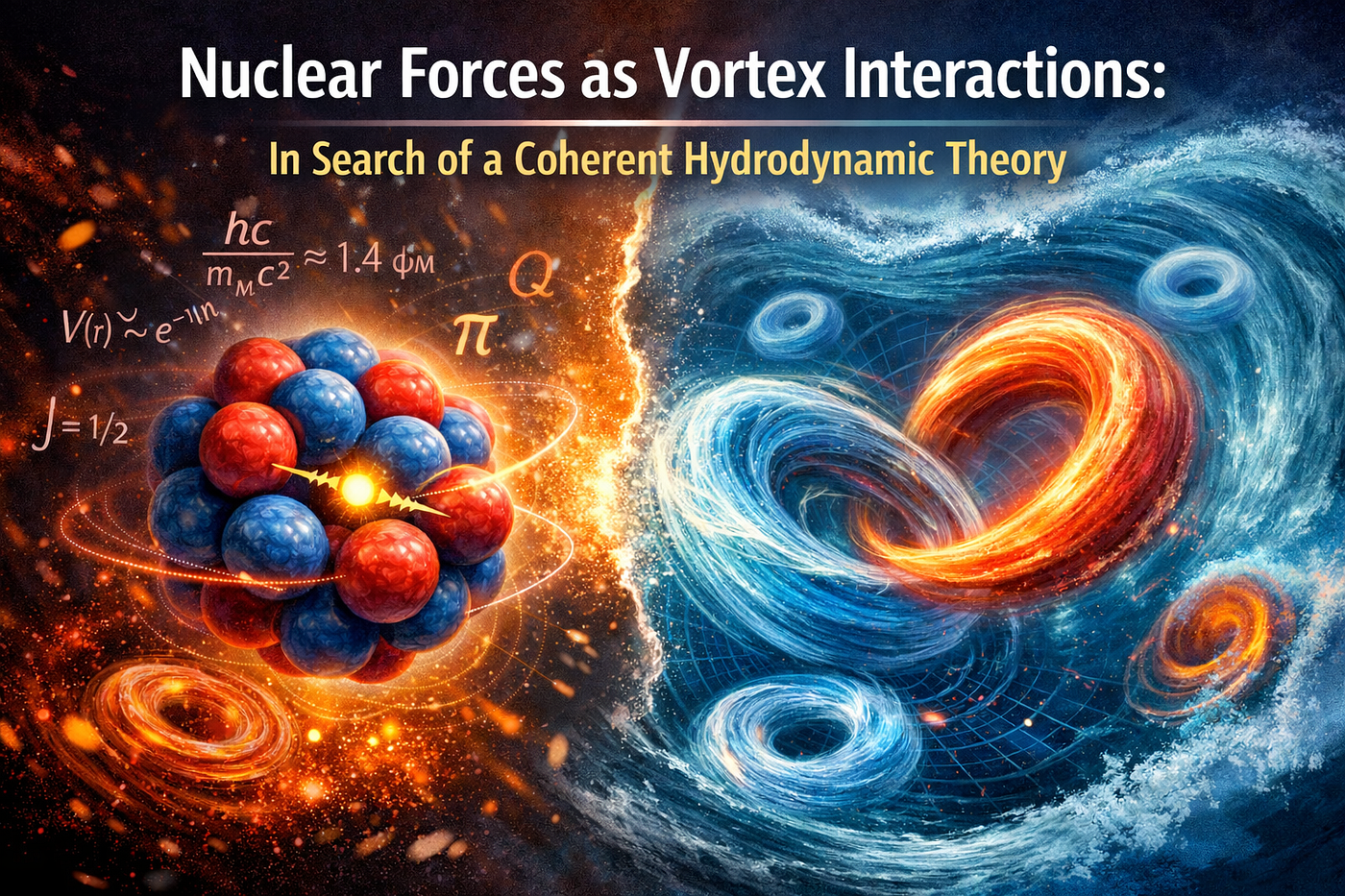
Nuclear Forces as Vortex Interactions: In Search of a Coherent Hydrodynamic Theory
Imagine trying to explain why protons and neutrons stick together in an atomic nucleus using only the laws of fluid motion. No particle…
Nuclear Forces as Vortex Interactions: In Search of a Coherent Hydrodynamic Theory
Imagine trying to explain why protons and neutrons stick together in an atomic nucleus using only the laws of fluid motion. No particle exchange, no “color charge” — just vorticity, pressure, flow. It sounds tempting and beautiful. But the devil, as always, is in the details. And here, the details are two oceans deep.
Part One: Hydrodynamics Is Richer Than It Seems
Most people, upon hearing the word “hydrodynamics,” picture water in a pipe or waves on the sea. In reality, it is a vast world with dozens of fundamentally different regimes of behavior.
The Smoke Ring and Its Surprises
Exhale a smoke ring — it will travel several meters while holding its shape. This is a vortex ring: a stable structure that moves under its own self-induced velocity field. If nuclei were such “smoke rings,” it would be elegant.
But a vortex ring has at least two independent types of rotation: one along the large circumference of the torus (fluid flows around the entire ring), and another inside the tube (fluid swirls crosswise). These are not the same motion, and they generate fundamentally different velocity fields. The mixing of these two modes is the first source of confusion when building a model.
Now add that a smoke ring lives long only in air without turbulence. In a real viscous medium, the ring quickly dissipates. A nuclear model requires a medium with zero viscosity — or with compensating elasticity. This imposes strict constraints on the “medium” itself, whose self‑consistent properties must be understood.
Incompressibility vs. Elasticity
In ordinary water, sound travels at ~1500 m/s — water is nearly incompressible. In an incompressible fluid, the velocity field around a vortex decays as 1/r²: slowly, with infinite range. But nuclear forces decay exponentially, roughly as e⁻ʳ/¹·⁴ ᶠᵐ — after two or three femtometers there is almost nothing left.
To obtain exponential decay, you need a medium with elasticity — like jelly or rubber. In such a medium, a vortex “feels” resistance to deformation at large distances, and its influence decays quickly. But introducing elasticity immediately gives rise to elastic waves, additional modes, possible instabilities — and the need to justify why this particular kind of elasticity, and not another.
Laminar Flow, Turbulence, and Chaos
Two vortex rings flying one behind the other form a beautiful and predictable system. But three are already chaotic. If a nucleus contains 208 nucleons (as in lead), the system’s behavior is fundamentally nonlinear: interactions do not add pairwise. In nature, this is called three‑body and many‑body nuclear forces; in hydrodynamics, it corresponds to nonlinear cross‑terms. This is not a correction: without them, calculations for hydrogen‑3 and helium‑3 give wrong answers.
Part Two: Nuclear Interactions Are Not a Single Force but a Whole Zoo
Nuclear physics is often presented as “one force that holds everything together.” In reality, the nucleon‑nucleon interaction consists of at least six different effects, each with its own physics and its own scale.
The Hard Core at 0.5 fm
At distances less than half a femtometer, nucleons behave like billiard balls: they do not pass through each other. This “hard core” — a sharp, almost step‑like repulsion — must be reproduced accurately, otherwise nuclei in the model would collapse to a point.
In hydrodynamics, this means that when two vortex‑based nucleons overlap, an extremely strong repulsive force must appear. It must turn on sharply: not “gradually increasing” but almost instantaneously. Obtaining such behavior from smooth fluid equations is a non‑trivial task.
Attraction That Remembers Direction
Two nucleons attract each other at intermediate distances (1–2 fm). But the force depends on how their spins are oriented. If the spins are parallel to each other and perpendicular to the line joining the nuclei, the force is one value. If they are parallel and aligned along that line, it is another. If they are antiparallel, a third.
This is called the tensor force, and it cannot be derived from a simple central potential. It is precisely because of this force that the deuteron (proton + neutron) is not a sphere but a slightly oblate ellipsoid. The deuteron’s quadrupole moment is direct experimental evidence of this angular dependence.
In hydrodynamic terms, the tensor force requires that the velocity field of a vortex be anisotropic and depend on the orientation of the vortex axis. This is achievable, but it means that a single number (scalar circulation) is insufficient; at a minimum, a vortex axis is needed — so a nucleon must be an object with a direction, not merely a “little ball of flows.”
Why All Nuclei Have the Same Density
Iron, lead, uranium — different nuclei, but the average density of nuclear matter is always the same: ~0.16 nucleons per cubic femtometer. If the nuclear force were simply attractive, nuclei would shrink to a minimal volume. But they do not.
This is called saturation, and it requires that at the equilibrium density the forces balance exactly. In hydrodynamics, this means the existence of a stable equilibrium for a vortex lattice — a minimum of the total energy at a specific inter‑vortex distance. Obtaining such equilibrium, and with the correct density value, is a separate difficult task.
The Proton and Neutron Feel the Same Nuclear Force
Nuclear physics knows an empirical fact: proton‑proton, neutron‑neutron, and proton‑neutron interactions (in identical quantum states) are practically identical. Electromagnetism distinguishes them, but the nuclear force does not.
For a hydrodynamic model, this means that the difference between proton and neutron must lie in something that does not affect the interaction strength. For example, the sign of the circulation. The velocity field depends on the square of the velocity — the sign then disappears. An elegant solution. But it also means that no matter how many times you flip a neutron into a proton, the nuclear force does not change. The electric charge, however, does change. So electromagnetism and the nuclear force in the model must “see” different modes of the vortex: one mode is responsible for charge, another for the nuclear force. This directly leads to a problem with two independent circulation parameters.
Part Three: Where the Two Worlds Collide
Quantum Numbers from a Classical Fluid
Nucleons are fermions. Two nucleons with identical quantum numbers cannot occupy the same state. From this follow the nuclear shell structure, the magic numbers (2, 8, 20, 28, 50, 82, 126), and the explanation for the exceptional stability of helium‑4 and calcium‑40.
Classical hydrodynamics knows no “Pauli exclusion principle.” Its objects are fields, not fermionic particles. To reproduce Fermi statistics, you must either quantize the vortices (which moves the problem from classical mechanics to quantum field theory) or find a classical analogue of the exclusion — for example, a topological impossibility for two vortices with identical parameters to occupy the same spatial cell. This is possible in principle, but requires careful justification.
Discrete Energy Levels
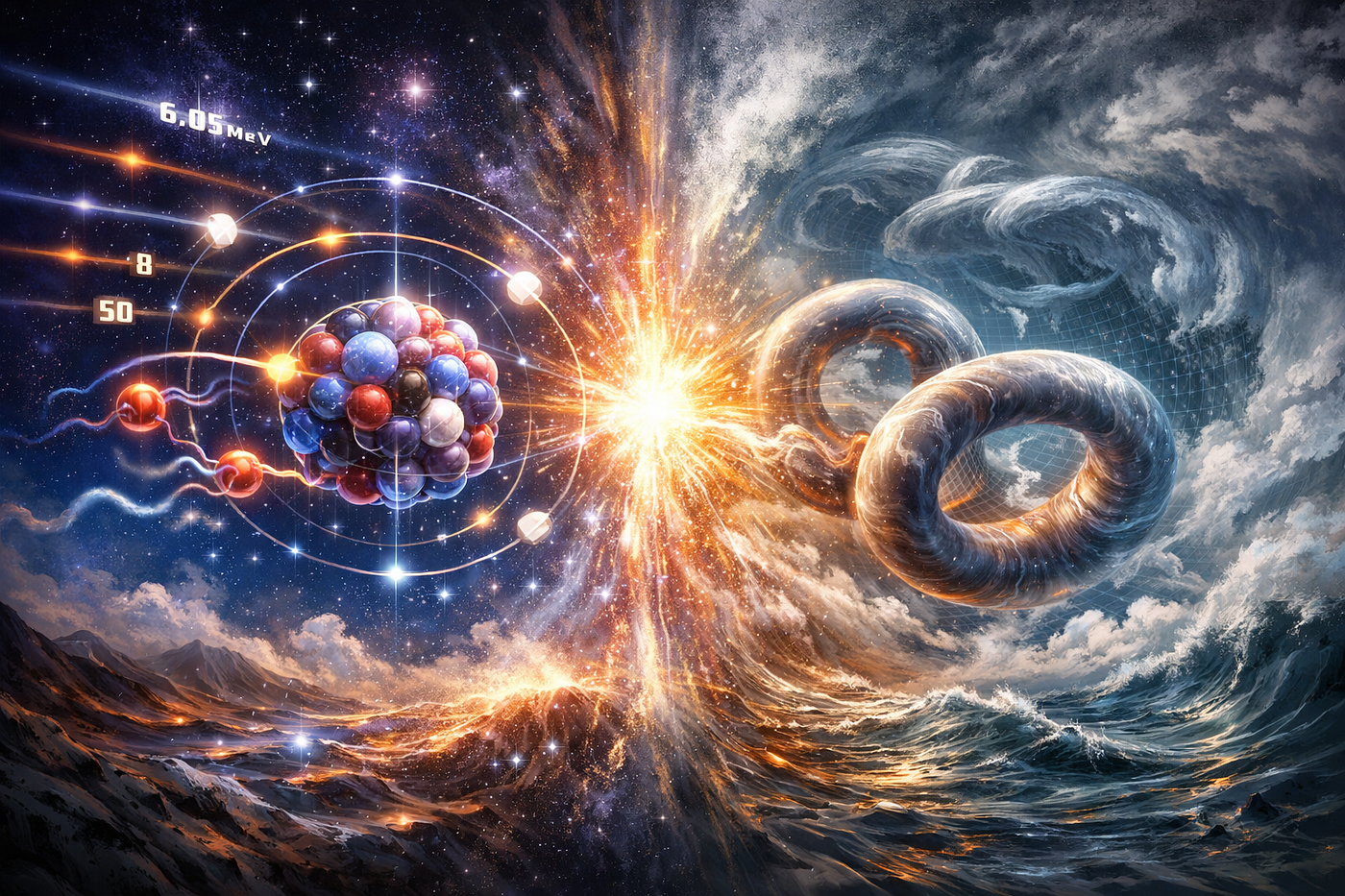
Nuclei have clear discrete energy levels: the ground state of oxygen‑16 is at 0 MeV, the first excited state at 6.05 MeV. The gap is large and specific. A hydrodynamic model must reproduce these numbers, not just “roughly correct magnitudes.”
In a classical system, discreteness of levels arises from boundary conditions — like a string that sounds only at certain frequencies. For a vortex system, the boundary condition is the quantization of circulation: Γ = nħ/m. But setting the correct quantum numbers for a hundred nucleons in a nucleus, reproducing the specific spectrum — that is no longer a simplification, but a full‑fledged many‑body problem.
The Pion and What It Means for Hydrodynamics
Standard physics explains nuclear attraction by the exchange of pions. The pion is a real particle with a mass of 135–140 MeV, and its mass sets the range of the nuclear force through the uncertainty relation: ~ħc / m_π c² ≈ 1.4 fm.
In the hydrodynamic picture, there is no pion. Instead, there is the velocity field induced by one vortex at the location of another. This field decays as a power law if the medium is incompressible, or exponentially if the medium is elastic. And here comes the crucial question: what exactly “plays the role” of the pion? Which property of the medium or the vortex sets the scale of 1.4 fm? Answering this question honestly, without fine‑tuning, is one of the key requirements for any hydrodynamic model of nuclear forces.
Conclusion: Why It’s Beautiful and Why It’s Hard
Hydrodynamics is one of the richest branches of physics. It includes incompressible and compressible, viscous and ideal, classical and quantum, laminar and turbulent regimes. Vortices can be point‑like, filamentary, ring‑shaped, with or without vorticity. They interact nonlinearly, recombine, decay.
Nuclear interactions are no less rich. They contain hard‑core repulsion and soft attraction, tensor and spin‑orbit components, three‑body forces and collective modes, fermionic statistics and isospin symmetry.
The problem of hydrodynamic modeling of nuclear forces is a problem of marrying two very different and very rich worlds. The beauty of the approach is that it potentially explains all of this from a few fundamental principles. The difficulty is that every nuance of nuclear physics imposes a separate requirement on the properties of the hydrodynamic model. And many of these requirements turn out to be contradictory.
That is precisely why such a problem remains open, and precisely why it is interesting.
메타데이터
- post_id
- f256b126ed0a
- slug
- nuclear-forces-as-vortex-interactions-in-search-of-a-coherent-hydrodynamic-theory-f256b126ed0a
- url
- https://medium.com/@osenilophys/nuclear-forces-as-vortex-interactions-in-search-of-a-coherent-hydrodynamic-theory-f256b126ed0a
- canonical_url
- https://medium.com/@osenilophys/nuclear-forces-as-vortex-interactions-in-search-of-a-coherent-hydrodynamic-theory-f256b126ed0a
- author_url
- https://medium.com/@osenilophys
- status
- ok
- fetched_at
- 2026-06-23 17:05:31




