Central asia's pipeline map redraws as china, azerbaijan court transit roles
Kazakhstan's Atasu-Alashankou line runs 200,000 barrels per day of Russian crude, leaving just ~20,000 barrels per day of Kazakh capacity…
Central asia's pipeline map redraws as china, azerbaijan court transit roles
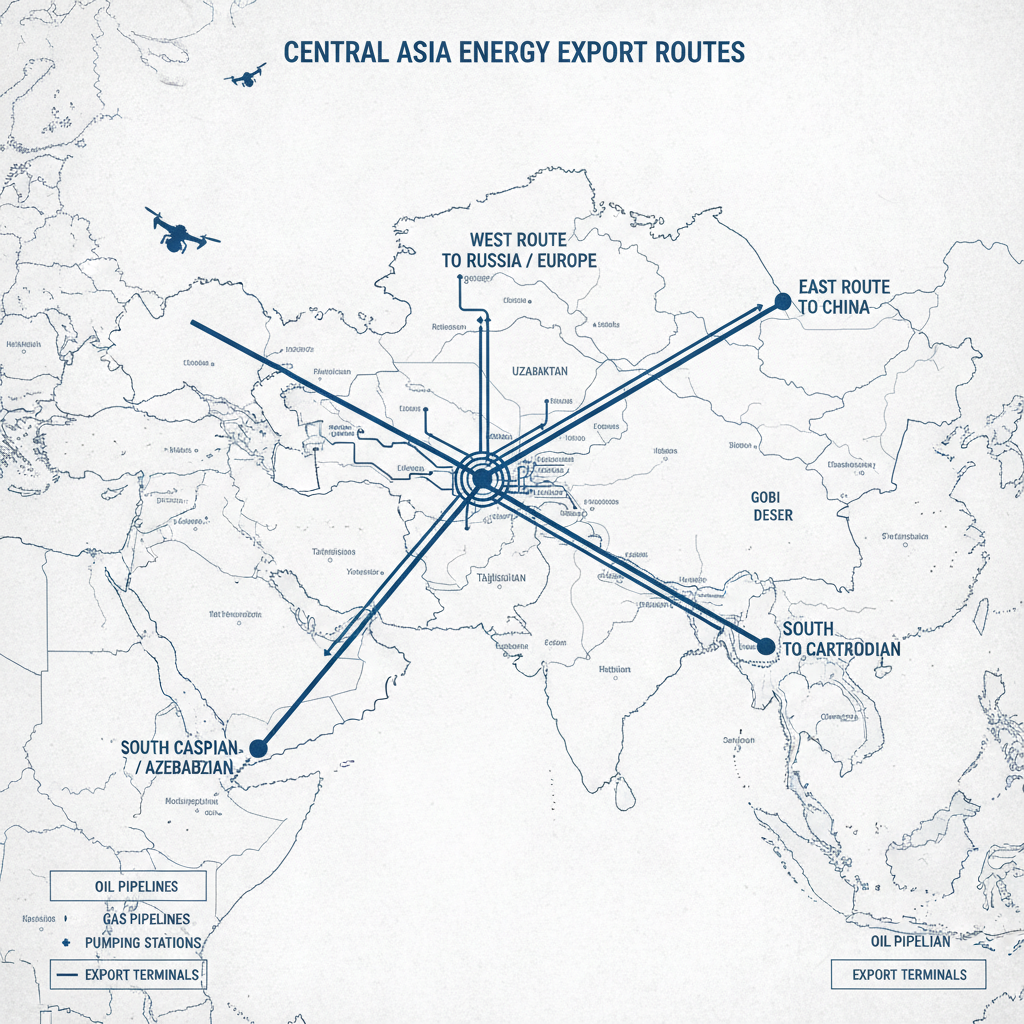
Kazakhstan's Atasu-Alashankou line runs 200,000 barrels per day of Russian crude, leaving just ~20,000 barrels per day of Kazakh capacity, as Baku pushes a new Caspian export corridor.
The drone strikes near Novorossiysk in late July did more than halt CPC loadings. They forced a reckoning that Central Asian energy officials have spent two decades avoiding: every barrel out of the region eventually crosses someone else's border.
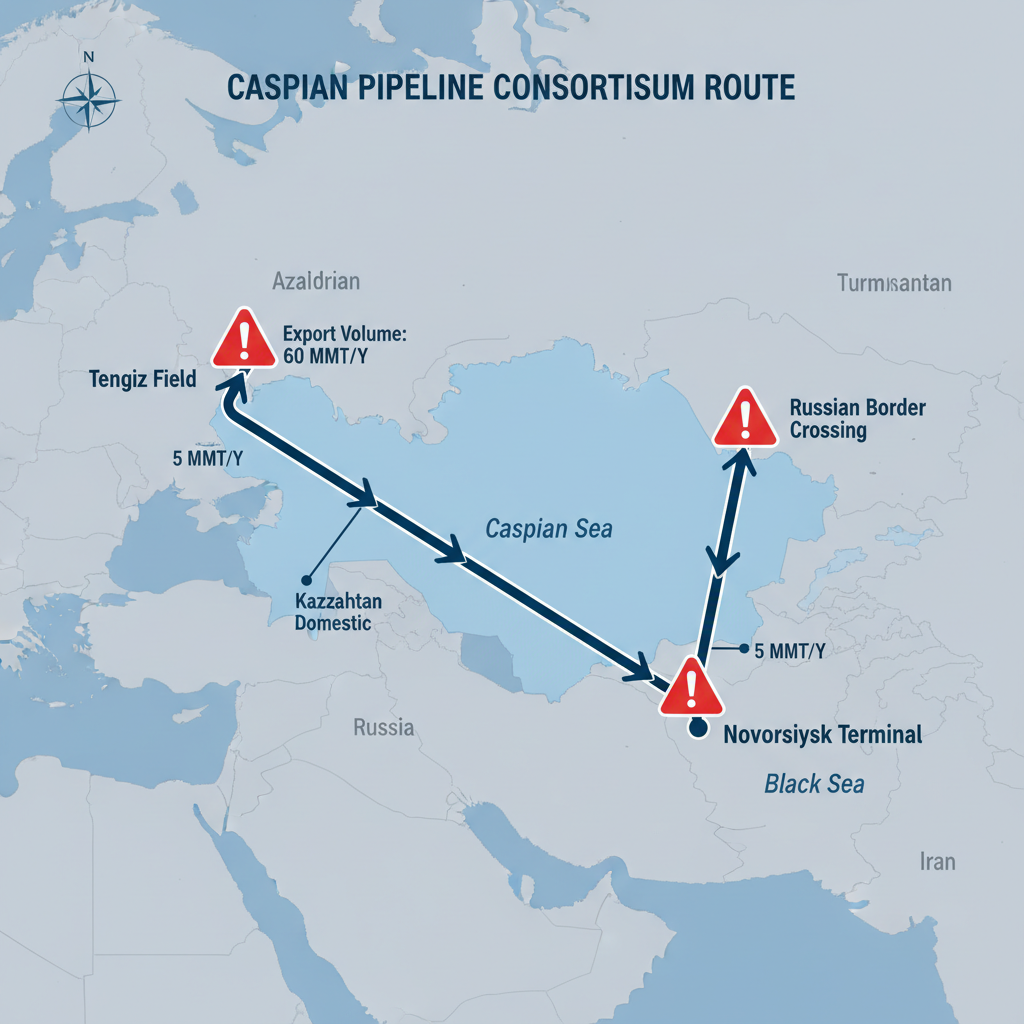
Kazakhstan learned this the hard way. The Caspian Pipeline Consortium terminal at Yuzhnaya Ozhereyevka near Novorossiysk handles roughly 80% of Kazakh crude exports — about 1.5 million barrels per day before the attacks. When Ukrainian drones hit two tankers in the approach channel on July 29, loadings stopped again. This was the second halt in a month. The first, in early July, cost Kazakhstan an estimated $200 million in lost export revenue over ten days.
The math is brutal. Kazakhstan produces around 1.9 million barrels per day. It consumes maybe 400,000. The rest has exactly three ways out: CPC through Russia, the Atyrau-Samara pipeline north to Russian ports, and the Atasu-Alashankou line east to China. All three run through someone else's territory. None is truly spare.
The Chinese bottleneck nobody talks about
China's energy security strategy gets plenty of attention. The Central Asia-China Gas Pipeline, running from Turkmenistan through Uzbekistan and Kazakhstan to Xinjiang, delivered 45.8 billion cubic meters in 2024. The Power of Siberia pipeline from Russia added another 31 bcm. Beijing loves to point at these lines as proof it has escaped the Strait of Hormuz.
What Beijing doesn't advertise is that Kazakhstan's oil route east is mostly Russian oil in transit.
The Atasu-Alashankou pipeline, which connects to the Kazakhstan-China crude line, has a design capacity of roughly 440,000 barrels per day. Actual throughput runs 220,000 to 240,000 barrels per day. Of that, about 200,000 barrels per day is Russian crude, shipped under a swap arrangement where Moscow delivers oil to Kazakh refineries in exchange for Kazakh-grade crude moving east.
Kazakh capacity on that line? Somewhere between 20,000 and 40,000 barrels per day.
The Russian Oil & Gas Monitor flagged this in August: even if Kazakhstan wanted to redirect volumes to China to escape the CPC vulnerability, it can't. The line has roughly 180,000 barrels per day of idle capacity, but that capacity is spoken for by Russian supply contracts. Kazakhstan's own crude is heavier, higher in sulfur, and doesn't meet the quality spec the Chinese refineries along that route are configured to process.
This is the quiet reality of Central Asian energy. The routes exist, but they were built by different countries for different purposes. Kazakhstan didn't build Atasu-Alashankou to diversify its own exports. It built it to monetize Russian transit fees.
Baku's opening
Azerbaijan sees the chaos and smells opportunity.
The Baku-Tbilisi-Ceyhan pipeline has run at roughly 80-85% capacity since 2022, shipping around 700,000 barrels per day of Azeri crude to the Mediterranean. But the BTC system was designed with spare capacity — the original design called for 1 million barrels per day. That unused 200,000+ barrels per day is what Baku is now marketing to Astana.
The pitch is simple: ship Kazakh crude by tanker across the Caspian to Baku, feed it into BTC, and bypass Russia entirely. Kazakhstan has actually done this before. In 2023, after Russia briefly shut CPC for "environmental violations" following Ukrainian drone strikes on Novorossiysk, Kazakhstan moved about 100,000 barrels per day through the Baku-Tbilisi-Ceyhan route via the Aktau port.
The problem is logistics. The Caspian tanker fleet is old, small, and mostly sanctioned. Kazakh crude moves from Aktau to Baku in 12,000-tonne tankers — there aren't enough of them. The current fleet can move maybe 150,000 barrels per day across the Caspian, and much of that capacity is already committed to moving Turkmen and Azeri cargoes.
Then there's the quality mismatch. BTC was built for Azeri Light, a sweet crude with API gravity around 34 degrees. Kazakhstan's Tengiz crude is similar — light, low-sulfur. But the blend that moves through the system matters to refiners in Italy, Germany, and France who have long-term contracts for Azeri Light. They didn't sign up for a Kazakh blend, even if the specs are close.
Jeff Gabel, an energy infrastructure analyst, called the potential Kazakhstan-Azerbaijan route "the biggest regional transformation of economic infrastructure in decades" in an August post. He's not wrong about the scale. But he's optimistic about the timeline. Moving meaningful volumes — say, 500,000 barrels per day — would require at least a $3 billion investment in new tankers, port upgrades at Aktau and Baku, and a dedicated pipeline spur from the Kazakh coast to the BTC system.
No one has signed that check yet.
The drone factor
The attacks near Novorossiysk weren't just about Ukraine. They signaled a new reality: the Black Sea is now a contested zone where energy infrastructure is a legitimate military target.
Ukraine has drone-launching capabilities that reach 1,000+ kilometers. Novorossiysk sits inside that envelope. The port of Supsa in Georgia, where the Baku-Supsa pipeline terminates, is also within range — though Georgia's neutrality makes it a less likely target. The BTC terminal at Ceyhan sits further away, roughly 1,500 kilometers from Ukrainian launch sites, outside current drone range.
This geographic reality is reshaping how Kazakhstan and Azerbaijan think about infrastructure security. DroneDiplomacy — the term Gabel used — isn't just about defense systems. It's about route selection based on vulnerability.
The Atyrau-Samara pipeline to Russia's Samara region, which feeds into the Transneft system and onward to Novorossiysk, is arguably more exposed than CPC itself. The line runs through the Volga region, which has seen repeated drone strikes on refineries in 2024 and 2025. Russia's own maritime exports from Novorossiysk are near record levels — roughly 2 million barrels per day — which means the port is both the most important energy outlet in the region and the most targeted.
For Kazakhstan, the drone threat creates a perverse incentive. Russia needs CPC operational because it needs the transit fees — CPC generates roughly $1.5 billion per year in Russian transit revenues. Moscow also needs the port for its own exports. So Russia has an interest in defending Novorossiysk. But Kazakhstan can't control the defense. It can only watch.
Turkmenistan's quiet hedge
Turkmenistan faces a different problem. Its gas exports go almost exclusively to China — about 35 bcm per year through the Central Asia-China pipeline, which accounts for roughly 40% of China's pipeline gas imports. There is no diversification story for Ashgabat. The TAPI pipeline to Afghanistan, Pakistan, and India remains a construction site with no completion date. The Trans-Caspian Gas Pipeline to Europe is still a proposal on paper.
What Turkmenistan has done instead is hedge its transit risk through pricing and volume flexibility. Ashgabat renegotiated its supply contracts with CNPC in 2024, reportedly linking prices to a basket of international benchmarks rather than the opaque formula used previously. The details are murky, but the direction is clear: Turkmenistan wants more money and more predictability from the China route, because it has no alternative.
The Central Asia-China pipeline is actually three parallel lines — Line A, B, and C — with combined capacity of 55 bcm per year. Line D, which would add another 30 bcm from Turkmenistan through Uzbekistan, Tajikistan, and Kyrgyzstan, has been announced repeatedly since 2013. It has never broken ground. The route crosses the Pamir Mountains and requires financing that neither Beijing nor Ashgabat seems willing to commit.
The transit state calculus
Every Central Asian country is now trying to figure out the same thing: how to become a transit state rather than a terminal state.
Kazakhstan wants to be the corridor for Russian goods to China and Chinese goods to Europe. The Middle Corridor — the trade route through the Caspian, Caucasus, and Turkey — is its best shot. Kazakhstan's portion of that route involves upgrading the ports of Aktau and Kuryk, which have a combined capacity of around 21 million tonnes per year. The country has allocated $4 billion through 2029 for port upgrades, rail electrification, and logistics hubs.
Azerbaijan wants to be the energy bridge between the Caspian and Europe. The Southern Gas Corridor, which delivers 10 bcm per year of Azerbaijani gas to Italy, Greece, and Bulgaria, is already operating. Baku has floated expanding that corridor to carry Kazakh or Turkmen gas, but the pipeline infrastructure — specifically the Trans Adriatic Pipeline, which has a capacity of 20 bcm per year — would need new compressor stations and additional financing.
Pakistan wants in too. The China-Pakistan Economic Corridor, which includes the Gwadar deep-water port, has been proposed as an outlet for Central Asian oil and gas. The numbers don't add up yet — the route would require a 1,000-kilometer pipeline through Afghanistan, which hasn't been built, and the security situation in Balochistan makes any energy project there a hard sell. But the aspiration is real.
The through-line is simple: in a region where every export route crosses at least one hostile or unreliable border, the countries that win are the ones that control the crossings.
Kazakhstan controls no crossings. It exports through Russia's ports, China's pipelines, and Azerbaijan's terminals. It has money — the sovereign wealth fund holds over $60 billion — but money doesn't buy geography.
The drone strikes at Novorossiysk were a reminder that geography still matters. Central Asia's energy future will be shaped not by new pipelines, but by who controls the existing ones. And for now, that's still Moscow, Beijing, and — increasingly — Baku.
메타데이터
- post_id
- f25b6b73ee9a
- slug
- central-asias-pipeline-map-redraws-as-china-azerbaijan-court-transit-roles-f25b6b73ee9a
- url
- https://medium.com/@thecentralasianpipeline/central-asias-pipeline-map-redraws-as-china-azerbaijan-court-transit-roles-f25b6b73ee9a
- canonical_url
- https://medium.com/@thecentralasianpipeline/central-asias-pipeline-map-redraws-as-china-azerbaijan-court-transit-roles-f25b6b73ee9a
- author_url
- https://medium.com/@thecentralasianpipeline
- status
- ok
- fetched_at
- 2026-08-22 12:17:47