Rerankers: The Highest ROI Precision Layer in RAG
Why strong retrieval systems optimise recall first and precision second
Rerankers: The Highest ROI Precision Layer in RAG
Why strong retrieval systems optimise recall first and precision second
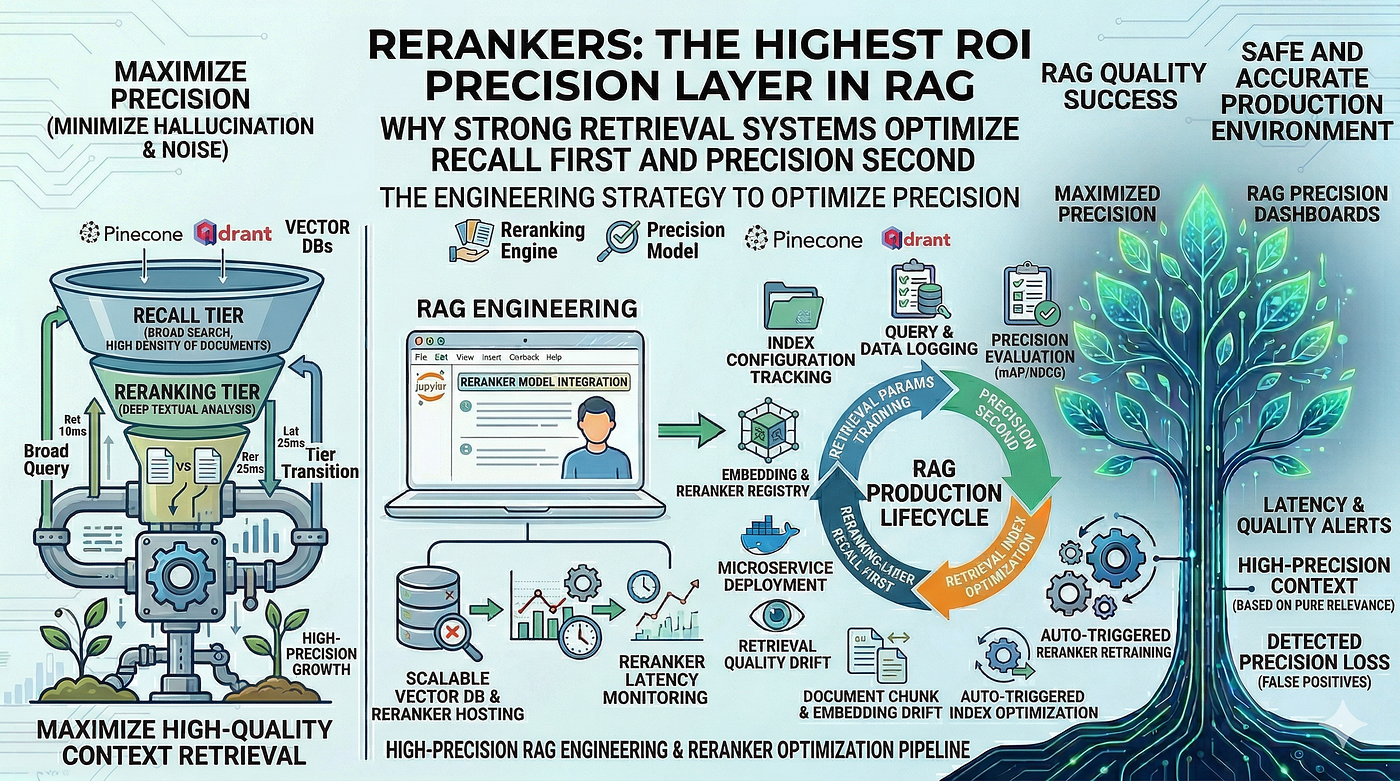
Once a Retrieval-Augmented Generation (RAG) system starts working reliably at scale, the next major quality bottleneck is rarely the language model.
It is usually the last-mile precision problem in retrieval.
A vector retriever can be excellent at broad semantic recall and still place the best evidence at rank 7, 11, or 19. The right document is technically present, but it misses the limited context window that finally reaches the model.
This is where many teams plateau. They improve embeddings, retune chunk sizes, or swap vector databases, yet answer quality still feels inconsistent.
The missing layer is often:
a reranker that converts high-recall candidates into high-precision evidence
This article explains why rerankers are often the highest return-on-investment (ROI) improvement in production RAG systems, especially once retrieval is already “good enough.”
We’ll cover:
- why retrievers plateau
- retriever vs reranker mental models
- cross-encoders explained
- top-20 truncation for latency
- MRR (Mean Reciprocal Rank)
- nDCG (Normalized Discounted Cumulative Gain)
- schema-aware reranking
- Text2SQL evidence prioritisation
- production serving optimisations
The goal is to make reranking feel less like a research add-on and more like a practical precision control layer for enterprise AI systems.
Why retrieval quality still fails after “good embeddings”
A common engineering misconception is:
better embeddings = solved retrieval
In practice, dense retrieval usually optimises for candidate recall, not final evidence ordering.
A typical top-10 result set might look like this:
1. partially relevant wiki page
2. exact schema join doc
3. deprecated policy chunk
4. similar product description
5. exact legal clause
The right evidence exists, but the ranking order is still noisy.
This becomes expensive in production because the language model only sees a small context budget, usually top 3–5 chunks.
So the real optimisation target is not:
“Did retrieval find it?”
It is:
“Did the best evidence make it into the final prompt window?”
That is the reranker’s job.
Retriever vs reranker: the production mental model
The easiest way to understand this layer is:
Retriever
Optimizes:
high recall under low latency
Goal:
do not miss relevant candidates
This is why we use:
- ANN (Approximate Nearest Neighbour)
- HNSW (Hierarchical Navigable Small World)
- IVF (Inverted File Index)
Reranker
Optimizes:
high precision on a small candidate set
Goal:
rank the most useful evidence first
This is usually slower but dramatically more accurate.
The strongest production pipeline is:
ANN retriever → top 50 recall
             ↓
cross-encoder reranker → top 5 precision
             ↓
LLM generation
This recall-first, precision-second architecture is the most reliable way to improve grounded generation quality.
What a cross-encoder reranker actually does
The most common reranker architecture is a cross-encoder.
Unlike a vector retriever that embeds query and documents independently, a cross-encoder jointly processes:
(query, document)
as one pair.
This allows the model to reason over fine-grained token interactions such as:
- exact table-column relationships
- negation
- temporal qualifiers
- legal wording nuances
- join path semantics
- subtle schema aliases
That token-level interaction is why rerankers often outperform retrievers so dramatically on final ordering.
A practical implementation using a widely used enterprise reranker:
from sentence_transformers import CrossEncoder

reranker = CrossEncoder(
    "BAAI/bge-reranker-large"
)
This model now becomes the precision layer after broad ANN recall.
Implementing reranking in production
A realistic reranking function looks like this:
def rerank(query: str, docs: list[str], top_k: int = 5):
    pairs = [(query, doc) for doc in docs]
    scores = reranker.predict(pairs)
    ranked = sorted(
        zip(docs, scores),
        key=lambda x: x[1],
        reverse=True
    )
    return ranked[:top_k]
This simple layer often produces a larger quality improvement than changing the base language model.
That is why rerankers have become one of the most effective production upgrades in enterprise RAG.
Top-20 truncation: the most important latency optimisation
Rerankers are powerful because they use deeper query-document interaction. The cost is latency.
A common mistake is reranking everything returned by the retriever.
At scale, that quickly becomes expensive because every candidate requires a transformer forward pass.
The production-safe optimization is:
rerank only the top 20 retriever candidates
This is called candidate truncation before precision scoring.
A practical implementation:
def rerank(
    query: str, docs: list[str],
    candidate_k: int = 20, inal_k: int = 5):
    candidates = docs[:candidate_k]
    pairs = [(query, doc) for doc in candidates]
    scores = reranker.predict(pairs)
    ranked = sorted(
        zip(candidates, scores),
        key=lambda x: x[1],
        reverse=True
    )
    return ranked[:final_k]
Why 20 works so well:
- most recall value is already captured
- latency remains bounded
- GPU batching stays efficient
- p95 remains predictable
This is one of the most important real-world reranking optimisations.
MRR and nDCG: how to measure reranker quality
Two small acronyms become very important here.
MRR — Mean Reciprocal Rank
This measures:
how early the first correct result appears
Higher MRR means the best evidence consistently appears near the top.
This is especially useful for:
- FAQ assistants
- support search
- single-answer workflows
nDCG — Normalised Discounted Cumulative Gain
This measures:
ranking quality across the whole ordered list
It rewards:
- highly relevant docs near the top
- moderately relevant docs lower down
- correct ordering quality overall
nDCG is often the stronger KPI for:
- enterprise RAG
- policy search
- legal discovery
- Text2SQL schema evidence
These metrics are far better than only tracking retrieval latency.
Why rerankers are especially powerful for Text2SQL
This is where reranking becomes a business-critical precision layer.
A query like:
“show total sales by region for last quarter”
may retrieve many similar schema chunks.
The reranker can prioritise exact join evidence such as:
sales_fact.region_iddim_region.region_namedate_dim.quarter
above vaguely similar sales documentation.
This directly reduces:
- wrong joins
- hallucinated columns
- incorrect filters
- aggregation mistakes
In practice, rerankers often create a measurable uplift in:
SQL execution success rate
which is one of the most business-facing quality metrics.
Schema-aware reranking: the staff-level optimisation
A powerful production extension is metadata-aware or schema-aware reranking.
Instead of relying only on the cross-encoder score, combine it with structured priors.
A realistic scoring strategy:
final_score = (
    rerank_score
    + schema_bonus
    + freshness_bonus
    - stale_penalty
)
This allows the system to favour:
- active schemas
- recent policies
- tenant-authorised docs
- exact table ownership
- high-trust document sources
This hybrid scoring layer is one of the strongest upgrades for enterprise retrieval quality.
Production serving optimizations that matter
Once rerankers enter the critical path, serving discipline becomes important.
The highest ROI optimisations are:
Batch inference
scores = reranker.predict(pairs, batch_size=16)This improves:
- GPU utilisation
- throughput
- amortised latency
Dynamic candidate windows
Not every query needs top 20.
Examples:
- simple FAQ → top 10
- ambiguous schema question → top 30
- legal clause search → top 40
This is called:
query-adaptive reranking windows
A very strong production optimization.
Result caching
Repeated enterprise queries often follow predictable patterns.
Cache:
*(query_hash, doc_ids) → reranked result*
This can significantly reduce p95 latency.
The production failure this layer prevents
Without reranking, the most common failure is:
the right evidence is retrieved but never reaches the prompt
This leads to:
- noisy citations
- wrong joins
- outdated policy references
- weaker grounding
- hallucination spikes
- inconsistent answers under the same query family
These are difficult failures because retrieval dashboards may still look healthy.
That is why reranking is often the difference between:
retrieval that works and retrieval that is trustworthy
Final takeaway
Once retrieval recall is reasonably strong, rerankers often become the highest ROI precision upgrade in the entire RAG stack.
The most important mindset shift is:
retrievers are optimised to not miss evidence; rerankers are optimized to make the best evidence impossible to ignore
That distinction is what transforms a decent retrieval system into a production-grade grounding pipeline.
Next in the series
Article 6: Secure RAG — Authorisation-Aware Retrieval and Row-Level Security
We’ll move deeper into:
- unauthorised chunk leakage
- metadata filters before ANN
- tenant-aware retrieval
- RBAC (Role-Based Access Control)
- RLS (Row-Level Security)
- secure reranking boundaries
- enterprise permission leak prevention
메타데이터
- post_id
- f267c826ebff
- slug
- rerankers-the-highest-roi-precision-layer-in-rag-f267c826ebff
- url
- https://medium.com/@photokheecher/rerankers-the-highest-roi-precision-layer-in-rag-f267c826ebff
- canonical_url
- https://medium.com/@photokheecher/rerankers-the-highest-roi-precision-layer-in-rag-f267c826ebff
- author_url
- https://medium.com/@photokheecher
- status
- ok
- fetched_at
- 2026-07-10 09:52:19