Sri Lanka does not have a dengue problem. It has a dengue plateau.
Fifteen years of the same numbers, the same hospitals filling up in June, the same conversations on the same WhatsApp groups. A research…
Sri Lanka does not have a dengue problem. It has a dengue plateau.
Fifteen years of the same numbers, the same hospitals filling up in June, the same conversations on the same WhatsApp groups. A research note on why the plateau is structural, and the cheapest meaningful intervention left.
Every June my phone fills up with the same conversation. Someone’s child has been waiting eight hours for a hospital bed. Someone’s platelets are crashing. Someone has been told to come back in the morning because there is no room.
What is not always said out loud is that this is roughly on schedule.
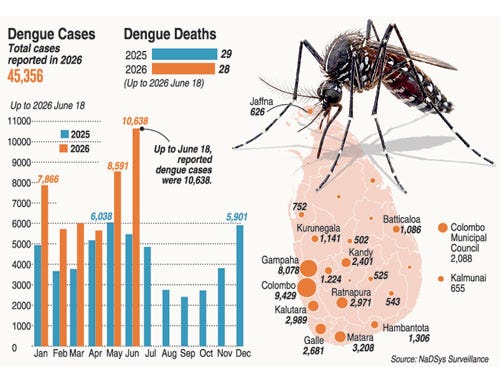
Sri Lanka’s reported dengue incidence has sat between 300 and 400 cases per 100,000 population every single year since 2009. The national target is closer to 100. We have spent fifteen years three to four times above target, through every government, every outbreak, the COVID interruption, and a steady increase in vector control spending. By mid-June 2026, the country had already crossed 44,000 cases for the year, with 28 deaths. That is normal now.
Sri Lanka does not have a dengue problem. It has a dengue plateau, and a plateau is a different kind of problem. A problem can be solved by doing more of what you are already doing. A plateau means what you are doing has reached its ceiling. I want to argue, in this note, that we have hit ours, that the reason is structural, and that there is one relatively cheap thing left worth trying.
Why the plateau is not the PHI’s fault
The 2017 epidemic year cost the government an estimated US$12.7 million in direct expenditure on dengue control alone [1]. Combined vector control and vaccination spending has been put as high as US$28.95 million annually in some assessments [2]. None of this is wasted in any obvious sense. The Public Health Inspectors are inspecting. The larviciding is happening. The fogging is happening. The community clean-up drives are happening, sometimes with real community energy behind them. The country has a National Action Plan [3], a dedicated National Dengue Control Unit at the Ministry of Health, and a surveillance system that compares well with most of its regional peers.
What it does not have is a downward trend. The conventional toolkit is being squeezed from three sides at once.
Biologically, the chemistry we have been spraying for over a decade is wearing out. A 2024 study in Parasites & Vectors monitored insecticide resistance in Aedes aegypti across the country and found low mortality from both permethrin (between 10 and 89 per cent, depending on site) and deltamethrin (40 to 92 per cent) [4]. The kdr 1534C allele, which confers pyrethroid resistance, was present in surveyed populations at frequencies between 0.05 and 0.80 in 2017, a substantial jump from 2015 samples [5]. There is no biological reason to expect that trend to reverse on its own.
Operationally, PHIs typically deploy after cases have been notified in their area. By the time the household inspection happens, transmission is usually already established. There are also whole categories of breeding sites that ground inspections rarely reach. Rooftop water tanks on three-storey houses in Wellawatte. Underground rainwater reservoirs in older Colombo properties. Standing water inside scaffolded construction sites. Blocked drainage on the upper floors of mid-rise apartments. These are well-documented Aedes aegypti habitats. They are not visible from the street.
Climatically, the seasonal calendar that IVM operations are built around is becoming a poorer guide every year. Sri Lankan machine learning studies have repeatedly identified minimum temperature at a five-week lag as the single best climatic predictor of dengue outbreaks [6]. The monsoons are shifting in intensity and timing. After Cyclone Ditwah in late 2025, large parts of the Western Province had standing water in places that were not normally breeding sites, and the 2026 caseload reflects that.
Take these together and the plateau makes sense. The instrument is not broken. It is just mismatched to the problem the country now has.
What technology can and cannot honestly do
I want to be careful here. There is a fashion for saying “AI” in a sentence about any health problem in any low-or-middle-income country, and that fashion is annoying and usually wrong.
No machine learning model will reduce dengue in Sri Lanka. The reduction, if it happens, will happen because PHIs visited the right premises at the right time, because households emptied a tyre that would have bred mosquitoes, because a sterile-insect release went out a fortnight before peak transmission. The technology question is narrower. It is whether those decisions can be made with better information.
On that narrower question, three technology streams have matured to a useful point.
Climate-driven forecasting is the first. Researchers at the University of Peradeniya and elsewhere have shown that ML models trained on weather data, satellite-derived vegetation indices and historical case counts can predict outbreak weeks in Sri Lankan districts with usable accuracy and a lead time of three to four weeks [7]. A NASA-affiliated graph neural network study reported similar results across all 25 districts. The data is mostly free. Running such models on commodity cloud costs in the low thousands of US dollars per month.
Computer vision on satellite, drone and street-level imagery is the second. A 2024 paper in Scientific Reports used object detection on satellite and Street View imagery in Rio de Janeiro to map breeding micro-habitats (water tanks, exposed tyres, plastic containers, storm drains) at a resolution far finer than any door-to-door inspection could produce, and found significant correlations with ovitrap-measured infestation [8]. Drone surveys of rooftop containers in Tapachula, Mexico [9], and in Dongguan, China [10], have shown that UAVs detect breeding sites ground inspections miss, especially in dense urban housing. Sentinel-2 imagery is free. Consumer drones are commodity equipment. The intellectual work sits in the trained models, which can be open-sourced and re-trained locally.
Real-time entomological surveillance is the third. IoT smart ovitraps with embedded neural networks now achieve 91 to 97 per cent accuracy in distinguishing Aedes from other mosquito species, and stream results to cloud dashboards continuously [11]. Combined with a citizen reporting channel, this turns the current periodic, sample-based entomological survey into something closer to a live signal.
What these three have in common is that they amplify the existing workforce rather than replace it. The PHI is still the last mile. The question is whether the PHI is being pointed at the right premises at the right time.
The precedent nobody talks about enough
Between 2022 and 2024, a team in Gampaha conducted a Sterile Insect Technique trial against Aedes albopictus over a 30-hectare release area. Over 33 weeks they released 3.3 million radiation-sterilised males. The trial achieved 98 per cent induced sterility in mosquito eggs and a sustained suppression effect for 13 weeks after releases ended [12].
That is at the upper end of what SIT has achieved anywhere in the world, and it happened in our climate, against our vector, with our researchers. I find it striking how little public conversation this has had outside the vector control community. The biology works. What does not yet exist is the operational system that could decide where else, and when, similar releases should happen. The Gampaha trial was a research project, not a national programme. The gap between proven biology and the absence of a targeting system is, in my view, the gap a national platform should be designed to close.
PRISM: Predict, Reveal, Inform, Suppress, Measure
The platform I want to propose is deliberately minimal, and built mostly on open source. I have called it PRISM-Dengue in a longer concept note. Five layers, each named for what it does. None of them is individually novel. The work is in stitching them together for this country.
Predict ingests climate data from the Department of Meteorology, satellite-derived environmental data from NASA POWER and Sentinel-2, and dengue surveillance data from the NDCU. It produces weekly outbreak-risk forecasts at MOH-area resolution, three to four weeks out.
Reveal runs computer vision on satellite imagery, periodic drone surveys of high-density urban zones, and crowdsourced street-level photos to map breeding micro-habitats that ground surveys miss.
Inform is the two-way information layer. An Android application pushes prioritised daily tasks to PHIs. A citizen reporting channel through WhatsApp and SMS pulls geo-tagged reports back, with on-device classification to filter noise. An anonymised public dashboard, aggregated to street-cluster level rather than household, gives CSOs, ward councillors and journalists a shared view of where risk is rising.
Suppress is the field intervention layer. AI-prioritised PHI inspections. Targeted source reduction campaigns. Most importantly, this is where Gampaha-style SIT releases get scheduled where the Predict layer says they should, turning a research success into an operational lever. The deliberate intent is to reduce dependence on pyrethroids, not increase it.
Measure is the evaluation and accountability layer. A pre-registered protocol, an independent academic evaluator, model performance monitoring, cost-per-case-averted accounting, and an open-data release at month 18. Without this layer, the rest is just another tool launched and forgotten.
A 12-month pilot in two MOH areas, one in Colombo MC and one in Gampaha, would cost roughly US$450,000. That is around 3.5 per cent of what the country spent on dengue control during the 2017 epidemic year. A national scale-up across 25 districts over 36 months is costed at around US$2.7 million. The target cost-per-case-averted at national scale is under US$100. For comparison, Wolbachia replacement programmes in lower-middle-income settings have been priced at roughly US$1,500 per DALY averted [13][14]. Modelled estimates for genetic methods range as low as US$2 to US$30 per case averted in favourable scenarios. A coordination and targeting platform should land between these benchmarks, and probably nearer the cheaper end.
Why this configuration before the obvious alternatives
Sri Lanka could scale up Wolbachia, as Singapore and parts of Colombia and Brazil have done. It could operationalise the Gampaha SIT trial into something national. It could buy into the second-generation dengue vaccines now in late-stage trials. I think we should do all three, in time. There are two reasons to start with the integration layer.
One is that none of those interventions works in a vacuum. Wolbachia releases need to happen in the right places at the right time. SIT requires the same. Mass vaccination needs to be aimed at populations where transmission is rising. Without a targeting and forecasting system, each tool wastes a meaningful share of its effect.
The other is cost. The integration layer is the cheapest of the available bets. It uses data the state already collects. It uses workforce the state already pays. It uses satellite imagery and climate data that are free. The marginal investment is in software, training and a small team. If it works, it makes every subsequent intervention more efficient. If it does not, the country has lost less than 4 per cent of one epidemic year’s spend, and gained a published evaluation that the region currently lacks.
The honest difficulties
There is no point pretending implementation is easy. Three classes of problem will determine whether this works.
Inter-agency data sharing comes first. NDCU, the Department of Meteorology, the Survey Department, municipal councils, and the Information and Communication Technology Agency all hold pieces of what a forecasting model needs. None of them currently shares data with the others on a routine, machine-readable basis. ICTA is the natural integrator, but the MOUs will take months of patient work.
Workforce adoption is the second. The Mo-Buzz pilot, a mobile dengue surveillance system trialled in Colombo in the mid-2010s, saw initial PHI uptake of under 10 per cent. After training and supervisor incentives, uptake climbed to 76 per cent [15]. That number is the baseline we should plan around. The Inform layer has to demonstrably save PHIs time in their first month of use. If it does not, it will not be used in the second.
Privacy and trust is the third. Geolocated household-level dengue data is sensitive. The public dashboard has to aggregate to street-cluster level, never household. A formal Data Protection Impact Assessment, with Ministry of Health Ethics Review Committee oversight, has to come before launch, not after.
None of these are reasons not to do it. They are the work of doing it well.
The ask
This piece is not a funding pitch dressed up as analysis. But the practical ask is small. A 12-month pilot. US$450,000. Two MOH areas. An independent academic evaluator. An open-source release of all code and models. A public dashboard from day one.
If the pilot does not produce a measurable reduction in container index and case incidence relative to matched controls, the country has lost a modest sum and gained a published evaluation, which is itself useful for the region.
The reason to try this now is that the biology and the climate are not going to give Sri Lanka another fifteen years to figure it out. The plateau we have been looking at is not a stable state. It is the current equilibrium between an ageing toolkit and a vector that is adapting faster than we are.
Read full paper: https://zenodo.org/records/20807292
References
[1] Tissera, H. et al. Severe Dengue Epidemic, Sri Lanka, 2017. Emerging Infectious Diseases, CDC. https://wwwnc.cdc.gov/eid/article/26/4/19-0435_article
[2] Perera, C. et al. Evaluating the economic burden of dengue in Sri Lanka: A systematic review of costs from 2010 to 2024. https://pmc.ncbi.nlm.nih.gov/articles/PMC12887775/
[3] Ministry of Health, Sri Lanka. National Action Plan for Prevention and Control of Dengue in Sri Lanka 2019–2023. https://www.health.gov.lk/wp-content/uploads/2022/09/x5_Dengue_National-Action-Plan.pdf
[4] Fernando, S.D. et al. Fine-scale monitoring of insecticide resistance in Aedes aegypti from Sri Lanka. Parasites & Vectors, 2024. https://parasitesandvectors.biomedcentral.com/articles/10.1186/s13071-023-06100-9
[5] Karunaratne, S.H.P.P. et al. Resistance to commonly used insecticides and underlying mechanisms of resistance in Aedes aegypti from Sri Lanka. Parasites & Vectors. https://parasitesandvectors.biomedcentral.com/articles/10.1186/s13071-020-04284-y
[6] Withanage, G.P. et al. A forecasting model for dengue incidence in the District of Gampaha, Sri Lanka. Parasites & Vectors. https://link.springer.com/article/10.1186/s13071-018-2828-2
[7] Prediction of Dengue Outbreaks in Sri Lanka Using Machine Learning Techniques. https://sljm.sljol.info/articles/568/files/68060c4a7bc38.pdf
[8] High-resolution mapping of urban Aedes aegypti immature abundance through breeding site detection based on satellite and street view imagery. Scientific Reports, 2024. https://www.nature.com/articles/s41598-024-67914-w
[9] Field Effectiveness of Drones to Identify Potential Aedes aegypti Breeding Sites in Household Environments from Tapachula, Mexico. https://www.ncbi.nlm.nih.gov/pmc/articles/PMC8396529/
[10] Unmanned Aerial Vehicle Surveillance of Rooftop Aedes Breeding Sites Before Dengue Season, Dongguan City, 2024–2025. China CDC Weekly. https://weekly.chinacdc.cn/en/article/doi/10.46234/ccdcw2026.049?viewType=HTML
[11] An IoT-based smart mosquito trap system embedded with real-time mosquito image processing by neural networks for mosquito surveillance. Frontiers in Bioengineering and Biotechnology, 2023. https://www.frontiersin.org/journals/bioengineering-and-biotechnology/articles/10.3389/fbioe.2023.1100968/full
[12] Gunawardena, Y.I.N.S. et al. Suppression of Aedes albopictus in Sri Lanka using the Sterile Insect Technique with a sustained effect. https://www.ncbi.nlm.nih.gov/pmc/articles/PMC12443424/
[13] Soh, S. et al. Economic impact of dengue in Singapore from 2010 to 2020 and the cost-effectiveness of Wolbachia interventions. PLOS Global Public Health. https://journals.plos.org/globalpublichealth/article?id=10.1371/journal.pgph.0000024
[14] The cost-effectiveness of Wolbachia-based biocontrol interventions for dengue: A scoping review. PLOS Neglected Tropical Diseases. https://journals.plos.org/plosntds/article?id=10.1371/journal.pntd.0014395
[15] Lwin, M.O. et al. Lessons From the Implementation of Mo-Buzz, a Mobile Pandemic Surveillance System for Dengue. https://pubmed.ncbi.nlm.nih.gov/28970191/
메타데이터
- post_id
- f272eb757ddd
- slug
- sri-lanka-does-not-have-a-dengue-problem-it-has-a-dengue-plateau-f272eb757ddd
- url
- https://medium.com/@anjulaweeranayake/sri-lanka-does-not-have-a-dengue-problem-it-has-a-dengue-plateau-f272eb757ddd
- canonical_url
- https://medium.com/@anjulaweeranayake/sri-lanka-does-not-have-a-dengue-problem-it-has-a-dengue-plateau-f272eb757ddd
- author_url
- https://medium.com/@anjulaweeranayake
- status
- ok
- fetched_at
- 2026-07-09 20:10:33