The Emoji That Decides Whether Society Trusts You
How a Simple Digital Symbol Could Become the Interface for Reputation, Access, and Algorithmic Control
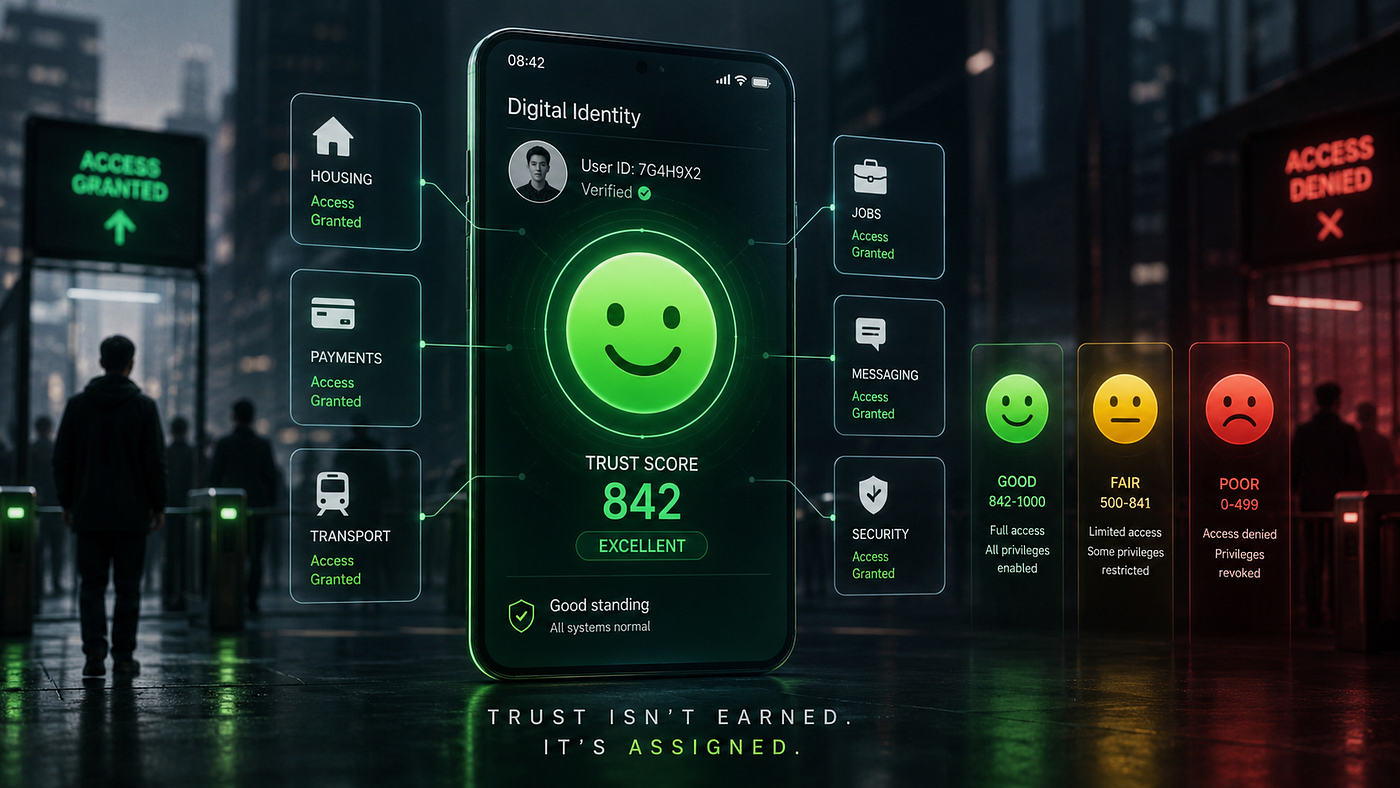
The Emoji That Decides Whether Society Trusts You
How a familiar digital symbol could become the interface for an invisible social-credit system
Imagine opening a rental application, dating profile, employment platform, banking app, or government-services portal and seeing one symbol beside your name:
🟢
No numerical score. No written explanation. Just a green circle indicating that you are considered reliable.
Someone else receives:
🟡
Another person sees:
🔴
The symbols appear harmless. They resemble the status indicators already used in messaging applications, traffic systems, video games, security dashboards, and online marketplaces.
But beneath each emoji could be an extensive behavioral profile assembled from payment history, customer reviews, identity verification, legal records, platform violations, location data, employment activity, purchasing behavior, communication patterns, and algorithmic predictions.
The emoji would not be the social-credit system itself.
It would be its interface.
And that distinction may make an emoji-based social-credit system more plausible—and potentially more powerful—than the dramatic numerical scores portrayed in dystopian fiction.
Society Already Scores People
Social scoring is not a completely futuristic concept. Modern institutions routinely convert complicated human behavior into simplified measurements.
Credit bureaus measure financial risk. Insurance companies classify policyholders. Employers rank applicants. Schools grade students. Online marketplaces rate buyers and sellers. Social platforms assign verification marks, trust indicators, moderation strikes, and account-status labels.
Uber, for example, uses mutual ratings to influence trust between riders and drivers. Driver ratings are calculated from recent passenger evaluations, and drivers may be required to remain above locally determined thresholds to retain platform access.
Airbnb similarly uses reviews, ratings, check marks, warning icons, and behavioral feedback to help hosts evaluate potential guests. Its policies state that ratings may affect Instant Book eligibility, experienced-guest status, platform enforcement, search visibility, and continued participation.
These systems are not equivalent to a government-controlled national social-credit program. They are generally restricted to particular transactions and platforms.
Nevertheless, they establish an important principle:
A reputation signal can determine access.
A low rating may affect whether someone can drive for income, rent accommodations, sell products, receive favorable terms, or participate in a digital community.
An emoji could consolidate those signals into something even simpler.
Why an Emoji Would Be So Effective
Emoji are already a nearly universal form of digital shorthand.
Research describes emoji as pictographic communication that adds emotional, interpersonal, and contextual information to written language. They can communicate approval, warning, identity, uncertainty, humor, anger, safety, or urgency without requiring a complete sentence.
Unicode classifies emoji as standardized pictographic characters, although their precise visual appearance may vary across devices and vendors.
This makes emoji particularly suited to reputation systems for four reasons.
- They are instantly readable
A five-digit score requires interpretation. A red warning symbol does not.
Consider the difference:
Trust score: 573
versus:
⚠️ Restricted
The second signal creates an immediate emotional reaction, even when the viewer has no idea how the classification was calculated.
- They compress complicated information
An algorithm may evaluate hundreds of variables, but the user sees only one symbol.
A green circle could mean:
- identity verified;
- payments current;
- no recent policy violations;
- positive transaction history;
- low predicted risk.
A red circle could represent an entirely different mixture of circumstances:
- disputed debt;
- inaccurate identity matching;
- recent criminal allegations;
- poor customer reviews;
- suspicious account activity;
- behavioral predictions;
- association with flagged accounts.
The symbol compresses all of this into a single visual judgment.
- They appear neutral
Words such as untrustworthy, dangerous, or high risk sound accusatory.
An emoji appears softer.
A platform could claim that it is merely showing a “status indicator,” even when the status materially affects housing, employment, transportation, credit, or access to public services.
- They encourage social conditioning
People quickly learn what symbols unlock opportunities.
If 🟢 receives faster service, lower deposits, better employment access, and fewer identity checks, users will modify their behavior to preserve it.
The system would not need to issue explicit orders. It could govern through incentives, friction, visibility, and fear of losing status.
What the Emoji System Could Look Like
A basic model might use five classifications:
🟢 Good Standing
The person has verified information, acceptable transaction history, no significant unresolved violations, and access to normal privileges.
🔵 Verified
The person’s identity has been confirmed, but the system has insufficient behavioral data to assign a broader reputation classification.
🟡 Limited or Under Review
The person has disputed information, unusual account activity, limited history, or an unresolved review.
🟠 Restricted
Certain services require additional verification, deposits, supervision, or approval.
🔴 High Risk or Suspended
The person is denied particular services or temporarily excluded from the system.
A more sophisticated version could display several contextual symbols:
- 💳✅ reliable payment history;
- 🏠✅ positive rental history;
- 🚗⚠️ transportation violations;
- 💬⚠️ communication complaints;
- 🪪✅ verified identity;
- ⚖️🔄 legal information under review;
- 🔒 private or protected profile;
- ⏳ temporary status awaiting reassessment.
This would create a form of visual reputation grammar. Each emoji would communicate a category, while combinations would construct a broader social identity.
The concept resembles a digital coat of arms—but generated by databases rather than inherited from a family.
China’s Social-Credit System Is More Complicated Than the Popular Myth
Any discussion of social credit usually turns to China. However, the Chinese system is frequently mischaracterized as a single artificial-intelligence engine that continuously gives every citizen one universal numerical score.
Research and legal analyses indicate that the actual structure is more fragmented. It includes government regulatory records, sector-specific blacklists and redlists, financial credit reporting, corporate compliance systems, local pilot programs, and commercial reputation products. It is better understood as an ecosystem of related initiatives than as one unified science-fiction score.
That distinction matters.
A future emoji-based system would not necessarily require one centralized database. It could operate through interoperability.
A housing platform might contribute rental status. A payment processor might contribute transaction reliability. A transportation provider might report violations. A government agency might contribute licensing or court information. An identity service might provide verification.
The emoji could then act as the shared output of many disconnected systems.
In other words, the most realistic social-credit infrastructure may not resemble one enormous government computer. It may resemble hundreds of ordinary databases communicating through standardized trust signals.
Research on Chinese local models also illustrates how scoring frameworks can extend beyond clear violations of law into moral or social classifications. A Stanford analysis of one local “national model” program found hundreds of rules that rewarded or penalized different forms of behavior, including conduct outside traditional financial credit reporting.
The lesson is not that every reputation system inevitably becomes authoritarian. The lesson is that once institutions build a mechanism for classifying trustworthiness, the definition of “trustworthy behavior” can expand.
The Most Dangerous Feature Would Be Context Collapse
A person can be reliable in one context and unreliable in another.
Someone may have missed credit-card payments but be an excellent employee.
Someone may have poor customer-service ratings because of discrimination, disability, language barriers, or a single hostile interaction.
Someone may have a criminal record that is decades old.
Someone may have been incorrectly identified by an automated fraud-detection system.
Someone may have violated the rules of one platform without presenting any meaningful risk to another.
A universal emoji would erase these distinctions.
This is known conceptually as context collapse: information created for one environment is applied in another environment where it may not be relevant or fair.
A low passenger rating could influence housing.
A disputed bill could influence employment.
An online argument could affect financial access.
A person’s friends, relatives, customers, or digital associations could influence how the system categorizes them.
The problem is not merely that the database could contain incorrect information. It is that correct information could be used for the wrong purpose.
The Emoji Could Become More Powerful Than the Explanation
Human beings naturally react to visual signals.
Green means proceed. Red means stop. A check mark indicates approval. A warning triangle indicates danger. A lock indicates restriction.
Once a reputation emoji becomes familiar, viewers may stop asking what produced it.
A landlord may see 🔴 and reject an applicant.
An employer may see 🟡 and select someone else.
A customer may see ⚠️ and cancel a transaction.
A police officer, security guard, teacher, banker, or medical administrator may subconsciously interpret the symbol as evidence about the person’s character.
The symbol would begin to function as a digital stigma.
This is particularly concerning because emoji meanings are not always stable. Interpretation can vary across cultures, generations, platforms, and visual designs. Research has repeatedly examined emoji ambiguity, semantic variation, and the possibility of miscommunication.
A symbol simple enough to be understood instantly may also be too simple to communicate the truth.
Artificial Intelligence Would Make the System More Dynamic
Traditional scores usually rely on fixed formulas and defined historical data.
An AI-based reputation engine could go further.
It could analyze:
- language and sentiment;
- social-network relationships;
- transaction patterns;
- behavioral anomalies;
- images and video;
- location history;
- predicted rule violations;
- identity inconsistencies;
- similarities to previously flagged users.
The resulting emoji could change in real time.
A person might begin the day as 🟢, become 🟡 after an automated fraud alert, and become 🔴 before being given an opportunity to challenge the evidence.
This creates several technical and ethical problems:
Opacity: The person may not understand why the status changed.
Automation bias: Employees may trust the system more than contradictory human evidence.
Feedback loops: A restricted person receives fewer opportunities, producing data that appears to justify continued restriction.
Proxy discrimination: Seemingly neutral variables may correlate with race, income, neighborhood, disability, age, or other protected characteristics.
Data contamination: Incorrect information from one source may spread throughout connected systems.
Behavioral conformity: People may avoid lawful but unpopular activities because they fear algorithmic consequences.
The National Institute of Standards and Technology identifies validity, reliability, transparency, explainability, privacy, accountability, safety, and the management of harmful bias as central characteristics of trustworthy AI.
An unexplained reputation emoji would fail many of those principles unless the underlying system offered meaningful transparency and recourse.
Europe Has Already Drawn a Legal Boundary
The European Union’s AI Act prohibits certain forms of AI-based social scoring when they lead to detrimental or unfavorable treatment that is unrelated or disproportionate to the context in which the data was generated.
The European Commission identifies social scoring among the AI practices prohibited under the Act because of their potential to undermine fundamental rights and European values.
This does not mean that every credit score, fraud assessment, platform rating, or risk classification is prohibited. Context-specific scoring systems may remain lawful, particularly when governed under other legal frameworks.
The important principle is proportionality.
A system should not convert unrelated behavior into a universal judgment about someone’s eligibility, credibility, or social worth.
That is precisely the risk an emoji-based social-credit identity would create.
Could an Ethical Version Exist?
A narrowly designed reputation symbol could provide useful information.
A verified-payment symbol might reduce marketplace fraud. A temporary safety warning could protect users from an actively compromised account. A professional-license indicator could confirm that someone is qualified to perform regulated work.
The ethical dividing line would depend on how the symbol is designed and used.
A defensible system would need several safeguards.
It must be contextual
A transportation rating should remain within transportation unless there is a legally justified reason to use it elsewhere.
It must disclose its meaning
A person viewing an emoji should be able to see the factors, evidence, dates, and rules behind it.
It must allow correction and appeal
Users must be able to dispute incorrect data, submit context, and receive a review by someone with authority to reverse the decision.
It must expire
Minor violations should not become permanent digital identities.
It must distinguish allegations from findings
An unresolved complaint cannot be treated as equivalent to a verified violation.
It must limit visibility
A reputation indicator should only be shown to parties with a legitimate need to see it.
It must avoid protected and irrelevant data
Health conditions, political activity, personal relationships, religion, disability, and lawful expression should not become hidden reputation variables.
It must preserve human judgment
The emoji should never substitute for individualized evaluation when housing, employment, education, liberty, healthcare, or essential services are at stake.
The Real Power Is Not the Score. It Is the Symbol.
A traditional social-credit score looks bureaucratic. It reminds people that they are being measured.
An emoji feels natural.
That is why it could be more influential.
People already use visual symbols to decide whether a message is safe, an account is authentic, a driver is dependable, a seller is reputable, or a payment has been approved. An emoji-based system would extend that visual logic from individual transactions to the person.
The transformation could happen gradually.
First, the emoji means “identity verified.”
Then it means “trusted user.”
Then it affects transaction limits.
Then it affects platform access.
Then companies begin sharing it.
Eventually, the symbol stops describing what someone did and begins defining who the system believes they are.
The central question is therefore not whether technology can reduce a human reputation to an emoji.
It can.
The question is whether society will recognize the moment when a convenient status indicator becomes a portable judgment of human worth.
Because once an emoji determines who receives access, opportunity, credibility, and freedom, it is no longer decorative language.
It is governance.
메타데이터
- post_id
- f28554ddb478
- slug
- the-emoji-that-decides-whether-society-trusts-you-f28554ddb478
- url
- https://medium.com/@czanstkek/the-emoji-that-decides-whether-society-trusts-you-f28554ddb478
- canonical_url
- https://medium.com/@czanstkek/the-emoji-that-decides-whether-society-trusts-you-f28554ddb478
- author_url
- https://medium.com/@czanstkek
- status
- ok
- fetched_at
- 2026-08-01 07:12:28




