Covert Narcissism and the Ethics of Existential Freeloading: How Some People Consume Emotional…
I used to think the people who hurt me most in life were the loud ones.
Covert Narcissism and the Ethics of Existential Freeloading: How Some People Consume Emotional Labor, Creative Energy, and Resources While Performing Intellectual Superiority

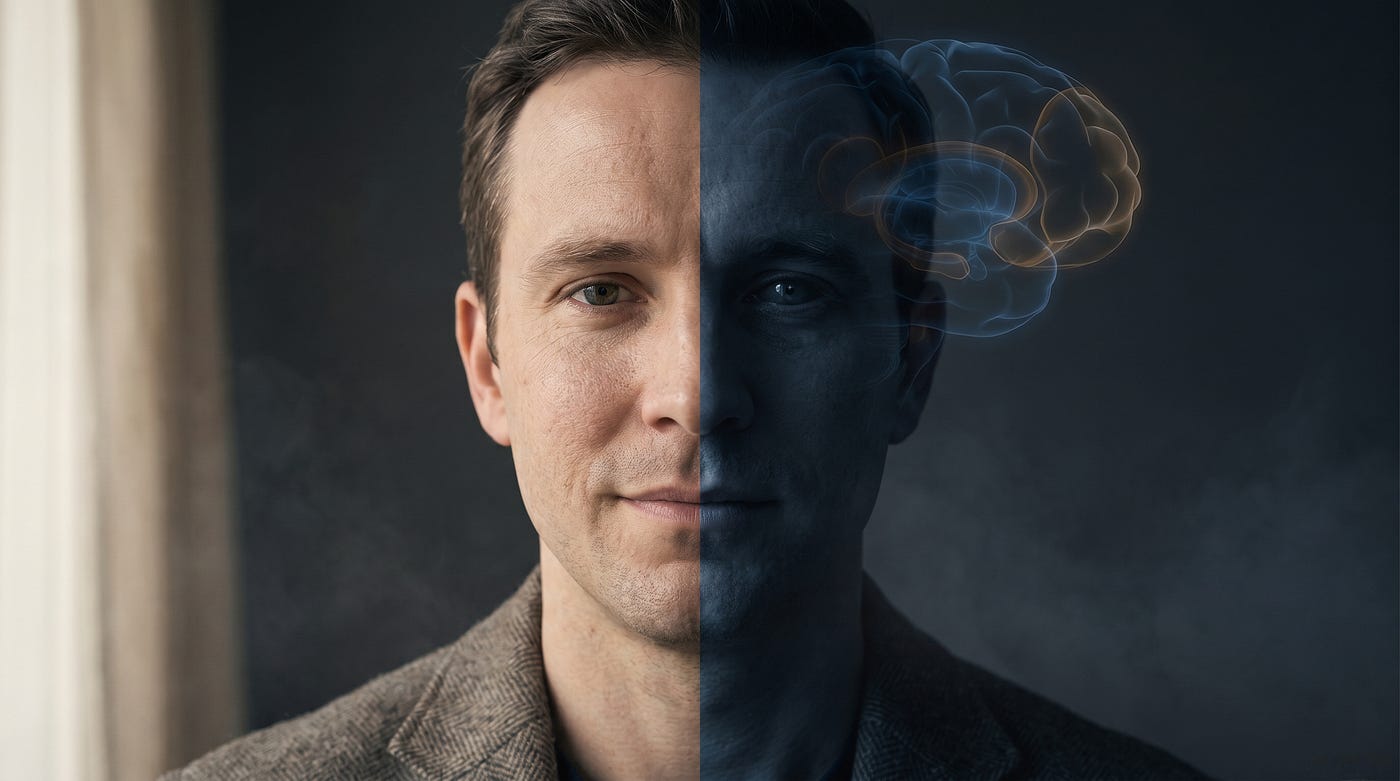
Image is generated via Chat Gpt 2.0 Model.
I used to think the people who hurt me most in life were the loud ones.
The screamers. The credit-stealers. The bosses with no filter. The ex who slammed doors. I prepared for those people the way you prepare for bad weather. You can see them coming.
It took me almost a decade to understand that the people who quietly emptied me were never loud. They were soft-voiced. They were “deeply sensitive.” They were “just going through a hard time.” They were “smarter than the room” and a little misunderstood. They never asked for anything outright. They didn’t have to. By the time I noticed, I had already been feeding them my time, my ideas, my warmth, my certainty, my creative output, and the residue of my nervous system for years.
Nobody had a word for what they were doing.
So I’ll give it one here.
I call it existential freeloading.
And the people who do it most efficiently are not the loud narcissists you were warned about as a teenager. They are the covert ones. The cerebral ones. The “I’m not like other people” ones. The ones who consume your entire life force while quietly performing intellectual superiority over you, as if the act of being absorbed by them was a privilege you should be grateful for.
This article is about how that machine works.
It is also about why nobody talks about it.
The Word “Narcissist” Stopped Meaning Anything, So Let Me Redefine It
I want to be honest with you. The word “narcissist” has been so abused on the internet that most people now use it to mean “anyone who hurt my feelings.” That’s not what I’m doing here.
Clinical and personality research distinguishes between two main flavors: grandiose narcissism, which is loud, entitled, openly self-impressed; and vulnerable (or covert) narcissism, which is quiet, brittle, hyper-sensitive, and rotates around an inner conviction of being secretly special and chronically misunderstood.
Both share a core ingredient: entitlement.
They both believe the rules apply to other people. They both believe their inner life is more textured, more painful, more important than yours. They both expect emotional services from the people around them without paying back in kind. The only difference is the marketing.
The grandiose narcissist hands you a bill in advance and dares you to refuse it. The covert narcissist lets you volunteer, then quietly resents you for not volunteering more.
That second move is the one this article is about.
Because if grandiose narcissism is theft at gunpoint, covert narcissism is the slow, polite, almost imperceptible draining of an account you didn’t know was open.
And the most modern, most camouflaged version of the covert narcissist is the one who dresses the whole operation in the costume of intelligence. The “deep thinker.” The “tortured artist.” The “highly sensitive person” who somehow keeps needing emergency emotional bailouts at 1 a.m. The friend who reads philosophy at you but never asks how your week was. The partner whose inner world is a continent and yours is a footnote.
They don’t appear to be taking.
They appear to be suffering beautifully.
That is the disguise.
Existential Freeloading: A Definition I Wish Existed When I Was Twenty-Three
Let me actually define this term, because I’m going to use it a lot.
Existential freeloading is the systematic consumption of another person’s existence — their time, attention, emotional labor, creative energy, resources, and stability — without any corresponding contribution to that person’s existence in return.
It is not the same as “having needs.” Everyone has needs.
It is not the same as a temporary imbalance. Real friendships and partnerships routinely run lopsided. Someone is having a breakdown, someone is in residency, someone just had a baby, someone lost a parent. We carry each other.
Existential freeloading is structural. It is a permanent posture. It is a person whose default setting is “you give and I receive, and then I subtly punish you for noticing the imbalance.”
What makes the existential freeloader different from a normal selfish person is the moral architecture they build around the freeloading. Selfish people know they’re being selfish. Existential freeloaders have convinced themselves they’re owed.
They are owed your patience because they suffered as a child.
They are owed your ideas because they “would have thought of it eventually.”
They are owed your money because they are an artist and you are a sellout.
They are owed your time because their inner crisis is more profound than your outer responsibilities.
They are owed your emotional regulation because they “feel things more deeply.”
They are owed your silence because confrontation would “be too much for them right now.”
And the cruelest part: they are owed your admiration for all the suffering you have to do on their behalf. Because in their telling, they are not the consumer of your life. They are the gift you didn’t deserve to receive.
The First Time I Realized I Was Funding Someone Else’s Personality
I think I have to tell you a small story, or this article will feel like a lecture.
Years ago, I had a close friend — I’ll call him M. — who was, by every visible measure, brilliant. He read everything. He could quote thinkers I had only heard of. He was the kind of person who would casually mention a 19th-century essayist in a conversation about which restaurant to go to.
I idolized him a little. Many people did.
What I didn’t notice for a long time was that M. never actually finished anything. He started novels and abandoned them. He sketched out businesses and shelved them. He’d pitch ideas to me in monologues that lasted forty minutes, and when I’d say, gently, “That sounds great, are you going to build it?” he’d give me a tired, knowing smile, as if I’d just confessed I didn’t understand him.
What he did finish, reliably, was me.
He’d call at 11 p.m. when he was spiraling. He’d ask me to read his half-drafts and then react badly if I suggested anything. He’d borrow money in the form of “I’ll get you next time.” He’d take my best lines from late-night conversations and use them in his own writing, uncredited, with the air of someone returning to a thought he’d had alone.
When I finally asked him, very gently, why our friendship had started to feel one-directional, he looked at me with what I can only describe as pity.
He said, “I think you’ve been very sensitive lately. Maybe that’s something to look at.”
That was the moment I understood.
He wasn’t taking from me by mistake. He was taking from me on principle. He believed his inner life deserved the staffing.
And he believed my noticing it was a flaw in me.
What Covert Narcissism Actually Looks Like (Not the TikTok Version)
The internet has flattened covert narcissism into a checklist of red flags, most of which are unfair to ordinary anxious people. So let me describe what it actually looks like in adult life, in the version that does real damage.
The covert narcissist does not constantly tell you they’re amazing. They do something more efficient. They construct a permanent emotional atmosphere in which everyone around them is gently reminded, over and over, that they are almost getting through something, almost coping, almost being understood, almost recovering from a wound that nobody can quite see.
They never say “I am better than you.” They say things like:
“Most people just wouldn’t understand this.”
“I’m sensitive in a way that’s hard to explain.”
“I don’t really fit anywhere.”
“It’s hard being like this.”
These statements are not lies, exactly. They are recruiting tools. They invite you to volunteer to be the one person who finally understands, finally fits with them, finally gets it. And once you sign up, the bill begins.
The bill is paid in emotional labor.
You will be the one who manages their moods. You will be the one who reads between their lines. You will be the one who decodes their silences. You will apologize before they do. You will explain them to other people. You will defend them in their absence. You will absorb their bad days and ration out your good ones so as not to upstage them. You will learn to feel guilty for being happy in their presence.
And in return, they will give you what looks like depth. Long conversations about consciousness, capitalism, art, the soul. Late-night messages full of literary quotation. The intoxicating sense that you are part of an inner circle of two, surrounded by an uncomprehending world.
That depth, I am sorry to tell you, is often the most expensive thing you will ever buy.
The Performance of Intellectual Superiority Is a Billing System
Here’s the part of this I have been waiting to write for years.
When a covert narcissist also identifies as an intellectual — a writer, a “thinker,” a philosophy guy, an artist, an autodidact, a perpetual graduate student of the soul — the intellectual posture becomes a billing system. It is how they justify the freeloading.
Watch the move carefully.
They consume your help, your money, your ideas, your stability. Then, at the precise moment you might begin to expect reciprocity, they invoke their intellectual hierarchy. They are not freeloading. They are thinking. They are suffering for the work. They are doing the kind of inner labor that ordinary people don’t recognize as labor. And you, by asking for so much as a thank-you, have revealed yourself to be one of the ordinary people.
The intellectual frame turns ingratitude into rigor.
It turns selfishness into a vocation.
It turns the people around them into staff, but a strange kind of staff — staff who are also supposed to feel honored.
This is why so many of us, especially those of us who consider ourselves smart, well-read, curious people, get caught. We are flattered into the role. We don’t notice we’ve been hired, because the job description was disguised as friendship, or love, or mentorship, or art.
And the worst part of the trap is that any attempt to leave it gets pathologized.
You aren’t burnt out. You’re shallow.
You aren’t being used. You’re insecure.
You aren’t asking for fairness. You’re being petty, materialistic, “bourgeois,” “unevolved,” “not ready for this kind of relationship.”
The vocabulary of intellectual superiority becomes the locked door.
The Emotional Thermodynamics of Being Drained
There is a useful way to think about what is actually happening to you when you are around an existential freeloader for a long time. I think of it as emotional thermodynamics.
Energy in a system has to go somewhere. In a healthy relationship, energy moves in both directions. You give support, you receive support. You vent, you listen. You ask, you offer. Over time, the temperature of the relationship is roughly stable, because both people are putting heat into it.
In a relationship with a covert narcissist, the heat only flows one way.
You generate it. They absorb it. They never radiate it back.
And because the laws of thermodynamics are inescapable, the heat has to come from somewhere. So it comes from you. Your sleep. Your concentration. Your other relationships. Your physical health. Your creative reserves. Your sense of self-trust. Your willingness to make plans. Your hobbies. Your ambition. Your faith that you are a basically lovable person.
What is unique about the covert intellectual narcissist is that they make this drain feel like enlightenment. While you are running yourself empty, you are also being told, implicitly and constantly, that this hollowing out is a higher form of love, or a higher form of friendship, or a higher form of artistic life.
You are not exhausted, the story goes.
You are deepening.
You are not depleted.
You are finally being seen by someone who matches your complexity.
You are not being used.
You are participating in something rare.
By the time you realize the math doesn’t work — that you have given far more than you ever received, and that the person you gave it to has somehow become more confident in their specialness while you’ve become less confident in everything — it has been years.
That is the cost of the trick.
How the Covert Narcissist Consumes Emotional Labor
Let me get specific about the three big categories the existential freeloader feeds on, because vague descriptions of “energy” are part of why we struggle to name this.
The first is emotional labor.
Emotional labor was originally a sociological concept describing the work of managing other people’s feelings as part of a paid job — flight attendants smiling, nurses soothing, therapists holding space. The concept has been broadened, sometimes too loosely, to describe the unpaid, invisible work people do in personal life to regulate the emotional climate of a household, friendship, or workplace.
That broader definition is exactly what the covert narcissist consumes by the bucket.
You become the one who tracks their moods. You become the one who softens their bad news. You become the one who interprets their sulks, predicts their tantrums, and rehearses your own sentences in advance to avoid setting them off. You become the one who explains them to their family, their colleagues, their other friends, when those people start to find them difficult.
Crucially, you also become the archive of their inner life. They will tell you their dreams, their childhood wounds, their philosophical doubts, their late-night spirals — and they will expect you to remember every detail forever, to bring it up tenderly at the right moments, to weave it into your understanding of them.
Meanwhile, they will not remember the name of your sister.
They are not being rude. They are being consistent. In their architecture, your job is to hold them. Their job is to be held.
That asymmetry, repeated across thousands of interactions, is unpaid labor on a scale that would bankrupt a small company.
You are that company.
How the Covert Narcissist Consumes Creative Energy
The second category is creative energy, and this is where the cerebral version of covert narcissism does its most damaging work.
Creative people who get tangled up with existential freeloaders almost always tell the same story, with slightly different decorations. They were full of ideas. They were generating, building, sketching, writing, coding, designing. Then they entered a relationship — romantic, platonic, professional, mentor-mentee — with a person who seemed to get them more than anyone ever had.
For a while, this person was a brilliant audience. They asked great questions. They quoted your half-formed thoughts back to you with admiring eyes. They made you feel, for the first time, like a real artist or thinker.
Then, slowly, something shifted.
Your ideas began appearing in their conversations with other people, slightly tweaked, presented as their own.
Your enthusiasm for your own projects began to wilt under their “honest” feedback, which was always framed as protective (“I just don’t want you to embarrass yourself”).
Your time for your own work began to shrink, because their crises always had to be handled first.
Your inner monologue, which used to be full of curiosity and play, started to be occupied almost entirely by them — their moods, their unresolved problems, their grievances against the world.
When you finally produced something anyway, they reacted in one of two ways: they damned it with faint praise (“It’s good, for what it’s trying to be”), or they took quiet possession of it (“Remember when we came up with that together?”).
This isn’t bad luck. It is a pattern. Toxic collaboration with someone who covets your output but cannot generate their own is a recognized dynamic, and it tends to leave the productive person doubting whether they were ever talented in the first place.
The cruelest version of this is when the covert narcissist genuinely cannot tell the difference between being inspired by you and being you. In their internal experience, your ideas merge with theirs the moment they hear them. They are not lying when they say “we” created it. They have already absorbed your contribution into their self-concept. That’s how they survive.
Your creative energy is the food.
Their sense of being a genius is the meal.
How the Covert Narcissist Consumes Resources
The third category is the one people are most embarrassed to talk about, so I’ll talk about it bluntly.
The covert narcissist consumes resources: money, housing, time, professional contacts, social access, logistical support, and the quiet, boring infrastructure that makes a functioning adult life possible.
This rarely looks like obvious leeching. The covert intellectual narcissist almost never asks for things directly, because directness would expose the dynamic. Instead, they construct circumstances in which you have to offer.
Their car breaks down again, and they are too overwhelmed to call about it. You drive them everywhere for three weeks.
Their landlord is impossible, and the apartment is “destroying their mental health.” You let them stay with you “just for a bit.” A bit becomes seven months.
Their job is unworthy of them. They cannot bring themselves to apply for a worthier one. You proofread their resume, introduce them to your contacts, host the dinners where the contacts gather. You watch them charm your network. You watch your network slowly transfer toward them.
Their finances are a disaster, but always for principled reasons — capitalism, family of origin, the soul-killing nature of stable employment. You cover the dinner. You cover the trip. You cover the rent shortfall “just this month.” The shortfall is structural, but the favor is always framed as occasional.
If you ever bring up the financial imbalance, you are vulgar. You don’t understand the spirit of generosity. You’re keeping score. You’ve been “infected by transactional thinking.”
This is one of the most efficient sleights of hand in their entire repertoire: the person who is freeloading off you accuses you of being shallow for noticing.
The accusation is so embarrassing that most decent, generous people back down immediately. Which, of course, was the point.
Why Empathic, Capable People Are the Preferred Prey
If you are reading this and recognizing yourself in the role of the giver, please understand something: you are not stupid. You are not weak. You are not “an easy target.” You were selected on purpose.
Covert narcissists, particularly the cerebral kind, do not hunt randomly. They hunt for very specific traits.
They look for people with high empathy, because high empathy can be redirected into self-erasing care.
They look for people with strong skills and creative output, because those people produce harvestable goods.
They look for people with a slightly insecure sense of intellectual self-worth, because such people are flattered when someone “deep” finally takes them seriously.
They look for people with good professional networks, because those networks can be siphoned.
They look for people raised to be helpful, agreeable, peacekeeping — especially people who were the responsible ones in chaotic childhoods.
In other words, they look for competent, caring adults with a slight wound around being seen as enough.
If you are that person, you are not their victim because you failed. You are their target because you are valuable. They are not “incompatible” with you. They are perfectly compatible with you, in the way a parasite is perfectly compatible with a host.
This is one of the most clarifying reframes you can do for yourself if you are coming out of one of these dynamics. The relationship did not work because you were too good at it. It worked because you supplied, in abundance, exactly the resources the other person could not generate internally.
That’s not a character flaw.
That’s a market mismatch.
And no one ever taught you to refuse a market in which the only commodity being traded was your own life force.
The Vocabulary of Sophistication as a Weapon
Now we come to the most modern, most camouflaged version of all of this, and the one I really want you to leave this article able to name.
The cerebral covert narcissist uses the vocabulary of sophistication as a weapon.
This is the person who deflects every legitimate request with a polysyllabic reframe. You ask them to apologize, and they begin a monologue about how “linear apologies” are a colonial construct. You ask them to pay back what they owe, and they tell you that “transactional friendships” are the death of intimacy. You ask them to do the dishes, and they explain that domestic labor under late capitalism is irreducibly gendered and therefore your framing is suspect.
They are not always wrong about the abstract ideas. That’s what makes the move so effective. They are using genuinely interesting concepts to short-circuit ordinary fairness.
The point of this maneuver is never to deepen the conversation. The point is to make you feel that, in order to ask for the most basic adult reciprocity, you have to first defeat them in a graduate-level argument. Most people, sensibly, give up. The freeloader counts on it.
If you watch closely, you’ll notice that this kind of “intellectual” person almost never deploys their sophistication against themselves. They never use their ability to deconstruct concepts to interrogate their own consumption of you. They never apply their theoretical lenses to their own behavior. The sharp critical eye is always turned outward, always at the person asking them to be a slightly more decent partner, friend, or colleague.
That’s the giveaway.
Real intellectuals — the ones who are actually thinking — turn their tools on themselves first. They are interested in being wrong correctly. They are humbled by complexity, not armored by it.
The covert intellectual narcissist is armored. Their reading is a fortress. Their vocabulary is a moat. Their theory is a permission slip.
The moment you understand that the sophistication is a defense, not a practice, you stop being intimidated by it.
The “Highly Sensitive Person” Identity as a Permanent Hall Pass
I want to be careful here, because there are people who are genuinely, neurologically more sensitive than average, and that is real, and that deserves accommodation.
But there is a specific use of the “highly sensitive person” label, in the wild, that functions as a permanent hall pass.
You’ll know it when you see it. The person leans on their sensitivity any time accountability comes near. They cannot be told the truth about anything because they are “too sensitive for confrontation.” They cannot be given critical feedback because their nervous system is “too delicate.” They cannot apologize because the act of admitting fault is “destabilizing.” They cannot be present for your bad day because they “absorb other people’s energy too easily.” They cannot do hard things in the relationship because they are “still healing.”
But — and this is the tell — they have an astonishing tolerance for taking. The same nervous system that supposedly cannot handle a calm conversation about money can effortlessly handle being given money, being given time, being given audience, being given help, being given housing, being given emotional bandwidth.
The sensitivity, in other words, is selective. It is a one-way valve.
Real sensitivity makes people more careful with how they affect others, not less. People who are genuinely thin-skinned tend to be hyper-attuned to the impact they have on the people around them, and they overcorrect into kindness, sometimes to their own cost.
The covert narcissist’s “sensitivity” works in the opposite direction. It demands an enormous accommodation from everyone else and refuses to extend any in return. It is sensitivity as a tool of power, dressed in the language of fragility.
When you stop responding to that performance with sympathy and start responding to it with neutral curiosity — “interesting that your sensitivity always seems to require me to do something different and never seems to require you to do something different” — the spell breaks fast.
You may also discover that you, the supposed insensitive bulldozer in the relationship, have been carrying the actual nervous system of the partnership the entire time.
The Quiet Cruelty of Withholding
One of the signature moves of the covert narcissist, and the one that ages you fastest, is withholding.
The grandiose narcissist attacks. You can fight an attacker.
The covert narcissist withholds. You cannot fight an absence.
They withhold answers when you ask direct questions. They withhold presence when you need them. They withhold praise when you accomplish something. They withhold sex, or affection, or warmth, on a schedule designed to keep you uncertain. They withhold information that would help you. They withhold their actual opinions, especially the ones that would make them accountable.
And then, crucially, they withhold explanations for the withholding.
You are left in a permanent state of having to interpret. You become a forensic investigator of your own intimate life. You are constantly running models — “If I do X, will they respond? Are they upset because of Y, or Z? Is now a good time, or will it provoke a silent week?”
This is exhausting in a way that doesn’t show up on any visible chart. It eats up cognitive bandwidth you’ll never get back. People who have spent years with a withholding partner describe a particular kind of fatigue: their mind is always busy, but never producing.
And the withholding has a function. It re-establishes, every single day, who has power in the relationship. The person who withholds is the person who is being chased, and the person being chased is the one whose inner state matters most. You can spend a decade with a covert narcissist and never realize that the actual content of every fight, every reconciliation, every silence, was always the same: please come back, please tell me what’s wrong, please don’t disappear.
That structure is not love.
That structure is debt collection, in slow motion.
When the Covert Narcissist Is Your Coworker, Not Your Partner
This dynamic doesn’t stay in your romantic life. It is, in many workplaces, the dominant style.
The covert intellectual narcissist at work is the person who is mysteriously praised by leadership despite producing very little visible output, because they have engineered their presence to signal depth — long, slow, contemplative pauses in meetings; sentences that begin “I think the more interesting question is…”; a habit of reframing other people’s ideas as their own clarifications.
They do not contribute the work. They contribute the commentary on the work.
They are masters of the meta-level move. When you produce a deliverable, they critique its framing. When you fix the framing, they suggest you “rethink the underlying assumptions.” When you rethink the assumptions, they nod sagely and say it might be worth waiting. They are always one ladder rung above the actual labor, looking down with concern.
And when promotions, credit, or attention are being distributed, somehow it is their name that floats to the top. You did the work; they explained the work to leadership; leadership remembers the explanation, not the work.
If you have ever ended a quarter exhausted, unrecognized, and quietly furious while your less-productive coworker was praised for their “strategic thinking,” you have probably been in proximity to one.
The way these people thrive in modern professional environments is not an accident. Knowledge work has become so abstract that the difference between doing a thing and talking about a thing has blurred almost completely. In environments where talking is rewarded as much as doing, the covert intellectual narcissist is in their natural habitat. They are not faking value; they have correctly identified that, in a poorly designed system, performing value pays better than producing it.
The ethical disaster underneath that is what we are circling here. They are not just taking credit. They are silently siphoning the moral standing of the people who actually built the thing.
That is freeloading on a deeper level than money. It is freeloading on meaning.
Why I Call This “Existential” and Not Just “Emotional”
I want to defend my word choice for a moment. I called this existential freeloading, not emotional freeloading, and I meant the bigger word.
Emotional freeloading would describe someone who consumes your moods. Existential freeloading describes someone who consumes your being.
When you are in long, sustained contact with one of these people, what they take from you is not just time and feeling. They take the texture of your inner life. They take your relationship to yourself. You stop having opinions that are not pre-filtered through what they will think. You stop noticing things in the world unless those things can be brought home to them. You stop dreaming in your own voice; your dreams are increasingly about them. Your interior monologue, which used to be a place you visited, becomes a courtroom in which you are constantly arguing their case against your own better instincts.
This is not exaggeration. People emerging from these dynamics often describe a strange disorientation in which, for months after the relationship ends, they no longer know what they actually like — what food, what books, what kind of weekend. Their preferences have atrophied. Their inner compass has been recalibrated to magnetic north of someone else’s needs.
That is what I mean by existential. They were not just borrowing your hours. They were occupying your existence.
There is a phrase I think about a lot: parasitism is the most intimate form of contact. The parasite, in order to survive, becomes profoundly entangled with the host. The host’s biology has to be modified to support the parasite. Boundaries between the two organisms blur. The parasite does not hate the host. In fact, the parasite is, in a strange way, devoted to the host. It cannot live without it. But its devotion is not love. It is metabolism.
The existential freeloader’s devotion to you is metabolism.
You are not their beloved. You are their environment.
The Ethical Question Almost Nobody Asks
Now I want to ask the question this whole article has been building toward, and it is a question I rarely see discussed seriously.
Is what they are doing wrong?
This sounds like an obvious question. Of course it’s wrong. They are using people. People are not to be used.
But the covert intellectual narcissist has a sophisticated answer ready, and it is worth taking seriously, even just to dismantle it.
Their answer goes something like this. Everyone is using everyone. All relationships are economies. Love itself is an exchange of services. The fact that I happen to be a net consumer in my relationships is not a moral failing; it is simply a description of where I am in the cycle. I am owed support because I am suffering, or because I am building something only I can see, or because the world has not yet given me what I deserve. When I have it, I will give back. Until then, my receiving is part of the cosmic balance.
There is a version of this argument that sounds quite generous. We do all need help. We all go through phases of being net takers — illness, grief, parenthood, depression. A good community absorbs that without keeping score.
But here is the test, and I want you to use it the next time someone tries this argument on you.
A real period of being a net taker is time-limited and self-aware. The person knows it. They feel slightly uncomfortable. They name it. They look forward to the moment they can give back. They take measures, even small ones, to reduce the asymmetry. They thank you. They remember.
Existential freeloading is time-unlimited and self-flattering. The person believes their receiving is correct. They feel no discomfort about it. They never name the imbalance, except to rebrand it as a feature of their specialness. They make no effort to reduce it. They do not thank you. They do not remember.
That is the ethical line.
It is not “needing help.” It is “needing help indefinitely, while pretending to be the gift in the relationship.”
When you can locate that line, you stop feeling guilty for naming it.
The Hidden Cost: What You Lose When You Are the Host
Here is the part of this I want you to feel, not just read.
When you spend years being the host organism for an existential freeloader, the bill comes due in your own life, not in theirs.
You will look up one day and realize you have not written anything you cared about in three years. You will realize you have stopped calling the friends who used to make you laugh, because explaining the dynamic was too tiring. You will realize you cannot remember the last time you slept well. You will realize your savings are smaller than they should be at your age, and the difference is more or less the running total of what you absorbed for them.
You will realize you have become quieter — not wiser-quieter, but smaller-quieter. The version of you that used to take up room has been politely escorted into a corner.
You will realize you are tired in a way that no amount of sleep fixes.
And the worst part: you may realize that you no longer trust your own judgment about what was real. Years of being told that your perception was off, that you were overreacting, that you were being shallow, that you didn’t understand them deeply enough — that erodes something subtle in you. You begin to outsource your reality testing. You ask other people whether what you experienced was actually what you experienced.
That, more than the lost time or the lost money or the lost ideas, is the real theft.
They took your confidence in your own mind.
And the cruel joke is that they will, sometimes years later, move on to the next person and tell that person about you. They will describe you as the difficult one. The unstable one. The one who couldn’t handle their depth.
You will hear about it. It will hurt for a moment.
Then, if you are lucky, you will laugh.
Because by then, you will know what their depth actually was. It was a hole. It was a hole they kept filling with other people’s lives, and the hole was always exactly the same size, no matter how much you fed it.
How They Got This Way (and Why That Doesn’t Excuse Them)
I think a serious essay on this subject has an obligation to ask how covert narcissists become the way they are, and to take the answer seriously, even as we refuse to use it as an exit pass for them.
Most of the research and clinical writing on vulnerable narcissism points back to early experiences — childhoods marked by inconsistent attention, conditional love, emotional neglect dressed as high expectations, or being treated as an extension of a parent’s self-image rather than as a separate person. Out of that soil grows a child who learns very early that their real self is not safe to display, but that a curated, “special” version of themselves can sometimes secure care. They construct, over years, an inner identity in which they are secretly extraordinary, chronically misunderstood, and entitled to a kind of cosmic compensation for the love they did not reliably receive.
That story is real. I do not say it dismissively.
I have known covert narcissists I genuinely loved. I have known them to be, in their better moments, capable of insight, of beauty, even of fleeting tenderness. I do not think they are monsters. I think they are people who were once children and who built, in the dark, a self-rescue structure that has long since stopped serving them and started consuming everyone they touch.
That is sad. It is genuinely sad.
It is also not your problem to fix.
Here is the ethical clarity I want you to carry away from this article: the origin of a behavior does not determine your obligation to bear it.
A person can have entirely understandable reasons for becoming a freeloader, and you are still not required to be their food.
The therapeutic instinct that says “they had a hard childhood, you should be patient” is, when extended indefinitely, a form of cruelty toward you. It says your finite life is the appropriate place for their infinite wound.
It isn’t.
Compassion at a distance is still compassion. You can wish them well, refuse to fund them, and feel no shame about that combination. In fact, refusing to fund them may be the only honest contribution you can make to their eventual change. As long as the supply of hosts is uninterrupted, they have no reason to look at themselves.
You are not punishing them by leaving.
You are returning their life to them, which is the only place healing was ever going to happen.
The First Sign You Are Getting Free
Let me give you something to look for, if you suspect you are in one of these dynamics and you are starting to walk out of it.
The first sign you are getting free is not anger.
It is boredom.
For a long time, the relationship felt intense. The fights were big. The reconciliations were bigger. The intellectual conversations were thrilling. The emotional weather changed every six hours. You mistook all of this for depth.
When you start to recover, the most surprising feeling is not rage. It is the dawning, unglamorous realization that this person, whom you spent years considering more interesting than anyone else you had ever met, is actually kind of boring.
The same monologues. The same victim narratives. The same intellectual hobby horses, dressed up as new insights every other week. The same withholding patterns. The same selective sensitivity. The same vocabulary moves to deflect accountability.
You see the loop.
And once you see the loop, the spell really does break, and it doesn’t come back.
People often expect freedom to feel triumphant. In my experience, it feels more like quiet. The room is calmer. Your phone is calmer. Your stomach is calmer. Your inner monologue is no longer running their courtroom drama; it is just yours again, smaller and more pleasant than you remembered.
You will catch yourself reading something interesting and not mentally drafting it into a message to them.
You will eat dinner without monitoring anyone’s mood.
You will say “no” to a small request without rehearsing it for thirty minutes.
These are tiny events. They are also, for someone coming out of years of being a host organism, enormous.
What to Do If You Are Currently the Host
I don’t want to end this without giving you something you can actually use.
If you suspect, right now, that you are the host in one of these dynamics, here is what I have learned and what other survivors have told me works.
Stop explaining yourself. The covert narcissist’s entire game depends on dragging you into long, sophisticated arguments in which you must justify the most basic human requests. You will not win those arguments. You don’t have to. You can simply decline to have them. “I’m not going to discuss this further” is a complete sentence. Their outrage at your refusal to debate is not your problem.
Stop sharing your wins. For a long time, you have been feeding them not just your support but your good news, and it has been quietly converted into envy, “feedback,” or absorption into their own self-narrative. Until you are out, your wins are not safe with them. Tell other people. Keep some things for yourself.
Reintroduce other voices. You almost certainly have, scattered behind you, a number of people who tried gently to tell you something was off. Call one of them. Not to gossip about the freeloader. Just to remember what it feels like to talk to someone who isn’t running an extraction operation. Re-establishing those other relationships is what rebuilds your reality testing.
Track the money and the labor, in writing. This will feel cold. Do it anyway. You don’t need to confront anyone with the data. You need to confront yourself. Most people, when they actually write down what they have given over the past few years, discover the imbalance was even worse than they thought. The numbers will give you permission your feelings have been refusing.
Expect the smear campaign. When you leave, you will be described to other people in ways that range from “fragile” to “cruel” to “always was a little unstable.” This is predictable. The covert narcissist does not have access to the version of themselves that did the freeloading; they only have access to the suffering protagonist of their own movie. In that movie, your departure is an injustice. Let them tell the story. The people who matter will work out the truth eventually, and the people who don’t, won’t.
Grieve the version of them you thought existed. This is the hardest one. You did not lose a real partner or friend, because the person you thought you had was, in important ways, never there. You lost a projection. Grieving a projection is strangely harder than grieving a person, because you have to grieve yourself, too — the version of you who believed the projection, who loved them, who poured into them. Be gentle with that earlier self. They were doing the best they could with the information they had.
The Ethics of Being a Reciprocating Person in a Free-Riding World
Here is the larger picture I want you to leave with.
The reason existential freeloading works at all is that most of us, especially most of us who were raised to be decent, have a default assumption that other adults are doing roughly what we are doing — paying attention to the imbalance, trying to correct it, feeling vaguely guilty when they take more than they give.
We extend this assumption to everyone. It is the operating system of normal human cooperation. Without it, society does not function.
The covert narcissist exploits this operating system. They count on your assumption that they are also keeping score. They count on the fact that, by the time you realize they aren’t, you will be too embarrassed and too tired to do anything about it.
In a sense, you are not just being individually exploited. You are part of a much larger pattern in which generous, reciprocating people quietly subsidize the lives of non-reciprocating people, and the non-reciprocating people, in turn, build the cultural language that pathologizes the very generosity they are feeding on.
This is why the public conversation about narcissism feels so weirdly inverted. The actual takers are very rarely the ones who walk around worrying that they might be narcissists. The chronically generous, chronically self-doubting, chronically over-functioning people are the ones who lie awake at night wondering if they are too much, too needy, too sensitive, too selfish.
If you are reading this and worrying that you might be the bad one — congratulations, you are almost certainly not. The covert narcissist does not perform this kind of audit on themselves. That is the whole point. The audit is what they have outsourced to you.
You can stop. You can give the audit back.
You are allowed to be a reciprocating person in a world that contains some non-reciprocating people. You are allowed to notice the difference. You are allowed to act on the difference. You are not obligated to fund someone else’s specialness with your finite life.
That is not cruelty. That is the basic ethical hygiene of being a person.
What I Wish Someone Had Told Me Sooner
I want to end this with the things I wish someone had told me, in plain language, before I lost the years I lost.
You are allowed to leave a person who has never raised their voice at you.
You are allowed to leave a person who is “going through something” if the something never ends.
You are allowed to leave a person who is intellectually impressive but emotionally hollow.
You are allowed to leave a person whom everyone else admires.
You are allowed to leave without a clean reason. “I am tired all the time when I am around them” is a clean reason.
You are allowed to notice that someone is taking more than they are giving, even if they are taking it elegantly, even if they are taking it in beautiful sentences, even if they are taking it while quoting philosophers you respect.
You are allowed to call this what it is.
It is not a personality clash. It is not a phase. It is not “the complexity of long-term love.” It is not the price of being friends with a genius.
It is freeloading.
And the fact that it is dressed in the costume of intellectual superiority does not make it more legitimate. If anything, it makes it worse, because it adds insult — the suggestion that you, the one who has been keeping the lights on, are the shallow one for noticing the electricity bill.
You are not shallow.
You are paying attention.
Attention is what they fed on. Attention, returned to you, is what gets you out.
A Final Word, From the Other Side
I am writing this from the other side of one of these relationships. Not all of them. Some I am still untangling. But one major one, I am clear of.
What I want to tell you, if you are in the middle of one right now, is that the world on the other side is much quieter than you have been led to believe, and much warmer.
The intellectual conversations you have over there — with friends, with strangers, with yourself — are not less rich. They are more rich, because they are not being conducted at your expense. The art you make is not less deep. It is more deep, because it is not being made under the gaze of someone secretly hoping you will fail to surpass them. The love you find is not less complex. It is more complex, in the ways that count, because complexity in a reciprocating relationship is exciting instead of exhausting.
The covert narcissist convinced you that depth required suffering. That intimacy required draining. That brilliance required tolerance of cruelty. That love required disappearing.
None of that is true. They needed it to be true, because if it weren’t, you would have left earlier. It was the marketing. It was always the marketing.
On the other side, depth is calm. Intimacy is generous. Brilliance is kind. Love lets you keep your edges.
You will be amazed at how much of yourself comes back when no one is metabolizing you.
You will write again.
You will sleep again.
You will laugh in a way that doesn’t have to be vetted by anyone first.
You will catch yourself, three months in, doing some small ordinary thing — making coffee, walking somewhere — and you will realize you have not thought about them in two days. Two whole days. And the realization will not feel like nostalgia or grief. It will feel like air.
That is the ethical proof, in the end, of what was wrong before. A relationship that costs you your existence was not a relationship. It was a residency you paid for. You were funding someone else’s life.
You are allowed to defund them.
You are allowed to keep your life.
You are allowed, after everything, to be the one who finally stops giving.
That, too, is a form of generosity. The most important one.
It’s the one you give to yourself.
메타데이터
- post_id
- f29b572202bf
- slug
- covert-narcissism-and-the-ethics-of-existential-freeloading-how-some-people-consume-emotional-f29b572202bf
- url
- https://medium.com/@waheedahmedofficial/covert-narcissism-and-the-ethics-of-existential-freeloading-how-some-people-consume-emotional-f29b572202bf
- canonical_url
- https://medium.com/@waheedahmedofficial/covert-narcissism-and-the-ethics-of-existential-freeloading-how-some-people-consume-emotional-f29b572202bf
- author_url
- https://medium.com/@waheedahmedofficial
- status
- ok
- fetched_at
- 2026-06-09 15:37:30