Decision Architecture: The Missing Layer Between AI Agents and Real Autonomy
Most companies today believe they are building AI agents.
Decision Architecture: The Missing Layer Between AI Agents and Real Autonomy
Most companies today believe they are building AI agents.
In reality, they are building automated workflows wrapped in LLM calls.
This confusion is not merely semantic — it is architectural.
And it is quietly becoming one of the biggest failure points in enterprise AI adoption.
The illusion of “AI agents”
If you look closely at how most organizations implement so-called AI agents, a very consistent pattern emerges.
There is usually a prompt that defines behavior, a model call that generates responses, a set of tools such as APIs, functions or workflows, and some orchestration logic that coordinates execution. Finally, all of this is conveniently labeled as an “agent”.
However, despite the naming, something fundamental is missing.
These systems do not actually decide.
They execute.
The decision-making logic — which should define autonomy — is either hidden inside prompts, hardcoded into workflows, or implicitly delegated to the model without explicit constraints or structure.
This is where the confusion begins.
Because we are calling execution systems “agents”, and then expecting them to behave like autonomous systems.
Automation vs autonomy: the real misunderstanding
Traditional automation is simple and deterministic:
If X happens, do Y.
AI agents, in theory, are supposed to operate differently:
Given a goal, decide what to do and execute it.
But what most so-called “agents” actually do in practice is something much closer to an enhanced automation pipeline. They detect an input, call an LLM, select a tool, and execute a predefined or semi-predefined path.
This is still automation — just more flexible, probabilistic automation.
The missing component is not intelligence.
It is structure around decision-making.
Without a defined decision system, there is no real autonomy — only dynamic execution.
Introducing Decision Architecture
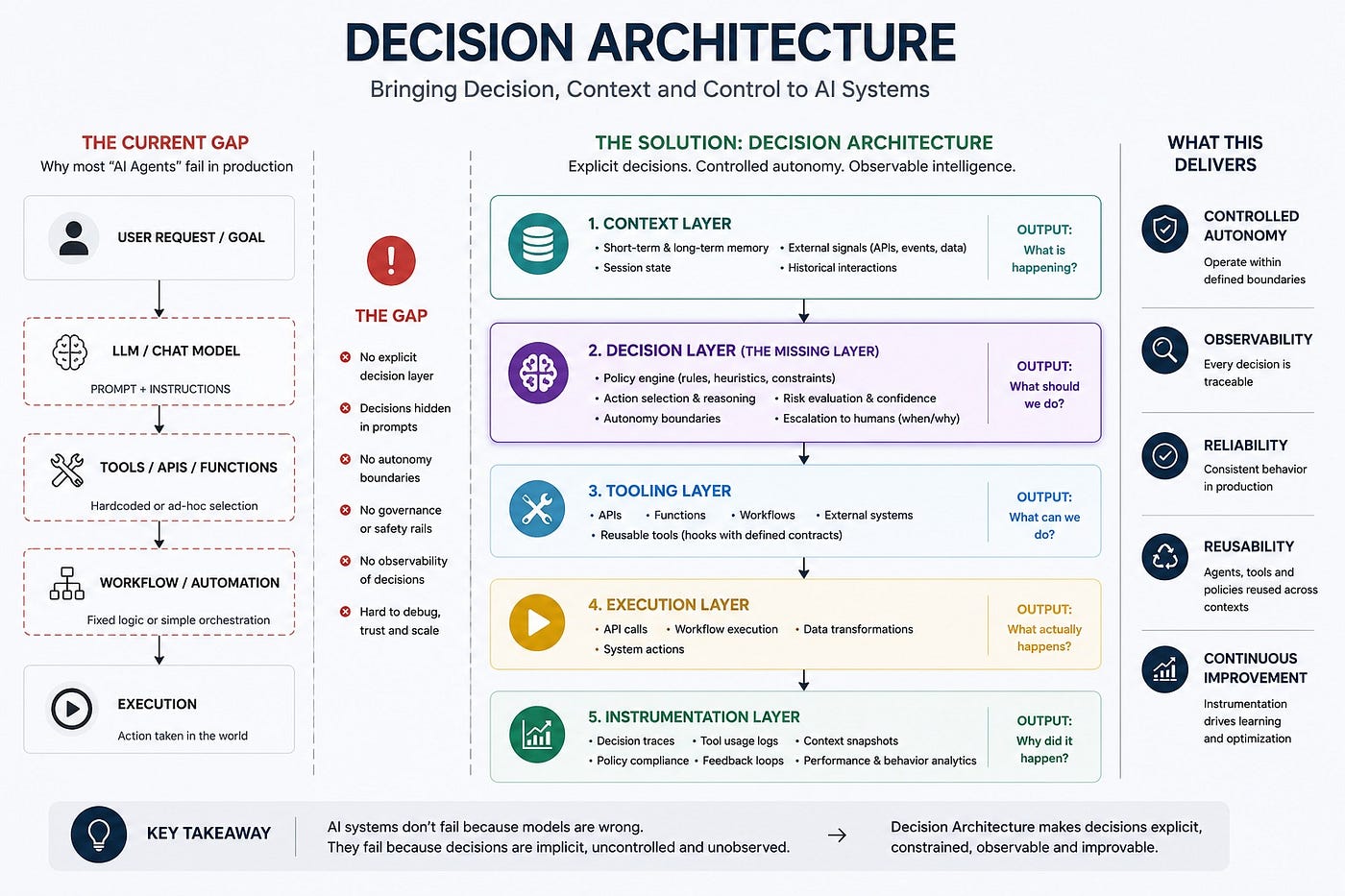
Decision Architecture is the missing layer between AI models and real autonomous behavior.
It defines how AI systems perceive context, how they make decisions, how they select tools, how they respect constraints, and how they operate within controlled autonomy boundaries.
In other words, Decision Architecture is what transforms “AI usage” into actual “AI systems”.
Without it, there are no agents in the real sense.
There are only scripted intelligence systems that simulate autonomy but do not possess structured decision-making.
The core problem: decisions are implicit today
In most current implementations, responsibilities are fragmented in a way that hides the actual decision logic.
Prompts define behavior. Tools define capability. Workflows define execution.
But there is no explicit layer that defines how decisions are made, validated, constrained, and observed over time.
This absence creates systems that are inherently fragile in production: they are unpredictable, difficult to debug, nearly impossible to govern at scale, and inconsistent across different contexts.
The underlying issue is simple but critical:
decision-making exists, but it is implicit rather than designed.
The 4 layers of Decision Architecture
To solve this, we must separate concerns properly and explicitly define the architecture of decision-making systems.
1. Context Layer — What does the system know and believe?
The Context Layer is not just memory. It represents the system’s perceived reality at the moment a decision is made.
It includes short-term memory such as the current interaction, long-term memory that reflects historical user or organizational behavior, external signals coming from APIs, events, or telemetry systems, as well as system-level state such as queues, workflows, or backend conditions. It also incorporates historical decisions and their outcomes.
Without this layer, no meaningful decision can be made, because the system lacks awareness of the environment in which it is operating.
To illustrate this in practice, consider a customer support AI agent. Its context may include the fact that a user has opened three tickets in the past seven days, that the previous ticket was escalated to Tier 2 support, that there is an ongoing system outage in the user’s region, and that there is a high risk of breaching SLA constraints.
Most systems today ignore this richness entirely. They typically only pass the user message and perhaps some limited chat history.
Decision Architecture fundamentally changes this behavior. The same prompt, when enriched with full context, leads to completely different decisions, because the system now understands pressure, history, and external conditions rather than isolated inputs.
2. Decision Layer — How does the system choose?
The Decision Layer is the true missing brain of most AI systems today.
It is not the model itself, but the structured logic that surrounds the model and constrains how decisions are made.
This layer defines decision policies, heuristics, operational constraints, action selection logic, escalation rules, and trade-off evaluation mechanisms such as balancing speed, cost, risk, and confidence.
To make this concrete, consider a finance approval system handling invoices.
If an invoice is $45,000, the vendor is new, and the category is high risk, the decision layer can explicitly enforce a policy such as requiring human approval for any new vendor above a certain threshold. If the vendor is recurring and low risk, the system may automatically approve. If fraud risk exceeds a certain threshold, the system may block and escalate immediately.
In most current implementations, this logic is either embedded inside prompts or not formally defined at all. As a result, decisions become probabilistic, inconsistent, and non-auditable.
With Decision Architecture, however, the system gains explicit boundaries. It becomes possible to explain why a decision was made and ensure consistent behavior across different contexts and executions.
3. Tooling Layer — What can the system actually do?
The Tooling Layer defines the actual capabilities available to the system.
Tools are not intelligence. They are exposed capabilities that the decision system can invoke.
This includes APIs such as CRM or ERP systems, internal services, external integrations, workflows such as email or ticketing systems, deployment pipelines, and reusable functional “hooks” that encapsulate operational actions.
For example, an IT operations agent may have access to tools that restart services, scale clusters, open incident tickets, query logs, or rollback deployments.
A common mistake today is that these tools are exposed without governance or alignment to decision policies. This leads to models selecting tools blindly, without structured reasoning about constraints or consequences.
In a proper Decision Architecture, tools are not freely accessible capabilities. They become a controlled action space. Their usage is filtered by context, constrained by policy, and selected through explicit decision logic rather than implicit model behavior.
4. Instrumentation Layer — Why did it happen?
The Instrumentation Layer is arguably the most important layer in production systems, yet it is also the most neglected.
Without it, AI systems become impossible to debug, impossible to audit, and impossible to improve systematically.
This layer includes decision traces that capture step-by-step reasoning, tool invocation logs, context snapshots at the moment of decision, policy evaluation history, outcome tracking, and structured feedback loops that connect decisions to results.
To illustrate its importance, consider an AI hiring assistant. Such a system must be able to answer questions like why a specific candidate was rejected, which signals influenced the decision, which policy triggered that outcome, and whether any human override occurred.
Instrumentation makes this possible by providing a full decision graph, confidence scores, policy triggers, and tool-level traceability such as CV parsing or scoring model outputs.
Today, most systems only log inputs and outputs. As a result, the entire decision process is lost.
With Decision Architecture, every action becomes traceable, explainable, and improvable — which is a prerequisite for enterprise-grade adoption.
Agents are not entities — they are configurations
A key shift in thinking is that an AI agent is not a standalone object or system.
It is a configuration of context scope, decision policy, tool access, constraints, and autonomy level.
This means that the same underlying model can behave in radically different ways depending on how its Decision Architecture is defined.
The autonomy spectrum nobody formalizes correctly
Most systems today exist somewhere along a spectrum that is rarely formalized properly.
At Level 0, we have deterministic automation. At Level 1, AI-assisted execution. At Level 2, bounded decision-making systems. At Level 3, adaptive agents. And at Level 4, fully autonomous systems, which remain rare in enterprise environments.
The real challenge is not reaching full autonomy.
The challenge is clearly defining and governing Levels 1 through 3, where most real-world systems operate today.
The real breakthrough: reuse is about decision patterns, not agents
Organizations today attempt to reuse prompts, agents, or workflows.
However, the real reusable unit in scalable AI systems is not the agent itself.
It is decision logic under constraints.
This enables systems where behavior is driven by context, tools are reused as controlled hooks, and specialization emerges dynamically without redesigning entire systems.
The missing discipline: instrumentation-driven AI
Most AI systems fail not because models are weak, but because decisions are not traced, behavior is not observable, and feedback is not structured.
Instrumentation is what transforms AI from experimental systems into production-grade infrastructure.
It defines why a decision was made, what alternatives existed, which tools were selected, and how outcomes evolve over time.
Without it, improvement is guesswork. With it, AI systems become continuously optimizable.
The anti-patterns we keep repeating
Across enterprises, the same structural issues appear repeatedly.
There is agent sprawl, where too many disconnected agents are created without coordination. There is tool explosion without governance. There is prompt-driven architecture being mistaken for system design. There are no clear decision boundaries, and observability is fundamentally absent.
This is not an AI problem.
It is an architectural problem.
A reference model for Decision Architecture
A proper AI system should be structured as a flow of interconnected layers:
Context defines reality. Decision defines behavior. Tools define capability. Execution defines action. Instrumentation defines understanding.
This separation is what enables scalable autonomy in real systems.
Final thought
We are not missing better models.
We are missing better architecture.
Until we explicitly separate decision from execution, intelligence from tools, and behavior from prompts, we will continue building systems that appear intelligent but behave like automation.
Decision Architecture is not an optimization.
It is the missing foundation for real AI systems.
메타데이터
- post_id
- f2a6b2cddbf3
- slug
- decision-architecture-the-missing-layer-between-ai-agents-and-real-autonomy-f2a6b2cddbf3
- url
- https://medium.com/@cloudzone.io/decision-architecture-the-missing-layer-between-ai-agents-and-real-autonomy-f2a6b2cddbf3
- canonical_url
- https://medium.com/@cloudzone.io/decision-architecture-the-missing-layer-between-ai-agents-and-real-autonomy-f2a6b2cddbf3
- author_url
- https://medium.com/@cloudzone.io
- status
- ok
- fetched_at
- 2026-07-25 16:21:19



