Linguistic Analysis on The Angry Speech Register of Bikol And Why Exoticizing It Is Bad
As a child, I would often hear the sharp words: “purulpugón ko an kamolmóg mo pag naabutan ta kang dai pa tuspók!”/“I will pound your hands…
Linguistic Analysis on The Angry Speech Register of Bikol And Why Exoticizing It Is Bad
As a child, I would often hear the sharp words: “purulpugón ko an kamolmóg mo pag naabutan ta kang dai pa tuspók!”/“I will pound your hands together if I find you not yet asleep!” in an early, scorching afternoon. Of course, my mom didn’t need to drop the profanities because other than the fact that nobody is allowed to curse inside the house, the words kamolmóg (hand) and tuspók (asleep) are enough to send me scurrying back to bed in fear.
These terms are part of a vocabulary set we’d usually call the “angry register” of Bikol, locally known as tamanggot or rapsak.
Angry register is highly nuanced and complex to the point that it’s commonly misunderstood in the deeper level. It’s also hilarious and annoying, and it would probably piss someone off when repeatedly billboarded to their face. But it would only take a few under-researched vlogs and viral feature articles to circulate online before this linguistic feature is exoticized and reduced down to the pitfalls of stereotypes: “Bikol is an angry language.”
Angry register as we know it
In English, maybe the closest equivalent of this phenomenon is the lexical insertion of the curse word fcking as in, “I will pound your fcking hands together if I find you not yet fcking asleep!” — This is angry… but this is not a register. Also, angry register is not a profanity.
Angry register is a rare speech register present among the many languages of Bikol including, but not limited to, Sentral Bikol, Rinconada, Boînën, Minasbate, Southern Sorsoganon, and Northern Catandunganon.
American linguist Jason Lobel, who conducted his linguistic fieldworks in Southeast Asia and North Bornean languages, first described the register as “a distinct set of linguistic forms used specifically in situations of anger.”
In other words, speakers often have a distinct set of words that replaces common terms to express varying expressions of anger. For example, the Sentral Bikol word kamót (hand) can shift to its ‘angry’ counterpart, kamolmóg, or turóg (asleep) to the angry tuspók. The same when malutò (rice) becomes malustod, bagyo (storm) becomes alimagyo, bitis (feet) becomes samingkil, or manok (chicken) becomes maldos.
So when someone expresses annoyance over these things at once, you can expect a mouthful of sharp, blistering remarks.
Despite the term, though, both ‘angry’ and ‘register’ are somewhat misnomers. One does not have to be angry to use it, and speech registers are not entirely triggered by emotions. Yet in this case, Lobel considered that the use of the term may remain acceptable as ‘angry’ encompasses different ranges of anggot (anger, Nag.)/dagit (anger, Leg.), including, but not limited to, agitation, irritation, frustration, and even nagging and banter. Meanwhile, the term “register” refers to a contextualized situation in which one can navigate in these ranges of emotions.
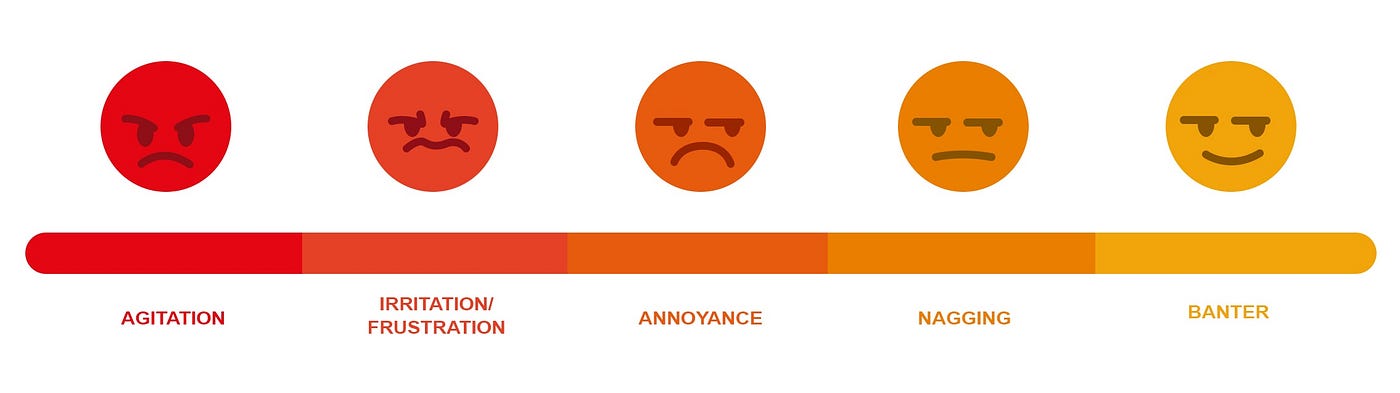
Ranges of Anger— it’s important to note that this is nonexclusive and may even go beyond the two extremes depending on the contextualized situation.
For lack of a better word, “angry register” is sufficient because there is usually an intention to evoke and imitate anger even in playful banters that the term “heightened emotions” (like heightened kilig, heightened fear, or heightened shame) cannot cover. And as Lobel would put in, this register is often used in sarcasm or humor, but “the majority of its usage is in anger.”
Beyond the ranges of anggot and dagit, this register may also be used to intimidate, antagonize, or to add emphasis and emotion in speech.
Another Bikolano lexicographer/educator Jaime T. Malanyaon, who wrote a thesaurus in Bikol (1990), classified the non-angry and angry speech register as “mga tataramon na itinataram sa maluya saka makusog na boses” (words articulated in weak and strong voice). This suggests that while the register is associated with anger, it is not solely triggered by emotion but can also be a deliberate linguistic choice used for emphasis, humor, or social positioning.
The distinctive features
In 1865 Vocabulario de la lengua bicol, about 40+ words are labeled with “spoken when angry” or “said in anger.” Most of these are morphologically different from their regular speech register equivalent. For example, the Sentral Bikol word gadan (dead) shifts to tigbak in angry register. Even the word for happiness, ugma, has an angry equivalent: dayakdak.
However, not all entries with this label in the Vocabulario are true angry registers but mere interjections.
Lobel (2005) further observed in his study that most of the actual angry register words are morphologically distinct from their standard counterparts, reinforcing that the angry register is a lexical phenomenon rather than just a shift in tone. Yet many, in fact most, words in angry register follow systematic processes that can morphologically transform the regular/neutral words.
Ex. bagyo (storm) → alimagyo (ali+[m]agyo)
uran (rain) → usran (u[s]ran)
gab-i (night) → gabsok (gab+[sok])
sarwal (shorts) → samarigwal (s[am]ar[ig]wal)
This is the reason why I believe that the perceived harsh or ‘angry’-ness of the Sentral Bikol language is more phonetic rather than emotional.

A Personal Database (In-Progress) of the Morphological Breakdown of Words in Angry Register — Derived from Lisboa’s 2005 study on Bikol-Naga (Nag), Buhi (Buh), and Nabua (Nab).
Although the angry register is strongly associated with Sentral Bikol, it is rare but not unique to the language at all. Among the Central Philippine languages, which are a subgroup of the Greater Central Philippine (GCP) family, the angry register might have developed in multiple languages, possibly tracing back to a reconstructed Proto-Central Philippine (PCP) ancestor from which languages like Sentral Bikol descended.
What remains distinct today for Sentral Bikol is the fact that its speakers are the only ones who still intensively use this vocabulary in daily speech.
With the morphological patterns still intact, Bikol speakers can continuously generate more and more words through infixation (inserting a morpheme within a word), partial replacement and full reduplication of sounds.
This is not commonly observed in other Philippine languages. In Tagalog, the closest equivalent is often the degrees of intensity, where a stronger or more forceful term replaces a neutral one (e.g., kain → lamon).
Ex. *Kinain *na ng aso ang ulam. (The dog already ate **the food.)
*Nilamon *na ng aso ang ulam. (The dog already devoured **the food.)
The same for the Tagalog words higa (to lie down) → hilata (to lie down lazily/relaxed manner).
However, Tagalog lacks a systematic process that actively transforms neutral words into emotionally charged or context-specific registers through morphological modification.
In the sample above, no systematic morphological changes occurred. The words lamon (to devour) and hilata (to lie down lazily/relaxed manner) can be used when the speaker is angry, but anger itself is not embedded in the lexicon.
Notice when these false angers (e.g. lamon, hilata) can be translated to English. In Bikol, words in angry register have the same meaning as their counterparts. The difference is the implied anger when spoken.
To date, it remains widely debated whether Cebuano, Kinaray-a, Butuanon, and Nortehanon-Waray (the neighbor of Bikol), have also utilized an angry register, or if these are simply remnants of centuries of language loaning. I know many writers from these languages who can provide a long list of words with angry register counterparts, and there needs to be more linguistic studies to further understand the implication of this phenomenon to their languages.
Additionally, even if these languages once had or still retain traces of an angry register, what sets Sentral Bikol apart today is its intensive and consistent use of this register in everyday speech, along with its still-active morphological patterns that allow speakers to continuously generate new vocabulary all the time.
I mean, I literally once yelled at my kurasgmag (cat) to take a fcking sit (tuskaw) — and I made it up.
Language as an exotic curiosity
When “The World’s Only Angry Language” is over-sensationalized on the internet, it misrepresents the entire Bikol culture by portraying Bikolanos as inherently hot-tempered, eating spicy foods as snacks while speaking angry words as a random quirk.
When language and culture become an exotic curiosity, its nuances and complexities are reduced to a stereotype.
This is the reason why we always need to challenge the media. Let’s address some of the most common misconceptions going around online that I have collected:
1. “Angry registers are profanities.” False. While angry registers intensify speech, they do not really contain curse words. Speakers may usually insert profanities alongside them, but these are not necessary.
Ex. “Makauyam kang gamadya ka.” (You’re so annoying, dog!) — this phrase is not profane when directed at an actual dog. However, when said to a person, it becomes offensive due to the implied insult.
2. “Angry register is unique to Bikol.” False. Lobel (2005) himself documented the existence of angry registers in Agusan Manobo, Rajah Kabungsuwan Manobo, and Mongondow. There are also ongoing discussions on whether Cebuano and Waray, among others, also contain similar speech patterns. Anger register is not unique to Bikol but rare among Philippine languages.
3. “Angry register makes language sound angry.” False. A speech register is just one aspect of a language, much like how the formal register in English does not make the entire language sound formal, or how the polite register in Japanese does not make the entire language sound polite. In fact, another speech register in Rinconada, called sainigin, is used by parents as an introductory language for their babies — and still, this does not make the entire Rinconada region “babies.”
4. “Angry register was developed to annoy a dominant language (Spanish).” False. In reality, most words in the register are native terms, and there is no evidence that it was intentionally created as a form of resistance to the Spanish. Its historical and linguistic development remains understudied. However, there are hypotheses that link the angry register to Sentral Bikol’s (as well as related languages’) Proto-Central Philippine (PCP) ancestor, which, for instance, can explain how an angry word in Bikol is a cognate of a neutral word in Waray.
5. “Angry register is also used in English and Tagalog.” False. While English and Tagalog can — no doubt — express anger through expletives or other stronger word choices, they do not exhibit the structured morphological transformations found in Sentral Bikol’s angry register.
- “Angry register is the same as superlative degree.” False. Superlative degree expresses the extreme quality among multiple things (e.g., fastest, best, tallest). Intensification of an adjective (e.g., very fast, very good, very tall) is also not the same as angry register. Notice when these false angers have English translations:
Ex., in Tagalog:
kain (to eat) → lamon (to devour)
higa (to lie down) → hilata (to lie down lazily/relaxed manner)
In Bikol, words in angry register have the same meaning as their counterpart, hence they can’t be translated differently.
Ex., in Sentral Bikol:
kamót (hand) → kamolmóg (hand)
turóg (asleep) → tuspók (asleep)
Both samples are nuanced. But the difference lies in the implied anger when words in angry register, such as kamolmóg and tuspók are spoken.
Bikol is NOT an angry language
The more we analyze the angry registers in Sentral Bikol and other languages, the less they seem like objects of curiosity to be observed inside a glass cage.
Don’t get me wrong, though. It’s important we appreciate the broader linguistic features of our language, but when outsiders view them as mere spectacles rather than something with deep value to native speakers, it turns into a one-dimensional perspective of the culture. And that is bad-bad. I guess that’s why I kind of fumed when I kept seeing the angry register making headlines, so I thought I had to write this. I can handle my anger management, in that regard.
메타데이터
- post_id
- f2bb92f61a8d
- slug
- linguistic-analysis-on-the-angry-speech-register-of-bikol-and-why-exoticizing-it-is-bad-f2bb92f61a8d
- url
- https://medium.com/@jeremiahcordial/linguistic-analysis-on-the-angry-speech-register-of-bikol-and-why-exoticizing-it-is-bad-f2bb92f61a8d
- canonical_url
- https://medium.com/@jeremiahcordial/linguistic-analysis-on-the-angry-speech-register-of-bikol-and-why-exoticizing-it-is-bad-f2bb92f61a8d
- author_url
- https://medium.com/@jeremiahcordial
- status
- ok
- fetched_at
- 2026-07-21 00:06:05