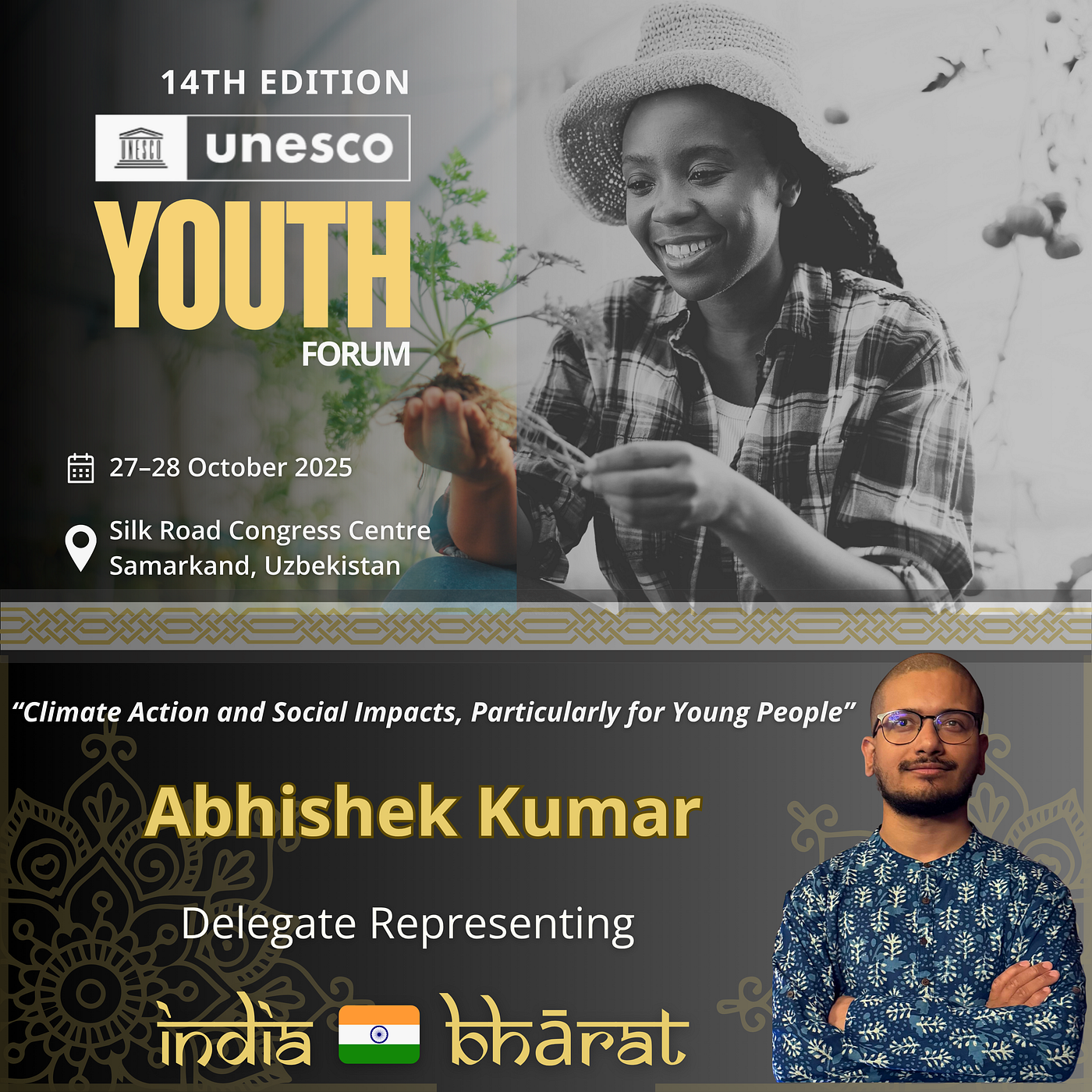
Highlights and Reflections from the 14th UNESCO Youth Forum 2025: Representing India in Samarkand
“कालाति क्रमात् काल एव फलम पिबति” (when the right action is not taken at the right time, then time itself defeats the purpose of such…
Highlights and Reflections from the 14th UNESCO Youth Forum 2025: Representing India in Samarkand
“कालाति क्रमात् काल एव फलम पिबति” (when the right action is not taken at the right time, then time itself defeats the purpose of such action) — Acharya Chanakya
Namaste!
I am elated to share my experience representing India 🇮🇳 Bhārat (the largest cohort constituting about one-sixth of humanity) at the 14th Edition of the UNESCO Youth Forum 2025, held in Samarkand, Uzbekistan, from 27–28 October 2025, on the theme “Climate Action and Social Impacts, Particularly for Young People.” As one of the rapporteurs from the Asia-Pacific region, it was humbling and deeply meaningful to work with the rapporteurs’ team and co-draft the Call to Action and Global Recommendations. The ***Conclusions of the Youth Forum* document was eventually finalised and adopted by consensus, with contributions from fellow rapporteurs, moderators, and youth delegates from over 135 countries. It was later presented and discussed at the [43rd UNESCO General Conference](https://www.unesco.org/en/general-conference/43)**.
![Visual/Image Description [Alt Text]: A collage of eleven images (from top to bottom and left to right in chronological sequence) — 1. Group photo in front of Registan Square in Samarkand from the cultural visit, 2. Samarkand 2025 logo, 3. Image of a ship (international art project) from the Ship of Tolerance Concert, 4. Image of moderators and rapporteurs from the working session, 5. Group picture of youth forum participants, 6. Group picture from the Asia-Pacific Regional working session, 7. logo of the 14th edition of the UNESCO Youth Forum, 8. Image from the panel discussion during the opening ceremony, 9. Solo image of Abhishek in a traditional Indian attire (Himachali cap and muffler, along with Bharatiya traditional Kurta), 10. Image from the panel discussion during the opening ceremony, with the event poster presentation in the background, and 11. Group picture of the rapporteurs and moderators. The background of the collage is of a cultural heritage site in Samarkand.](https://miro.medium.com/v2/resize:fit:1400/1*dBCveBeA0lXbBxyvGevAAA.png)
Visual/Image Description [Alt Text]: A collage of eleven images (from top to bottom and left to right in chronological sequence) — 1. Group photo in front of Registan Square in Samarkand from the cultural visit, 2. Samarkand 2025 logo, 3. Image of a ship (international art project) from the Ship of Tolerance Concert, 4. Image of moderators and rapporteurs from the working session, 5. Group picture of youth forum participants, 6. Group picture from the Asia-Pacific Regional working session, 7. logo of the 14th edition of the UNESCO Youth Forum, 8. Image from the panel discussion during the opening ceremony, 9. Solo image of Abhishek in a traditional Indian attire (Himachali cap and muffler, along with Bharatiya traditional Kurta), 10. Image from the panel discussion during the opening ceremony, with the event poster presentation in the background, and 11. Group picture of the rapporteurs and moderators. The background of the collage is of a cultural heritage site in Samarkand.
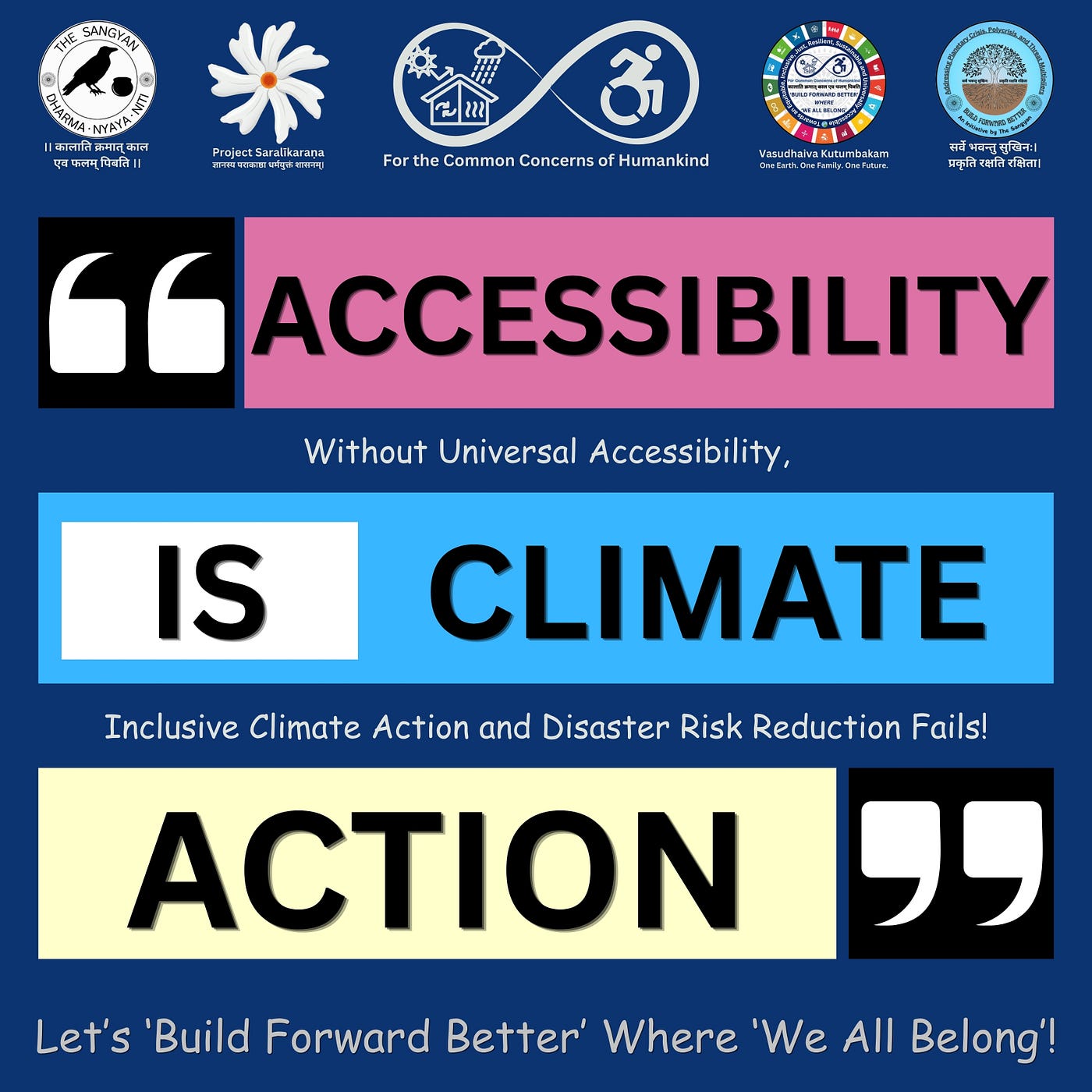
Serving as the Rapporteur for the Asia and the Pacific region, I had the opportunity and responsibility of drafting our region’s recommendations (Pages 15–17 of the **official document**), reflecting the priorities of the world’s most climate-vulnerable and youth-populated region. Our collective call emphasised climate justice, intergenerational equity, universal accessibility, and meaningful youth leadership and participation across systems and dimensions.
I was grateful to be one of the youth panellists during the Opening Ceremony, in conversation with Dr. Lidia Brito, Assistant Director-General for Social and Human Sciences, to reflect on universally accessible and culturally rooted climate education, and on what it truly takes to drive climate action for youth and for UNESCO. Dr. Brito’s warm appreciation for my thoughts and work — particularly its integration of culture, education, inclusion, and sustainability — was deeply encouraging, especially as these dimensions lie at the heart of UNESCO’s mandate as well.
[embed]14th Edition of the UNESCO Youth Forum Opening Ceremony
One of the highlights for me at the Forum was the selection of my action project (**Annex II of the Conclusions — Page 22), “Universally Accessible and Culturally-rooted Education for Inclusive Climate Action, Disaster Risk Reduction, and Environmental Protection,” as one of the five youth-led projects for follow-up to the Forum under the [UNESCO Global Youth Grant Scheme](https://www.unesco.org/en/youth/global-grant-scheme). I look forward to effectively implementing this initiative over the coming year, building upon years of research, advocacy, and campaign endeavours at [The Sangyan](https://linktr.ee/sangyan)** to advance and promote inclusive, culturally grounded climate education that empowers vulnerable communities, embeds Indigenous Traditional Knowledge and Indian Knowledge Systems, and integrates universal accessibility, universal design for learning, and interactive pedagogies and approaches such as storytelling, roleplays, and educational and learning games.
Throughout the Forum’s events, working sessions, breakout discussions, project café, and informal exchanges, I tried my best to ensure that I voiced the concerns, solutions, and perspectives of the world’s largest cohort (India 🇮🇳 Bhārat) at the global forum to the best of my ability and added value to the process and platform. My sincere gratitude goes to fellow delegates, facilitators, moderators, rapporteurs, and the UNESCO Youth Section team for enabling a process rooted in dialogue, sincerity, and shared purpose. This journey was an affirmation of the timeless value of Vasudhaiva Kuṭumbakam — One Earth, One Family, One Future — and a reminder that collective action across regions, identities, and disciplines is essential to address the common concerns of humankind, particularly the threat multiplier that is climate change.
![Visual/Image Description [Alt Text]: On a blue background with yellow lines, delegate profile of Abhishek Kumar (India — ASIA AND THE PACIFIC) for the CLaiMATE Match Networking Session (“Sharing your climate story and connecting with peers to build collaborations”) during the 14th Edition of the UNESCO Youth Forum 2025 in Samarkand (Uzbekistan). Beside the image of Abhishek wearing a turquoise Bharatiya traditional kurta, lies the following textual content: “I was once evacuated during a flood as a child — an experience that revealed how climate change-induced disasters magnify inequities for persons with disabilities and other vulnerable communities. That lived experience, coupled with coming across the IPCC’s mantra that reducing inequities is the best way to fight climate chaos, paved the way for me to take action towards climate justice. I founded The Sangyan (https://linktr.ee/sangyan) to work on the convergence law, inclusion, and sustainability, advancing disability-inclusive and universally accessible climate action. Presently, I’m exploring the impact of climate change on losses and damages to (in)tangible cultural heritage and working on “Universally Accessible and Culturally-rooted Education for Inclusive Climate Action, Disaster Risk Reduction, and Environmental Protection,” integrating universal design for learning, interactive storytelling, educational and learning games, Indian Knowledge Systems, and Indigenous Traditional Knowledge, to achieve intergenerational equity and justice. For me, hope lies in transforming lived experiences into leadership and creating culture of environmental consciousness, Lifestyle For Environment and Responsible Consumption and Production through education, and ensuring that every community — especially those most vulnerable — can shape and sustain our shared human civilization and planetary future guided by Dharma (Righteouness: The Right Thing To Do — A person’s moral and social obligations both as an individual and also as a member of society), Nyaya (justice) and Niti (principled and rule-based laws and policies).” Additionally, there are further details — Areas of Interest: Climate education, art, communication / Cultural heritage, traditional and indigenous knowledge / Policy, advocacy, governance; Skills and Strengths: Education / training / facilitation / Creative arts / storytelling / design / Policy / advocacy / governance; and Skills to Learn: Communications / social media / content creation / Scientific research / data analysis / Technical / digital tools.](https://miro.medium.com/v2/resize:fit:1400/1*bcobmZcNgewgZWMJuEX2ng.png)
Visual/Image Description [Alt Text]: On a blue background with yellow lines, delegate profile of Abhishek Kumar (India — ASIA AND THE PACIFIC) for the CLaiMATE Match Networking Session (“Sharing your climate story and connecting with peers to build collaborations”) during the 14th Edition of the UNESCO Youth Forum 2025 in Samarkand (Uzbekistan). Beside the image of Abhishek wearing a turquoise Bharatiya traditional kurta, lies the following textual content: “I was once evacuated during a flood as a child — an experience that revealed how climate change-induced disasters magnify inequities for persons with disabilities and other vulnerable communities. That lived experience, coupled with coming across the IPCC’s mantra that reducing inequities is the best way to fight climate chaos, paved the way for me to take action towards climate justice. I founded The Sangyan (https://linktr.ee/sangyan) to work on the convergence law, inclusion, and sustainability, advancing disability-inclusive and universally accessible climate action. Presently, I’m exploring the impact of climate change on losses and damages to (in)tangible cultural heritage and working on “Universally Accessible and Culturally-rooted Education for Inclusive Climate Action, Disaster Risk Reduction, and Environmental Protection,” integrating universal design for learning, interactive storytelling, educational and learning games, Indian Knowledge Systems, and Indigenous Traditional Knowledge, to achieve intergenerational equity and justice. For me, hope lies in transforming lived experiences into leadership and creating culture of environmental consciousness, Lifestyle For Environment and Responsible Consumption and Production through education, and ensuring that every community — especially those most vulnerable — can shape and sustain our shared human civilization and planetary future guided by Dharma (Righteouness: The Right Thing To Do — A person’s moral and social obligations both as an individual and also as a member of society), Nyaya (justice) and Niti (principled and rule-based laws and policies).” Additionally, there are further details — Areas of Interest: Climate education, art, communication / Cultural heritage, traditional and indigenous knowledge / Policy, advocacy, governance; Skills and Strengths: Education / training / facilitation / Creative arts / storytelling / design / Policy / advocacy / governance; and Skills to Learn: Communications / social media / content creation / Scientific research / data analysis / Technical / digital tools.
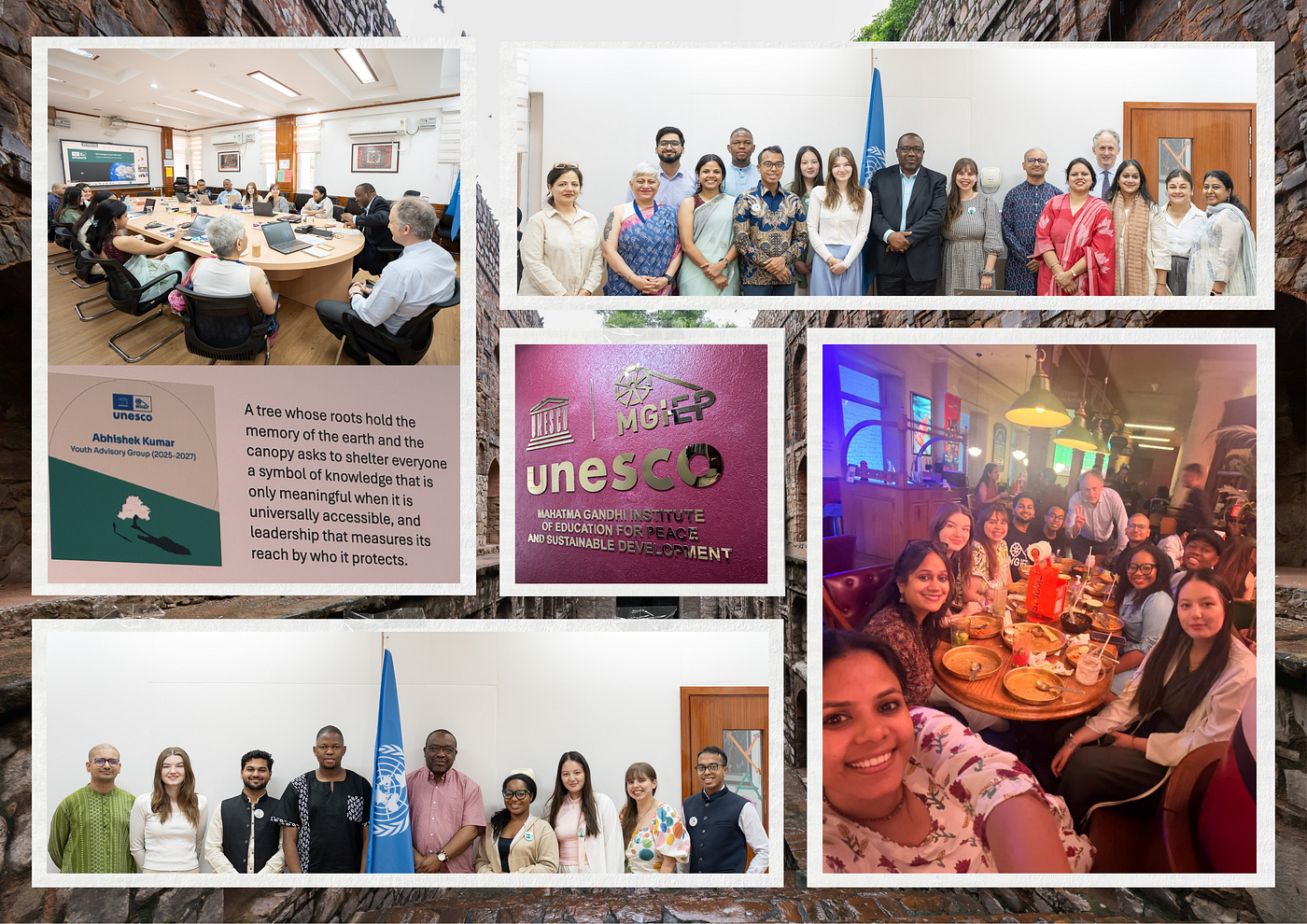
This journey and post would not be complete without thanking **UNESCO MGIEP for nominating me for the [14th Edition of the UNESCO Youth Forum 2025](https://www.unesco.org/en/articles/14th-edition-unesco-youth-forum)**, especially Fazola Nasretdinova, Ankita Singh, and Sumit Kumar, for their constant support throughout the process and for assisting me with logistics and beyond. To name just a few would not do justice to all those I must thank; however, I would like to acknowledge the rapporteurs’ team (Kaarina Harkonmäki from the Europe and North America region, Jorge Alexis Perea Armijos from the Latin America and the Caribbean region, Dr. Bibi Nausheen Jaffur from the Africa region, and Bdoor Abu bader from the Arab States region), the moderators (Emmana Jeffers, John Linus, Hatim Lachheb, Rebeka Bibič, Brendan R. Joseph, and Rukhsora Shakirova), and my fellow panellists for the Opening Ceremony (Anastasia (Natassa) MALLIRI, Amal Ridene, Gazi Nouman, and Ella Iradukunda).
I would like to acknowledge Souria Saad-Zoi, Kristina Balalovska, Alessia Ulfe Bandini, Julia Stevens, Isabel Pestaña Heras, Aurélie Derigaud-Choquette, and the rest of the 14th UNESCO Youth Forum Secretariat team for their constant support, which enabled the whole process and forum. Last by definitely not least, I would like to appreciate the organising team, the people, and the government of Uzbekistan for hosting me and other participants from around the world in the heritage city of Samarkand, who ensured a warm welcome and wonderful hospitality throughout our stay.
As I look forward to the implementation of my action project with the support of UNESCO under the Global Youth Grant Scheme, and to building upon the outcomes of the Forum, I remain hopeful that our collective efforts will translate into impactful and sustainable change. Like the squirrel in the ***Rāmāyaṇa* who contributed to building the Śrī Rāmasetu, I hope to make my own modest yet meaningful contribution towards inclusive climate action and disaster risk reduction, intergenerational equity, and a climate-resilient future that leaves no one behind. I share this update with ultimate gratitude to [Maa Saraswati](https://www.instagram.com/p/DFmoUwaz-Nt/?utm_source=ig_web_copy_link&igsh=MzRlODBiNWFlZA==) (Mother Goddess of knowledge, wisdom, speech, artforms, and supreme consciousness), [Guru-Kṛpā](https://www.instagram.com/p/DL6sKA7TrFi/?utm_source=ig_web_copy_link&igsh=MzRlODBiNWFlZA==)** (blessings of Gurus), and everyone who has been part of this evolutionary journey over the years.
Dhanyawād!
— Adv. Abhishek Kumar, Youth Delegate representing India 🇮🇳 Bhārat at the 14th Edition of the UNESCO Youth Forum 2025 and Rapporteur for the Asia and the Pacific region
Founder and Curator of The Sangyan | द संज्ञान, Prakalp Drishtant | Project Drishtant | प्रकल्प दृष्टान्त, and the ‘Build Forward Better’ Campaign
Conclusions of the 14th Edition of the UNESCO Youth Forum 2025
Access the complete document — “**Conclusions of the 14th Edition of the UNESCO Youth Forum 2025**” (dated 30th October 2025) for the Call to Action, Global and Regional Youth Recommendations (Europe and North America, Latin America and the Caribbean, Asia and the Pacific, Africa, and the Arab States), and Youth-led Action Projects: https://unesdoc.unesco.org/ark:/48223/pf0000396223
Contextual Background
I approach my effort for climate justice by integrating ‘**Lifestyle For Environment’ into every aspect of my day-to-day life, be it the food I eat, the clothes I wear, the mode of my travel, and so on. For me, every action must be environmentally conscious, as we have a responsibility towards nature — articulated through Dharma (the right thing to do) and Bhūta Ṛṇa** (our debt to nature) — which sustains our very survival.
Against that backdrop, when I was invited to attend the 14th Edition of the UNESCO Youth Forum 2025 in Samarkand (Uzbekistan) and entrusted with the opportunity to participate and represent India 🇮🇳 Bhārat, it became my utmost responsibility to make optimum use of the platform, both in my personal and professional capacity, and to contribute meaningfully to the Forum.
To ensure that the carbon footprint resulting from my travel led to a logical and responsible conclusion, I tried — to the best of my ability — to engage deeply and learn from the diverse cohort of participants from across the world. The Forum enabled intersectional, intercultural, and intersectoral cross-learning, collaborations, and networking, which shall go a long way. I actively contributed and participated in discussions and shared my lived experiences, research findings, and perspectives from the Indian civilizational context and wisdom.
메타데이터
- post_id
- f2dcc88a802a
- slug
- highlights-and-reflections-from-the-14th-unesco-youth-forum-2025-representing-india-in-samarkand-f2dcc88a802a
- url
- https://medium.com/@sangyan/highlights-and-reflections-from-the-14th-unesco-youth-forum-2025-representing-india-in-samarkand-f2dcc88a802a
- canonical_url
- https://medium.com/@sangyan/highlights-and-reflections-from-the-14th-unesco-youth-forum-2025-representing-india-in-samarkand-f2dcc88a802a
- author_url
- https://medium.com/@sangyan
- status
- ok
- fetched_at
- 2026-06-09 15:37:30