Is Your SAP Testing Strategy Ready for the Future? Key Trends and Insights
SAP environments are becoming more intricate due to modular cloud deployments, industry-specific extensions, and integration with AI-driven…
Is Your SAP Testing Strategy Ready for the Future? Key Trends and Insights
SAP environments are becoming more intricate due to modular cloud deployments, industry-specific extensions, and integration with AI-driven business systems. These shifts increase the susceptibility of core processes to defects that conventional SAP testing practices fail to capture. As SAP S/4HANA programs, cloud integrations, and rapid configuration updates scale, enterprises require an SAP testing strategy that adapts to dynamic workflows instead of relying on static regression cycles. The focus must move toward risk-based prioritization, automated insights, and curated SAP application testing assets that ensure stability across interconnected modules and high-velocity deployments.
Why Future-Ready SAP Testing Matters
A modern SAP testing strategy must address architectural shifts, upgrades, and cross-system dependencies. SAP S/4HANA introduces simplified data structures and high-speed data handling, which require validation patterns different from those in ECC systems. Traditional approaches struggle here because they rely on manually curated test scripts that do not factor in semantic changes. As a result, test cycles become error-prone and susceptible to coverage gaps.
Key factors reshaping the SAP testing strategy include:
- High Deployment Frequency: SAP Cloud ALM and CI/CD practices introduce rapid changes that require continuous validation.
- Complex Extensions: SAP BTP solutions bring event-driven workflows that need dedicated testing approaches.
- Business Model Diversification: Multi-entity and multi-country operations amplify the number of critical test paths.
Transitioning from reactive validation to predictive assurance requires a deliberate shift. Teams must prioritize business-critical flows using risk-based scoring models. These models identify functions that are most susceptible to breakage. Furthermore, coverage metrics need recalibration because SAP modules influence adjacent processes. For instance, a pricing adjustment in SD can unintentionally skew settlement workflows in FI.
Another limitation arises from insufficient automation depth. Many enterprises use automation only for repetitive tasks. A future-ready SAP test automation framework must support API-level validation, data reconciliation, integration of flows, and event-triggered assertions. Without these layers, automation remains superficial.
A mature SAP testing strategy should incorporate:
- Shift-Left Validation: Align design, configuration, and testing from early blueprint stages.
- Intelligent Test Suite Optimization: Use process mining to identify redundant scripts and augment test suite relevance.
- Synthetic Test Data Generation: Reduce reliance on inconsistent production data while meeting compliance requirements.
Future-oriented SAP testing solutions must rely on automation, analytics, and domain accelerators. These capabilities keep assurance aligned with transformation programs and key SAP modernization objectives.
Intelligent SAP Test Automation for Modern Workflows
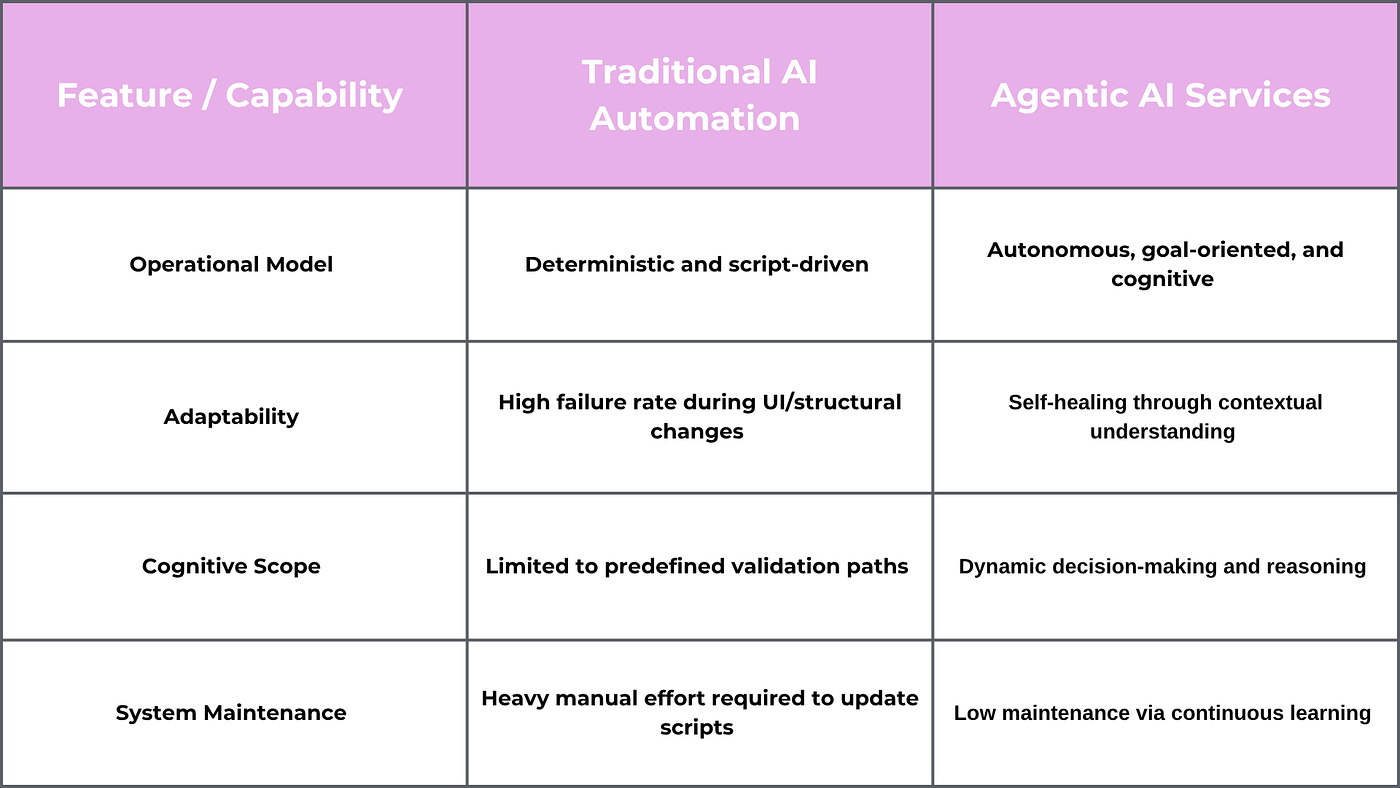
Many organizations invest in a SAP automation testing platform, expecting instant improvement. But automation alone is not enough. Without intelligence, scripts remain fragile and break during SAP changes.
Next-generation SAP test automation focuses on understanding contexts like configuration details, UI metadata, APIs, and how processes vary across plants or regions. By adjusting automatically to these differences, automation becomes more reliable and useful.
Key capabilities include:
- Self-healing scripts that update object references automatically
- API-focused validation using OData and REST interfaces
- Cross-module automation that follows real workflows across SD, MM, PP, FI, and other areas
Integrating automation into CI/CD pipelines helps catch issues earlier in the release cycle. Reliable SAP application testing data is also important, as unstable datasets often lead to inconsistent results. Synthetic test data and historical execution insights provide more predictable outcomes.
Modern SAP testing solutions prioritize:
- Broader coverage across CRM, HR, and legacy systems
- Using process insights to fine-tune automation flows
- Clear dashboards that highlight automation health
This evolution shifts teams away from manual scripts and toward structured, engineering-led SAP test automation.
Data-Led SAP Testing Solutions and Predictive Quality Engineering
Modern SAP testing solutions extend beyond execution tools. They combine data engineering, analytics, process intelligence, and monitoring to build proactive assurance workflows. SAP environments generate large volumes of logs, configuration deltas, user behavior metrics, and performance traces. Ignoring these datasets leaves validation skewed and reactive.
Predictive quality engineering identifies failure-prone areas through correlations across logs and transactional data. For instance, performance delays in procurement may correlate with vendor master inconsistencies. These insights allow teams to prioritize testing based on vulnerability rather than assumption.
Key capabilities driving advanced SAP testing solutions:
- Configuration Analytics: Detect inconsistent parameters that trigger transactional failures.
- Root-Cause Intelligence: Cross-compare successful versus failed execution traces.
- Process Modeling: Highlight risky decision points across end-to-end flows.
Continuous monitoring strengthens SAP application testing by feeding production insights back into testing cycles. When teams understand which modules experience more inconsistent behavior, they recalibrate regression suites and reduce unnecessary test volume.
Analytics-driven SAP testing solutions emphasize deeper coverage through focused execution. Instead of running extensive regressions, teams target the workflows responsible for most incidents. This reduces cycle duration while improving consistency.
Predictive intelligence introduces efficiencies such as:
- Early detection of misconfigurations
- Identification of workflows susceptible to latency
- Mapping master data conflicts that affect settlement cycles
Many SAP testing companies use accelerators that analyze BAPIs, IDocs, integration logs, and dynamic data combinations. These tools detect issues that simple functional scripts often miss. Moreover, this data-led approach helps SAP application testing evolve into a more informed and proactive discipline.
Integration-Aware SAP Application Testing and Multi-Ecosystem Assurance
SAP rarely runs as a standalone system. It connects with CRM applications, MES solutions, finance systems, analytics tools, supplier platforms, and more. Every connection introduces new risks, making integration-aware SAP application testing essential.
Challenges arise because each system changes differently. A small API update can break up EDI transactions, or a delay in SAP BTP events can create mismatches across downstream systems.
Key elements of integration-aware validation include:
- End-to-End Traceability: Validate the flow of data across source, SAP, and downstream environments.
- Data Synchronization Checks: Confirm that data remains consistent across all systems.
- Error-Handling Simulation: Test failure responses across IDocs, APIs, and queues.
A structured integration blueprint helps teams track all cross-system touchpoints. This blueprint must evolve as organizations introduce new capabilities and integrate more external applications.
Performance validation is equally important. High-volume posting, ATP validation, material planning runs, and warehouse movements require stress checks across all connected systems. If integration queues slow down, essential business processes such as billing or dispatch become vulnerable.
A strong integration-focused SAP testing strategy includes:
- Standardized test design patterns for distributed workflows
- Validation across synchronous and asynchronous event flows
- Continuous monitoring to detect latency or queue build-up
- Schema and payload validation for API interfaces
As enterprises adopt modular cloud systems, integration depth becomes more distributed. SAP testing must keep pace with this distributed architecture. Multi-system assurance thereby becomes a defining factor in future-ready SAP testing solutions.
Conclusion
SAP transformation introduces new modules, configurations, and integrations that increase the risk of disruption. A strong SAP testing strategy must therefore rely on analytics, deeper automation, and consistent integration checks. Quality engineering becomes central to guiding how teams plan, execute, and refine testing across SAP systems.
Modern SAP testing solutions support this shift through automation depth, continuous monitoring, and cross-system validation. These capabilities help create stable ERP operations even as organizations expand or modernize their platforms.
ImpactQA supports these needs through specialized SAP testing services, accelerators, and frameworks designed for multi-system environments. With strong automation, structured validation, and integration-focused testing, enterprises can build a more reliable and future-ready SAP ecosystem.
메타데이터
- post_id
- f2df4574a7bc
- slug
- is-your-sap-testing-strategy-ready-for-the-future-key-trends-and-insights-f2df4574a7bc
- url
- https://medium.com/@josephwarner079/is-your-sap-testing-strategy-ready-for-the-future-key-trends-and-insights-f2df4574a7bc
- canonical_url
- https://medium.com/@josephwarner079/is-your-sap-testing-strategy-ready-for-the-future-key-trends-and-insights-f2df4574a7bc
- author_url
- https://medium.com/@josephwarner079
- status
- ok
- fetched_at
- 2026-07-25 15:01:39