Interactive effects of arbuscular mycorrhiza fungi Glomus intraradices and Trichoderma harzianum…
Abstract
Interactive effects of arbuscular mycorrhiza fungi Glomus intraradices and Trichoderma harzianum against Fusarium wilt of tomato
Abstract
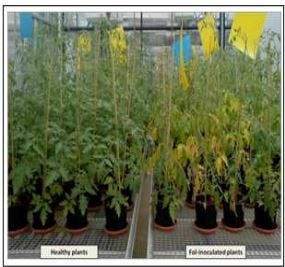
Biological control agents (BCA) are important as some establish symbiosis with plants hence controlling plant diseases, improving plant nutrients uptake and water absorption. Use of BCA in soil borne disease management is not fully harnessed and is also faced with inconsistencies in developing their formulations. We therefore investigated the use of arbuscular mycorrhiza fungus (AMF), Glomus intraradices, and ***Trichoderma harzianum* (T-22) against soilborne pathogen Fusarium oxysporum f. sp. Lycopersici (Fol) in tomato. G. intraradices isolate 510 held on expanded clay as carrier material was incorporated into the substrate during germination of tomato seeds and at the transplanting stage. T-22 inoculum was also initiated from potato dextrose agar and inoculated at each transplanting stage, while Fol was applied through drenching. To test the possible synergistic effects, AMF and T-22 were applied in combination under varying niches. Results showed that application of AMF and T-22 together had significant reduction (30.5% p<0.005) in Fol. Tests under varying phosphorous (P) regimes revealed significant reduction in wilting symptoms by 40.3% (p<0.005) following Fol infection. Plants grown under high levels of P showed typical Fol symptoms characterized by yellowing and gradual wilting, while plants with low levels of P wilted directly without undergoing the yellowing stages. The results show the significant role of AMF and T-22 as BCA against the soil-borne pathogen Fol and contributes to development of safe and sustainable disease management strategy.

Introduction
Fusarium oxysporum is an ubiquitous soilborne pathogen that includes various pathogenic strains which lead to economic losses in tomatoes (Solananum lycopersicum) (Gordon and Martyn, 1997; Fravel et al., 2003; Di Pietro et al., 2003). Chemicals applied to control Fol have been unsuccessful as they barely target their ecological niches but also pose dangers to the environment (Lucas, 2006). Abuscular mycorrhiza fungi is shown to present bio-protection effects against fungal phytopathogens including Phytophthora, Fusarium, Pythium and Rhizoctonia (Pozo et al., 1996; Cordier et al., 1998; Akköprü and Demir, 2005). Its ubiquitous nature is a fundamental component for development, exploitation and adaptation to interactions with the other rhizosphere microfloral of which knowledge of mode of interactions can be harnessed for development of an effective biological control strategy (Linderman, 1994; Fillion et al., 1999; Vazquez et al., 2000). Trichoderma is a soilborne fungus commonly used as an antagonist against fungal pathogens and as a bio-pesticide, which is exploited for its **biological** control potential (Harman, 2000; Harman et al., 2004). Moreover, control may be achieved indirectly by inducing host plant resistance where not only microbial organisms have been used but also compounds that mimic their cellular components to induce resistance (Kiirika et al., 2014).
The efficacy of these biological control agents and consistence performance in controlling soil borne diseases are the hurdles that must be overcome if their application is to be widely used even for commercial purposes. Attempts to combine alternative treatments to improve performance have been made but their application is faced with similar constraints as the level of protection is influenced by factors such as the pathogen strain, environment, soil type and nutrients (Guetsky et al., 2001; Larkin and Fravel, 2002; Spadaro and Gullino, 2005). Optimal plant nutrition is essential for a successful disease management where manipulation of mineral nutrients such as nitrogen, phosphorous, sulphur and potassium have been shown to contribute to control of various plant diseases. Phosphorus (taken up by plants as H2PO4 — and HPO4 2-) is shown to have multiple roles not only as an essential plant nutrient but also mitigates disease development in plants (Sweeney et al., 2000). High levels of phosphorous in the soil however shown to reduce host’s ability to develop AMF symbiosis (Balzergue et al., 2013). In the current study, we investigated the interactions of AMF and T-22 under varying phosphorous regimes aimed at controlling Fol. Tests to determine control effects of AMF and T-22 against Fol, tests were carried out under different substrates containing different P regimes. We hypothesized that application of AMF and T-22 inhibits Fol infection and the effects will be synergistic for combined applications.
메타데이터
- post_id
- f2e3188e32b2
- slug
- interactive-effects-of-arbuscular-mycorrhiza-fungi-glomus-intraradices-and-trichoderma-harzianum-f2e3188e32b2
- url
- https://medium.com/@eityruna/interactive-effects-of-arbuscular-mycorrhiza-fungi-glomus-intraradices-and-trichoderma-harzianum-f2e3188e32b2
- canonical_url
- https://medium.com/@eityruna/interactive-effects-of-arbuscular-mycorrhiza-fungi-glomus-intraradices-and-trichoderma-harzianum-f2e3188e32b2
- author_url
- https://medium.com/@eityruna
- status
- ok
- fetched_at
- 2026-08-17 06:20:34