Can Arcade Games Help Kids Learn Patience, Focus and Problem-Solving?
Arcade games get a mixed reputation with parents, but the truth is more interesting than most people expect. Beyond the flashing lights and…
Can Arcade Games Help Kids Learn Patience, Focus and Problem-Solving?
Arcade games get a mixed reputation with parents, but the truth is more interesting than most people expect. Beyond the flashing lights and sound effects, arcade play actually builds patience, focus, and problem-solving in kids’ real skills, not just a fun way to pass an hour. For Burlington families weighing whether arcade time is worth it, here’s what’s actually happening behind the screen.
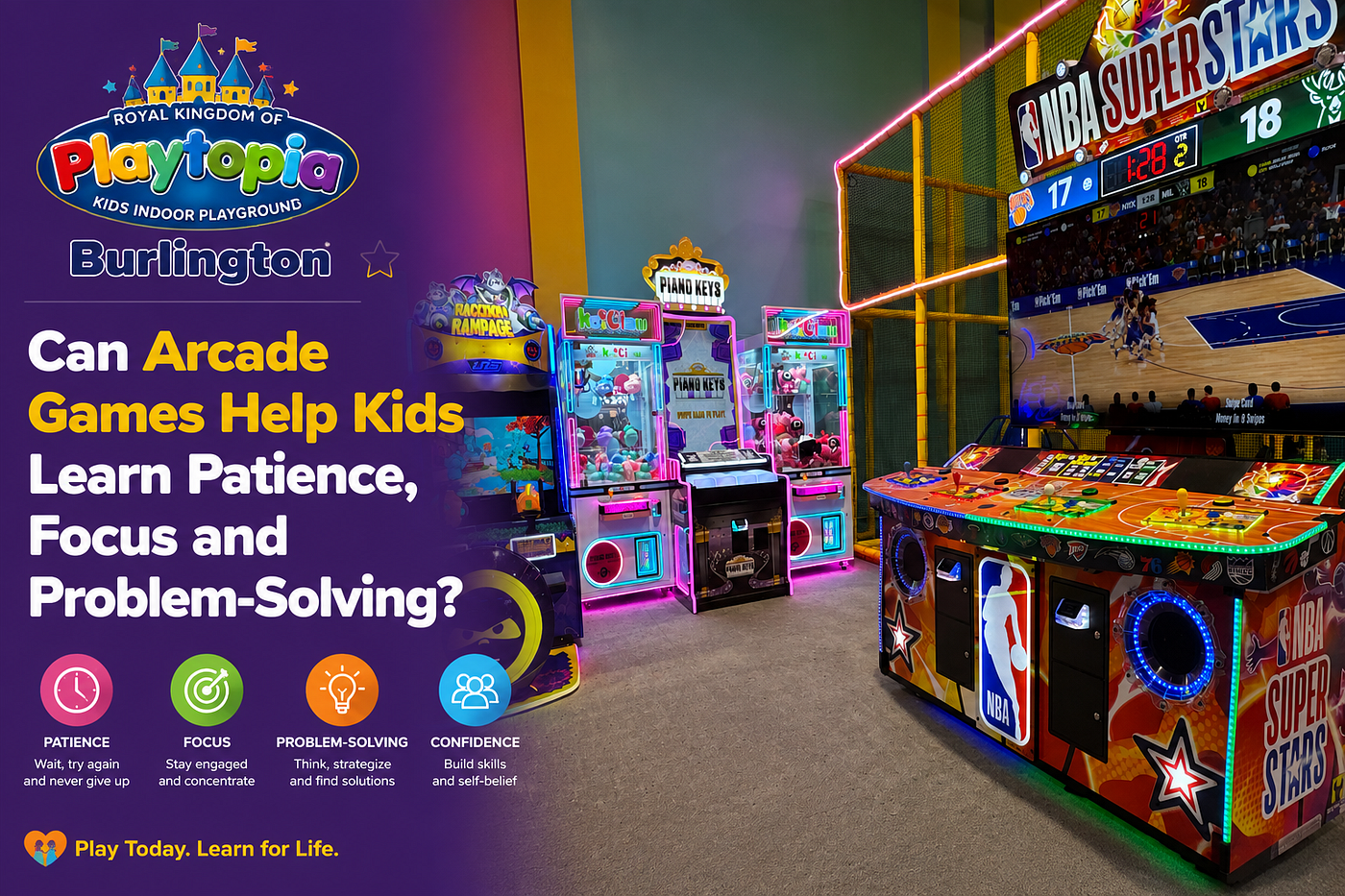
View_of_arcade_games_at_playtopia_burlington
Aren’t arcade games just another screen?
It’s a fair question, and worth answering honestly. Arcade games are different from passive screen time like watching videos. They require a child to react, think ahead, and adjust their strategy in real time. That kind of active engagement is closer to a puzzle than a passive scroll, and it uses a different part of a child’s brain than simply watching something play out.
How do arcade games build patience?
Most arcade games don’t reward a child on the first try. Getting a high score, beating a level, or landing a tricky shot usually takes a few attempts. Kids learn, often without realizing it, that improvement takes repetition. That’s a genuinely useful lesson, and one that’s easier to absorb through a game than through a lecture about trying harder.
Building focus and concentration
Arcade games demand attention in short, intense bursts. A racing game requires constant small adjustments. A claw machine takes precise timing. A shooting gallery rewards a steady hand and a sharp eye. These moments train a child’s ability to concentrate on one task without getting distracted, a skill that carries over well beyond the arcade floor.
Do arcade games actually teach problem-solving?
Many arcade games are built around quick decision-making. A child has to read a situation, figure out the best move, and act on it within seconds. Here’s what that looks like in practice:
- Pattern recognition — noticing how a game behaves and adjusting strategy accordingly.
- Cause and effect — understanding that a specific action leads to a specific result.
- Quick decision-making — choosing a move under a bit of time pressure, then living with the outcome.
- Trial and error — trying something, seeing it fail, and adjusting without giving up.
Worth noting: these are the same mental skills used in everyday problem-solving, just practiced in a low-stakes, genuinely fun setting.
What to look for in a good arcade setup
Not every arcade offers the same value. A few things worth checking:
- A mix of games suited to different ages and skill levels
- Clean, well-maintained machines that actually work properly
- A ticket or reward system that feels fair and motivating
- A space that’s supervised and safe for kids to enjoy independently
Level Up at Playtopia Burlington
Playtopia Burlington’s indoor arcade is built with exactly this in mind. There’s a genuine range of games for different ages, a rewards system that keeps kids motivated to improve, and a supervised, family-friendly space where parents can relax while their kids build real skills without even realizing it. It’s the kind of stop that turns a regular outing into something kids ask to come back to.
Ready to see how many rounds it takes to master a new game? Plan a visit to the arcade at Playtopia Burlington and let the kids start racking up wins.
메타데이터
- post_id
- f2e51bb3007c
- slug
- can-arcade-games-help-kids-learn-patience-focus-and-problem-solving-f2e51bb3007c
- url
- https://medium.com/@playtopia.ca/can-arcade-games-help-kids-learn-patience-focus-and-problem-solving-f2e51bb3007c
- canonical_url
- https://medium.com/@playtopia.ca/can-arcade-games-help-kids-learn-patience-focus-and-problem-solving-f2e51bb3007c
- author_url
- https://medium.com/@playtopia.ca
- status
- ok
- fetched_at
- 2026-08-05 22:41:39