Qalb in Qur’anic Context
قَلْب (qalb) is from the root ق ل ب, and the Qur’an’s own usage strongly shows the root idea of turning, changing, reversing, and shifting…
Qalb in Qur’anic Context
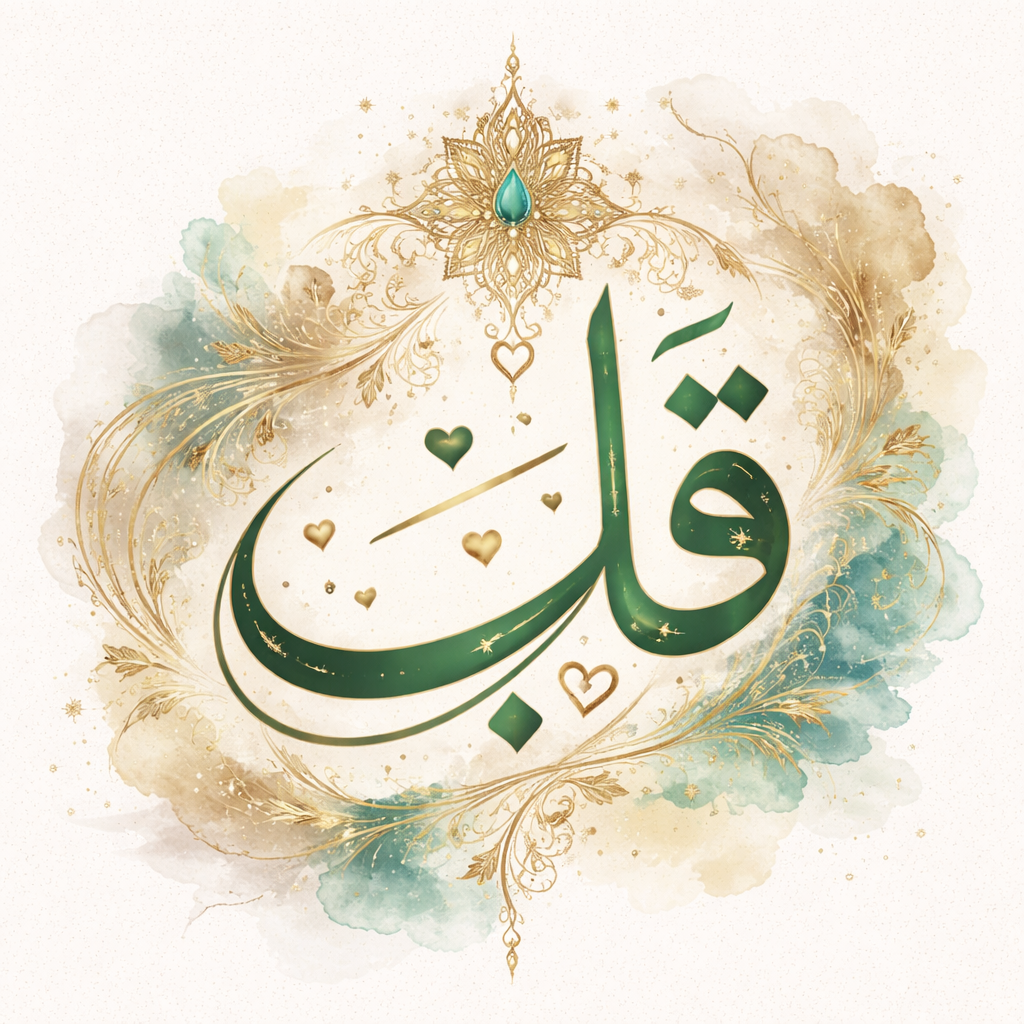
قَلْب (qalb) is from the root ق ل ب, and the Qur’an’s own usage strongly shows the root idea of turning, changing, reversing, and shifting. The Quranic Arabic Corpus lists this root across verbs, nouns, and participles with meanings such as turn, overturn, return, turn about, and heart. That pattern is why many scholars connect qalb to something that turns or changes state. (corpus.quran.com)
The big Quranic idea of qalb
In the Qur’an, qalb is not just the physical organ. It is the inner center of:
- understanding,
- intention,
- faith,
- receptivity,
- moral condition,
- and spiritual change.
So when the Qur’an uses qalb, it often means the inner self that turns toward truth or away from it. This matches the root sense of turning.
1) The heart is where understanding happens
A very important verse is:
22:46 فَتَكُونَ لَهُمْ قُلُوبٌ يَعْقِلُونَ بِهَا “so that they may have hearts by which they reason…” and then: “it is not the eyes that are blind, but the hearts in the chests.” (Quran.com)
This verse is very important because it shows that in Qur’anic language, the heart reasons. Tafsir on this verse explains that real blindness is not physical eyesight alone; it is loss of inner insight. A person may see outwardly, but if the heart does not understand, he still misses the truth. (Quran.com)
Another key verse is:
50:37 لِمَنْ كَانَ لَهُ قَلْبٌ
“for whoever has a heart…”
Tafsir there reports from Ibn ʿAbbas that qalb here means ʿaql in the sense of sound understanding, because the heart is the center by which one truly grasps the reminder.
Meaning here
So in Qur’anic context, qalb is the place of:
- reflection,
- comprehension,
- receiving warning,
- and benefiting from revelation.
2) The heart can be alive, soft, and responsive
Another major theme is that the heart is meant to soften and respond to Allah’s reminder.
57:16 says believers’ hearts should become humble to Allah’s remembrance. Tafsir explains khushūʿ al-qalb as the heart becoming soft, receptive, obedient, and ready to submit to divine guidance.
And in 8:24, Allah says:
وَاعْلَمُوا أَنَّ اللَّهَ يَحُولُ بَيْنَ الْمَرْءِ وَقَلْبِهِ “Know that Allah stands between a person and his heart.”
Tafsir on this says the statement carries a warning and deep wisdom: Allah has complete power over the human inner state. Ibn Kathir reports explanations including that Allah prevents a person from what the heart might want, and that hearts are fully under His control.
Meaning here
This fits the root ق ل ب beautifully:
- the heart turns,
- but Allah is the One with ultimate control over that turning.
3) The heart can become sick
The Qur’an also speaks of diseased hearts.
2:10 فِي قُلُوبِهِمْ مَرَضٌ “In their hearts is a disease…”
Tafsir explains this disease as spiritual corruption such as hypocrisy, unbelief, rejection of truth, and surrender to lower desires. Maʿarif describes it as a spiritual sickness; Ibn Kathir also presents it as the inner corruption of hypocrites.
Meaning here
So the qalb is not neutral in the Qur’an. It has conditions:
- healthy,
- sick,
- soft,
- hard,
- sound,
- blind,
- sealed.
That is another strong reason scholars connect qalb with the idea of constant inner turning and change.
4) The heart can be sealed
2:7 says:
خَتَمَ اللَّهُ عَلَىٰ قُلُوبِهِمْ “Allah has sealed their hearts…”
In Qur’anic context, this is not about the biological heart. It means the inner faculty of receiving truth has become closed off as a result of persistent rejection. Tafsir places this with loss of receptivity, understanding, and guidance.
Meaning here
A sealed qalb is a heart that no longer turns properly toward guidance.
5) The ideal is a sound heart
One of the most beautiful verses is:
26:89 إِلَّا مَنْ أَتَى اللَّهَ بِقَلْبٍ سَلِيمٍ “Except the one who comes to Allah with a sound heart.”
Tafsir explains qalb salīm as a heart free from shirk and inner corruption. Reports cited there say it is the heart of a true believer, unlike the diseased heart of the disbeliever or hypocrite.
Meaning here
The Qur’anic goal is not merely “having a heart,” but having a sound, pure, whole, unspoiled heart before Allah.
6) The heart can turn in fear on the Last Day
24:37 says believers fear a Day:
تَتَقَلَّبُ فِيهِ الْقُلُوبُ وَالْأَبْصَارُ “when hearts and eyes will be overturned / will turn about.”
This is especially important for your question, because here the same root appears in verbal form: تَتَقَلَّبُ. Tafsir explains it as the terror and upheaval of the Day of Judgment affecting the inner and outer faculties of human beings.
Meaning here
This verse almost gives you the root meaning directly:
- hearts turn,
- eyes turn,
- everything is shaken, reversed, and unsettled.
That helps explain why qalb is such a fitting noun from ق ل ب.
7) The root outside “qalb” confirms the turning meaning
The broader root usage in the Qur’an confirms the semantic field:
- Allah “alternates” night and day: يُقَلِّبُ اللَّهُ اللَّيْلَ وَالنَّهَارَ in 24:44,
- the People of the Cave are “turned” right and left in 18:18,
- people are “returned” to Allah in 29:21 and related uses,
- faces are “turned about” in the Fire in 33:66.
These are not about the heart specifically, but they prove the root ق ل ب carries the strong sense of:
- turning,
- reversal,
- alternation,
- return,
- changed condition.
So when the noun qalb is used for the inner human center, it naturally carries the shade of something liable to turn, change, and shift.
Best conclusion
So the detailed Qur’anic picture is this:
Qalb is called qalb not just because it means “heart,” but because in the Qur’an it is the inner faculty that keeps turning — toward faith or away from it, toward humility or hardness, toward health or disease, toward guidance or blindness.
The other forms of ق ل ب in the Qur’an strengthen this meaning by repeatedly showing the root as one of turning, reversal, alternation, and return.
메타데이터
- post_id
- f2ea9642be4e
- slug
- qalb-in-quranic-context-f2ea9642be4e
- url
- https://medium.com/@emque123/qalb-in-quranic-context-f2ea9642be4e
- canonical_url
- https://medium.com/@emque123/qalb-in-quranic-context-f2ea9642be4e
- author_url
- https://medium.com/@emque123
- status
- ok
- fetched_at
- 2026-06-24 11:06:28