Multi-Agent Orchestration on Microsoft Azure
Dividing tasks into specialized domains managed by agents, organizations can achieve modularity, and operational clarity. The Microsoft…
Multi-Agent Orchestration on Microsoft Azure
Dividing tasks into specialized domains managed by agents, organizations can achieve modularity, and operational clarity. The Microsoft Agent Framework(MAF) is latest after AutoGen and Semantic Kernel.
The Microsoft Agent Framework supports five built-in multi-agent orchestration topologies.
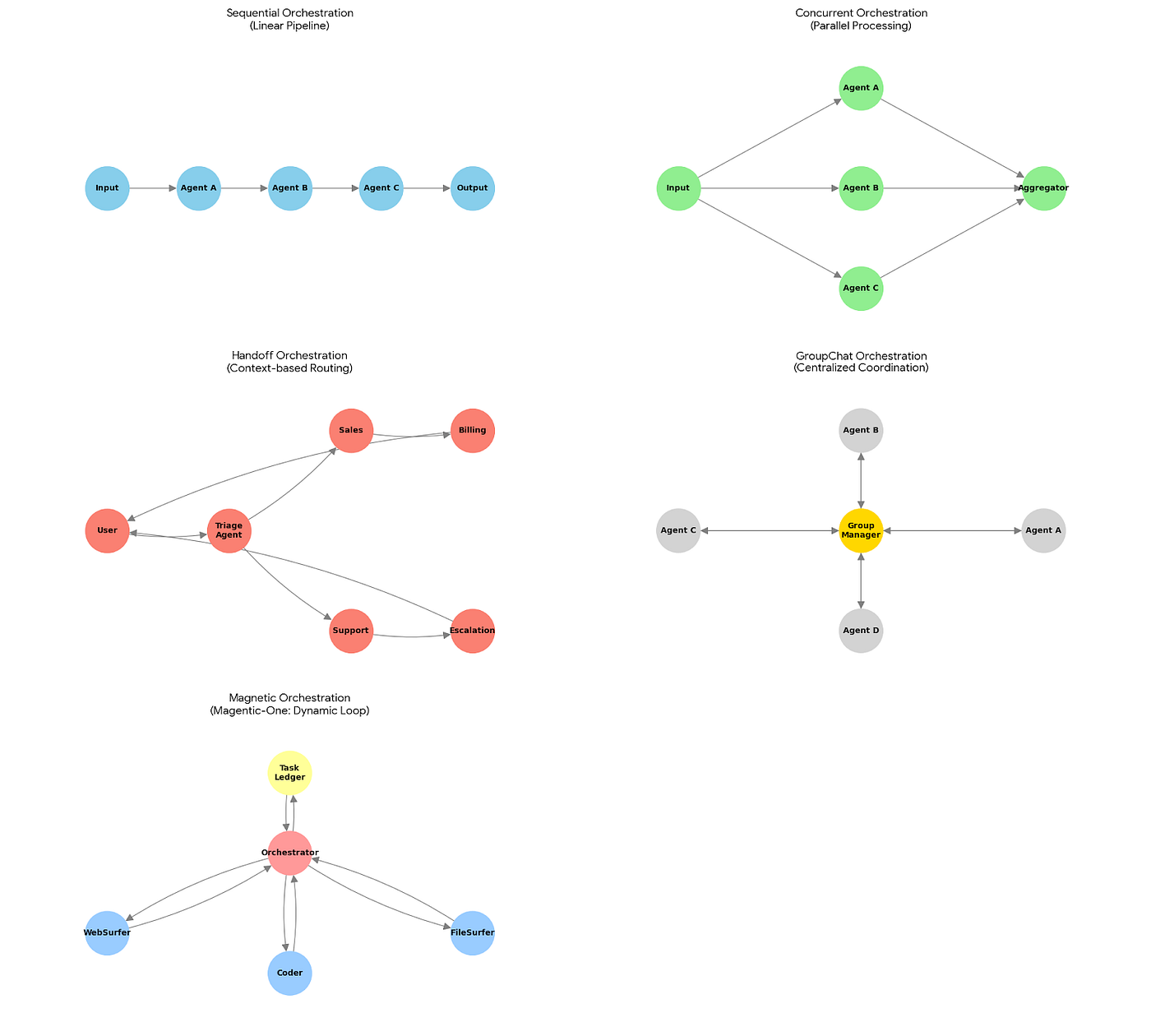
Sequential Orchestration

- Is predefined and linear pipeline
- Passes the updated conversation directly to the next participant agent.
- Pipes and Filters design pattern used in cloud architecture
- Example of [Researcher agent] > [writer agent] >[editing agent].
- Disadvantage: downstream error propagation if an early step produces error output or encounters a tool execution failure.
Concurrent Orchestration
- Multiple agents in parallel on a shared input.
- Latency is based on slowest agent rather than the sum of all tasks
- Fan-out/Fan-in or Map-Reduce software patterns
- Example of triggering [static security analysis], [compliance checks], and [automated QA] rules on a code PR.
- Aggregator Agent process merges the results into a unified report.
Handoff Orchestration

- Mesh topology where agents directly transfer control to one another.
- If agent a task falls outside its specialization, invokes the designated handoff tool(such as handoffto<agent_name>), suspending its own runtime, shifting the active agent flag to hand-off agent.
- Example of Bug triage: Customer incident hand-off to [Billing agent],[Technical Agent] or [User Management Agent].
Group Chat Orchestration
- Collaborative conversation in a shared thread.
- Star topology managed by a centralized chair -Group Chat Manager.
- Speaker selection functions — Round Robin or model-driven selector agents.
- Example of Scripts or Architecture validation: brainstorming and collaborative validation, allowing agents to challenge and build upon reasoning steps.
- Disadvantages: Shared thread context, the system requires Human-in-loop to control token overhead.
Magentic Orchestration

- Dynamic hierarchical planner model
- Magentic-One manager tracks goals, generates step-by-step plans, delegates actions to specialist sub-agents.
- Magentic-One manager dynamically adjusts its strategies in response to runtime hurdles or unexpected API outputs.
- Example of open-ended, complex tasks where the path to a solution cannot be known in advance.
- Disadvatage: iterative planning loops adds to reasoning overhead, results in higher execution costs and latency.
Best practices:
- Model Routing classification, format validation, and data extraction steps to smaller models, and reasoning models for complex planning and synthesis tasks.
- Integrating middleware that summarizes or removes duplicate messages, between agent transitions controls token usage.
- Avoid hardcoding static credentials or API keys in configuration files. Use APIM endpoints or Azure Active Directory with DefaultAzureCredential to govern secure access to model endpoints.
- Use OpenTelemetry to export traces to Azure App Insights to identify bottlenecks and infinite conversational loops.
메타데이터
- post_id
- f2edfd804b3a
- slug
- multi-agent-orchestration-on-microsoft-azure-f2edfd804b3a
- url
- https://medium.com/@nischal-s/multi-agent-orchestration-on-microsoft-azure-f2edfd804b3a
- canonical_url
- https://medium.com/@nischal-s/multi-agent-orchestration-on-microsoft-azure-f2edfd804b3a
- author_url
- https://medium.com/@nischal-s
- status
- ok
- fetched_at
- 2026-08-04 16:50:48



