Differences Between Baltic Amber and Dominican Amber
Amber has captivated people for centuries with its golden glow and the ancient secrets it holds inside. Two of the most renowned sources of…
Differences Between Baltic Amber and Dominican Amber
Amber has captivated people for centuries with its golden glow and the ancient secrets it holds inside. Two of the most renowned sources of this gemstone are the Baltic region of Northern Europe and the Dominican Republic in the Caribbean. At first glance, amber from these regions might seem similar — both are beautiful pieces of fossilized tree resin used in jewelry — but there are fascinating differences in their origin, appearance, and properties. Understanding the differences between Baltic amber and Dominican amber can help you appreciate each type’s unique qualities. In this article, we will explore how these ambers differ in terms of formation, look, inclusions, chemistry, and their roles in jewelry and culture.
Origins and Formation of Baltic vs. Dominican Amber
When comparing Baltic amber and Dominican amber, a good place to start is their origin story. These gemstones formed in different eras and environments, which influences their characteristics today.
Baltic Amber’s Ancient Northern Origins
Baltic amber, often called the “Gold of the North,” comes from the region surrounding the Baltic Sea — including modern-day Poland, Lithuania, Latvia, Russia (Kaliningrad area), and Estonia. This amber is remarkably old, with an age of around 40 to 50 million years (dating back to the Eocene epoch). It began as resin from ancient coniferous trees (similar to pines or cypresses) that once thrived in the vast forests of Northern Europe. Over millions of years, the sticky resin was buried and hardened through a natural polymerization process, transforming into amber.
One distinctive aspect of Baltic amber’s formation is that much of the resin was carried by rivers and deposited in coastal sediments. As a result, significant Baltic amber deposits are found in marine “blue earth” layers and along the shores of the Baltic Sea. Even today, it’s not uncommon for locals to find small amber nuggets washed up on Baltic beaches after storms. This long geological journey — from forest resin to seashore gemstone — means Baltic amber often has signs of this history, including occasional saltwater inclusions or a worn surface from being tumbled by waves.
The history of Baltic amber is rich and extensive. For thousands of years, people have collected and traded it. The ancient Romans, for instance, valued Baltic amber immensely; routes for trading amber from Northern Europe to the Mediterranean became known as the “Amber Road.” Such a long legacy has made Baltic amber synonymous with history and tradition. It’s not just a gem, but a cultural treasure in regions around the Baltic Sea.
Dominican Amber’s Tropical Caribbean Origins
Dominican amber, by contrast, formed in a very different setting. It is found on the Caribbean island of Hispaniola, primarily in the Dominican Republic (with some deposits in adjacent areas). The resin that created Dominican amber oozed from tropical trees in a prehistoric rainforest. Scientists believe one of the main sources was an extinct species of tree in the Hymenaea genus (a tropical legume tree). These trees produced copious resin that dripped and flowed in the humid forest, sometimes trapping insects and plant material along the way.
Dominican amber is younger than Baltic amber. Most Dominican amber formed around 15 to 20 million years ago (during the Miocene epoch, and possibly as early as the Oligocene, according to some studies). Even the oldest Dominican ambers are roughly half the age of Baltic ambers. Because of its more recent formation, Dominican amber is often not as fully fossilized — it’s still true amber (not just copal), but its slightly younger age can influence some of its properties, as we will see later.
Geologically, Dominican amber is found not by the seaside, but inland, often buried in sedimentary rock layers in mountainous regions of the Dominican Republic. It typically occurs within lignite (a type of brown coal) or sandstone that formed from the ancient forest floor. Extracting it is a challenging task: local miners commonly dig narrow tunnels (called bell pits) into hillsides to reach the amber-bearing layers. This mining method is quite primitive and risky — pits are dug by hand with basic tools, ventilation is poor, and cave-ins are a constant danger. Despite these hardships, mining continues on a small scale, driven by the stone’s beauty and value.
Summary of Origins: In short, Baltic amber hails from an ancient northern pine forest and was shaped by the Baltic Sea’s coastal processes, whereas Dominican amber comes from a younger tropical rainforest environment and is mined from inland deposits. These distinct origins — one in a cool temperate climate, the other in a lush tropical climate — set the stage for many differences in appearance and composition between the two ambers.
Physical Characteristics and Appearance
Even without knowing their background, you can often spot differences in look and feel between Baltic and Dominican amber. They each boast a range of colors and clarity levels, but certain traits are more typical of one versus the other.
Color Variations in Baltic Amber and Dominican Amber
Color is the first thing you notice about any gemstone. Both Baltic and Dominican ambers come in beautiful colors, but their color palettes have some differences:
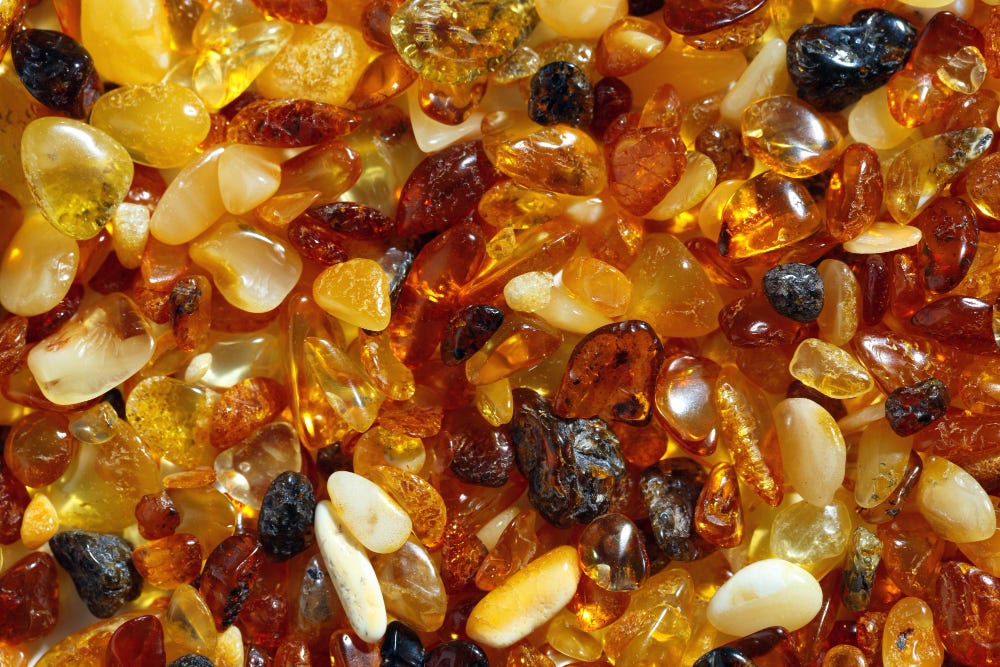
- Baltic Amber Colors: Baltic amber is famous for its warm, rich hues. The most common colors are golden honey, yellow-orange cognac, and deep orange-brown. There are also other varieties: for instance, butterscotch amber is a popular Baltic amber variety with a creamy yellow or milky appearance (this opaque, matte amber is practically a trademark of Baltic sources). You can also find Baltic amber in shades of cherry red (often achieved by gentle heating of amber to deepen its color) and green (usually a mossy or olive green tint, sometimes enhanced by treatments). Blue-colored Baltic amber is extremely rare — authentic blue-toned pieces from the Baltic are so scarce that most people will never encounter one. Generally, if you come across blue amber, it’s almost certainly not Baltic.
- Dominican Amber Colors: Dominican amber, on the other hand, is renowned for a broader color spectrum and especially for colors that are uncommon elsewhere. While you can find typical amber shades of yellow, orange, and brown in Dominican amber too, this region is particularly famous for its red amber, green amber, and the coveted blue amber. Dominican blue amber is one of the most extraordinary varieties — it can appear pale yellow or brown in normal indoor light, but when exposed to sunlight it shows a striking blue fluorescence, almost glowing electric blue. This effect is caused by natural chemicals (aromatic compounds) in the resin that fluoresce under ultraviolet light. Blue amber is essentially unique to the Dominican Republic’s mines, making it a highly prized collector’s item. Dominican amber also includes lovely cherry reds and cognac oranges, sometimes naturally and sometimes as a result of slight heating under the earth. In summary, Dominican amber can surprise with vibrant colors, whereas Baltic amber’s colors are typically more “classic” and warm.
It’s important to note that color alone cannot definitively tell you an amber’s origin — there is overlap. For example, a yellow piece of amber could come from either the Baltic or the Dominican. However, if you see a piece with a rich blue sheen or a very clear, bright red, you might suspect it to be Dominican amber. Conversely, an opaque butter-yellow piece is likely Baltic.
Transparency and Clarity Differences
Beyond color, another noticeable difference is the clarity or transparency of the amber. Amber can range from completely transparent (clear like glass) to fully opaque (solid and cloudy, with no light passing through).
- Baltic Amber Clarity: Baltic amber spans the full range of clarity. You can find very transparent Baltic amber that you can see through easily, especially when it’s polished. However, Baltic amber is also well known for its cloudy or opaque varieties. Many Baltic amber pieces contain tiny air bubbles or microscopic particles inside that give them a hazy look. This is why some Baltic amber appears milky or frothy (like the butterscotch kind, which owes its matte yellow appearance to millions of micro-bubbles). Even within otherwise clear Baltic amber, you might see swirls or wisps of cloudiness (sometimes called “sun spangles” or schlieren) from how the resin flowed and solidified. These internal characteristics often mean that inclusions (like insects) in Baltic amber can be harder to see unless the piece is quite transparent.
- Dominican Amber Clarity: Dominican amber is typically more transparent on average. A lot of Dominican amber is clear or at least translucent, meaning you can hold it up to the light and easily see through it. It’s common to find Dominican amber pieces that are water-clear yellow or orange, which makes any inclusion inside clearly visible. The high clarity is part of what makes Dominican amber exciting for collectors who love to see insects or plant fragments encased inside. That said, not all Dominican amber is perfectly clear — some pieces have impurities or many internal flow lines that can create cloudy regions. But relative to Baltic amber, Dominican amber tends to contain fewer clouding elements like air bubbles. The difference is such that if you have two similar-colored pieces — one Dominican and one Baltic — the one you can more easily read text through is likely the Dominican piece.
The reason for these clarity differences lies in how the resin was exuded and fossilized. Baltic resin often interacted with moisture or trapped more gas bubbles as it hardened (especially since some resin chunks were transported by water to a marine environment), whereas the Dominican resin, which hardened in a warm, dense rainforest environment, often retained high transparency.
Notable Unique Features
Each type of amber also has special features worth highlighting:
- Baltic Amber’s “Sun Spangles” and Opaque Varieties: When Baltic amber is gently heated (a common treatment to improve clarity or change color), it can develop sparkling disc-like cracks known as sun spangles. These look like tiny shiny scales or circular flash patterns inside the amber. Some jewelry lovers find this effect attractive, as it adds internal texture. Additionally, Baltic amber’s opaque varieties (like white “bone amber” or the yellow butterscotch amber) are uniquely prized and commonly used in jewelry from that region. These opaque ambers are less common in Dominican sources.
- Dominican Amber’s Blue Glow: The most famous unique feature of Dominican amber is the blue glow discussed earlier. To elaborate, if you shine ultraviolet light (a UV blacklight) on Dominican blue amber, it fluoresces a vivid bright blue. Even in normal sunlight, this fluorescence can cause a piece of blue amber to show a bluish halo. This phenomenon doesn’t occur in Baltic amber — under UV light, Baltic amber typically fluoresces a weaker bluish or whitish glow, nothing like the strong blue of Dominican blue amber. This makes blue amber from the Dominican Republic incredibly distinctive.
- Hardness and Texture: Both Baltic and Dominican amber are relatively soft, organic gem materials. On the Mohs hardness scale, they both rank around 2 to 3, which is quite soft (for comparison, a fingernail is about 2.5, and glass is around 5.5). There is no huge difference in hardness between the two, though some gem enthusiasts say Baltic amber can be slightly more robust due to its greater age and level of polymerization. In practice, both types can be scratched by sharp objects and should be handled with some care. To the touch, raw Baltic amber sometimes has a slightly waxy feel and may develop a light patina over time. Dominican amber, when held, feels just as lightweight and warm as Baltic amber; very clear pieces can almost resemble hardened candy or glass because you can see right through them, but they’re much lighter than glass.
In summary, Baltic amber tends to showcase classic warm colors and often has some cloudiness, whereas Dominican amber tends to have more exotic colors (especially blue or red) and is usually more transparent. These visual cues are helpful guides, although there are exceptions in each case and you might find clear Baltic pieces or cloudy Dominican ones as well.
Inclusions: Treasures Trapped Inside
One of amber’s most fascinating aspects is that it sometimes contains inclusions — bits of the prehistoric world encased within it. These can be insects, spiders, plant material like leaves or seeds, and occasionally even small vertebrates. Both Baltic and Dominican amber are known for inclusions, but there are differences in abundance and the types of creatures or plants found.
Inclusions in Baltic Amber
Baltic amber has been studied for over two centuries by scientists (paleontologists) because it preserves a snapshot of life in a northern European forest tens of millions of years ago. Insect inclusions are quite common in Baltic amber. You might find ants, beetles, flies, mosquitoes, moths, or other small insects, as well as spiders, mites, or even pollen and bits of leaves. Because the Baltic resin sometimes flowed near or into water, an intriguing clue to Baltic amber’s history is that some pieces contain microorganisms from the sea — for example, tiny barnacles or microscopic plankton (foraminifera) have been identified attached to Baltic amber pieces. Finding marine microfossils stuck to amber suggests the resin sometimes floated out to sea or was deposited in ancient coastal areas. This is something uniquely noted in Baltic amber and not seen in amber from landlocked deposits like the Dominican.
The preservation quality of Baltic amber inclusions is generally very good, though the presence of cloudiness in the resin can sometimes make fine details harder to see. Even so, scientists have described thousands of extinct species from Baltic amber fossils — everything from ancient ants and bees to flies carrying malaria parasites have been found, providing rich insight into the Eocene ecosystem. The inclusions in Baltic amber often reflect a temperate forest environment. For instance, you’ll find creatures that thrived in a climate similar to a warm coastal forest: various insects that prefer resinous trees, as well as bits of pine needles or oak leaves preserved alongside them.
Larger creatures in Baltic amber are exceedingly rare but not unheard of — there are famous specimens of Baltic amber containing small lizards, snail shells, or bird feathers. These are very scarce and highly valued by collectors and museums. Typically, though, the creatures in Baltic amber are quite small (a few millimeters in size). The resin hardened fairly quickly, which helped preserve delicate structures like insect wings or tiny hairs in many cases.
Collectors and jewelry makers prize Baltic amber with visible inclusions. A piece of clear Baltic amber showcasing an ancient insect can significantly increase in value. There’s something awe-inspiring about seeing a 35- to 45-million-year-old insect perfectly preserved, and knowing it once buzzed around in a world long gone.
Inclusions in Dominican Amber
Dominican amber is often celebrated for its abundance of spectacular inclusions. Because this amber formed in a tropical rainforest, the types of inclusions reflect that environment. You’ll frequently find tropical insects: for example, stingless bees, colorful beetles, spiders, ants, and mosquitoes, as well as fragments of exotic flowers and leaves. Dominican amber is particularly famous for preserving some creatures with astonishing detail. Thanks to the high clarity of the resin, inclusions in Dominican amber are often easy to observe under a microscope or even with the naked eye. You can often see minute features like the facets of an insect’s eye or the tiny legs of a trapped spider in remarkable definition.
A notable difference is that inclusions seem to be more common in Dominican amber pieces (or at least a higher percentage of Dominican amber on the market contains eye-visible fossils). This might be partly because the sticky resin in a busy tropical forest trapped a lot of organisms, and partly because collectors actively seek out and select pieces with interesting inclusions for sale.
Dominican amber has yielded some spectacularly rare inclusions that spark wonder. For example, small lizards (geckos or anoles) have been found preserved, including one famous piece with a tiny lizard perfectly encased. There is even a piece of Dominican amber reported to contain parts of a hummingbird — an incredibly rare find, as vertebrates larger than a few centimeters almost never get caught in resin. Frogs, snail shells, and feathers from birds have also been discovered. These kinds of inclusions are extraordinary and are usually kept in museum collections or high-end private collections due to their scientific value.
In terms of insect inclusions, Dominican amber often contains species that are different from those in Baltic amber, which is expected given the different environments and ages. For example, Dominican amber might have ancient relatives of tropical butterflies or bees that you wouldn’t see in Baltic amber. The preservation is so detailed that researchers have been able to reconstruct aspects of the long-vanished Miocene tropical forest — identifying plants and insects and even analyzing the pollen inside the amber.
Comparing the two, you could say Baltic amber inclusions often reflect a temperate forest ecosystem, occasionally even showing evidence of contact with the sea, while Dominican amber inclusions reflect a dense tropical jungle ecosystem, with an arguably higher frequency of well-preserved insects. If you had two pieces — one with a perfectly preserved fly in clear resin and another with a slightly hazy ant — the crystal-clear one with a tropical species is likely Dominican, and the hazier could be Baltic (though both types can produce clear or hazy pieces).
Because amber inclusions are so prized, there are also many fakes on the market (for example, modern insects inserted into melted amber or plastic). Knowing the typical characteristics of Baltic vs. Dominican inclusions can help in authentication. For instance, a very large, colorful butterfly perfectly preserved in clear amber might raise suspicion — large butterflies are virtually unknown in Baltic amber and even in Dominican amber they would be rare (and likely brittle). Experts can often tell by the species of insect and the style of preservation which region an amber piece came from.
Chemical Composition and Other Properties
Thus far, we’ve looked at visible differences, but Baltic and Dominican amber also differ in their chemistry and some physical properties. While an average person might not test these at home, these factors are interesting and help gemologists identify an amber’s origin.
Succinic Acid Content — “Succinite” vs. Other Amber
One of the hallmark differences lies in a chemical called succinic acid. Baltic amber is notable for its succinic acid content, whereas Dominican amber contains very little.
- Baltic Amber (Succinite): Baltic amber typically contains about 3% to 8% succinic acid by weight. Because of this, Baltic amber’s scientific name is often succinite. Succinic acid is an organic compound that doesn’t visibly change amber, but it’s a signature of Baltic amber’s tree source. Interestingly, succinic acid is sometimes credited with health benefits — in folk medicine and crystal healing circles, Baltic amber is believed to release soothing oils due to its succinic acid when warmed against the skin. (This is the rationale behind Baltic amber teething necklaces for babies, which proponents claim can relieve pain, though scientific evidence is not conclusive.)
From a testing standpoint, succinic acid provides a way to identify Baltic amber in a lab. If amber is ground into powder and treated with certain chemicals, Baltic amber will produce a distinct reaction or smell (a gentle heating can release a fragrant, pine-like aroma from Baltic amber, partly due to the succinic acid and other resins). In fact, a simple burn test — though not recommended unless you’re okay damaging a piece — will show that Baltic amber tends to burn with a soothing pine resin scent. This high succinic content and the related piney aroma are unique markers of Baltic amber.
- Dominican Amber: Dominican amber, in contrast, has a negligible amount of succinic acid. Chemically, it’s a different resin type, sometimes called retinite (since it lacks succinic acid). If you performed the same chemical test on Dominican amber, the reaction would be faint or negative because there isn’t much succinic acid to detect. In practical terms, this difference in chemistry doesn’t change how the amber looks or is used — a casual admirer wouldn’t know the succinic acid content just by looking. However, to a gemologist or chemist, this is a key difference confirming origin. One anecdotal effect of the chemistry is the scent: when heated or cut, Dominican amber can also smell pleasant, but the aroma is often described as more subtle or “sweet incense-like” compared to the sharp pine scent of Baltic.
The succinic acid content has given Baltic amber a sort of marketing edge historically — it was often touted as having special properties (hence the many Baltic amber medicinal products). Dominican amber doesn’t share that particular trait, but it has other unique selling points (like its colors and clarity).
Density and “Float” Test
Amber is very lightweight for a gemstone. Both Baltic and Dominican amber will float in saltwater (and sometimes even in plain water if the piece is small enough) because their density is around or just slightly above 1.0 (water’s density is 1.0 g/cm³).
- Baltic Amber Density: Baltic amber’s density is typically in the range of about 1.05 to 1.10 g/cm³. Thanks to those trapped bubbles and its composition, many pieces of Baltic amber will float in a saturated salt solution (very salty water) since the saltwater can have a density of about 1.1+ g/cm³, equal to or higher than the amber’s density. This “float test” is a classic way to distinguish real amber from many fakes: real amber (Baltic, especially) often floats in saltwater, whereas imitations like plastics or glass sink because they’re heavier (be aware though, some plastics can float too, and Dominican amber’s density overlaps with Baltic’s, so this test is not foolproof for origin, only for authenticity of amber in general).
- Dominican Amber Density: Dominican amber’s density generally ranges from about 1.04 to 1.12 g/cm³. There is overlap with Baltic amber, but Dominican amber can be a tad heavier on average (since it often has fewer air bubbles). In a saltwater float test, some Dominican amber pieces will float, but others might sink or hover just below the surface, depending on their exact density and inclusion content. For example, a Dominican amber with a big insect might be slightly heavier.
The density difference between Baltic and Dominican amber is small and not something you’d notice just by handling them (both feel very light). But it’s interesting that Baltic amber — often more opaque — is slightly less dense on average, while clear Dominican amber is slightly more dense. In either case, both types of amber feel almost “warm” and lightweight in the hand, quite unlike heavier gemstones or even glass.
Fluorescence under UV Light
A fun property of amber is that it fluoresces under ultraviolet (UV) light. This means amber can glow or display a visible color when exposed to UV rays (like those from a blacklight). Both Baltic and Dominican amber have a fluorescent response, but their behaviors differ:
- Baltic Amber UV Response: Baltic amber typically shows a moderate fluorescence. Under longwave UV light (the common kind of blacklight at 365 nm), Baltic amber often emits a gentle glow that appears yellowish-white, milky blue, or greenish. It’s usually a cloudy glow, not extremely bright, but definitely visible in a dark room. Under shortwave UV (which is a more intense UV often used by mineralogists), Baltic amber may show a faint light blue or greenish-blue, though some pieces might not react strongly. In practical terms, if you have a UV flashlight, a piece of Baltic amber will often display a mild milky-blue or yellow haze in the dark.
- Dominican Amber UV Response: Dominican amber tends to have a stronger and more varied fluorescence. Especially in the case of blue amber from the Dominican Republic, under longwave UV light it will glow a vibrant blue. In fact, the blue visible in normal light is a result of this strong fluorescence. Even Dominican amber pieces that are not blue amber can fluoresce a blue or greenish-blue color more intensely than Baltic amber does. Collectors sometimes use UV light to quickly check rough Dominican amber — those that fluoresce bright blue under UV are likely to be the coveted blue amber. Under shortwave UV, Dominican amber also generally shows a stronger reaction than Baltic, sometimes a bright blue or green flash.
This difference in fluorescence is due to the different chemical compounds present in the resins. Dominican amber contains certain polycyclic aromatic hydrocarbons (from its original tree resin and perhaps interactions while fossilizing) that react strongly to UV light. Baltic amber’s chemistry lacks those specific compounds in high concentration, so its fluorescence is weaker. For someone with a UV lamp, this can be a cool experiment to tell them apart: the piece that glows intensely blue is probably Dominican, while the one with a soft glow is likely Baltic.
Other Chemical and Physical Traits
- Refractive Index: Both Baltic and Dominican amber have a similar refractive index (~1.54), meaning they bend light similarly. This isn’t something noticeable without instruments and doesn’t differentiate the two.
- Static Electricity: All amber, when rubbed with a cloth, can develop static electricity. The ancient Greeks observed this property (and the Greek word for amber, elektron, is the root of the word “electricity”). Baltic and Dominican amber both will attract a small piece of paper or dust after rubbing — there’s no meaningful difference here, as this is a general amber trait.
- Behavior with Heat: Amber softens under heat and will eventually burn if it gets hot enough. Both types behave similarly in this regard. One difference is the aroma upon burning or heating: as mentioned, Baltic amber tends to give off a piney resin smell, while Dominican amber’s scent might be slightly sweeter. Neither melts like plastic; instead, amber will char and combust slowly, because it’s an organic resin.
In summary, aside from the succinic acid distinction (Baltic amber being high in it, Dominican low), the two types share many physical properties typical of amber. It’s in the subtle details and lab tests (like fluorescence and succinic content) that experts can tell them apart chemically.
Uses, Value, and Market Differences
Both Baltic and Dominican amber are sought after for jewelry, decorative objects, and collecting, but their presence in the market and perceived value can differ, partly due to their availability and the aspects we’ve discussed.
Baltic Amber in Jewelry and Culture
Baltic amber has been used in jewelry for millennia. From ancient times, people carved and polished amber into beads, amulets, and art objects. One of the most famous examples is the Amber Room — a chamber in the Catherine Palace of Tsarskoye Selo (near St. Petersburg) decorated entirely with amber panels (originally crafted in the 1700s in Prussia, though sadly lost during World War II). Such artifacts speak to the high esteem Baltic amber has held in human culture.
In modern times, Baltic amber remains extremely popular in jewelry. If you visit Gdańsk, Poland — often called the world capital of amber — you will find countless shops selling amber necklaces, earrings, bracelets, and carved figurines. The abundance of Baltic amber (especially from the Kaliningrad region, which has been a major source) means that there is a well-developed amber industry in Europe. Craftsmen have developed techniques to enhance Baltic amber: for example, they might heat-treat amber in oil to clarify it or deepen its color, and press small amber fragments together to create larger pieces (so-called “pressed amber”). These practices allow for a wide variety of amber jewelry at different price points.
Baltic amber is also commonly used in holistic medicine products — you’ll find Baltic amber teething necklaces for babies, amber-infused oils, and amber powder in folk remedies. This ties back to the succinic acid content and the age-old belief in amber’s healing powers. Whether or not one subscribes to these beliefs, the marketing around Baltic amber often highlights it as a “therapeutic” gem, especially in regions like Eastern Europe.
When it comes to value, Baltic amber generally commands higher prices than Dominican amber for comparable pieces. There are a few reasons for this:
- Historical Prestige: Baltic amber has a long-standing reputation and has been traded as a luxury item for ages. This history adds perceived value.
- Global Demand: Baltic amber is known worldwide; many people, especially in Europe and Asia, specifically seek out Baltic amber jewelry. The demand is high, which keeps prices higher.
- Industry and Design: There’s a vast range of Baltic amber jewelry designs, from inexpensive chip bracelets to high-end gold-set pieces with perfect amber cabochons. The high-end spectrum (with gold and amber combinations, or antique pieces) pushes the general price range up.
- Color Preferences: The rich honey and cognac tones of Baltic amber are classic and always in style. Some people simply prefer that look and are willing to pay for quality.
That said, Baltic amber prices can vary widely. Small tumbled stones or simple beads are quite affordable. On the other hand, a large, flawless Baltic amber piece with a rare inclusion (say, a big insect or a lizard) can be extremely expensive — potentially thousands of dollars or more. Inclusions increase value for both types of amber, but because Baltic amber is older, a really unique inclusion in Baltic amber might be seen as more singular (e.g., it might represent a species that went extinct 40 million years ago vs. 20 million for Dominican).
Culturally, Baltic amber is woven into the identity of the Baltic region. It’s nicknamed “Lithuanian Gold” or “Baltic Gold.” Festivals, museums, and galleries in Poland, Lithuania, and nearby countries celebrate amber. This cultural significance ensures that Baltic amber never goes out of fashion in those areas, and it continues to be a top choice for souvenirs and heirloom jewelry.
Dominican Amber in Jewelry and Collecting
Dominican amber may not have the same ancient lore as Baltic amber, but it has made a name for itself, particularly since the mid-20th century. Local people in the Dominican Republic were aware of amber deposits for a long time (there are even some references to the indigenous Taíno people using amber), but large-scale mining and export picked up in the 1900s. Amber from the Dominican Republic gained international attention partly due to the spectacular fossils found in it — scientists and collectors took note. A pop culture moment that raised its profile was the novel and movie Jurassic Park, which featured amber (in the story, it was a Dominican amber mosquito that held dinosaur DNA — a bit of science fiction, but it captured imaginations).
In jewelry, Dominican amber is often used in artisanal or one-of-a-kind pieces. You’ll find beautiful Dominican amber pendants where the focus is on a single clear piece with an inclusion, set simply to let the amber star. The Dominican Republic has a number of amber workshops and even two museums (in Santo Domingo and Puerto Plata) that also sell high-end amber items. Visitors to the country often buy Dominican amber as a keepsake, especially pieces that show off the unique blue hue or a cool fossil.
Compared to Baltic amber, Dominican amber is less commonly seen in mainstream jewelry stores around the world. It’s somewhat a connoisseur’s gem — gem enthusiasts and amber collectors definitely seek it out, but the average consumer might not immediately know the difference. Because of this, Dominican amber jewelry might be found more in niche markets, gem shows, or stores specializing in fossils and minerals.
One area where Dominican amber shines is in the collectors’ fossil market. Paleontologists and fossil collectors highly value Dominican amber for the scientific treasures it holds. It’s not unusual for a particularly special piece (like one containing a rare insect or small animal) to be sold as a collector’s specimen rather than as jewelry. These pieces might end up displayed in a cabinet rather than worn. In this sense, Dominican amber straddles the line between gem and scientific artifact more than Baltic amber does (since the inclusions are often more dramatic or visible).
In terms of value, on average Dominican amber jewelry can be slightly less expensive than Baltic amber jewelry of similar size/quality, primarily because Baltic amber is more famous and in higher demand globally. However, this is a broad generalization. For instance, a Dominican blue amber necklace will be far more expensive than a standard Baltic amber necklace. Blue amber, being unique to the Dominican, can fetch very high prices per gram — it’s considered the rarest amber variety. Also, Dominican amber with a perfect, visible insect (especially a rare type) can be priced higher than a plain Baltic amber piece of the same size.
Local market vs. Export: In the Dominican Republic, you might find amber sold at various qualities — from inexpensive trinkets (some might even be sub-fossil copal sold as amber) to museum-grade items. Locals know that foreigners find the blue amber intriguing, so many top pieces are reserved for export or for the museums/galleries. Meanwhile, Baltic amber’s local market (in the Baltic region) is very developed and standardized — you have certified shops, guilds, etc. Dominican amber is a bit more “wild” in the marketplace, which is part of its charm but requires buyers to be a bit savvy.
Price and Value Considerations
To directly compare values:
- Generally, everyday Baltic amber (small polished pieces, common colors) might cost a bit more than everyday Dominican amber pieces of similar size, due to higher demand for Baltic. For example, a simple Baltic amber pendant might be priced slightly above a similar Dominican amber pendant at a gem show.
- Rare colors: Baltic amber’s rare colors (like true green or red) are usually achieved by treatment and can be pricey but still available. Dominican amber’s rare color — blue — is naturally occurring and very expensive. A single gram of fine blue amber can cost many times more than a gram of typical Baltic amber. So in that category, Dominican amber leads in value.
- Inclusion pieces: Both ambers see high prices when a piece contains something special. A Baltic amber with a large, clear insect is very valuable, but such pieces are less common because Baltic amber often has some haze. A Dominican amber with a clear insect is also valuable, and these are more commonly found. Depending on the specific inclusion, either could be more expensive. For example, a Dominican amber with a tiny lizard might be essentially priceless to collectors (far exceeding normal amber prices), whereas Baltic amber has nothing comparable because lizard inclusions are virtually unheard of.
- Size: Large pieces of amber are rare from any source because resin usually dripped in small blobs. However, Baltic amber has historically produced some larger chunks (multi-kilogram pieces have been found in Kaliningrad’s mines). Dominican amber tends to be found in smaller sizes on average, though you can still get big pieces. A large, high-quality piece of Baltic amber suitable for carving or display can be very expensive just for its size. A similarly large piece of Dominican amber could be expensive too, especially if it has color or clarity, but many Dominican pieces are smaller so the market often deals in smaller specimens.
In essence, Baltic amber dominates much of the jewelry market and has consistently high value in that realm, whereas Dominican amber has pockets of very high value (blue amber, exceptional fossils) but also offers many moderately priced pieces especially in its local market or among collectors.
Subtle Differences in Market and Usage
A few more differences in how these ambers are used and perceived:
- Wellness Products: As mentioned, Baltic amber is frequently used in wellness or metaphysical products. Shops selling teething necklaces or “amber healing stones” almost always use Baltic amber. Dominican amber isn’t typically marketed for these purposes.
- Tourism: If you travel to the Baltic Sea coast, amber is one of the top souvenirs. There are even amber catching tours and workshops for tourists. In the Dominican Republic, tourists certainly are offered amber (and there’s the Amber Museum), but it’s one highlight among many (with other local products like larimar gemstone, rum, cigars, etc., also taking attention).
- Art and Carvings: Baltic amber is sometimes carved into intricate sculptures or used in decorative inlays (taking advantage of some larger pieces available and the historical tradition of carving it). Dominican amber is less commonly carved into big sculptures, partly due to piece size and availability; it’s more often kept as natural as possible to emphasize its clarity or inclusion.
- Imitations and Enhancements: Both ambers face imitations (plastic fakes, etc.), but Baltic amber also has “reconstructed amber” (pressed amber) widely in the market. Pressed amber is made by fusing small amber pieces with heat and pressure — it’s still real amber, but not a single piece as found in nature. This is done mostly with Baltic amber because of the industry scale and the desire to use all remnants. Dominican amber is less often pressed; most Dominican pieces sold are in natural form (possibly polished, but not fused). If you see amber that looks like a perfect large transparent piece at a low price, it could be pressed Baltic amber or even fake plastic. Dominican amber, if it’s a large clear piece with an insect, is likely to be genuine because that’s exactly what they specialize in — but you should always verify authenticity regardless of origin.
Choosing Between Baltic and Dominican Amber (Tips for Buyers)
Personal Preferences and Interests
If you’re new to amber and considering a purchase, the differences we’ve outlined can guide you to a choice that fits your interests.
Firstly, determine what fascinates you most about amber:
- If you love the idea of holding something truly ancient (from the time when mammals were diversifying after the dinosaurs) and value history and legend, then Baltic amber might resonate with you. Its classic honey-gold appearance and European heritage give it a timeless appeal. Many people also appreciate Baltic amber if they are drawn to its folk medicine lore or the romance of the Amber Road and its ancient trade history.
- If you are intrigued by brilliant colors and visible fossils, Dominican amber might captivate you. For someone excited by paleontology or unique gem colors like blue amber, the Dominican variety offers something very special. A piece of clear Dominican amber with a 20-million-year-old insect inside is like a conversation piece and a window into a long-lost tropical world.
Practical Considerations When Buying Amber
From a practical standpoint, if you are shopping for amber jewelry or specimens, consider the following factors:
- Authenticity: Always buy from reputable sources, because whether it’s Baltic or Dominican, you want to be sure you’re getting real amber. Be cautious of imitations or “pressed” amber being sold as natural. (Our company ensures every amber piece comes with a certificate of authenticity, for example, so you know the origin is genuine.)
- Quality: Decide if you prefer transparent or opaque amber. For instance, do you want to clearly see inclusions (then a clear Dominican piece might be ideal) or do you love the classic warm glow (then a Baltic butterscotch amber might appeal)? Both types can be beautiful; it comes down to personal taste and how you imagine enjoying the amber.
- Color Preference: If you’re drawn to the classic golden, honey, or cognac tones, you’ll find abundant options in Baltic amber. On the other hand, if rare colors like blue or deep red fascinate you, you’ll likely be looking at Dominican amber pieces. Your color preference can guide you toward one source or the other.
- Budget: Consider your budget. Common Baltic amber and common Dominican amber pieces can be quite affordable, but unique pieces (a large transparent amber, a piece of blue amber, or amber with a particularly striking inclusion) will command higher prices. Baltic amber’s long-standing popularity can make high-quality Baltic jewelry a bit more expensive on average, whereas Dominican amber might offer good value for a simple piece — except in cases of very rare Dominican items, which can be expensive too.
- Design and Style: Think about the style of jewelry or display piece you want. Baltic amber is often crafted into traditional beads, pendants, and rings set in silver or gold, with a refined, classic look. Dominican amber is frequently showcased in more artisanal designs, sometimes even left as raw slabs or polished freeform shapes to highlight an inclusion or its natural colors. Choose the amber that fits the style you’ll enjoy wearing or displaying.
For those who wish to own a piece of this ancient resin, our store offers a variety of options. We specialize in genuine Baltic amber jewelry, showcasing the classic beauty of Baltic amber in everything from necklaces and bracelets to decorative pieces. Each item is carefully crafted and comes with certification of authenticity, so you can cherish the real Baltic gemstone with confidence. We also occasionally feature Dominican amber collectibles for enthusiasts drawn to its unique colors and fossils. By exploring our selection, you can experience firsthand what makes each type of amber special.
Baltic amber and Dominican amber, while both formed from ancient tree resin, are quite distinct when you examine them closely. The Baltic variety carries the weight of millions of years of history, with warm colors and a storied place in human culture. In contrast, Dominican amber dazzles with tropical flair, offering rare colors like blue and a clearer window into the past with its frequent, well-preserved inclusions.
To recap the differences: Baltic amber is older (Eocene age, roughly 40–50 million years ago), derived from northern coniferous forests, rich in succinic acid, and often features golden to honey colors (frequently opaque or translucent) with a deep-rooted place in Old World history and jewelry. Dominican amber is younger (Miocene age, around 15 to 20 million years ago), born of a tropical rainforest’s resin, containing minimal succinic acid, and flaunts a wider color range (often very clear, with the possibility of blue or red hues) along with incredible inclusions that tell tales of a long-lost jungle. Baltic amber might be the choice for tradition, warmth, and classic beauty, while Dominican amber appeals to those seeking something exotic, vibrant, and scientifically fascinating.
Yet, despite their differences, both types remind us of the marvels of nature — ordinary tree sap transformed into gemstone over eons, preserving the whispers of ancient worlds. Collectors, jewelers, and curious buyers are fortunate to be able to enjoy both Baltic and Dominican amber today. By understanding their unique characteristics, you can better appreciate the amber you have or make an informed decision when choosing one for yourself. Whether you wear it as a piece of jewelry or display it as a fossil treasure, amber is a tangible link to Earth’s history and a testament to natural beauty. Both Baltic and Dominican ambers are shining examples of that magic, each with its own allure. Enjoy the glow, and treasure the story, of whichever amber you choose to hold in your hand.
메타데이터
- post_id
- f2f709cb711d
- slug
- differences-between-baltic-amber-and-dominican-amber-f2f709cb711d
- url
- https://medium.com/@gentarus/differences-between-baltic-amber-and-dominican-amber-f2f709cb711d
- canonical_url
- https://medium.com/@gentarus/differences-between-baltic-amber-and-dominican-amber-f2f709cb711d
- author_url
- https://medium.com/@gentarus
- status
- ok
- fetched_at
- 2026-06-22 12:55:45