Working People Are Falling Out of the Economy
The Pitch: Economic Update for May 7th, 2026
Working People Are Falling Out of the Economy
The Pitch: Economic Update for May 7th, 2026
Friends,
This week, we’re looking at why millions of Americans have fallen off the SNAP rolls, exploring why economists resisted raising the minimum wage for so long, and congratulating the Senate on the passage of an anti-corruption rule.
But first, we have to talk about the biggest economic pain most Americans are feeling in their daily lives: “The average price of a gallon of gas in the United States is on the rise in all 50 states,” reported Keith Liang at *USA Today *on Monday. Liang adds, “the average price of gas rose to $4.46 per gallon on May 4, up from an average of $4.11 one week ago on April 27, according to the AAA auto club.”
These prices don’t affect all Americans equally. Talmon Joseph Smith at the New York Times writes that “higher-income people increased spending on gasoline the most in March,” but they bought basically the same amount of gas as they did in the months before the war on Iran began.
“Lower-income households, however, spent much more on gas than usual but cut back on the amount of gasoline they bought,” Smith writes. Even gas prices, a relatively inelastic good, are a part of the K-shaped economy. In other words, for a chunk of the working population at the low end of the wage scale, gasoline is becoming a luxury good.
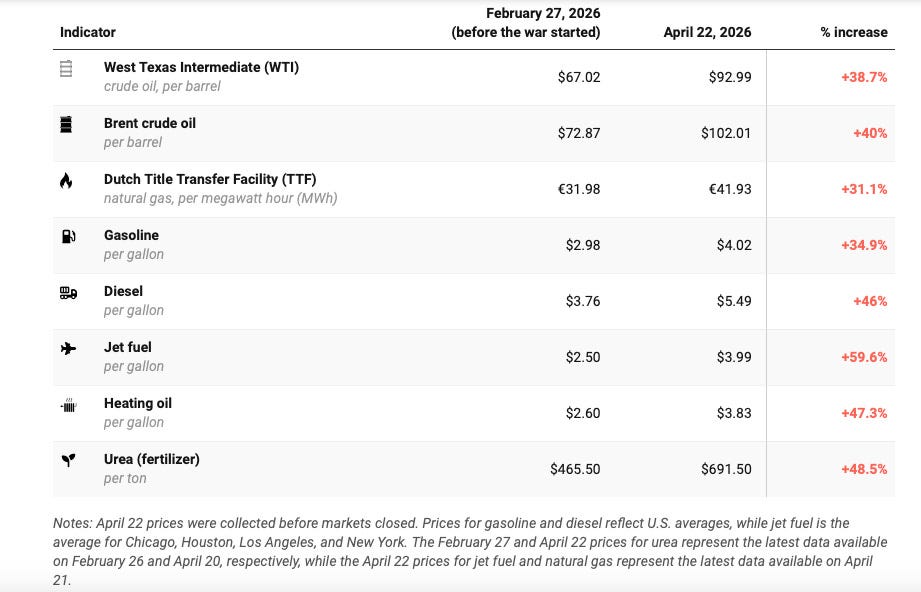
And now we’re starting to see the upstream effects of the war on Iran and its subsequent closure of the Strait of Hormuz are having on the rest of the economy. To get a feel for how much further this goes than just your local gas station, this graphic from the Center for American Progress, which uses data ending on April 22nd, shows the effects of the war on prices for goods ranging from jet fuel to fertilizer:
All those higher prices are manifesting in the economy in a bunch of different ways. For one thing, the restaurant industry is seeing more customers staying home.
“Several U.S. restaurant chains including Wingstop and Domino’s reported weaker-than-expected sales growth in the latest quarter, saying that soaring gasoline prices caused by the U.S.-Israeli war on Iran have forced their customers to cut back on other spending,” reports Waylon Cunningham at *Reuters*.
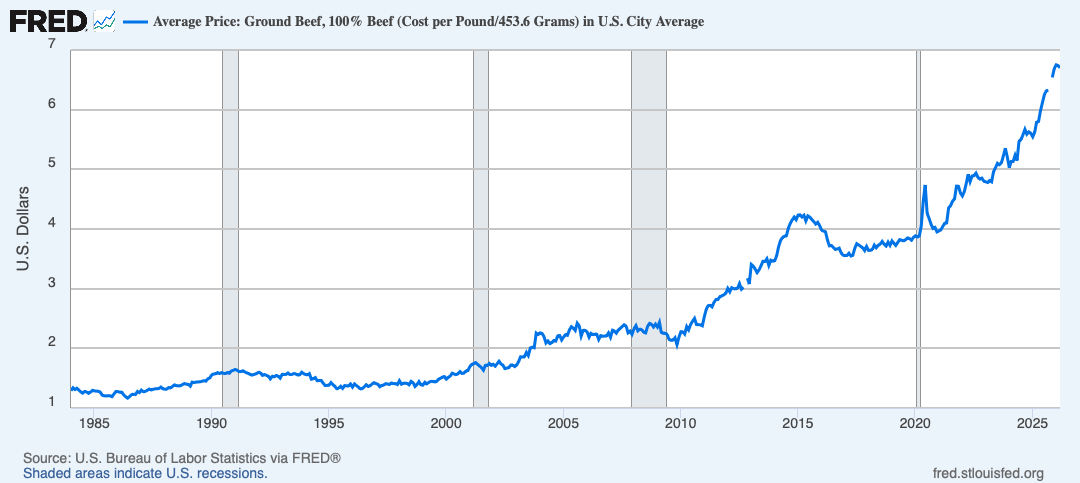
Just this morning, Shake Shack shares plunged after the fast-food chain reported results that came in lower than expectations and McDonald’s warned that higher costs will bring its profits down, too. It doesn’t help these last two chains that the price of beef has recently neared a record $7 per pound, and industry experts predict those prices will stay high for at least a year and a half.
In the end, it’s just plain math: The higher gas prices go, the less likely people are to visit restaurants. An analyst at Revenue Management Solutions reported that “for a restaurant drive-through with 300 daily transactions, a $1 spike in gasoline prices loses the restaurant about six customers a day, piling up to $22,000 in lost annual sales.”
This gas price crisis is demonstrating the real economic powerhouse of the American economy — workers and their families. Gas prices are a clear metric of that spending power because if they rise quickly, consumers will have less to spend in their everyday lives. Restaurants are a leading indicator of how badly these prices are hurting American workers, but probably every neighborhood business is starting to feel the pinch as people readjust their budgets.
Higher gas prices have also put pressure on the social safety net. For *Atlanta News First*, Adam Murphy explains that rising prices “are putting increased pressure on organizations like the Atlanta Community Food Bank, which depends on a fleet of trucks to distribute food across the region.”
Murphy explains, “The nonprofit says its fuel costs have jumped 28% in recent months, adding about $3,000 to its monthly expenses — money that would otherwise go toward feeding families.” That amounts to roughly 9000 meals that weren’t made or delivered to Atlanta-area families in need.
As Americans are planning their summer vacations, the rising cost of fuel is forcing them to make some tough choices about their plans for air and car travel. That means we might soon see a decrease in spending at destinations around the country, and many of the jobs supported by that consumer spending are going to be at risk.
At the same time, oil companies are reporting massive profits. Chevron “announced first-quarter earnings on Friday that exceeded consensus expectations from Wall Street analysts,” reports Bitget. The report continues, “Chevron’s largest business segment — the upstream division including crude oil — generated about $3.9 billion in profit, an increase of 4% year-over-year.” Those profits come in large part from the higher prices that Americans have been paying since the bombing in Iran and the closure of the Strait of Hormuz.
In the earnings call, Chevron reiterated an earlier vow to buy back somewhere between $10 billion and $20 billion in stocks from shareholders this year — meaning those runaway profits, built on the higher costs that the American people have been paying for gas, will instead be turned into a massive no-strings-attached giveaway for an elite group of shareholders and corporate executives. Those higher gas prices are flowing straight from the pockets of working people into the offshore accounts of the rich and powerful.
Whenever I’ve written about gas prices recently, I’ve gotten responses from people who correctly point out that climate change is ultimately a bigger problem than a two-dollar increase in the price of gas. And that’s true: America needs to do a lot more to break its oil dependence, and hopefully this crisis will force us to consider the establishment of policies that speed our transition to clean energy technologies and off the fossil fuels responsible for our worsening climate crisis.
Building a cleaner-energy future isn’t just better for the environment — it makes smart economic sense, too, as it can reduce energy costs and create millions of jobs to build whole infrastructure pipelines in our country. And right now, we have to face the reality that the high price of oil is eating away at the wallets of American workers. They’ll spend less in their communities, and local job markets will soon start to show the effects of that decreasing consumer demand. This is not a problem that will go away in a matter of days or weeks; it’s looking more and more like something that will be dragging the economy down for at least the next year.
The Latest Economic News and Updates
SNAP Participation Way Down
With most Americans falling farther and farther behind, you’d think that participation in the Supplemental Nutrition Assistance Program — the food subsidization policy formerly known as “food stamps” — would be increasing right now. Not so, according to the Center on Budget and Policy Priorities. In fact, since President Trump signed his tax bill into law last summer, millions of Americans have fallen off of SNAP rolls.
The Trump tax bill, which handed trillions of dollars in tax cuts to the richest Americans, also shifted “significant new costs to states,” the CBPP reports. Additionally, it “dramatically expands SNAP’s already harsh and ineffective provision taking away people’s benefits for not meeting a work requirement. And it ended eligibility for many people with a lawful immigration status.”
CBPP studied the numbers and found that “SNAP participation nationwide fell by more than 3 million people (8 percent) between the law’s July 2025 enactment and January 2026.”
Because SNAP is a partnership between federal and state governments, the dropoffs in SNAP rolls “are especially pronounced in some states — 42 percent in Arizona (51 percent using more recent state data) and 12 percent in Virginia and Tennessee.”
On the graph below, which tracks the SNAP participation in every state, you can see that participation has dropped across the board — every one of those fine grey lines is a state, with Georgia and Arizona dipping especially low at the bottom. The blue line represents the national loss of 8.25% of SNAP participants since the tax bill was signed at the beginning of July.
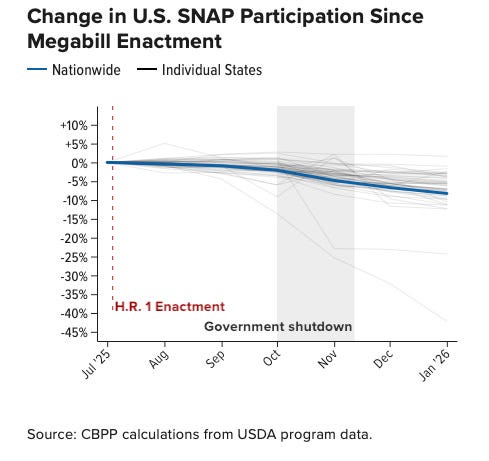
CBPP also reports that since the tax bill passed, “SNAP participation has dropped in every state, including by 5 percent or more in 36 states.”
Anyone who’s lived in America for the past year can tell you that the economy has not improved on virtually any metric felt by working people. So those three million people didn’t suddenly find jobs that pay a living wage. Instead, they’ve fallen out of the system entirely. Remember, SNAP doesn’t just feed hungry children — it also keeps grocery stores open in economically distressed areas. This number represents millions of dollars that used to be spent on food in communities around the country, but which instead has been funneled up to the wealthiest 1% in the form of tax cuts.
Why Economists Hated the Minimum Wage for So Long
[embed]
This week, Oxford Professor Eric Beinhocker, a good friend of the shop here at Civic Ventures, joined the *Slingshot*podcast to discuss an idea that he and CV founder Nick Hanauer have been working on for quite some time. He explains why economics is preparing for a major paradigm shift toward a new understanding of how the economy actually works.
First, Beinhocker explains how our leaders and economists currently believe the economy works: “the neoliberal paradigm asserts a model of growth that basically says the economy grows top-down.” Readers of The Pitch are very familiar with this paradigm. The assumption is that the rich and powerful will then use that money to create jobs and grow the economy — the money will then “trickle down” to everyone else.
Obviously, that theory has been proven false. “The reality that we’ve seen over the past decades — and there’s a growing body of evidence for it that I’ll talk about — is that the economy, in fact, actually grows from what we call ‘middle-out,’” Beinhocker continues.
He explains that “this makes intuitive sense: the bulk of the economy, the broad middle, between the bottom 10% and the top 10% — that’s where most of the spending in the economy comes from. That’s where the workers are; that’s where the savers are.”
“And so when the middle class does well, the economy does well,” Beinhocker says.
Hal Singer, the co-host of the Slingshot podcast, asks Beinhocker if he thinks economists supported neoliberal thinking that opposed increasing the minimum wage for so long because that kind of thinking benefits the wealthy people and institutions who sponsor the studies and institutions that keep economists in business. In less polite terms, Singer wonders, is the entire profession of economics corrupt?
Beinhocker rejects that hypothesis. He argues that it’s “not necessarily corruption or bad intent, at least by our fellow economists. I think what in essence happened is you had generations of economists who grew up in a particular economic framework, a particular economic paradigm.”
This is an important thought: If you’re an expert who has been swimming in the waters of neoliberalism for your entire education and career, it’s very hard to imagine anything else. Beinhocker continues, “because they’re locked into that framework, they find it very hard to believe the evidence right in front of their eyes.”
“When Alan Krueger and Andrew Card published their landmark study on the minimum wage in the 1990s, they were kind of given hell for it because no economist could believe it,” Beinhocker explains. “And then we’ve had decades of basically confirming their work. The problem isn’t the data; the problem is the paradigm, the theory.”
Eric and Nick have spent more than a decade working together to synthesize all this new research into a coherent paradigm that demonstrates how the economy really works, called Market Humanism. Just as neoliberalism is the economic theory powering trickle-down economics, Market Humanism is the thinking that powers middle-out economics.
We’ll have a lot more to say about this in the weeks and months ahead, but for now, if you’d like a preview of Market Humanist thinking, you should check out the Slingshot podcast.
This Week in Trickle-Down
- The Center for American Progress has released a new interactive map showing the childcare deserts in every major urban area in the United States. “Child care deserts are areas with little local licensed child care capacity, which includes center-based care, home-based care, Head Start, and state preschool programs, relative to the number of local young children, such that there are at least three local children for every one available local licensed slot,” the authors write, adding, “these gaps can result in missed early education opportunities during a critical developmental period, leading to persistent academic disparities that can strain the K-12 system and negatively affect children’s long-term outcomes.”
- Karla Walter at CAP sounds the alarm on The American Franchise Act, a piece of legislation that, if voted into law, would “let corporate franchisors off the hook when they undermine workers’ rights and leave small franchisees solely liable for labor law violations.” Walter explains, “If enacted, the AFA would roll back protections for the nearly 9 million Americans working at franchises, thereby leaving the owners of more than 800,000 individual franchise establishments solely accountable for any workplace misdeeds.”
This Week in Middle-Out
- The Center on Budget and Policy Priorities explains how a proposed California law would make it harder for corporations to shift their funds overseas in order to avoid paying taxes. The bill would update the way the law sees corporations, explains CBPP’s Don Griswold, “treating an entire corporate group — including all of its operating subsidiaries and fabricated shell companies around the world — as a single, integrated, unitary business enterprise, just as its corporate leadership and financial regulators treat it.” This is a common-sense piece of legislation that would make corporate tax evasion much more difficult.
- The Roosevelt Institute published a great report explaining why it would be a bad idea to give up on American manufacturing: “Despite employing less than 10 percent of workers, the US manufacturing sector is still the second largest in the world, the second most important in domestic output, the leading funder of research and development (R&D), the top export sector, and the second largest employer of engineers.”
- A new study from the Center for American Progress explains how sectoral pay standards — establishing pay levels and benefits within certain job sectors like security guards or construction workers — could increase the paychecks of working Americans. “These sorts of wage-setting mechanisms can reflect collective bargaining norms and complement other approaches to setting compensation across sectors,” Karla Walter writes. “Under these conditions, wage and benefit requirements will likely come close to the collectively bargained rate, reducing nonunion employers’ incentives to oppose unionization by taking labor costs out of competition.”
This Week on the Pitchfork Economics Podcast
We’re revisiting one of our favorite Pitchfork Economics episodes this week: A lively conversation with Anand Giridharadas, the author of Winners Take All, about how wealthy people use philanthropy to clean up their reputations, even as they continue to make income inequality even worse.
Closing Thoughts
Last Thursday, the Senate quietly passed a rule that should have gotten much more attention. And at a time when Congress faces criticism for its inaction and its unwillingness to challenge President Trump, it’s even more remarkable that the rule is a positive change.
“The Senate has approved a bipartisan resolution to prevent its own members from using prediction markets, banning senators who are often privy to sensitive information from making bets on upcoming events,” writes Mary Clare Jalonick at *PBS*.
Because the resolution passed unanimously and only affects the Senate’s internal rules, “it will go into effect immediately,” she continues.
Prediction markets have exploded in popularity in the past year, and they present a particularly lucrative opportunity for lawmakers who are often privy to top-secret information and developing situations weeks and months before the general public.
“Earlier this month, The Associated Press reported that a group of new accounts on Polymarket made highly specific, well-timed bets on whether the United States and Iran would reach a ceasefire on April 7, resulting in hundreds of thousands of dollars in profits for the new customers,” Jalonick writes.
Those bets attracted a lot of attention: “On the same day the AP published the report, the White House warned staff against using private information to trade on prediction markets,” Jalonick writes. But when a public servant is facing an opportunity to take home hundreds of thousands of dollars by placing a single well-timed bet on prediction markets, a warning simply isn’t enough. That’s why it’s important for the Senate to place this ban on prediction markets.
It’s also why more lawmakers want to go even further. “Sens. Todd Young, R-Ind., and Elissa Slotkin, D-Mich., have introduced a bill to ban all federally elected officials and government employees from using insider information to make prediction market bets,” Jalonick writes. “Young said the resolution was ‘a good first step’ and he encouraged the Senate to take up their bill.”
I agree with Senator Young — the Senate should be praised for taking action to prevent this new form of insider trading from taking root, but it should also apply this action to the entire federal government, and it should establish that anyone who violates the law faces strict punishment.
And for much the same reason, public servants with access to privileged information shouldn’t be allowed to make their own stock trades. Congresspeople through the years have introduced legislation to make stock trading illegal for members of Congress, but those bills haven’t moved forward. This new Senate ban on prediction markets should eliminate a number of the excuses against elected officials buying stock.
[embed]
I say all that to point you toward this video by Georgia Senator Jon Ossoff, which is a particularly strong candidate statement that directly ties together middle-out economics with the urgent need to end government corruption. He begins by discussing the affordability crisis that has raised so many of the essential costs of life in the United States — rent, education, healthcare. And then, Ossoff ties those costs back to political corruption.
“The problem is that the people’s elected representatives don’t represent the people,” Ossoff explains. Instead, “they represent the donors, and special interest. Corruption is why things don’t work for ordinary people.”
“Corruption’s impact isn’t abstract — it shows up in our daily lives,” Ossoff explains.
“Take prescription drugs,” for example, Ossoff says. “The cost of medicine in America is astronomical compared to other wealthy countries. About one in three American adults skip the medication their doctor prescribed, because they can’t afford it. Drug companies charge hundreds of times what it costs to produce.”
Ossoff asks, “But how have they gotten away with it? Every election cycle, drug companies spend millions on campaign contributions to Republicans and Democrats to shape policy and protect their profits. And members of Congress fall in line.”
“It’s corruption in plain sight,” he concludes.
This is true. And it’s important to make the case that corruption isn’t some problem separate from neoliberal politicians writing trickle-down economic policies into law. Corruption is how trickle-down economics takes over the system in the first place.
Ossoff tells a bracing story about how Congress defanged a 2003 law that would have allowed the federal government to negotiate with Big Pharma companies to lower drug prices, and the Congressmember who helped wipe out the government’s drug negotiation power almost immediately left Congress to take a $2 million-per-year job lobbying for Big Pharma.
When judging by the letter of the law, that Congressperson did nothing wrong. But nine out of ten Americans would likely tell you that was corruption, plain and simple. It’s literally taking money out of the pockets of Americans and transferring it to Big Pharma’s profits.
Ossoff points out that almost 20 years later, with his help, a bill did eventually pass through Congress that finally allowed Medicare to negotiate directly with Big Pharma. But the billions of dollars that Big Pharma raked in during those two decades, taken from poor and elderly Medicare patients, will never be returned.
While many campaign advisers consider promises to fight political corruption to be a non-starter for political candidates, it is in reality a middle-out issue — one that is popular with the American people. Because when you stop the flow of corrupt money, you free up more money that stays in the pockets of the American people. That’s about as core a middle-out principle as I can imagine.
Be kind. Stay strong.
Zach
메타데이터
- post_id
- f2fc6f63d8df
- slug
- working-people-are-falling-out-of-the-economy-f2fc6f63d8df
- url
- https://medium.com/civic-skunk-works/working-people-are-falling-out-of-the-economy-f2fc6f63d8df
- canonical_url
- https://medium.com/civic-skunk-works/working-people-are-falling-out-of-the-economy-f2fc6f63d8df
- author_url
- https://medium.com/@civicventures
- status
- ok
- fetched_at
- 2026-06-13 16:00:06