How to Start a White Label Chatbot Business in 2026
Most people assume launching an AI chatbot business means hiring developers, writing code, and burning through capital before a single…
How to Start a White Label Chatbot Business in 2026
Most people assume launching an AI chatbot business means hiring developers, writing code, and burning through capital before a single client signs up. That assumption is wrong — and it’s keeping a lot of smart entrepreneurs on the sidelines.
The white label chatbot model flips that entirely. You take an existing platform, brand it as your own, and sell it as a service. No backend engineering. No product team. Just a focused offer, the right niche, and a repeatable delivery process.
Here’s how to build that business from the ground up.
What a White Label Chatbot Business Actually Looks Like
Think of it like a private label food brand. The manufacturer makes the product. You put your name on it, price it, and sell it through your own channels. The customer buys from you, not the factory.
A white label chatbot business works the same way. You partner with a platform that handles the underlying technology. You rebrand it, package it into a service, and sell it to businesses that need automation but don’t know where to start.
The value you bring isn’t the code. It’s the clarity — knowing which businesses need chatbots, what problems to solve, and how to make the whole thing work without the client needing to understand any of it.
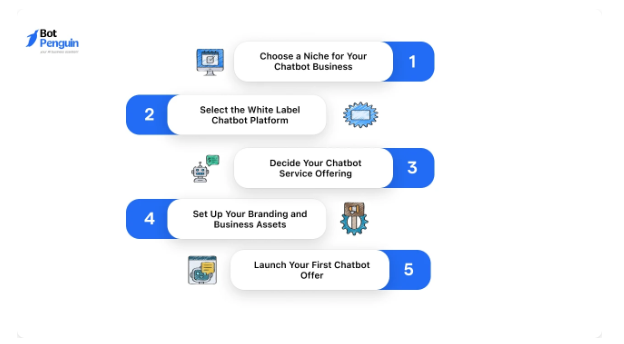
Step 1: Pick a Niche Before You Do Anything Else
This is where most beginners go wrong. They build a generic chatbot offer and try to sell it to everyone — restaurants, lawyers, gyms, dentists, online stores. The result is a confusing pitch that converts no one.
Niche selection is the foundation of this business. The tighter your focus, the easier it is to sell, deliver, and scale.
Some industries are particularly well-suited for chatbot automation:
- Healthcare clinics — appointment booking, patient FAQs, after-hours responses
- Real estate agencies — lead qualification, property inquiries, follow-up automation
- Ecommerce stores — order tracking, abandoned cart recovery, customer support
- Coaching and education businesses — lead capture, onboarding sequences, course FAQs
These industries share a common trait: high message volume and repetitive queries. When a clinic misses a booking call or a real estate agent loses a lead because no one responded at 9 PM, there’s a real cost. That urgency is what makes your offer easy to sell.
Start with one industry, one use case, and one clear outcome. Everything else follows from there.
Step 2: Choose a Platform That Can Carry Your Business
You’re not building the technology. You’re building a business on top of it. That means your platform choice is one of the most important decisions you’ll make.
Don’t evaluate platforms based on price alone. Evaluate them based on whether they can support your business as it grows.
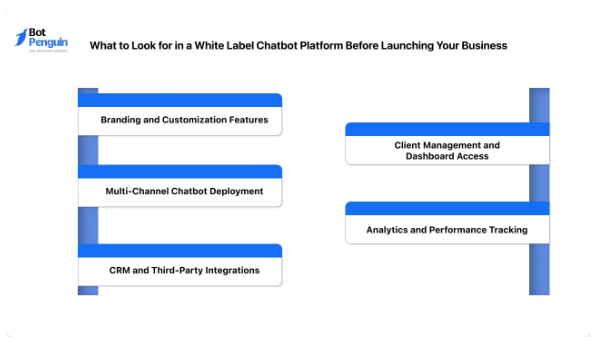
What to look for:
- Full white label branding — your logo, your domain, your name on everything
- Multi-channel deployment — website, WhatsApp, Instagram, Facebook
- No-code chatbot builder — so you can set up and adjust bots without a developer
- Client management dashboard — to handle multiple accounts without chaos
- CRM and tool integrations — so chatbots connect to the systems clients already use
- Analytics and reporting — so you can show clients the results they’re paying for
A platform that checks these boxes doesn’t just make delivery easier. It makes your service look more professional and gives you room to grow without hitting a ceiling at five clients.
Step 3: Build an Offer Clients Actually Want to Buy
“I sell chatbots” is not an offer. It’s a product description. Clients don’t buy tools — they buy outcomes.
Your offer needs to answer one question: what problem does this solve, and what does the client’s business look like after you solve it?
Two service models work well for this business:
Done-for-you setup — You handle everything from flow design to deployment. The client pays a one-time fee and gets a working chatbot. This is a good entry point and builds your portfolio quickly.
Monthly management plan — You handle updates, performance improvements, integrations, and ongoing support. The client pays a recurring fee. This is where the real business value lies.
Most successful operators combine both. The setup fee covers your initial work. The monthly retainer keeps revenue coming in without constantly chasing new clients.
A practical pricing range to start with: setup fees between $120 and $600 depending on complexity, and monthly fees between $40 and $250 based on usage and support level. These numbers aren’t fixed — adjust them based on your niche and the value you’re delivering.
A clinic paying $100 a month for a chatbot that handles bookings, reduces missed calls, and frees up front desk staff sees the ROI immediately. That’s a client who stays.
Step 4: Set Up Your Business Assets
Before you start selling, your business needs to look credible. This doesn’t mean spending weeks on a perfect website. It means having the basics in place so prospects take you seriously.
What you need:
- A niche-specific landing page that explains what you do, who it’s for, and what results clients can expect
- A working demo chatbot that prospects can interact with — ideally built for the same industry you’re targeting
- Pre-built templates you can reuse across clients to speed up delivery
- Simple, transparent pricing so prospects don’t have to ask before they can decide
The demo chatbot is the most important asset here. Showing a real estate lead qualification bot in action closes more deals than any pitch deck ever will. When a prospect sees their exact problem being solved in real time, the conversation shifts from “maybe” to “how do we get started.”
Step 5: Go Get Your First Client
You don’t need a perfect system to start. You need a simple offer, a working demo, and the willingness to reach out.
Where your first clients come from:
- Your existing network — former colleagues, local business owners, LinkedIn connections
- Direct outreach to businesses in your niche — clinics, agencies, stores, coaches
- Referrals from your first few clients once you’ve delivered results
Keep your outreach focused. Contact businesses that deal with high message volume, missed leads, or slow response times. These are the people who feel the pain your chatbot solves every single day.
When you reach out, don’t lead with features. Lead with the problem. “Are you losing leads because no one’s available to respond after hours?” lands better than “I build AI chatbots for real estate agents.”
Once you close your first two or three clients and deliver real results, referrals and word-of-mouth start doing a lot of the work for you.
Building the Chatbot Itself: Simpler Than You Think
No-code platforms have made chatbot creation genuinely accessible to non-technical people. You map out conversation flows, add responses and quick-reply options, connect actions like booking forms or lead capture, and deploy — all without writing a single line of code.
Training a chatbot for a client isn’t technical either. It’s about understanding what their customers typically ask. Start with their most common FAQs, support queries, and sales conversations. Feed that into the chatbot and refine from there.
The real power comes from integrations. A chatbot that captures a lead and automatically sends it to a CRM, triggers an email follow-up, and books an appointment — that’s not just a chatbot. That’s an automated sales assistant. That’s what clients pay for month after month.
For a deeper look at how to package and position this kind of service, the guide on How to Start a White Label Chatbot Business: Complete Guide covers the fundamentals in detail.
Why Platform Choice Shapes Everything
BotPenguin is built specifically for agencies, freelancers, and consultants who want to sell chatbot services without building the underlying technology.
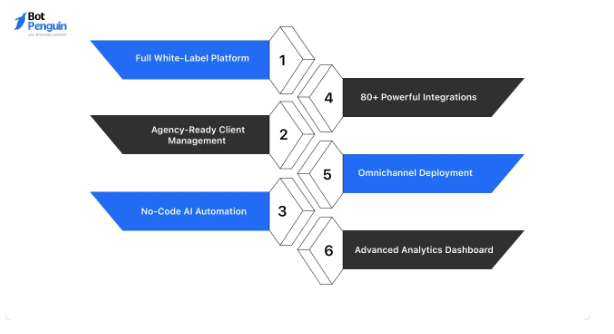
It supports full white label branding, multi-channel deployment across website, WhatsApp, Instagram, and Facebook, and a no-code builder with ready-made templates.
What makes BotPenguin particularly useful for this business model is the client management dashboard. As you grow past five or ten clients, managing separate accounts manually becomes a real bottleneck.
A centralized dashboard lets you switch between clients, update bots, and track performance without the overhead.
It also connects with CRMs, booking tools, and lead tracking workflows — so the chatbots you build for clients actually plug into their existing systems rather than sitting in isolation.
The Business Model in One Sentence
Find businesses that lose money from slow or missed customer communication, build them a branded chatbot that solves that specific problem, charge a setup fee to get started, and a monthly fee to keep it running.
That’s the whole model. The complexity people imagine isn’t there. What’s required is focus — on one niche, one problem, one clear offer — and consistent execution in the early weeks.
The market for business automation is growing. Businesses of every size are looking for ways to handle customer communication without adding headcount. A white label chatbot business positions you directly in the path of that demand, without requiring you to build anything from scratch.
Start narrow. Deliver results. Let the recurring revenue compound.
메타데이터
- post_id
- f317c434ea43
- slug
- how-to-start-a-white-label-chatbot-business-in-2026-f317c434ea43
- url
- https://medium.com/@botpenguin/how-to-start-a-white-label-chatbot-business-in-2026-f317c434ea43
- canonical_url
- https://medium.com/@botpenguin/how-to-start-a-white-label-chatbot-business-in-2026-f317c434ea43
- author_url
- https://medium.com/@botpenguin
- status
- ok
- fetched_at
- 2026-06-09 15:37:30