DAY 16 — Security
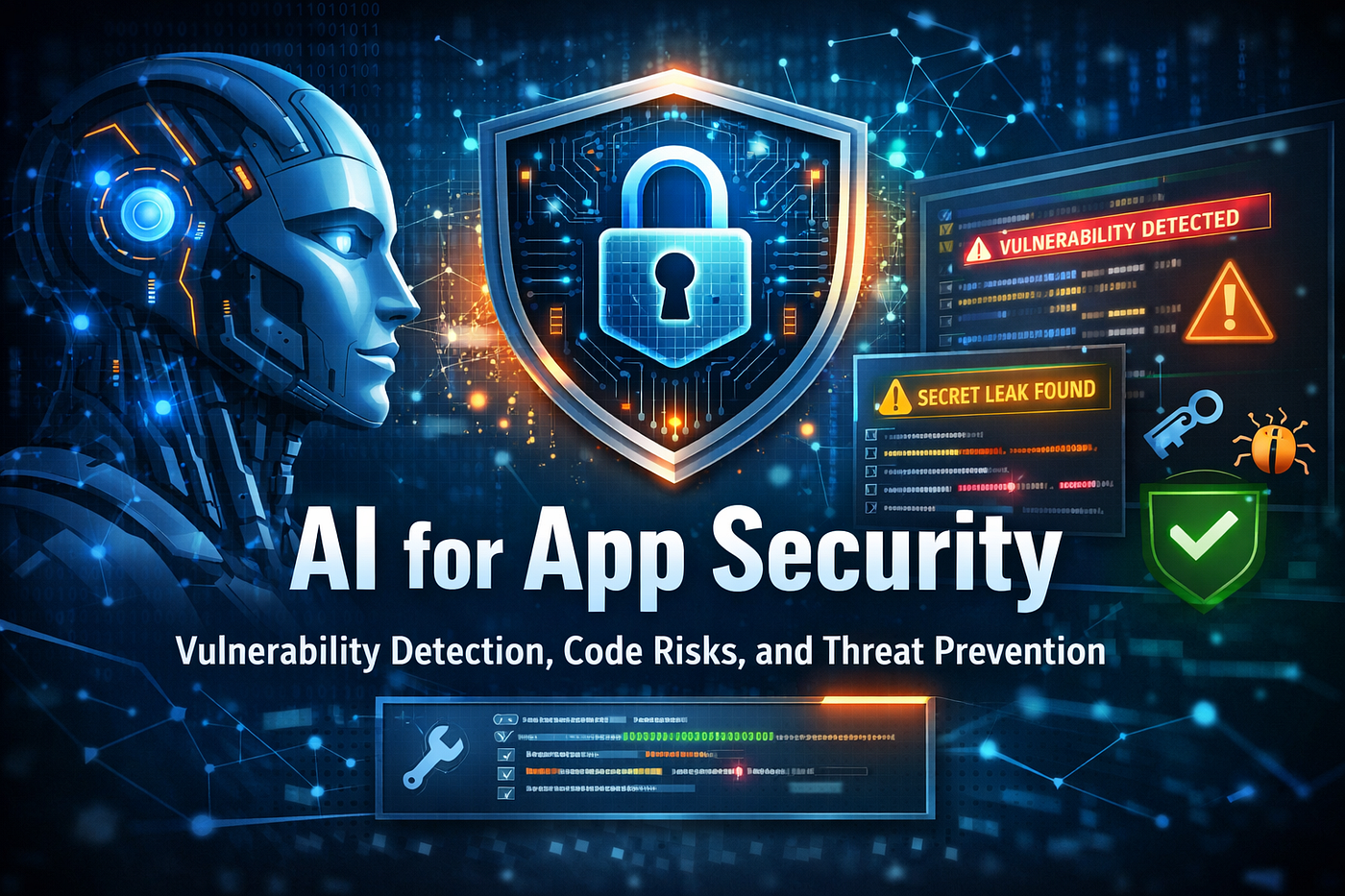
AI for App Security: Vulnerability Detection, Code Risks, and Threat Prevention
DAY 16 — Security
AI for App Security: Vulnerability Detection, Code Risks, and Threat Prevention
“In the AI era, speed without security is not innovation — it’s liability.”
On Day 15, we put CI/CD on autopilot. Pipelines deployed themselves. Rollbacks happened before humans noticed. Failures were predicted, not reacted to.
But there’s a hard truth every seasoned engineer knows:
The faster you ship, the faster you can ship vulnerabilities.
This is where Day 16 begins.
Security can no longer be a checklist, a quarterly audit, or a manual pen test scheduled just before release. In an AI-accelerated world, security must move at the same speed as code.
That means:
- Detecting vulnerabilities as code is written
- Identifying risks before they reach production
- Preventing secrets from ever leaking
- Auto-fixing issues instead of merely reporting them
Welcome to AI-powered App Security.
From DevSecOps to AI-SecOps
Traditional DevSecOps promised “shift-left security.” In reality, it often became:
- Static scanners generating thousands of warnings
- Security tickets ignored due to noise
- Manual triage slowing releases
- Developers overwhelmed by false positives
AI changes the equation.
Instead of:
- “Here are 2,000 issues”
AI security tools say:
- “These 3 vulnerabilities will be exploited in production — fix them now.”
Instead of:
- Rules written by humans
AI learns:
- From millions of real-world vulnerabilities
- From exploit databases
- From open-source attack patterns
- From your own codebase history
Security becomes context-aware, predictive, and actionable.
The Modern AI Security Stack
Before diving into tools, let’s define the four pillars of AI-driven app security:
- AI Vulnerability Detection
- Semantic Code Risk Analysis
- Secret Detection & Leak Prevention
- AI-Generated Fix Suggestions
Each pillar builds on the previous one.
1. AI Vulnerability Detection — Beyond Static Analysis
Why Traditional SAST Fails
Static Application Security Testing (SAST) tools rely on:
- Pattern matching
- Rule engines
- Syntax-level checks
They struggle with:
- Modern frameworks
- Asynchronous code
- Dynamic languages
- Contextual vulnerabilities
AI-based detection flips the model.
Instead of asking:
“Does this line match a known rule?”
AI asks:
“Does this code behave like something that has been exploited before?
Snyk AI — Security That Thinks Like an Attacker
What Makes Snyk AI Different?
Snyk combines:
- Static analysis
- Open-source dependency scanning
- Container security
- Infrastructure-as-Code scanning
- AI-powered risk prioritization
But the real power lies in how AI reasons about vulnerabilities.
Key Capabilities
🔍 Contextual Vulnerability Detection
Snyk AI understands:
- How data flows through your app
- Whether a vulnerability is reachable
- Whether user input can exploit it
A SQL injection warning isn’t flagged unless:
- The input is actually user-controlled
- The query is not properly sanitized
- The execution path is valid
🎯 Exploitability Scoring
Instead of CVSS alone, Snyk AI evaluates:
- Real-world exploit likelihood
- Active exploitation in the wild
- Your app’s exposure surface
This eliminates noise and focuses attention where it matters.
Shift-Left with Snyk AI
Snyk integrates directly into:
- IDEs (VS Code, IntelliJ)
- GitHub / GitLab PRs
- CI pipelines
- Container registries
Developers see:
- Vulnerabilities while coding
- Fix suggestions inline
- Security feedback before commit
Security stops being a gatekeeper and becomes a coding assistant.
2. DeepCode — Semantic Code Intelligence
If Snyk focuses on vulnerabilities, DeepCode (by Snyk) focuses on code intelligence.
What Is DeepCode?
DeepCode uses:
- Machine learning
- Symbolic execution
- Semantic analysis
Trained on:
- Millions of open-source repositories
- Known bug fixes
- Security patches
- Code review outcomes
It understands intent, not just syntax.
How DeepCode Thinks
Instead of:
“This function uses unsafe API”
It reasons:
“This function is meant to validate input, but fails under condition X, enabling privilege escalation.”
What DeepCode Detects Well
- Logic flaws
- Authentication bypasses
- Authorization gaps
- Race conditions
- Improper error handling
- Unsafe crypto usage
These are the vulnerabilities most scanners miss — and attackers love.
Example: Authentication Bug
Traditional scanner:
- ❌ No issues found
DeepCode:
- ⚠️ Session token validated only during creation, not reuse
- ⚠️ Missing expiry check enables session fixation
This is AI-level semantic understanding.
3. Secret Detection — Stopping Breaches Before They Happen
One leaked secret can:
- Drain cloud accounts
- Expose user data
- Trigger compliance violations
- Destroy trust overnight
The Hard Truth
Most breaches don’t start with:
- Zero-day exploits
They start with:
- API keys committed to Git
- Hardcoded tokens
- Credentials in logs
- Secrets copied into test configs
AI-Powered Secret Detection
Unlike regex-based scanners, AI secret detection:
- Understands context
- Distinguishes real secrets from false positives
- Detects custom token formats
- Flags secrets even when obfuscated
What AI Can Detect
- Cloud credentials (AWS, GCP, Azure)
- OAuth tokens
- JWT signing keys
- Database passwords
- Internal API keys
- Third-party service secrets
Even when:
- Renamed
- Encoded
- Split across lines
Preventing Secrets from Ever Reaching Git
Modern AI security tools:
- Scan pre-commit
- Block PRs automatically
- Rotate leaked secrets
- Notify security teams
- Suggest safer alternatives (env vars, vaults)
Security becomes preventive, not reactive.
4. AI Fix Suggestions — From Detection to Resolution
Detection without remediation is just noise.
AI closes the loop.
What AI Fix Suggestions Do
- Explain why an issue is dangerous
- Show how attackers exploit it
- Generate secure code replacements
- Match your language and framework
- Respect your existing architecture
This is where security finally becomes developer-friendly.
From Alert to Patch in Minutes
Example workflow:
- AI detects vulnerability in PR
- Flags it with severity + exploitability
- Explains root cause in plain English
- Generates a safe code diff
- Developer reviews & applies fix
- CI re-runs security checks
- Secure code ships
Security time drops from days to minutes.
AI Security in CI/CD — The Day 15 Connection
Let’s connect this back to Day 15 (CI/CD Automation).
AI + CI/CD + Security = Autonomous Protection
- Vulnerabilities detected during build
- High-risk issues block deployments
- Low-risk issues logged automatically
- Fix PRs generated by AI
- Rollbacks triggered if runtime threats detected
Security becomes continuous, not episodic.
Threat Prevention, Not Just Detection
The most advanced AI security systems go further:
- Predict attack vectors
- Identify unusual code patterns
- Detect anomalous runtime behavior
- Correlate logs with threat intelligence
- Adapt defenses dynamically
This is AI-driven threat prevention.
Why This Matters More Than Ever
In the AI era:
- Code is written faster
- Dependencies change daily
- Attack surfaces expand
- Threat actors use AI too
Manual security cannot keep up.
AI vs AI is no longer optional — it’s inevitable.
The New Role of Developers & Security Teams
Developers
- Get security feedback instantly
- Fix issues while context is fresh
- Learn secure coding naturally
Security Teams
- Focus on real threats
- Design policies, not rules
- Oversee AI-driven enforcement
Organizations
- Reduce breach risk
- Accelerate releases safely
- Improve compliance posture
- Build customer trust
Common Myths About AI Security
“AI will replace security engineers”
Reality: AI removes grunt work, not expertise.
“AI security is just fancy scanning”
Reality: It understands logic, flow, and intent.
“False positives still exist”
Reality: AI drastically reduces noise via context.
What’s Next After Day 16?
So far in this series:
- AI wrote code
- Tested it
- Refactored it
- Deployed it
- Secured it
The next evolution is AI running production itself:
- Self-healing systems
- Autonomous incident response
- AI-driven SRE
- Predictive reliability engineering
Security is no longer a phase.
It’s a living, learning system.
Final Thoughts — Security as Code’s Immune System
Think of AI security as:
- Your app’s immune system
- Always watching
- Always learning
- Always adapting
In a world where:
- Code ships daily
- Attacks happen hourly
- Trust is fragile
AI-powered security is not a luxury. It’s the cost of moving fast without breaking everything.
메타데이터
- post_id
- f32e1f5efc4e
- slug
- day-16-security-f32e1f5efc4e
- url
- https://medium.com/@sudhir1977/day-16-security-f32e1f5efc4e
- canonical_url
- https://medium.com/@sudhir1977/day-16-security-f32e1f5efc4e
- author_url
- https://medium.com/@sudhir1977
- status
- ok
- fetched_at
- 2026-06-21 19:25:17