Beyond Individual Control: Hidden Drivers of Drowning in Uganda’s Fishing Communities
Beyond Individual Control: Hidden Drivers of Drowning in Uganda’s Fishing Communities

In recent years, considerable attention has been given to promoting water safety among fishing communities through measures such as wearing life jackets, avoiding alcohol while operating boats, observing weather conditions, and preventing boat overloading.
These practices remain critical in reducing drowning incidents and saving lives.
At the same time, fishing communities are increasingly facing additional challenges that extend beyond individual behaviour.
Environmental degradation, climate change, equipment failure, and limited emergency response systems are creating new risks that require equal attention.
According to the Makerere University School of Public Health Executive Summary on understanding and preventing drowning in Uganda, drowning is a major cause of premature death in the country, particularly among young adults living and working on or near water (MakSPH, 2024).
The report further emphasizes that most drowning incidents are preventable through environmental modifications, stronger policies and regulations that reduce exposure to water-related risks, and coordinated safety interventions around water bodies.
Drowning remains a significant public health concern in Uganda’s fishing communities, particularly around Lake Kyoga. The findings show that many of these deaths occur in communities living around Lake Kyoga, where fishing, brick-making, water transport, and daily domestic activities depend heavily on the lake.
With numerous landing sites and large portions of surrounding districts covered by water, residents interact with the lake every day, increasing both livelihood opportunities and exposure to water-related risks.
Climate change has further increased the dangers faced by fishing communities. Weather patterns have become increasingly unpredictable, with strong winds, sudden storms, and rough waters developing with little warning.
A calm morning can quickly turn into a dangerous afternoon, leaving fishermen vulnerable while far from shore. Experience may help fishermen understand the water, but even the most experienced fisherman cannot control a storm.
Environmental pollution is creating additional challenges. Plastic waste, debris, and other aquatic litter often find their way into lakes and waterways, affecting both aquatic life and fishing activities.

SAF TESO staff orienting members of the fishing community around L. Kyoga on safety tips.
These materials can obstruct navigation routes, damage boat engines, entangle fishing nets, and create dangerous conditions for fishermen operating on the water.
Abandoned fishing gear, commonly known as ghost nets, can also trap boats and increase the risk of accidents. Environmental degradation does not only affect safety; it also affects livelihoods.
As aquatic ecosystems become degraded by pollution and changing climatic conditions, fish stocks may decline in some areas. This forces fishermen to travel farther from shore in search of a good catch.
The farther fishermen travel, the longer they remain exposed to danger. Longer journeys increase vulnerability to storms, strong currents, engine failure, and other emergencies.
In many cases, fishermen find themselves operating in remote sections of the lake where help may be hours away.
Unlike on land, emergencies on the water present unique challenges. When a vehicle develops mechanical problems on a road, it can often pull over safely. When a boat engine fails in the middle of a lake, there is no safe parking area.
A fisherman may begin the day with a functional boat only to encounter mechanical failure miles from shore. Similarly, many fishing boats are made from timber that weakens over time due to continuous exposure to water and weather conditions.
The challenge is that a boat does not announce when it will crack. Structural failure often occurs unexpectedly and sometimes at the worst possible moment. There are also situations where fishermen experience sudden illness while on the water. Dizziness, fatigue, or medical emergencies can quickly become life-threatening when there is no immediate access to healthcare or rescue services.
Water emergencies are further complicated by isolation. On land, people can run for help, call neighbours, or access emergency services. On the water, options are limited. Rescue depends largely on proximity, communication, and available resources.
Even when someone onshore is willing to help, reaching a distressed fisherman requires a boat, fuel, and valuable time. In many cases, help is simply too far away. Recognizing these risks, SAF-TESO continues to create awareness among fishing communities on the importance of water safety and drowning prevention.
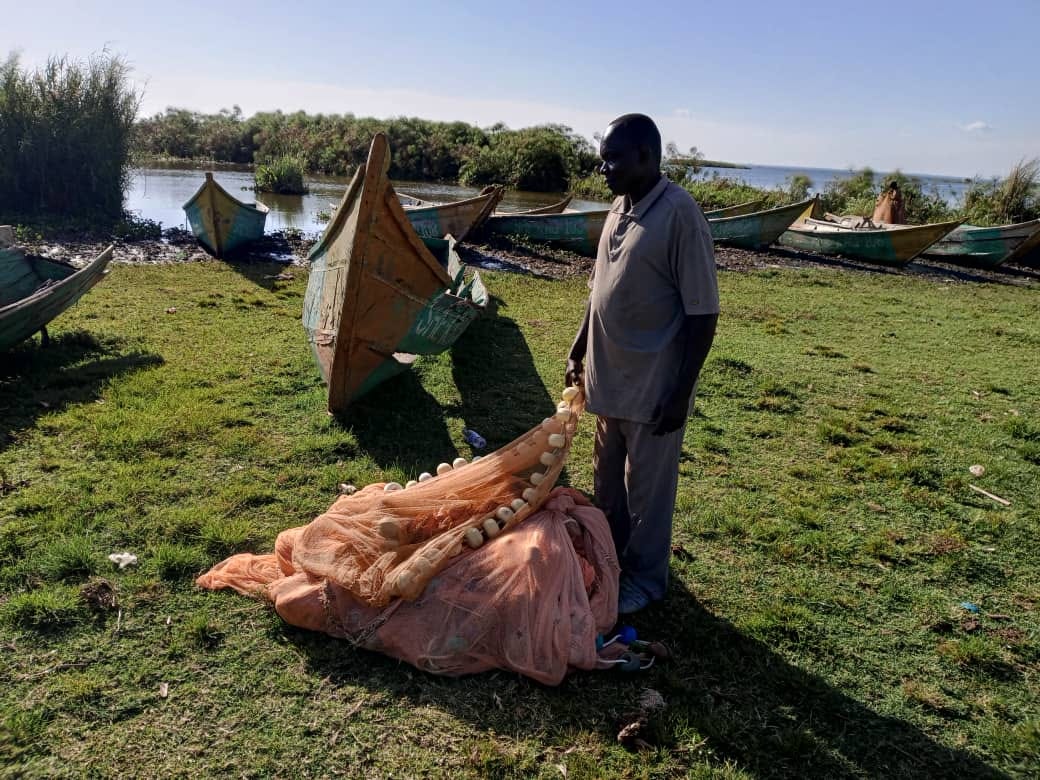
Such old nets should be discarded properly so that they don’t trap boats on the lake
The organization is promoting zero-waste practices and improved waste management in fishing communities in order to reduce aquatic debris that can obstruct navigation, damage boat engines, entangle fishing nets, and contribute to accidents on the water.
SAF-TESO further encourages fishermen to wear life jackets at all times while on the water, avoid operating boats while under the influence of alcohol, inspect boats regularly for signs of damage, and avoid overloading vessels beyond their safe carrying capacity.
The organization also encourages fishermen to pay close attention to weather conditions before and during fishing activities. Whenever strong winds, heavy rainfall, or threatening weather conditions arise, seeking safety at the nearest shore is often the wisest decision.
SAF-TESO further promotes teamwork among fishermen. Whenever possible, fishermen should operate alongside colleagues in neighbouring boats. Fishing is not a competition where one person must win and another must lose. Working together improves safety and increases the chances of rescue during emergencies.
However, addressing drowning in fishing communities requires more than individual responsibility. SAF-TESO is calling upon policymakers, development partners, researchers, and relevant government institutions to strengthen efforts aimed at preventing drowning and improving water safety.
The organization advocates for increased investment in security and emergency response systems on Uganda's water bodies. Strengthening marine rescue services through well-equipped patrol teams, trained marine officers, and emergency divers could significantly improve response during water-related emergencies and save lives.
SAF-TESO also calls for stronger measures to ensure the safety of boats operating on lakes and other water bodies. Institutions such as the Uganda National Bureau of Standards (UNBS) are referenced in ensuring quality of goods, and a similar level of attention is needed for boat safety through inspection and certification systems to reduce risks caused by structural weaknesses and mechanical failure.
The organization further emphasizes the importance of research and innovation in addressing emerging risks associated with climate change. As weather patterns continue to change, fishing communities require accurate and timely information to support safer decision-making.
SAF-TESO therefore encourages increased investment in research, weather monitoring systems, and community awareness initiatives that help fishermen understand and adapt to changing environmental conditions.
The organization also advocates for stronger environmental protection measures, including improved waste management and efforts to reduce pollution in lakes and waterways. Protecting aquatic ecosystems not only supports livelihoods but also contributes to safer fishing environments.
SAF-TESO believes that reducing drowning requires a collective effort involving fishing communities, policymakers, researchers, environmental stakeholders, emergency response agencies, and development partners.
Through collaboration and sustained investment, communities can become safer, more resilient, and better prepared to respond to the challenges affecting life on the water.
For many fishermen, the journey onto the lake is more than a daily routine. It is a means of providing food, paying school fees, supporting families, and sustaining entire communities.
Yet every journey carries risks, some preventable and others far beyond an individual’s control.
Climate change, environmental pollution, weak rescue systems, unsafe boats, and limited emergency response capacity continue to increase vulnerability among fishing communities.
Drowning prevention should not be viewed solely as an individual responsibility. It requires collective action, stronger systems, safer environments, and sustained investment in community resilience.
Clean waters save lives. Safe boats save lives. Timely rescue saves lives. And with the right policies, partnerships, and community action, more fishermen can return home safely to the families who depend on them.
메타데이터
- post_id
- f332bb849f5e
- slug
- beyond-individual-control-hidden-drivers-of-drowning-in-ugandas-fishing-communities-f332bb849f5e
- url
- https://medium.com/@shineafricafoundation/beyond-individual-control-hidden-drivers-of-drowning-in-ugandas-fishing-communities-f332bb849f5e
- canonical_url
- https://medium.com/@shineafricafoundation/beyond-individual-control-hidden-drivers-of-drowning-in-ugandas-fishing-communities-f332bb849f5e
- author_url
- https://medium.com/@shineafricafoundation
- status
- ok
- fetched_at
- 2026-06-22 17:31:34


