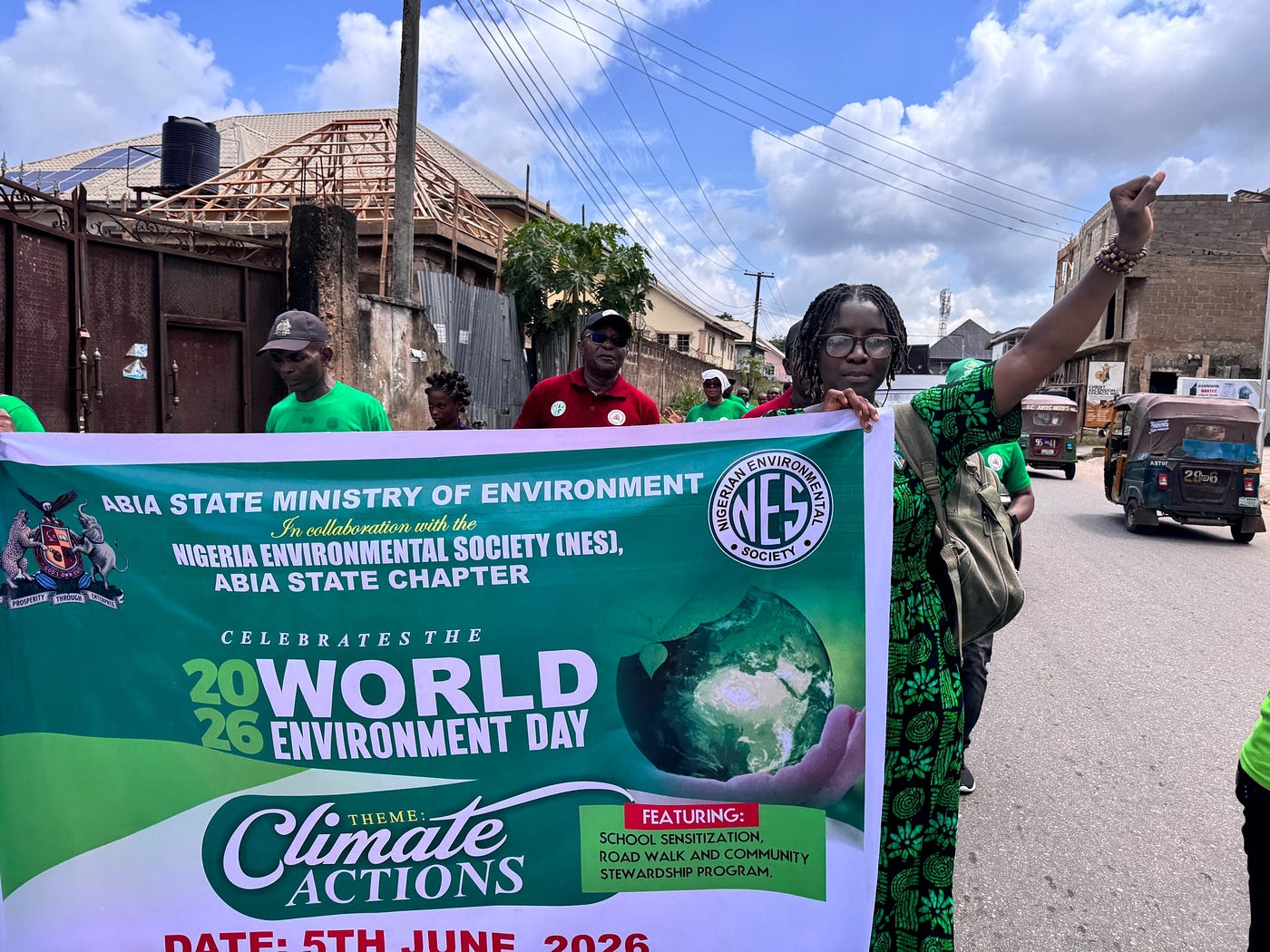
From Selection to Regional Leadership: My Journey as an NDC Youth Champion in South-East Nigeria.
From Participation to Influence: Why Nigeria’s NDC 3.0 Needs Young People at the Implementation Table

From Selection to Regional Leadership: My Journey as an NDC Youth Champion in South-East Nigeria.
From Participation to Influence: Why Nigeria’s NDC 3.0 Needs Young People at the Implementation Table
By Queen Amazu
Nigeria’s climate ambition will ultimately be judged not by the strength of its commitments on paper, but by what those commitments deliver in communities.

That is the central challenge facing the country as it moves into the implementation of its third Nationally Determined Contribution, NDC 3.0, under the Paris Agreement. The targets, policies and frameworks matter, but their success will depend on institutions, communities and citizens being able to translate them into practical action.
For young Nigerians, that presents both a responsibility and an opportunity.
Youth participation in climate governance should not end with invitations to conferences, consultations or policy roundtables. Young people need the knowledge to understand climate policy, the platforms to influence decisions, the networks to organise around shared priorities and the opportunity to participate in implementation and accountability.

My journey as an NDC Youth Champion has brought that challenge into sharper focus.
My subsequent appointment as South East Coordinator of the Nigeria NDC Youth Coalition, with responsibility covering Abia, Anambra, Ebonyi, Enugu and Imo states, has transformed what began as an individual leadership opportunity into a broader responsibility to help strengthen youth participation in climate governance across the region.
Beyond being in the room, the selection of NDC Youth Champions came at a critical point in Nigeria’s climate policy journey.
NDC 3.0 represents the country’s latest climate commitment under the Paris Agreement. Yet the effectiveness of any national climate commitment ultimately depends on implementation across different levels of governance, from federal institutions to states, local governments and communities.
That makes participation particularly important.
Young people are among those who will live longest with the consequences of decisions being made today on energy, agriculture, infrastructure, environmental protection, adaptation and economic development. Their involvement, therefore, should not be viewed simply as a question of representation.
It is a question of governance.
The real test is whether young people have opportunities to contribute to policy development, implementation, monitoring and accountability.
That was one of the lessons that became increasingly clear to me during the NDC Youth Champion training.
From Climate Advocacy to Policy Engagement
Climate advocacy can generate attention, but influence requires more than visibility.
It requires an understanding of how policy is developed, which institutions are responsible for implementation, where decisions are made and how evidence can be converted into practical recommendations.

The training deepened my understanding of the NDC process, climate governance, policy engagement and the various entry points available to young people seeking to contribute to climate action.
It reinforced a principle I consider fundamental: advocacy without policy literacy can easily become noise.
Young people seeking to influence climate policy must understand what an NDC is, how national commitments are developed and implemented, which institutions have responsibility for different areas of climate action, how citizens can participate and how commitments can be monitored beyond public announcements.
They must also understand the connection between national climate policy and the realities experienced by communities.
That connection is particularly important in Nigeria, where climate pressures intersect with agriculture, food security, livelihoods, energy access, urban development and environmental sustainability.
The challenge, therefore, is to move from simply talking about climate change to understanding the policy architecture through which solutions can be designed and implemented.
A Regional Responsibility
My appointment as South East Coordinator of the Nigeria NDC Youth Coalition adds another dimension to that responsibility.
The South East is not a single climate story.
Abia, Anambra, Ebonyi, Enugu and Imo have different economic structures, environmental conditions, agricultural systems, urban pressures and community vulnerabilities. A credible regional youth platform must recognise those differences rather than impose a single template on all five states.
The role of regional coordination should therefore not be to speak for every young person in the South East.
It should be to create structures through which young people can speak, organise, exchange knowledge, engage policymakers and contribute to NDC implementation.
That distinction is important because representation should create space for participation, not replace it.
Five States, Shared Priorities
The South East has considerable potential to contribute to Nigeria’s climate ambitions, particularly through youth led initiatives and locally grounded solutions.
In Abia, climate resilient agriculture, clean cooking, youth enterprise, environmental governance and sustainable tourism could provide important areas of engagement.
In Anambra, urban resilience, waste management, sustainable infrastructure and climate smart economic development offer significant opportunities.
Ebonyi’s agricultural economy creates strong entry points around food systems, rural livelihoods, ecosystem protection and climate resilience.
In Enugu, energy transition, urban resilience, environmental management and green economic opportunities could become important areas of youth participation.
Imo also presents opportunities around agriculture, biodiversity, environmental protection, energy and community resilience.
These priorities should not, however, be treated as predetermined conclusions. They need to be tested through consultations with young people, communities, government institutions, civil society organisations, researchers and other stakeholders.
That is where meaningful regional coordination begins: with listening before prescribing.
Five Priorities for Youth Climate Leadership
My approach to the responsibility is built around five broad priorities.
Expanding meaningful participation
Young people should have opportunities to understand climate policy, participate in consultations, engage institutions and contribute evidence and recommendations.
Participation should not be measured merely by the number of young people present at an event.
A more meaningful measure is whether their ideas influence decisions and whether they can see what happened to the recommendations they made.
Building constructive policy engagement
Climate commitments require institutions capable of implementing them.
Engagement with ministries, departments and agencies, local governments, legislators, development partners and other stakeholders will therefore remain important.
The objective should be constructive engagement rather than confrontation.
Young people should approach policy spaces with evidence, practical recommendations and an understanding of institutional realities.
The role of a youth coalition should be to help build bridges between young people and decision makers while retaining the independence necessary to ask difficult questions about implementation.
Taking climate conversations beyond policy circles
Climate policy can appear remote when it is communicated only through technical language.
Yet its consequences are experienced in farms, markets, homes, schools and communities.
This makes communication an important part of implementation.
Partnerships with media and broadcast organisations, including IKORO FM, can help bring climate conversations closer to citizens, particularly through radio and other accessible platforms.
The questions should be practical.
What does Nigeria’s NDC mean for farmers?
How does climate change affect livelihoods?
What opportunities exist for young people in the green economy?
What can communities do to adapt?
How can citizens understand and participate in climate programmes?
And how can institutions be held accountable for commitments they make?
These are questions that can turn climate policy from a technical conversation into a public one.
Building partnerships that produce results
No youth coalition can advance a national climate agenda in isolation.
Government institutions, civil society organisations, youth groups, media organisations, universities, private sector actors and development partners all have different capacities and expertise.
The objective should therefore be to build a connected regional ecosystem rather than a collection of isolated projects.
Partnerships should produce knowledge, capacity, policy engagement, resources and measurable community outcomes.
An event photograph may demonstrate that people gathered.
It does not, by itself, demonstrate that anything changed.
Supporting locally led solutions
National climate commitments eventually have to reach communities.
This is especially important in places where livelihoods depend heavily on agriculture, natural resources and other climate sensitive activities.
Young people should not be regarded merely as beneficiaries of climate programmes.
They can also be co designers, implementers, innovators, researchers and accountability partners.
Locally led action can help ensure that national climate ambition reflects the realities of the people it is intended to serve.
Inclusion Must Be Measurable
Meaningful youth participation must also include young women, persons with disabilities, vulnerable communities and young people in underserved areas.
Inclusion cannot remain a slogan.
If climate governance is to be genuinely participatory, the people most affected by climate and development challenges must have practical opportunities to contribute to the decisions intended to address them.
This requires deliberate outreach, accessible information, inclusive consultation processes and mechanisms through which contributions can be tracked.
It also requires asking a difficult question: who is still missing from the conversation?
From Consultation to Accountability
The broader debate around NDC 3.0 increasingly raises an issue that should concern every stakeholder in climate governance: implementation.
It is no longer sufficient to ask whether young people are included.
We must ask where they are included, what decisions they can influence, what resources are available to them, whether their recommendations are documented and how their participation affects outcomes.
Accountability must therefore become part of youth climate engagement.
This means following up on commitments, tracking implementation, generating evidence and communicating progress or gaps to the public.
The objective is not to create confrontation between young people and institutions.
It is to strengthen the relationship between commitments and results.
The Wider Significance
The significance of this work extends beyond the five South East states.
Nigeria’s climate commitments form part of a broader African and global effort to address climate change while pursuing economic development, poverty reduction, energy access and resilient livelihoods.
For Africa, the climate conversation is inseparable from development.
The continent needs solutions that respond to environmental pressures while recognising the realities of unemployment, infrastructure deficits, food insecurity, energy challenges and the need for sustainable economic opportunities.
That is why youth participation matters.
Africa has one of the world’s youngest populations. Young people are not simply future stakeholders in climate policy; they are already workers, entrepreneurs, farmers, researchers, communicators, community organisers and innovators.
Their participation should therefore be integrated into the architecture of implementation rather than treated as an occasional consultation exercise.
From Representation to Results
My appointment as South East Coordinator is an honour, but more importantly, it is a responsibility.
The next phase should be measured by what can be built beyond individual events and appointments.
That means stronger youth networks, better climate policy literacy, structured engagement with policymakers, credible communication platforms, youth led research and evidence, mechanisms for tracking commitments and pathways through which community experiences can inform policy.
The real measure of leadership will not be the number of meetings attended, certificates received or photographs taken.
It will be whether young people become more capable of influencing decisions, whether communities become better informed, whether institutions become more responsive and whether climate commitments become visible in real development outcomes.
The Work Ahead
Being selected as an NDC Youth Champion and subsequently entrusted with coordinating the South East has reinforced a conviction that has grown stronger throughout this journey: leadership is not necessarily about having the loudest voice.
It is about creating the conditions for more voices to be heard and turning those voices into collective action.
The responsibility now is to help build a bridge between policy and people, between commitments and implementation, and between participation and influence.
The South East is part of Nigeria. Nigeria is part of Africa. And Africa is part of a global climate community whose future will depend, in significant measure, on whether international commitments can become meaningful action at local level.
That is the work ahead.
Not merely to ensure that young people are present.
But to ensure that they are prepared, heard, involved and able to help shape the outcomes.
Because the ultimate test of NDC 3.0 will not be how compelling the commitments sound.
It will be what changes because of them.
메타데이터
- post_id
- f3439edef284
- slug
- from-selection-to-regional-leadership-my-journey-as-an-ndc-youth-champion-in-south-east-nigeria-f3439edef284
- url
- https://medium.com/@amazuqueenny/from-selection-to-regional-leadership-my-journey-as-an-ndc-youth-champion-in-south-east-nigeria-f3439edef284
- canonical_url
- https://medium.com/@amazuqueenny/from-selection-to-regional-leadership-my-journey-as-an-ndc-youth-champion-in-south-east-nigeria-f3439edef284
- author_url
- https://medium.com/@amazuqueenny
- status
- ok
- fetched_at
- 2026-09-01 10:48:52