Fair Value Gap vs Inefficient Market Behavior: Key Differences, Bullish Market Insights, and…
Learn how fair value gaps and inefficient market behavior shape price action, impact bullish market moves, and refine trading strategy
Fair Value Gap vs Inefficient Market Behavior: Key Differences, Bullish Market Insights, and Trading Strategy Guide
Learn how fair value gaps and inefficient market behavior shape price action, impact bullish market moves, and refine trading strategy

What You’ll Learn
- What a fair value gap is and how traders use it in different market conditions.
- How inefficient market behavior forms and the reasons behind sudden price imbalances.
- The key differences between fair value gaps and inefficient market behavior.
- How to apply fair value gaps and inefficiency concepts in a bullish market.
- Practical ways to build a trading strategy around fair value gaps and inefficiency.
- The role of risk management when trading with gaps and imbalances.
- How traders combine support, resistance, and indicators with fair value gaps.
Trading often comes down to how well you read price movements and market conditions. Two important ideas are the fair value gap and inefficient market behavior. Both play a role in how price moves, how liquidity works, and how traders plan their strategies.
A fair value gap is a price imbalance on charts where trading skipped certain levels, while inefficient market behavior describes irregular moves caused by low liquidity or overreaction. Traders use both concepts to predict corrections, plan entries in a bullish market, and refine their trading strategy effectively
In this article, we will look closely at what each means, how they are different, and how traders use them to build a trading strategy in a bullish market or any other condition.
Understanding the Fair Value Gap
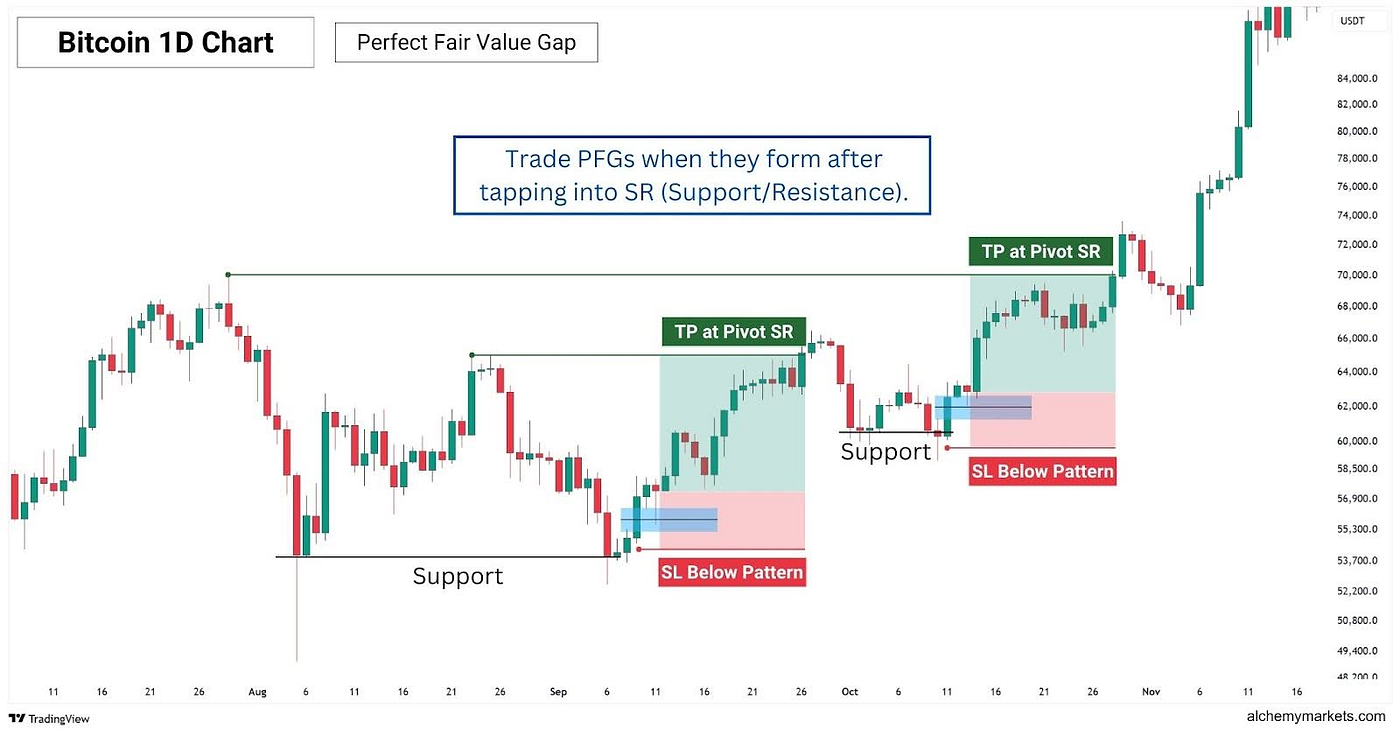
Image Source: Alchemy Markets
What is a Fair Value Gap
A fair value gap is a space on the chart where price moves quickly without giving the market a chance to trade evenly between buyers and sellers. It usually appears as a strong candle that skips over certain price levels. This means there was no fair trade at those points, leaving a gap.
Why Fair Value Gaps Matter
These gaps matter because they show where imbalance happened. Price often comes back to fill them later. For traders, this means a chance to watch for corrections or entries. Knowing this helps when planning a trading strategy in both bearish and bullish market conditions.
How Traders Use Fair Value Gaps
Traders often mark these areas on charts. When price returns, they watch how it reacts. It can be a spot to enter or exit a trade. Some use it to confirm trend strength, others to find reversal zones.
**Want to learn trading from scratch? Enroll in my comprehensive trading course**
Identifying Inefficient Market Behavior
What is Inefficient Market Behavior
Inefficient market behavior happens when prices don’t reflect true value. This can come from overreactions, low liquidity, or sudden news events. Instead of balanced moves, the market shows irregular and unsteady patterns.
Causes of Inefficient Market Behavior
This can be caused by big institutional orders, retail panic, or sudden gaps in liquidity. Economic announcements also create inefficient reactions. All of these cause the market to behave outside normal balance.
Spotting Inefficient Moves on Charts
On charts, you see inefficient behavior as sharp spikes or drops. Prices often move too fast and leave behind uneven candles. These usually get corrected later as markets balance out.
**Download my Prop Trading Guide and start trading with minimal investment**
Fair Value Gap vs Inefficient Market Behavior
Core Differences Between the Two
A fair value gap is a technical chart pattern, while inefficient market behavior is a broader concept. One shows imbalance on candles. The other explains why those imbalances happen.
How They Connect
Fair value gaps are often a result of inefficient market behavior. When markets react quickly and skip levels, that inefficiency creates a gap. Both ideas work together in explaining why charts look the way they do.
Which One Traders Focus On
Some traders focus mainly on fair value gaps because they are easier to spot. Others focus on inefficiency as a larger theme. The best approach is to use both together when building a trading strategy.
[embed]
Fair Value Gap and Bullish Market Analysis
Reading Gaps in a Bullish Market
In a bullish market, gaps often show areas where buyers were too strong. Price usually moves up fast, leaving zones that may be retested later. Traders keep watch to see if price corrects before continuing upward.
Using Gaps to Plan Entries
When the market is bullish, many traders wait for price to pull back into a fair value gap. This gives them a lower entry before price resumes the uptrend.
Managing Risks in a Bullish Setup
Even in strong bullish markets, gaps don’t always fill right away. Risk management is key. Traders place stop losses below or above important zones.
**Subscribe here and get exclusive access to all my proven trading strategies**
Inefficient Market Behavior in Bullish and Bearish Trends
Bullish Market Inefficiency
In a bullish market, inefficiency shows when buyers push too fast. This creates stretched candles or overbought conditions. Later, price may correct to restore balance.
Bearish Market Inefficiency
In a bearish market, inefficiency shows when sellers dominate. It creates sharp downward moves. Traders often look for retracements before the trend continues.
Balancing Market Efficiency
Markets don’t stay inefficient forever. Both bullish and bearish moves often retrace. That’s why traders track inefficiency to know where price may return.
Building a Trading Strategy Around Fair Value Gaps
Combining Gaps with Support and Resistance
Many traders don’t use fair value gaps alone. They combine them with support and resistance. This creates stronger signals and more accurate entries.
Adding Indicators for Confirmation
Some use moving averages or RSI to confirm gap entries. If indicators agree with the gap area, they feel more confident in placing trades.
Practical Example of a Gap Strategy
If price shoots up in a bullish market, leaving a gap, traders may wait for price to fall back into the gap. When it shows support, they enter long positions.
**Join my community and socialize with other traders across the globe**
Risk Management in Gap and Inefficiency Trading
Why Risk Control Matters
Both fair value gaps and inefficient behavior can trick traders. Price may not always react as expected. That’s why risk control is necessary.
Placing Stop Loss and Take Profit
Traders usually place stop loss just beyond the gap zone. Take profit is set based on market structure or nearby resistance.
Managing Position Size
Position size should match risk tolerance. Small positions help reduce losses if the market does not move as planned.
Conclusion
Fair value gaps and inefficient market behavior are closely connected. One is a chart pattern, the other is the reason behind it. Both help traders understand imbalance, correction, and future moves. In a bullish market or bearish one, knowing how to use these tools can make a trading strategy more effective.
메타데이터
- post_id
- f34ac4c4e5ce
- slug
- fair-value-gap-vs-inefficient-market-behavior-key-differences-bullish-market-insights-and-f34ac4c4e5ce
- url
- https://medium.com/@socialen/fair-value-gap-vs-inefficient-market-behavior-key-differences-bullish-market-insights-and-f34ac4c4e5ce
- canonical_url
- https://medium.com/@socialen/fair-value-gap-vs-inefficient-market-behavior-key-differences-bullish-market-insights-and-f34ac4c4e5ce
- author_url
- https://medium.com/@socialen
- status
- ok
- fetched_at
- 2026-06-21 07:44:09