Now that the new General Plan has passed, what does it actually do?
What’s good, bad, and indifferent in the new General Plan 2045?
Now that the new General Plan has passed, what does it actually do?
What’s good, bad, and indifferent in the new General Plan 2045?
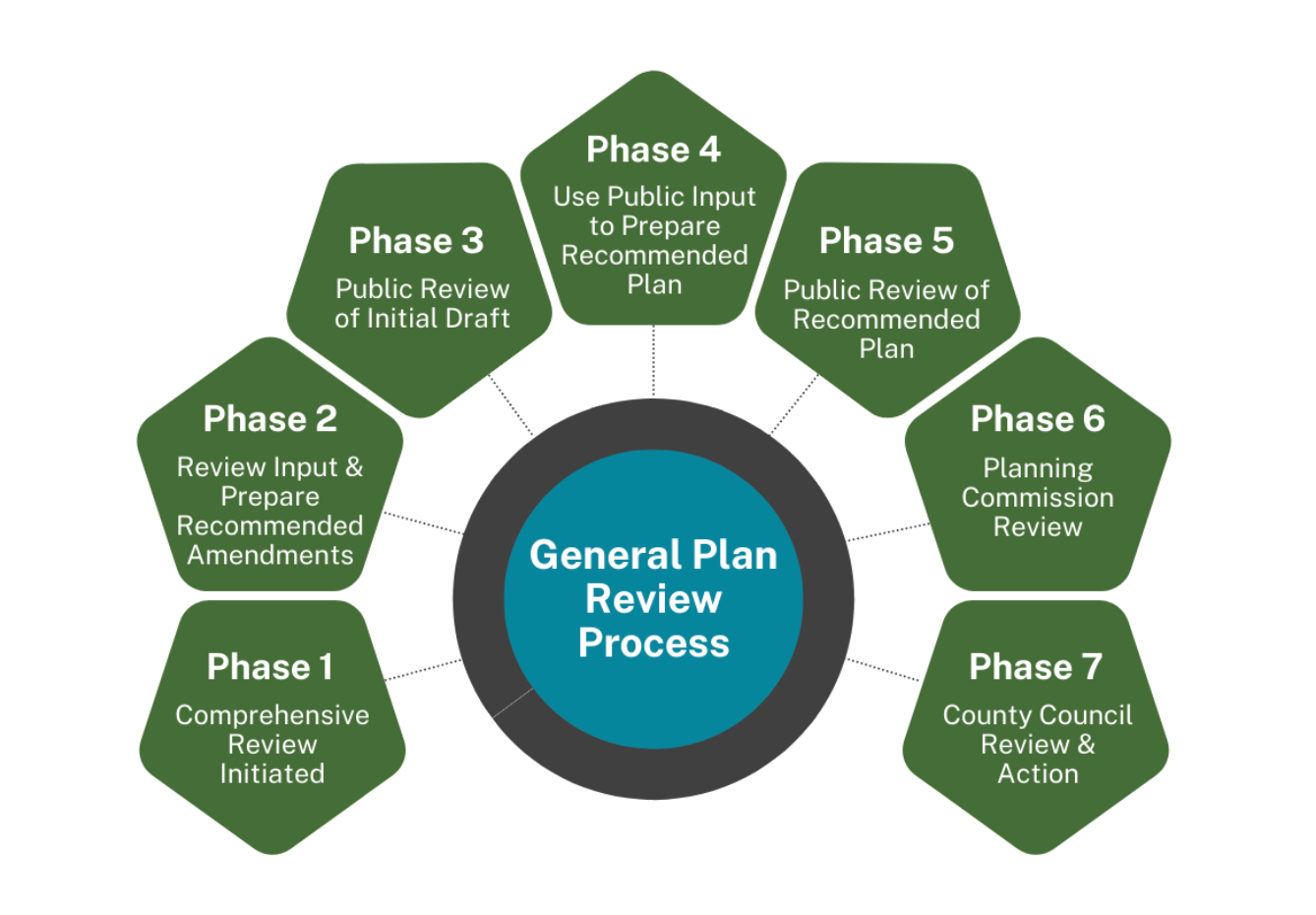
After more than a decade of work and a genuinely heated final stretch, the County Council passed General Plan 2045 on its second and final reading on June 3, and it now heads to Mayor Alameda’s desk. The plan is a 310-page, 20-year blueprint for how the island grows. Most of the public fight was about fear and rumor; far fewer people have actually read what’s in it. So I did — and here’s my honest take, the good, the bad, and the indifferent, read through my own lens as a left-libertarian who wants government to empower people rather than direct them. The short version: I agree with most of the plan’s goals, and nearly all of my worries are about its means and a couple of things it leaves out.
Here’s the full plan online.
The good
There’s a lot of it, and it maps closely onto what I’ve supported through my nonprofit work with Think BIG, and what I’m campaigning on in terms of resilience, local food, local power, and more affordable housing.
1. It steers growth into our towns and protects rural and ag land. The core land-use move is “Smart Growth”: focus new development inside existing urban centers, keep Rural-designated lands rural, and support the active use of Productive Agricultural lands. The idea is to stop sprawl from eating the countryside and to make our towns more walkable and complete. There is nothing coercive about this kind of “smart growth” — no one will lose any rights to their land and no one will be force to move. It’s just a planning emphasis that would, for example, disallow a new housing development like HPP in areas designated agricultural. It is better to build up, and more densely, in existing urban areas to accommodate growth than to spread out further.
This does NOT affect anyone’s property rights or what they can do on land they already own. It just guides future land use planning and possible zoning changes in terms of new communities, sprawl, etc.
2. It sets real climate and clean-energy targets. The plan commits to a “just transition” to a climate-resilient island, with the County government reaching net-zero emissions by 2045 or sooner, and supporting the statewide goal of 100% renewable energy and ground transportation by 2045 or sooner. These are goals and direction-setting — not a switch that flips overnight. These are existing state goals set in law so there is nothing ground-breaking at all in this. During my advocacy work with the County I have been pushing them to set more ambitious County-specific goals for green energy and transportation. Alas, those efforts have not yet succeeded.
3. It greens how we get around. Transportation is one of the plan’s biggest resilience levers: a 100% renewable-powered County-owned fleet by 2035, a 50% increase in transit ridership by 2045, fewer vehicle-miles driven, and safer, multimodal streets for walking and biking — so more of us can live, work, and shop closer to home. These are goals that apply to the County government itself, not to residents of the County. It’s a common mistake that people think this in some way affects their ability to drive gas cars. This is not at all true. This only applies to County-owned fleets.
4. It puts food security and local agriculture front and center. The plan calls for agriculture to be “a robust, diversified sector that addresses food security,” with more access to land for active food production and stronger ag infrastructure. For a district that imports most of its food, that’s the right direction. Local food is my #1 priority since it is our biggest vulnerabiilty in the event of serious crises, so I fully support this focus in the General Plan and I wish it had done more on local food.
5. It prioritizes affordable housing for residents. People, kanaka and others, are being pushed out of Hawaii because they can’t earn enought to pay for rent. Affordable housing is becoming a crisis too. The “Housing for All” goal pushes more homes across the full range of incomes, protects and improves the housing we already have, and explicitly prioritizes affordable housing for Hawaiʻi residents — the people being priced out, not speculators.
6. It calls for a “regenerative” — not unlimited — visitor industry. On tourism and vacation rentals, the plan’s goal is a visitor industry that balances preserving our natural and cultural resources with responsible visitation, favoring authentic, community-informed experiences — and it draws lines like no new resort zoning on the makai side of Aliʻi Drive. (The detailed short-term-rental rules live in County Code, but the plan sets the direction.)
7. It treats water as one connected system — mauka to makai, as it should. The plan protects drinking-water sources, expands municipal sewer in the designated Urban Growth Areas to cut pollution, and applies the Native Hawaiian ahupuaʻa framework to keep watersheds healthy — better recharge, cleaner water, less runoff. In a district on catchment and cesspools, water resilience is everything.
8. It plans for hazards and a changing climate. A plan governing the next 20 years on the most active volcano in the country has to take natural and manmade hazards seriously: the Plan aims to reduce the threat to life and property from natural disasters and to better identify and adapt to climate threats like sea-level rise and flooding, with an emphasis on equity so the most exposed communities aren’t left behind.
9. It sets resilience targets for waste, energy, and connectivity. Beyond the headline items, the plan commits the island to Zero Waste by 2045, to “strive toward energy self-sufficiency,” and to expand broadband — the unglamorous infrastructure that determines whether a rural district can actually thrive on its own.
None of this is radical; most of it is overdue. On goals, the plan and I are largely on the same page, but as I mentioned earlier I wish it had gone farther in adopting targets and goals beyond what state law already requires.
The bad — where it rubs against my principles
Now the part a left-libertarian like me has to say out loud. Almost none of it is about the plan’s aims; it’s about how those aims get pursued, and a couple of things the plan skips.
It pulls against my own more affordable housing push in some ways. The plan’s core move is to concentrate growth in towns and keep rural land rural. I’ve argued for making it easier to build ʻohana units and resilient homesteads across rural Puna, as well as in urban areas, which is already state and county policy. Read narrowly, “Smart Growth” principles could be used to block exactly that in rural areas. My reconciliation: resilient infill on lots people already own isn’t sprawl, and the plan shouldn’t be wielded to freeze families out of building more ‘ohanas on their own land — which would of course contradict recent ‘ohana expansion rules (up to three per lot are now allowed). But I won’t pretend the tension isn’t there in the new Plan.
The teeth are in a rule most people miss. Future rezonings and permits must be consistent with the plan’s land-use map. That’s the same overreach vector I flagged on the HPP zoning scare — a broad document quietly shaping specific future decisions — and it’s now adopted, island-wide. It doesn’t change your zoning today, but it shapes what can be approved tomorrow in terms of large-scale land use planning and zoning, so it’s worth watching.
The real decisions happen next, and quietly. A blueprint vote draws a crowd; the zoning amendments and budget line-items that actually carry it out get written later, with developers and agency staff in the room and often almost nobody watching. That’s where overreach and industry capture canhappen. The plan passing isn’t the finish line — it’s the starting gun for paying attention.
Geothermal gets a pass it hasn’t earned. The plan lists geothermal among the renewable technologies to “support,” and even concedes that such projects “can be controversial.” But it never grapples with the specific problem: PGV sits in Lava Zone 1, the highest-hazard ground on the island, and its siting and safety record are exactly what a serious clean-energy plan should scrutinize — not wave through. I’m strongly for renewables — I’ve spenty my entire career fighting for renewables. But I’m still not for “any renewable, anywhere, no questions asked.” PGV has a long and sordid history and the Plan shouldn’t just wave that away.
It’s nearly silent on the biggest wildcard for our grid and water: AI and data centers. The plan barely mentions large data centers — and that’s a serious gap. A single big data center can swallow the renewable headroom we’re all working to build and draw heavily on scarce water. My answer is a “bring your own generation” standard: large new loads should supply their own clean power and water rather than drawing down everyone else’s. The plan should have said so; the next step is to make it law.
And one thing it does NOT do
A lot of the opposition was aimed at things that aren’t actually in the plan. It does not ban your diesel truck — a Kaʻu councilwoman who ranches and drives a diesel truck said as much on the floor. It does not abolish fossil fuels by fiat, and it does not rezone private property or convert your land to conservation on its own. A General Plan is a long-range policy map, not a zoning ordinance. You can disagree with its direction — that’s fair — but it helps to argue about what it really says.
The indifferent
And then there’s the stuff that generated heat or ink but barely moves the needle for us.
· The Kona-specific lines. No new resort zoning on the makai side of Aliʻi Drive is fine — and of course entirely irrelevant to Puna.
· Aspirational targets without visible teeth. Net-zero by 2045, Zero Waste by 2045 — good north stars, but until they’re funded and implemented they’re words on a page. I’ll judge them by the budgets that follow, not the slogans.
· The boilerplate. A 310-page document is necessarily padded with process and background. Important to have; not worth losing sleep over either way.
What it means for Puna — and what I’ll push for
Read honestly, General Plan 2045 lines up very well with the resilient future I want for Puna and the Big Island: more local food, more local energy, better transportation options, affordable homes for our own people, tourism that respects this place, and water managed as the precious shared resource it is. My worries aren’t with those goals — they’re with the means (centralized control, the consistency lever, and the capture risk in implementation) and two real gaps (geothermal siting and the AI/data-center load coming for our grid and water).
So if you send me to the House, the job is clear enough: fund the good parts, watch the implementation like a hawk, favor policies that empower people over ones that mandate them, and fill the gaps — bring-your-own-generation for big new loads, and real siting and safety scrutiny for geothermal — all while protecting the rights and rural character people moved here for, rather than reaching past government’s proper role. Support the goals; never stop watching the lever. The full plan is online — and it’s worth a look before you decide what you think.
Tam Hunt is a policy attorney, U.S. Army veteran, and Hawaiian Paradise Park resident running for State House District 4 (Puna). Hunt4House.com.
Sources and further reading
• General Plan 2045, Final Draft (the full document) — County of Hawaiʻi
• General Plan approved on final reading despite opposition — West Hawaii Today
• Diesel-truck and property-rights fears addressed on the Council floor — West Hawaii Today
• Ahupuaʻa framework, food-system assessments, Aliʻi Drive resort limits — Honolulu Civil Beat
• Hawaii County General Plan (implementation through zoning and budgets) — Planning Department
메타데이터
- post_id
- f34dd527a612
- slug
- now-that-the-new-general-plan-has-passed-what-does-it-actually-do-f34dd527a612
- url
- https://medium.com/@tamhunt/now-that-the-new-general-plan-has-passed-what-does-it-actually-do-f34dd527a612
- canonical_url
- https://medium.com/@tamhunt/now-that-the-new-general-plan-has-passed-what-does-it-actually-do-f34dd527a612
- author_url
- https://medium.com/@tamhunt
- status
- ok
- fetched_at
- 2026-06-16 19:09:56