What Ben Graham Would Really Think About the SpaceX IPO
The Intelligent Investor’s Dilemma:
What Ben Graham Would Really Think About the SpaceX IPO
The Intelligent Investor’s Dilemma:
☕ If you enjoy this article, please support the work: buymeacoffee.com/reimaginedworld

Figure 1: Benjamin Graham’s disciplined value investing framework stands in stark contrast to the speculative fervour surrounding the SpaceX IPO. (AI generated imagery)
Introduction
Wall Street is bracing for what could be the largest initial public offering in the history of financial markets. Space Exploration Technologies Corp. — better known as SpaceX — is seeking to raise up to $80 billion at a staggering valuation of $1.75 trillion. For retail investors, who may be allocated up to 30% of the shares, the temptation to buy into Elon Musk’s interplanetary vision is almost overwhelming.
The narrative is undeniably compelling: a company that has revolutionised orbital launch economics, built a global satellite internet monopoly in Starlink, and openly plans to colonise Mars. But beneath the glossy S-1 prospectus and the soaring rhetoric lies a financial reality that demands rigorous scrutiny.
If we were to resurrect Benjamin Graham — the father of value investing, mentor to Warren Buffett, and author of The Intelligent Investor — and hand him the SpaceX prospectus, what would he say? Would he view this as a generational opportunity, or as the pinnacle of speculative excess? This article applies Graham’s time-tested analytical framework to the SpaceX IPO, examining the company’s financials, its corporate governance, and the inherent dangers of investing in a narrative rather than a balance sheet. The conclusion is stark: Graham would almost certainly counsel retail investors to exercise extreme caution.
The Ghost of Benjamin Graham
To understand how Graham would view SpaceX, one must first understand his core philosophy. Writing in the aftermath of the 1929 crash and the Great Depression, Graham sought to transform stock market participation from a casino game into a rigorous, quantitative discipline. His most crucial contribution was drawing a hard line between investment and speculation.
“An investment operation is one which, upon thorough analysis, promises safety of principal and an adequate return. Operations not meeting these requirements are speculative.”
This definition, from Security Analysis (1934), remains the most precise distinction ever drawn between the two activities. Graham’s framework rested on two foundational concepts. The first was the Mr. Market allegory — the stock market as a manic-depressive business partner who offers to buy or sell shares every day at irrational prices. The intelligent investor ignores his emotional swings and only transacts when the price is highly favourable. The second was the Margin of Safety: the principle of buying a security at a significant discount to its intrinsic value, providing a buffer against human error, bad luck, or unforeseen economic downturns.
Crucially, Graham was deeply sceptical of growth stock investing. He warned repeatedly that paying a massive premium for anticipated future growth is inherently dangerous because the future is fundamentally unknowable. “Obvious prospects for physical growth in a business do not translate into obvious profits for investors,” he cautioned. With this framework in mind, let us apply Graham’s specific quantitative criteria to the SpaceX IPO.
Graham’s Defensive Investor Checklist Applied to SpaceX
In The Intelligent Investor, Graham outlined seven stringent criteria for the “defensive investor” — someone seeking safety, minimal effort, and steady returns. The table below applies each criterion directly to SpaceX’s publicly filed financial data.

Out of Graham’s seven criteria, SpaceX passes exactly one: adequate size. By every other quantitative measure of financial safety, the company fails. Graham would not need to read further. The checklist alone would be sufficient to disqualify SpaceX as an investment for the defensive retail investor.

Figure 2: Applying Benjamin Graham’s seven criteria for defensive investors to the SpaceX IPO reveals a near-total failure on quantitative safety metrics. Source: The Intelligent Investor (Graham, 1949); SpaceX S-1 Prospectus (2026).
The Reality of the SpaceX Business Model
If Graham were analysing SpaceX, he would look past the rockets and focus intensely on the cash flow. What he would find is a company entirely dependent on a single profitable segment to subsidise massive speculative bets. According to the S-1 prospectus filed in May 2026, SpaceX’s revenue grew 33% year-over-year to $18.7 billion in 2025. However, this top-line growth masks a severe deterioration in profitability. The company swung from a modest $791 million profit in 2024 to a $4.9 billion net loss in 2025, driven by a massive $20.7 billion in capital expenditure.
The “crown jewel” of SpaceX is Starlink, its satellite internet division. Starlink accounted for $11.4 billion of revenue in 2025 and boasts a highly impressive 63% EBITDA margin. In the first quarter of 2026, Starlink generated $1.2 billion in profit. The problem is that Starlink’s profits are being entirely consumed by the rest of the business. The core space launch division lost money in Q1 2026. Furthermore, Musk has folded his artificial intelligence company, xAI (creator of the Grok chatbot), into SpaceX. This AI division is also bleeding cash, contributing to the staggering $4.27 billion net loss in the first three months of 2026 alone.
Graham would likely view SpaceX not as a single coherent business, but as a profitable telecom utility (Starlink) being used as a piggy bank to fund highly speculative, cash-incinerating ventures in interplanetary travel and artificial intelligence. At a $1.75 trillion valuation, investors are paying an astronomical premium for the promise of Mars, while the actual financials show accelerating losses and an accumulated deficit of $41.3 billion since the company’s founding in 2002.

Figure 3: SpaceX revenue has grown steadily, but net losses have accelerated dramatically, reaching $4.9 billion in 2025 and an annualised rate exceeding $17 billion in Q1 2026. Sources: Fortune (May 2026); CMC Markets (2026); Payload Space (2025).
The Key-Man Risk and Corporate Governance Nightmare
Perhaps the most alarming aspect of the SpaceX IPO from a Graham perspective is the corporate governance structure. Graham believed that investors were part-owners of a business and deserved robust legal protections. SpaceX’s prospectus explicitly dismantles these protections in ways that are, according to corporate governance experts, unprecedented.
SpaceX is incorporating in Texas and utilising a dual-class share structure. Everyday retail investors will buy Class A shares, carrying one vote each. Elon Musk and select insiders will hold Class B shares, carrying ten votes each. This structure grants Musk an iron grip on the company, with an estimated 83.8% to 85.1% of the voting control. The prospectus states plainly that Musk has the power to “elect, remove or fill any vacancy” on the board of directors. In fact, the only person who can fire Elon Musk is Elon Musk.
“It closes the voting door, the courthouse door and the proposal door simultaneously. It’s unprecedented in terms of creating a total lack of accountability. — Bruce Herbert, CEO, Newground Social Investment”
Furthermore, SpaceX has adopted policies that force shareholders into mandatory arbitration, explicitly requiring them to “irrevocably and unconditionally” waive their right to a jury trial or to participate in class-action lawsuits. Because of Musk’s voting dominance, SpaceX qualifies as a “controlled company” under SEC rules, exempting it from having independent directors on key compensation and nominating committees. The company itself warns in its risk factors: “You will not have the same protections afforded to shareholders of companies that are subject to all of the corporate governance requirements.”
Graham, who frequently agitated for shareholder rights and fought against entrenched, unaccountable management, would be appalled. He would see a structure designed to treat retail investors merely as a source of capital, explicitly denying them the rights of true ownership. Then there is the issue of divided attention. Graham preferred companies with focused, dedicated management teams. Elon Musk is currently the CEO of Tesla, the owner of X (formerly Twitter), the driving force behind xAI, heavily involved in government advisory roles, and the CEO, CTO, and Chairman of SpaceX. This level of key-man risk, combined with a total lack of board independence, violates every principle of conservative corporate governance.
The Danger of the ‘Visionary’ IPO
Defenders of the SpaceX valuation will argue that Graham’s metrics are outdated — that applying 1930s industrial analysis to a 21st-century space monopoly is foolish. They will point to companies like Amazon and Tesla, which defied traditional valuation metrics for years before generating massive wealth for their early backers. Graham would acknowledge this, but he would point to the difference between investment and speculation. Buying SpaceX at a $1.75 trillion valuation is a speculation that Elon Musk will successfully commercialise Mars and dominate artificial general intelligence. It may prove to be a brilliant speculation, but it is not an investment based on a demonstrable margin of safety.
History is littered with highly anticipated, “visionary” IPOs that inflicted brutal losses on retail investors who bought into the hype. When Uber went public in May 2019 at $45 per share, it was hailed as the future of transportation. Within months, the stock had plummeted over 30%, and it took years for early retail investors to break even. Lyft suffered a similar fate, dropping 40% shortly after its debut. WeWork, perhaps the ultimate example of a charismatic founder selling a vision over financial reality, collapsed entirely before it could even complete its IPO.
Even Amazon, the ultimate success story, serves as a cautionary tale. While a $1,000 investment in Amazon’s 1997 IPO would be worth millions today, the stock lost over 85% of its value during the dot-com crash. Only investors with extraordinary psychological fortitude — and the financial resources to hold through a near-total drawdown — survived to see the gains. Tesla similarly required years of patience and near-bankruptcy before delivering its extraordinary long-term returns.
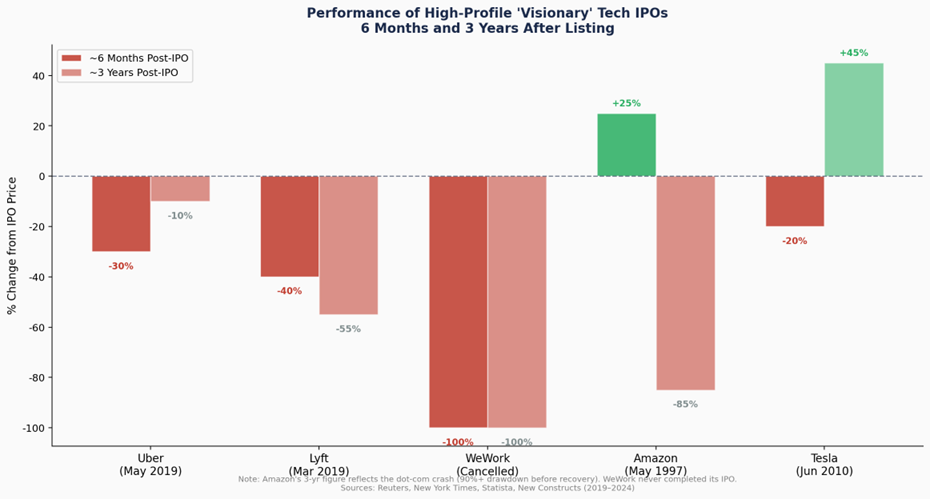
Figure 4: The historical performance of highly anticipated ‘visionary’ tech IPOs demonstrates the severe short-term risks facing retail investors. Sources: Reuters, New York Times, Statista, New Constructs (2019–2024).
What Graham Would Say to the Retail Investor
Graham drew a crucial distinction between two types of investor. The defensive investor prioritises safety of principal, minimal effort, and steady returns. The enterprising investor is willing to dedicate significant time and expertise to deep research, accepting higher risk in pursuit of potentially higher returns. For the defensive investor — which describes the vast majority of retail participants — SpaceX at IPO is almost certainly unsuitable.
The enterprising investor might argue that SpaceX represents a unique, once-in-a-generation opportunity to own a stake in the company that will define the next century of human civilisation. Graham would not dismiss this argument entirely. He would acknowledge that SpaceX’s Starlink business is genuinely profitable and growing rapidly, and that the company’s position in the commercial launch market is formidable. He might even concede that a small, highly speculative allocation — funded from money one can afford to lose entirely — is not irrational for an investor who fully understands the risks.
But he would insist on brutal honesty about what the purchase actually represents. It is not an investment in a company with a demonstrated earnings record, a conservative balance sheet, and a meaningful dividend. It is a bet on Elon Musk’s continued genius, health, and undivided attention; on the successful commercialisation of Mars; on the profitable deployment of artificial general intelligence; and on a corporate governance structure that explicitly denies shareholders any meaningful recourse if things go wrong.
“The investor’s chief problem — and even his worst enemy — is likely to be himself. — Benjamin Graham, The Intelligent Investor”
The fear of missing out on the SpaceX IPO will be intense. The media hype will be deafening. Social media will be flooded with stories of early investors who made fortunes. Graham’s warning about Mr. Market is precisely relevant here: the manic phase of the market’s personality is at its most dangerous when the narrative is most compelling. The intelligent investor does not follow Mr. Market into euphoria. He waits for the weighing machine to do its work.
Conclusion: The Defensive Investor Must Walk Away
If Benjamin Graham were alive today, he would likely marvel at SpaceX’s engineering achievements. The ability to land orbital boosters on drone ships and blanket the globe in high-speed internet is a triumph of human ingenuity. The Starlink business, viewed in isolation, is exactly the kind of profitable, growing utility that Graham would find interesting — at the right price.
But as a financial proposition at a $1.75 trillion valuation, Graham’s verdict would be unequivocal. SpaceX fails almost every quantitative test for financial safety. It is burning billions of dollars a quarter. Its corporate governance structure explicitly strips retail investors of their rights. Its valuation is entirely dependent on the future success of highly speculative ventures led by a CEO with deeply divided attention. And its accumulated deficit of $41.3 billion means that the company has consumed more capital than it has ever generated.
For the defensive retail investor seeking safety of principal and an adequate return, the SpaceX IPO is not an investment. It is a high-stakes speculation on the brilliance of one man and the colonisation of another planet. Ben Graham would politely decline the invitation, close the prospectus, and look elsewhere for a margin of safety. The intelligent investor would be wise to do the same.
☕ If you enjoy this article, please support the work: buymeacoffee.com/reimaginedworld
References
[1] Fortune. (2026, May 20). SpaceX finally files IPO prospectus, reveals revenue is up–but losses are too. https://fortune.com/2026/05/20/spacex-finally-files-ipo-prospectus-reveals-revenue-is-up-but-losses-are-too/
[2] CNBC. (2026, May 21). SpaceX IPO: What retail investors need to know before buying shares. https://www.cnbc.com/2026/05/21/spacex-ipo-what-retail-investors-need-to-know-before-buying-shares.html
[3] Graham, B., & Dodd, D. (1934). Security Analysis. McGraw-Hill.
[4] Graham, B. (1949). The Intelligent Investor. Harper & Brothers.
[5] CMC Markets. (2026). SpaceX IPO Preview: Starlink Profits, AI Losses, and the Risks. https://www.cmcmarkets.com/en-au/analysis/spacex-ipo-preview
[6] X/Twitter (@StockSavvyShay). (2026, May 21). SPACEX FULL FINANCIALS 2025 Full Year.
[7] TradingKey. (2026, April 13). $11.4 Billion Revenue Vs. 1.75 Trillion Valuation: Can Starlink Justify the Hype? https://www.tradingkey.com/analysis/stocks/us-stocks/261779128-starlink-spacexipo-rocket-launch-tradingkey
[8] Reuters. (2026, May 6). SpaceX IPO gives Musk sweeping power and curbs shareholder rights. https://www.reuters.com/sustainability/boards-policy-regulation/spacex-ipo-gives-musk-sweeping-power-curbs-shareholder-rights-2026-05-06/
[9] Reuters. (2026, April 29). Only Elon Musk can fire Elon Musk, SpaceX filing shows.
[10] New York Times. (2019, September 26). Wall Street Deflates America’s Favorite Start-Ups.
[11] New Constructs. (2019, September 11). Don’t Buy WeWork’s IPO At Any Price. https://www.newconstructs.com/dont-buy-weworks-ipo-at-any-price/
[12] Business Insider. (2019, May 13). Uber, Lyft IPO Trends: Money-Losing Unicorns Could Cause Market Issues.
[13] Statista. (2024, July 5). Chart: The Big ‘What If’: Amazon Went Public in 1997. https://www.statista.com/chart/9400/amazon-ipo-20-years/
Note — Some images may have been created with AI assistance.
메타데이터
- post_id
- f35331c569e7
- slug
- what-ben-graham-would-really-think-about-the-spacex-ipo-f35331c569e7
- url
- https://medium.com/@reimaginedworld/what-ben-graham-would-really-think-about-the-spacex-ipo-f35331c569e7
- canonical_url
- https://medium.com/@reimaginedworld/what-ben-graham-would-really-think-about-the-spacex-ipo-f35331c569e7
- author_url
- https://medium.com/@reimaginedworld
- status
- ok
- fetched_at
- 2026-06-09 15:37:30