The “Camino” was preparing me for another walk
In the spring of 2017, I set out on what I believed would be the most significant walk of my life.
The “Camino” was preparing me for another walk
In the spring of 2017, I set out on what I believed would be the most significant walk of my life.
Looking back now, I realize it began long before I ever put my feet in the Mediterranean Sea to start the Camino.
Mona Lisa
A few years earlier, in 2014 while living in Vail, Colorado, I felt God leading me to leave behind a life that was comfortable and familiar and move back to Italy. It didn’t make perfect sense on paper. Most people questioned it. But over the years I had learned that when that quiet voice spoke, life was always better when I listened.
That same voice would eventually lead me to another decision that made even less sense.
While visiting Paris for a quick solo weekend getaway in February 2017, I had just finished a tour of the Louvre Museum and stopped at a coffee shop to journal. As I sat there reflecting, I realized that throughout most of the tour I hadn’t really been present. My mind had been elsewhere.
I had spent the day walking among some of the greatest works of art in human history, standing just feet away from masterpieces like the Mona Lisa, yet my egoic mind kept pulling my attention away from the moment. Instead of experiencing what was before me, instead of being present in the now, I was lost in thought.
In my journal, I began writing about the decisions that had brought me to that point in my life. I reflected on the paths I had chosen, the experiences that had shaped me, and the questions that still lingered deep within my soul. I have journaled a lot most of my life and I use it as a way to dump or offload whatever is keeping me from being present. It became a moment of honest self-examination.
Side note: I have been asked before how I journal. Journaling has always been my form of prayer. I write as though no one else will ever read it, because it isn’t written for anyone else. It’s simply a conversation between me and my Creator. Depending on the conversation, you’ll see me call Him Lord, Father, or Abba. Those names each mean something different to me, but they all point to the same relationship. My biological Dad is Dad and only ever Dad, whom I love very much.
That afternoon in Paris, my journaling was not simply reflection. It was prayer. As I wrote about my life, the decisions that had led me there, and the restlessness I felt beneath the surface, I found myself in conversation with God. Somewhere in those pages, in the middle of that prayer, I wrote, I think I need to walk the Camino.
My Camino
Then, almost as if it appeared on the page before I consciously decided it, I wrote: I think I need to walk the Camino.
It was an idea that had lived quietly in my heart ever since I had read The Pilgrimage by Paulo Coelho. I continued journaling, praying over the thought, and sitting with what it might mean. The more I reflected, the more the idea felt less like a passing desire and more like a calling.
When I returned to Milan, I reached out to a friend who had recently completed the Camino in May of 2017. I wanted to hear about her experience, but even before we spoke, I sensed that something had already begun. The seed had been planted.
She said we should meet for coffee.
When we met, she brought a guidebook and asked, “Which one are you thinking about?”
I looked back at her, confused. “What do you mean, which one?”
Until that moment, I had no idea there was more than one Camino. In my mind, there was simply the Camino.
She opened the guidebook and began showing me the different routes that wound across Spain and Portugal. Each path had its own history, traditions, challenges, and reasons people chose to walk it.
I thanked her for taking the time to meet with me and told her I would pray about it. She knows me well, and so she wasn’t surprised by my response. Those closest to me know that I rarely make significant decisions without first taking them to prayer. I’ve always been open about my faith and my belief in the power of prayer, so my need to sit with it, pray over it, and seek direction would have seemed entirely natural to her.
When I got home, I spread the guidebook out in front of me and decided to sit with it for a while. I didn’t feel the need to make a decision that day. Instead, I prayed and meditated. I asked for wisdom, direction, and clarity. If this journey was something I was meant to undertake, I wanted to walk the path that had been prepared for me, not simply the one that seemed most appealing. So I waited and listened.
Instead of choosing one of the established routes, I felt God impress something entirely different on my heart. Walk the one I’ve given you.
I opened a map, and my eyes settled on a tiny town on the Mediterranean coast of southern France called Port-la-Nouvelle. I’d never been there. I didn’t know anyone there. There was no logical reason to begin there.
After a great deal of prayer, I finally made my decision.
When I shared it with my friend, her reaction was priceless. To this day, I will never forget the look on her face.
“That’s not even the Camino,” she said. “That’s not a normal starting point. How are you going to know where you’re going?” I just smiled.
“I grew up outside of Boulder, Colorado,” I replied. “I’m very familiar with how foothills work and I will use a map. I’ll keep the Pyrenees on my left and make my way through them until I reach Saint-Jean-Pied-de-Port.”
Saint-Jean-Pied-de-Port is the traditional starting point for the Camino Francés, the most well-known route of the Camino de Santiago. My plan was to begin even farther back, crossing the foothills and working my way toward the route before joining it.
She continued explaining all the reasons she thought it was a bad idea. The lack of trails. The navigation challenges. The unnecessary difficulty. The fact that nobody starts there.
But with each objection, I found myself becoming more convinced that I had made the right decision. The entire conversation reminded me of a shirt I had once seen that read:
“That’s a horrible idea. What time do we leave?”
There was something about the uncertainty of it all that felt right. I wasn’t looking for the easiest path. I was looking for the one I believed I was being called to walk.
I couldn’t shake it.
The idea was simple.
Start with my feet in one body of water.
Finish in another.
Everything in between would take care of itself.
I decided to begin on April 1, 2017.
My preparation was surprisingly simple. I wasn’t training to become a long-distance trekker because, quite frankly, I wasn’t one. I just wanted to give my body the best chance to handle whatever lay ahead. I leaned on the rowing machine for endurance and kept a simple strength routine centered around deadlifts from Tim Ferriss’ book the 4-hour Body. Intermittent fasting had already become part of my lifestyle, so I wasn’t overly concerned about meal schedules or how often I’d need to eat on the walk. Beyond that, I packed a backpack and trusted the rest would unfold as it was meant to.
I wish I could tell you I planned the journey carefully. I did not.
Had I done any real planning, I would’ve realized the south of France essentially shuts down around Easter. I would’ve picked a different date. A different starting point. Maybe even a different route altogether.
But I know myself, I know my egoic-mind.
If I don’t leave when I feel called, eventually I’ll find enough reasons not to go at all.
So when I felt led…I left.
One Step at a Time
On April 1st, I stepped into the Mediterranean Sea, let the water wash over my feet, picked up a small stone from the shoreline, slipped it into my backpack, and turned west.
My plan was to carry that stone across France and Spain and throw it into the Atlantic Ocean. The idea of that rock traveling from one place to another felt symbolic, as if it represented something far heavier and more meaningful than the little stone itself.
I had no idea how long the journey would take. I didn’t calculate daily mileage. I wasn’t an experienced long-distance trekker.
I would give myself however long it would take and started walking.
Growing up in Colorado, hiking and being outdoors was not foreign to me. But nothing remotely like this. My backpack held clothes, two pairs of shoes, a jacket, rain gear, my Bible, my journal, and enough supplies to get me to wherever the next day would lead.
Funny side note about two pairs of shoes: One of my favorite memories about my walk involves my shoes.
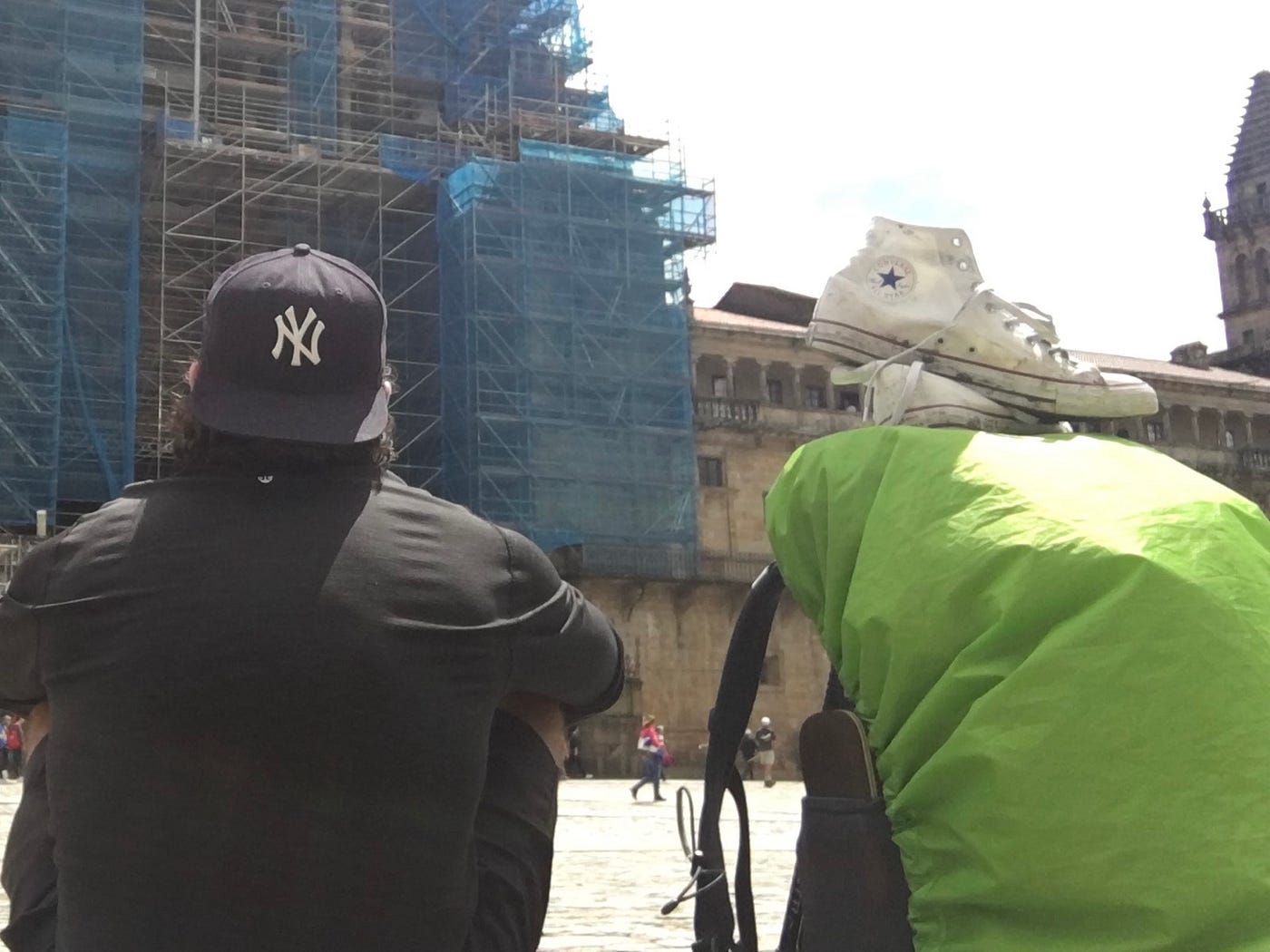
I started the journey with two pairs. The first was a pair of North Face trekking shoes, the kind most people would expect someone to wear on a long-distance hike. The second was a pair of white canvas Chuck Taylor All Stars.
My reasoning was simple. I thought that alternating between the two would change the shape of the toe box and the angle of the heel enough to give my feet some relief. I did not want to have mangled toes or feet after the walk; walking hundreds of miles in the exact same shoes day after day seemed like a good way to destroy them.
Besides, there was something undeniably funny about the idea of walking the Camino in Chuck Taylors.
My cousin was heavily into Twitter at the time and decided to tell Converse what I was planning. He tweeted the company and explained that I intended to walk the Camino de Santiago wearing Chuck Taylors.
Their response was something along the lines of, “Why would he do that?”
Looking back, I laugh because if something like that happened today, it would probably become a social media campaign. There would be hashtags, sponsorships, gear reviews, and daily updates. Back then, it was just a ridiculous idea that made people scratch their heads.
I knew the canvas uppers would hold up just fine. My concern was the soles. Before leaving, I replaced the factory inserts with orthopedic insoles I had from my New Balance running shoe. At some point during the walk, I also had to replace the pair I started with. I can’t remember the exact city It’s in my notes somewhere. What I do remember is the ending.
When I finally walked into Santiago de Compostela and reached that destination, I was wearing Chuck Taylors. Somehow, the shoes everyone questioned made it all the way to the finish.
The Ask
About a hundred or so steps into the journey, I stopped.
I turned around.
I looked back toward the Mediterranean. I looked up at the sky and prayed a simple prayer out loud:
“At some point on this walk… will You help me understand our relationship? Help me explain to other people why I hear You. Why I trust You. Why You allow certain things to happen. Give me the words along this walk to understand it better.”
Then I kept walking.

64 days: 1,510km across the Pyrenees, over into Spain to catch the beginning of the Camino de Santiago. Total Caminos incorporated: Camino Francese, Camino da Nord, Camino Primativo, and Camino Fisterra
The Detours
Looking back now, some of the most important moments on that Camino were the ones I never planned.
Just a few days into the journey, as I was walking along the shoulder of a road a sudden thud and bang and then impact. A car had hit me.
I went up over the hood, started over the roof and slid off to the side and was picking myself up behind it.
The driver looked visibly shaken, and as I looked at him, he was old, very old; His eyes were so glassy and grey; I could tell he was having trouble seeing clearly. Another man who had witnessed the entire incident stopped to help. While I gathered myself, the two men began arguing in French.
Their argument came to an abrupt halt when my excitement drew their attention. I had just realized that I was okay. Both men turned toward me as I exclaimed, loudly and with disbelief and relief, “Wow! I’m okay!”
I had just been hit by a car, and somehow, I was fine. I then took a selfie with the old guy because no way anyone was going to believe this. The poor old guy could not even see I was holding a camera phone!

The second driver explained that he worked in medical sales and offered to drive me to the next town, which was where I had been headed anyway. He mentioned that one of his clients was a physician and suggested I get checked out just to be safe. I gratefully accepted.
When we arrived, his physician client examined me and confirmed that I hadn’t suffered any serious injuries, just scrapes and would bruise up over the next few days. Given what had just happened, the news felt nothing short of miraculous. The same physician asked where I was headed.
When I explained what I was doing, he smiled; unbeknownst to me, he and his wife were avid hikers and he suggested a trail that crossed in the Pyrenees rather than following the roads.
That one conversation changed the entire journey.
A few days later, while walking this new trail, I met a woman named Ivelise from Barcelona. As we walked together, she shared stories from the many pilgrimages and long-distance treks she had completed over the years. She seemed to possess all the knowledge and experience that I lacked as a newcomer, and before long I found myself soaking up every bit of wisdom she offered.
She taught me about the network of pilgrim hostels and monasteries scattered along the route, places I would eventually use every four or five days to get a hot meal, shower, wash my clothes. In the south of France, pilgrim traffic was light, and days could pass with only a handful of encounters. But once I entered Spain, the Camino came alive. With each passing day, I met more pilgrims from every corner of the world. Nearly everyone seemed to be carrying a story as to why they were walking. Some were grieving the loss of a loved one. Others were post-divorce, a health scare, or a difficult chapter in their lives. They all had reasons for walking. Naturally, they would eventually ask me why I was there.
“Because God told me to.”
That answer almost always earned the same reaction: a warm smile, followed by a slightly skeptical look. “Seriously?”
“Yes, seriously.”
I knew it wasn’t the answer most people were expecting. They were often waiting for a story of grief, recovery, or personal crisis. Instead, all I could offer was the truth: I was walking because I felt called to walk.
The more miles I covered, the less strange that answer seemed to me. In fact, it became the simplest and most honest explanation I had. When I wasn’t staying at hostels, I planned to camp along the trail, sleeping under the stars and embracing the simplicity that had drawn me there in the first place. Like clockwork, every afternoon I would see these white butterflies, and they became my signal that it was time to start looking for a place to bed down for the night.
But Ivelise’s lessons went far beyond the hostels and monasteries. She taught me how to settle into the rhythm of walking day after day. We would walk early morning and siesta in the heat of the day and walk into the last light. She also convinced me to buy a pair of trekking poles. I had only used them once before while snowshoeing, but she explained how they distribute effort across the entire body and reduce the strain on your legs over long distances. At the next opportunity, we found a place that sold them, and I bought my first pair.
I would eventually come to think of her as my Camino Angel.

She also reminded me of my mom. They were the same age, and some of my favorite memories growing up in Colorado were the hikes I took with my mother before dementia slowly began taking pieces of her away. I love and miss you Mom!
Looking back now, I don’t think those memories, or even meeting Ivelise, were interruptions to my journey.
They were preparation.
The Lump
Sometime during that walk, I noticed a small lump developing on the back of my neck. I recorded it in my journal, noting that my sleep was good, my energy was strong, and I hadn’t experienced any unusual sweating or changes in bodily functions. Aside from the lump, everything felt normal, so there didn’t seem to be much reason for concern.
At first, I assumed it was muscular.
After all, I was carrying more food and water than expected because so many towns were closed for Easter. My backpack was heavier than I had anticipated, and it seemed reasonable to think I’d strained something causing inflammation.
As I crossed the Pyrenees and entered Spain, the conditions began to change. The weather grew milder, potable water became more readily available, and my tent was no longer covered in frost each morning. Realizing I no longer needed some of my cold-weather gear, I mailed the excess equipment back to Milan.
As the backpack became lighter, the swelling seemed to improve, so naturally, I thought nothing more of it.
It wasn’t until I returned home to Milan that the lump started growing again. At my massage therapist’s urging, I went to see a doctor.
Doctors ordered ultrasounds. More tests. Then finally a biopsy.
One by one, the possibilities became fewer.
Maybe an infection.
Maybe something in my blood.
Surely not cancer.
I held onto that one percent hope that the next test would finally explain everything.
Instead, each result simply eliminated another possibility.
Cancro
I still remember sitting in the doctor’s office with an oncologist present as he explained the results in Italian.
My Italian was good enough to follow most conversations, but not proficient especially with medical terms.
Then I heard one word.
Cancro.
I stopped him.
“Wait… did you say cancro… like cancer?”
He looked at me matter-of-factly.
“Yes. Like you lose your hair and die. Cancro.”
I wish I were making that up.
His response came with all the subtlety of a bucket of ice water.
“Yes. Like you lose your hair and die.”
I will never forget the way he said it. There was no pause, no softening of the explanation, and no concern for my comfort. Just a direct, unfiltered statement of fact.
I assume he was so blunt because his English wasn’t very good and he wanted to make absolutely certain there was no confusion about the meaning of the word. Nuance can be difficult in a second language, and perhaps that was simply the most straightforward description he could think of. Or maybe there was another reason that I wasn’t aware of.
Whatever the reason, the moment stuck with me. Of all the ways he could have defined the word cancro, he chose the one explanation that guaranteed I would never forget it.
He went on to explain my options. I could return to the United States for treatment or stay in Italy. They had an excellent oncology program, he said. The Institute of Oncology for Europe is just outside of Milan.
When I walked out of that office, fear finally caught up with me.
For just a moment.
The thoughts came quickly.
Why me?
Why now?
For just a moment, I listened to the fear.
It would’ve been easy to stay there in that fear, more thoughts.
I was living alone in a foreign country. My family was thousands of miles away. I had no idea what stage the cancer was, how aggressive it might be, or what the next several months would look like. To make matters more surreal, I had just returned to Milan from the walk and started a new relationship that felt almost too good to be true, a gift waiting for me at the end of the journey. Just as I was beginning to settle into that happiness and imagine a future unfolding in front of me, everything shifted. In an instant, my life was changing before my very eyes.
As I unlocked my bicycle to ride home, a thunderclap seemed to explode inside my mind. No one else could have heard it, but it demanded my full attention.
I stopped in my tracks.
Then, just as clearly as I had heard it years before, the voice returned.
“Do you remember that walk?”
I sheepishly replied, “Yes.”
“Do you trust Me?”
Without hesitation, I answered,
“Yes!”
“Then this is just another walk.”
A pause.
“I prepared you for this.”
“What is my role?”
“To find the beauty every day, as you did on our walk.”
I can’t fully explain what happened in that moment. I referred to it as a spiritual High-five in a video I did about the experience to notify my family that I had cancer:
[embed]
The diagnosis didn’t change.
The circumstances didn’t change.
The uncertainty certainly didn’t change.
But I did.
The fear that had tried to rush in only moments before was replaced by a peace that is difficult to describe unless you’ve experienced it yourself.
Not because cancer was somehow a good thing.
Not because I suddenly knew how everything would work out.
But because I realized I wasn’t walking into it alone.
Looking back now, I don’t think God sent me on the Camino because He wanted me to cross France and Spain.
I think He wanted to teach me how to walk, trusting Him. He was preparing me for a problem I didn’t know I was going to have, which is a theme that would continue in my life.
One lesson from that journey came back to me immediately.
Whenever the distance ahead felt overwhelming, I’d ask myself a simple question.
How do you eat an elephant?
One bite at a time. Which meant one step at a time.
Standing there with a cancer diagnosis in my hands, those words suddenly carried an entirely different meaning.
I didn’t need to figure out chemotherapy.
Or staging. Or survival rates. Or what life would look like a year from now.
I only needed to take the next step.
Another Camino
The diagnosis was lymphoma. There was more blood work. PET scans. CT scans. Appointments. Waiting.
The next several weeks filled quickly with consultations, and tests that would determine the stage and type of cancer I was facing.
For someone who likes to move forward, waiting became one of the hardest parts. You want answers. You want a plan. You want certainty.
Instead, you’re handed appointments and told to wait.
But this wasn’t the first time I had stood at the beginning of a long road without knowing what was around the next corner.
The Camino had taught me something I desperately needed to remember.
You don’t have to see the entire path.
Side note: If you are reading (or listening) to this, it means you have already made it through some of your toughest moments. You may not have emerged unscathed, but you made it through. By now, you’ve likely recognized something of your own experience in this journey. The battle with the egoic mind is not mine alone; it is part of the human condition. We have all heard that inner voice of fear, doubt, and uncertainty trying to convince us that we are alone, unsupported, or not enough.
Eckhart Tolle captured it best in The Power of Now, and I’ve always loved the way Wayne Dyer spoke about the same idea. Their words helped me make sense of what I was experiencing
Worry feels responsible. It feels like care. It can masquerade as love, preparation, or vigilance. But worry is not wisdom. At its core, worry is a declaration of mistrust in the intelligence that created you. It is, in a sense, saying that God made a mistake.
Nothing else in nature worries the way we do. Birds do not worry about tomorrow’s worms. Trees do not worry about the coming winter. Only the human ego lives in a state of anxiety about what might happen next.
God does not speak through fear. Fear is the language of the ego. The ego survives by convincing us that we are separate, unsupported, and alone.
But my walk revealed the opposite. It showed me that I was never alone. What appeared to be chance was often divine design. Time and again, events that seemed random or meaningless in the moment revealed their purpose later. The pieces fit together in ways I could never have planned.
When people say that everything happens for a reason or there are no accidents, it can be a statement that rubs some the wrong way, especially when life brings pain, loss, or hardship. From our limited perspective, it is difficult to understand why bad things happen. We see only a small section of the story, viewing life through a narrow, linear lens.
Yet God has shown me that I do not need to understand the entire picture. I only need to take the next step and trust.
Trying to figure out exactly how it all works is like trying to understand the ocean by examining a single drop of water. Our minds are simply too small to grasp the vastness of the design. What is asked of us is not complete understanding, but faith in the path unfolding before us.
You only have to take the next step.
That’s exactly what I did.
This first episode is where that journey begins.
In the next episode, I’ll share the update I wrote after my Bone Marrow Transplant. Looking back on the second time I faced cancer, it’s incredible to see how the lessons from that first Camino carried me through a completely different battle years later.
Then, in Episode Three, I’ll share my one-year anniversary update and reflect on everything that happened in between, what it taught me, and how it ultimately led me here.
After that, the podcast begins to do what I always hoped it would.
It stops being about my story.
It becomes about the remarkable people willing to share theirs.
That’s why I created From the Edge Podcast.
Every one of us knows someone who has stood at the edge of something that should have broken them: illness, injury, loss, addiction, betrayal, or unimaginable hardship, and somehow found a way to emerge with a deeper appreciation for life, a renewed sense of purpose, or a perspective they never would have discovered otherwise.
Those are the stories that deserve to be told.
If this episode resonated with you, I’d love for you to follow the podcast and share this episode with someone who might need the reminder that they’re not walking alone.
And if someone came to mind while you were listening, send them this episode. Then encourage them to reach out. I’d love the opportunity to hear their story and, perhaps, share it with our community.
Some of the most powerful stories have never been told.
Maybe theirs is one of them.
Until next time, remember…
You don’t have to see the whole path.
You only have to take the next step.
메타데이터
- post_id
- f38255b0cfa7
- slug
- the-camino-was-preparing-me-for-another-walk-f38255b0cfa7
- url
- https://medium.com/@chris.stiebler23/the-camino-was-preparing-me-for-another-walk-f38255b0cfa7
- canonical_url
- https://medium.com/@chris.stiebler23/the-camino-was-preparing-me-for-another-walk-f38255b0cfa7
- author_url
- https://medium.com/@chris.stiebler23
- status
- ok
- fetched_at
- 2026-08-09 15:42:22