The Vatican Has A Plan For Iran
And it’s badly needed.
BEYOND THE LEONINE
The Vatican Has A Plan For Iran
And it’s badly needed.
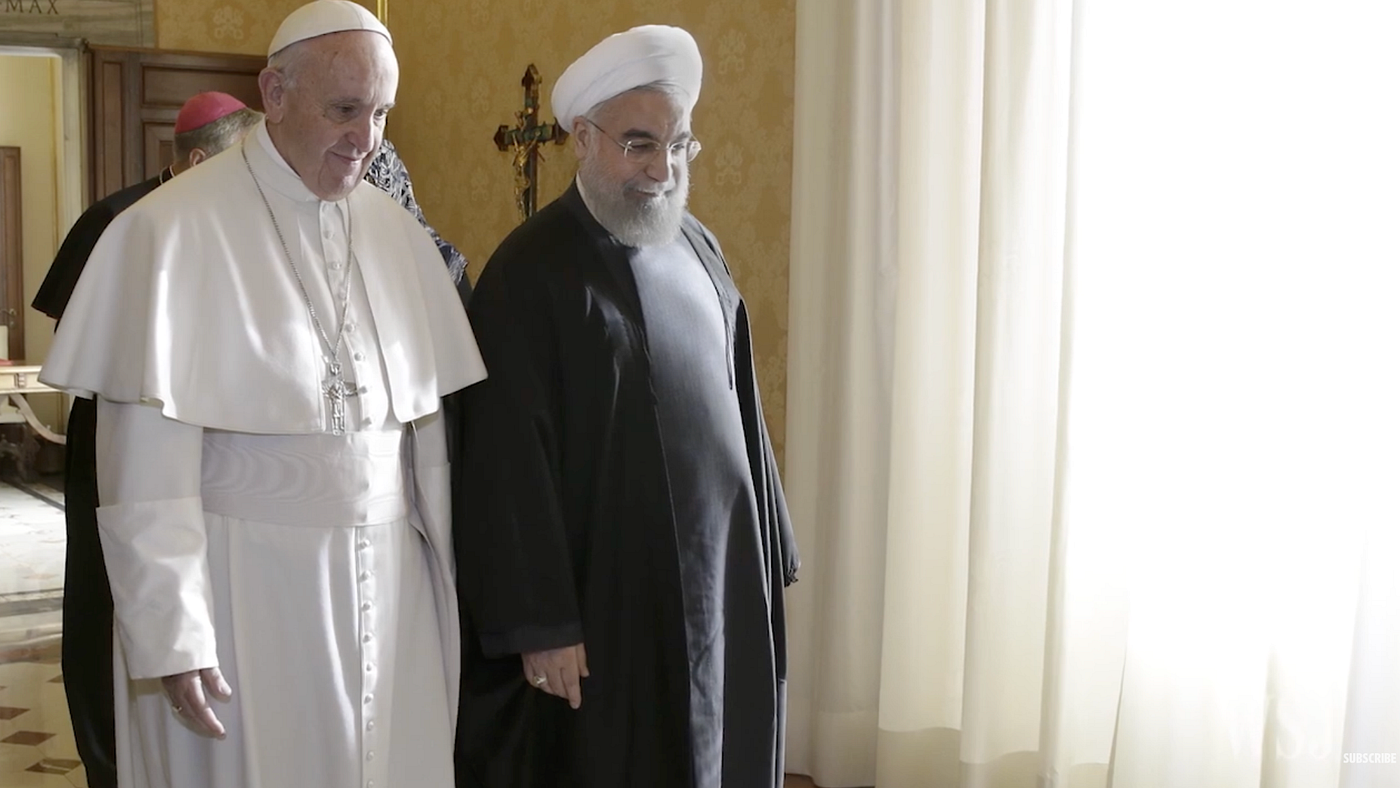
Pope Francis and Iranian President Hassan Rouhani at the Vatican in 2016 (source: YouTube)
The Vatican has a plan for Iran.
Not a plan to fix it. Not a plan to change its regime.
Rather, a plan to ensure the protection of Christians and other religious minorities, to advocate fundamental human rights, and to promote peace.
The voice of the Holy See is highly unique on the world stage. It’s not, strictly speaking, the voice of a “country,” but it does enjoy the rights and privileges of an independent sovereign territory nonetheless. It seeks not its own interests, but those of the Gospel. It represents the Church, but more importantly — at least in the minds of non-Catholic diplomats who listen to it carefully in multilateral organizations such as the United Nations and the European Union — it represents all of humanity.
Even those engaged in full-time diplomacy have a hard time grasping the role of the Holy See on the international stage. The Holy See itself has evolved in its understanding of how to best engage and collaborate with other global actors. But the extent of the Holy See’s influence upon the international community cannot be overstated, even when its operations are meagre and resources limited.
As for any sovereign entity, the real test comes in times of conflict. The papacy has not been directly involved in war since papal troupes were defeated by the Italian Risorgimento in 1870. But that doesn’t mean the Holy See has stopped fighting. It just means she’s picked up different arms. Besides, the Swiss Guardsman are commissioned only to defend the pope’s body and residence (and, when the See of Peter is vacant, the College of Cardinals).
Indeed, the diplomatic activity of the Holy See has not been without significant achievements. Pope John XXIII’s public appeal for peace led to a de-escalation of tensions during the Cuban Missile Crisis in 1962. Vatican shuttle diplomacy helped resolve the six-year Beagle Channel Dispute between Argentina and Chile in 1984. The restoration of diplomatic ties between the United States and Cuba was made possible by the tireless mediation of Pope Francis and Vatican diplomats. These are but a few examples of successful Vatican efforts to resolve conflicts.
What about Iran? What has the Holy See been up to since the Islamic Revolution of 1979? And before that?

Pope Paul VI and Iranian Prime Minister Mohammad Mossadegh in Tehran in 1970 (source: YouTube)
Pope Pius XII established official diplomatic ties with Iran in 1954, the year after the U.S. and U.K. orchestrated the overthrow of Prime Minister Mohammad Mossadegh to protect Western oil investments. Archbishop Raffaele Forni served as the first papal representative until his reassignment to Venezuela in 1955. The Islamic Republic of Iran continues to retain a relatively large diplomatic corps at its Embassy to the Holy See at Via Bruxelles, 57.
During his last international voyage, Paul VI made an overnight visit to Tehran where he was welcomed by Shah Mohammad Reza Pahlavi on 26 November 1970. Popes Francis and Leo XIV have gotten as close as they can to the country, both visiting Turkey and offering ostensible prayers for peace in the region. Last March, Leo spoke strongly against Iran’s murderous suppression of dissidents: “Violence can never lead to the justice, stability, and peace for which the peoples are waiting.”
The induction of Iranian ambassador Ayatollah Hossein Mokhtari to the Order of Pius at the Vatican last spring raised eyebrows. Not without reason did canonist Fr. Gerald Murry call it an “oversight,” although there are scores of diplomats accredited to the Holy See representing nations whose human rights’ violations are equally reprehensible.
In recent times, the most significant exchange between the Vatican and Iran involved a letter entrusted to Pope Benedict XVI by Iranian Vice President for Parliamentary Affairs Sayyed Mohammad-Reza Mir-Tajeddini, in which Iranian President Ahmadinejad made an appeal to all religions to join together in opposing secularism and materialism, expressing his personal desire to work closely with the Vatican in combatting religious intolerance and the breakdown of the family. In a reply to the Iranian President, Benedict wisely hinted that they should start with the Catholic Church in Iran by establishing a bilateral commission to address serious problems.
Despite Iran’s attempts to silence those problems by tightly controlling the media and heavily restricting internet usage, the problems are clear enough. And they’re not limited to Catholics.

Saint Peter Evangelical Church in Tehran (source: asianews)
In the heart of Tehran, Saint Peter Evangelical Church has been serving Tehran’s Protestant community for over 150 years. Just a couple of weeks ago, six government agents entered the church to identify worshipers in an apparent attempt to intimidate the community and gradually confiscate portions of its valuable property. Evangelical and Protestant communities find it particularly difficult to worship freely in Iran in comparison with other Christians who have more extensive structures of protection. The Executive Secretary of the Synod of the Iranian Evangelical Church in the Diaspora (SECID-E) has issued a statement warning that “without a timely response to this crisis, we could be deprived of the last remaining places of worship in the country.”
Such repression is a cause of major concern for the Vatican. Protestants and Evangelicals rely on the leverage they gain by maintaining close ties with the Apostolic Nunciature in Iran, which is currently without a Nuncio after the reassignment of Archbishop Andrzej Józwowicz to Sri Lanka.
Truth be told, there are only three Catholic churches in Tehran, the largest of which is Chaldean Rite and the smallest of which is Latin. That didn’t stop Pope Francis from making the Archbishop of Tehran a Cardinal in 2024. His Eminence Dominique Joseph Mathieu, O.F.M. Conv., has since been evacuated to Rome where he awaits an end to the war.
Since his election, Pope Leo has placed renewed emphasis on the inseverable bond between true peace and religious freedom. “The right to religious freedom is not optional but essential,” he insists, since, “created in God’s image and endowed with reason and free will, religious freedom allows individuals and communities to seek the truth, to live it freely, and to bear witness to it openly.” It is therefore “a cornerstone of any just society, for it safeguards the moral space in which conscience may be formed and exercised.” In other words, religious freedom “is not merely a legal right or a privilege granted to us by governments; it is a foundational condition that makes authentic reconciliation possible.”
A cornerstone of the Vatican’s plan for Iran — like any country — is religious freedom, for lasting peace is never achievable when such a basic right rooted in human dignity is denied.
But the Vatican’s plan also has a more intricate, outward facing component it has been working on for years.
Or, should I say, that Iran has been working on for years. Already during the reign of Pope Benedict XVI, Iran had been making a calculated effort to capitalize on the Vatican’s neutrality to gain leverage in the event the United States should launch an attack after Iran had failed to fully comply with United Nations’ nuclear weapons inspectors. In Iran’s mind, such leverage was in large part strengthened by what it perceived as a favorable and direct response to the Vatican’s appeal last April for the release of fifteen captive British sailors. President Ahmadinejad called the release “an Easter gift” while diplomat and former president Mohammad Khatami acknowledged that “the policy of the Holy See is important throughout the whole world.” Although Benedict avoided speaking openly about what would or should happen if Iran did not comply with U.N. nuclear inspections, Iranian diplomats knew well that the pope would decry any act of military aggression on the part of the United States. They had unmistakable memories of Cardinal Ratzinger’s support for Pope John Paul II’s vociferous opposition to the U.S.-led invasion of Iraq.
Iran’s diplomatic leverage was supercharged by the election of an American pope 2025. At the same time, Leo has shown that he will keep the moral high ground when it comes to Iran. He will never be forced into speaking about the true nature and aims of Iran’s nuclear program, but he will assume an offensive position when it comes to defending human rights and imploring respect for religious liberty.
That probably doesn’t bother Iran too much, but it does give good reason for U.S. leaders to arrogate Vatican support for its efforts to promote religious liberty. At a press conference in the White House last May, Secretary of State Marco Rubio, just before departing for Italy and the Vatican, remarked that the United States “shares with the Catholic Church a concern about the destruction of religious liberty” and “the persecution of Christian minorities.” Secretary Rubio didn’t need to focus on these as specific concerns within Iran, just as Mohammad Khatami didn’t need to spell out the details of a military threat from the United States to justify Iran’s right to build a domestic nuclear program.
The Vatican’s position within the international community is always unique. All the more so with Iran.
It’s not the Holy See’s prerogative to spell out the specifics of how to construct a more just regime in Iran. Even though Leo XIV has — wisely or unwisely — explicitly stated that the war in Iran does not meet the criteria of a “just war,” neither is it his duty to evaluate minutely the specific criteria the U.S. either used or failed to use in deciding to attack Iran.
If the Vatican has any plan with regard to Iran, it’s to decry the violation of human rights, promote religious liberty, favor international dialogue, inhibit the production and proliferation of nuclear arms, and safeguard the dignity of the human person as created in the image and likeness of God.
That’s a grand plan, but through the eyes of faith, far from grandiose.
메타데이터
- post_id
- f3a316558ffc
- slug
- the-vatican-has-a-plan-for-iran-f3a316558ffc
- url
- https://medium.com/the-geopolitical-economist/the-vatican-has-a-plan-for-iran-f3a316558ffc
- canonical_url
- https://medium.com/the-geopolitical-economist/the-vatican-has-a-plan-for-iran-f3a316558ffc
- author_url
- https://medium.com/@frdbg70
- status
- ok
- fetched_at
- 2026-07-14 21:21:30