What your brain does when it’s doing nothing — and why it defines you
The default mode network was once treated as irrelevant background noise. It turned out to be the system that builds the self.
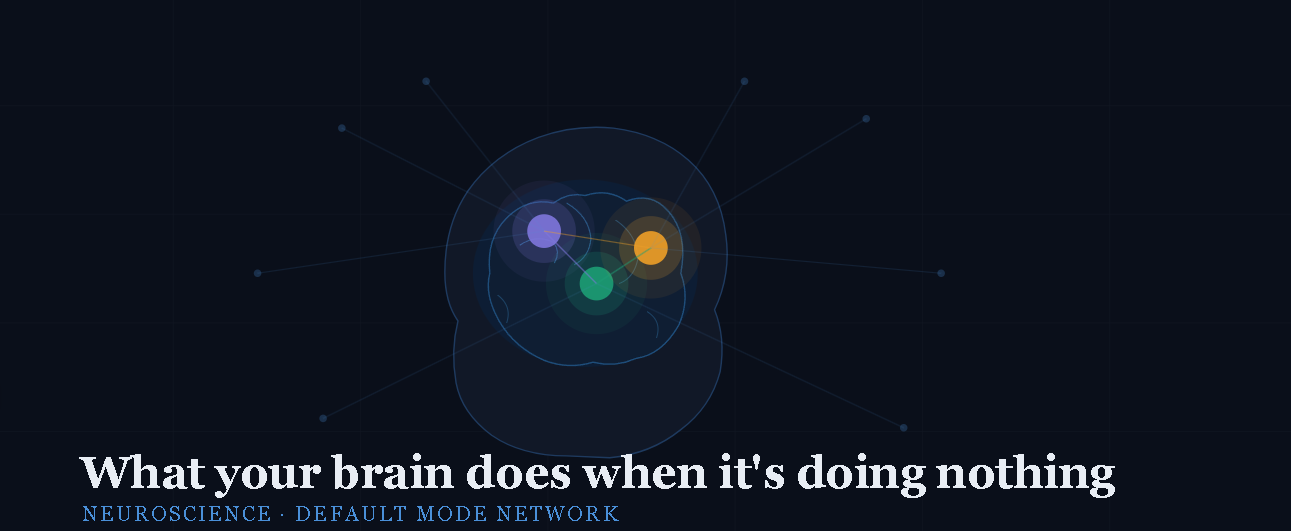
NEUROSCIENCE . COGNITION . SELF
What your brain does when it’s doing nothing — and why it defines you
The default mode network was once treated as irrelevant background noise. It turned out to be the system that builds the self.
In the late 1990s, neuroscientist Marcus Raichle noticed something that didn’t make sense.
When participants in his PET imaging studies were given a cognitively demanding task, a particular set of brain regions didn’t light up — they went quiet. These regions were active at baseline, consumed a disproportionate share of the brain’s energy budget, and reliably deactivated the moment the brain was asked to do something specific.
The prevailing assumption had been that resting brain activity was background noise — metabolic overhead to subtract before the real data appeared. Raichle’s data suggested the opposite: the “resting” state was the signal.
In 2001, Raichle and colleagues published a paper in the Proceedings of the National Academy of Sciences introducing what they called a “default mode of brain function” — a set of regions that operated as a coordinated network during rest and suppressed during externally directed tasks. The default mode network, or DMN, had been hiding in plain sight in years of neuroimaging data, consistently misclassified as noise.
The discovery reoriented a field. If the brain’s baseline state wasn’t passive but actively organized, the question became: what is it organized to do?
THE ACHITECTURE
Three hubs, one function
The DMN is not a single structure. It’s a distributed network — a set of regions that reliably co-activate and deactivate together, identified through patterns of correlated activity in fMRI data. The three core hubs, established by Buckner, Andrews-Hanna, and Schacter in a landmark 2008 review, are anatomically distinct but functionally coupled.

Simplified medial sagittal view showing approximate locations of the three core DMN hubs. Not to anatomical scale.
What’s notable about this trio isn’t their individual functions — it’s what they share. Each region is implicated in tasks that require simulating something not immediately present in the environment: a past event, a future scenario, another person’s perspective, or a self-concept built from memory and social feedback. They don’t co-activate because they’re neighbours. They co-activate because they’re solving the same class of problem.
This functional logic was formalized by Spreng and colleagues in 2009, who proposed a unified model arguing that prospection (future simulation), retrospection (memory retrieval), theory of mind (modelling others’ mental states), and self-referential judgment all recruit the DMN because they share a core computational demand: constructing a coherent first-person simulation of something non-present.

WHAT IT ACTUALLY DOES
The self-modelling state
Call it simulation. When you’re not focused on an external task, your brain defaults to running internal models — of who you are, who other people are, what happened yesterday, what might happen tomorrow. This isn’t random mental chatter. It’s a specific mode of processing, computationally demanding, and evolutionarily significant.
The experimental evidence for this is clean. When participants are asked to recall an autobiographical memory, the DMN activates. When they imagine a plausible future event, the same network activates — with substantial overlap in the specific regions engaged. When they’re asked to consider what a stranger is thinking, it activates again. And when they answer the question “does the word generous describe you?” the medial prefrontal cortex response is particularly pronounced — activating more than when they answer the same question about a celebrity or a fictional character.
These tasks feel subjectively different. The neuroscience says they rely on the same machinery.
The DMN isn’t a resting state. It’s a self-modelling state — the system the brain uses to generate and maintain a coherent first-person perspective across time.
This reframing matters because it changes what it means for the network to be “default.” The brain doesn’t fall back into passivity when you stop concentrating. It transitions into a mode that is, in certain respects, more personally significant: constructing and updating the continuous simulation that constitutes your sense of self.
THE WANDERING MIND
47% of the time, you’re not here
In 2010, psychologists Matthew Killingsworth and Daniel Gilbert published an unusual study in Science. Using a smartphone application that pinged participants at random intervals throughout the day, they tracked the moment-to-moment mental states of 2,250 adults. Participants reported what they were doing, whether their mind was wandering, and how happy they felt.
The headline finding: people’s minds were wandering 46.9% of waking hours. More significantly, mind-wandering predicted lower happiness, regardless of what activity participants were engaged in. “A wandering mind is an unhappy mind,” the authors concluded.
The paper generated enormous attention — and a great deal of misreading. The temptation, particularly in popular coverage, was to frame DMN activation as inherently costly — something to be minimized. That framing is too simple.
Subsequent research by Smallwood and Schooler drew an important distinction between spontaneous mind-wandering — unintentional, decoupled from current goals, associated with the negative affect Killingsworth and Gilbert measured — and deliberate prospection: intentional future-oriented simulation that serves planning, creative incubation, and goal pursuit. Both recruit the DMN. The functional and emotional consequences are starkly different.
The problem isn’t the network. It’s the content and intentionality of what the network is running.

WHEN THE SIMULATION LOOPS
The DMN in depression
One of the most replicated findings in depression neuroimaging is that the DMN doesn’t simply remain active — it becomes hyperconnected and increasingly decoupled from the regulatory influence of lateral prefrontal regions that normally modulate it. The self-simulation machinery keeps running, but the content narrows and the temporal range collapses.
In clinical depression, patients show elevated functional connectivity within the DMN at rest, particularly involving the subgenual anterior cingulate cortex — a region Sheline and colleagues identified in 2009 as a critical hub in the hyperactive DMN characteristic of depressive states. The future-simulation that helps healthy individuals plan and anticipate becomes foreclosed. Autobiographical memory retrieval skews toward negative, self-referential content. The model the brain keeps running is one where past failures are overrepresented and positive futures are inaccessible.
A necessary caveat: this is correlational evidence. The causal relationship between DMN hyperconnectivity and the subjective experience of depression is genuinely debated. Does ruminative cognition drive increased DMN coherence, or does baseline hyperconnectivity predispose individuals to ruminative thought patterns? The imaging data cannot resolve this, and any account that presents one direction as settled is outrunning the evidence.
What the data do support is a circuit-level description that aligns closely with the phenomenology of depression: a self-referential processing system that is overactive, insufficiently regulated, and running a highly constrained simulation with a narrow and predominantly negative self-narrative.

MODULATING THE NETWORK
Meditation, psychedelics, and the loosening of self
If the DMN constructs the self, what happens when you systematically disrupt it?
Brewer and colleagues published findings in 2011 showing that experienced meditators — with an average of 10,000 hours of practice — showed significantly reduced activity in key DMN regions during meditation compared to novices. Crucially, this suppression occurred even during the meditators’ resting baseline. Long-term practice appears to alter the network’s default activity level, not just its state during formal practice. The self-simulation is quieter.
A different line of evidence comes from psychedelic research. In a 2012 study, Carhart-Harris and colleagues administered psilocybin to participants in an fMRI scanner and found marked decreases in activity in the posterior cingulate cortex and medial prefrontal cortex — the DMN’s core hubs — that correlated strongly with the subjective experience of ego dissolution. The less the DMN functioned as a coherent network, the more participants reported a dissolution of ordinary self-boundaries.
The psychedelic findings warrant careful handling. This is a young field working with small samples, significant methodological variability, and a history of overstated claims. The mechanistic story is far from complete. What the evidence currently supports is a consistent directional relationship: reduce DMN coherence, and the sense of a bounded, continuous self becomes less fixed. That’s an interesting finding. It is not a theory of consciousness.

WHAT THE RESTING BRAIN TELLS US ABOUT THE SELF
You are something your brain does
The default mode network was initially treated as noise — a baseline to subtract before the “real” activity began. That framing turned out to be exactly backwards.
What Raichle’s group stumbled onto wasn’t the brain idling. It was the brain doing something deeply specific: constructing a model of the self through time. When you recall a past experience, simulate a future conversation, infer what someone else is thinking, or evaluate whether an adjective fits your personality — these aren’t separate functions that happen to share cortical real estate. They’re expressions of the same underlying operation.
The DMN isn’t a resting state. It’s a self-modelling state.
That reframe has consequences that extend beyond neuroscience. If the self is not a fixed entity but an ongoing simulation — a narrative the medial prefrontal cortex continuously regenerates using memory, social context, and anticipated futures — then identity is less like a possession and more like a process. You are not a thing your brain contains. You are something your brain does, most reliably when nothing external is demanding its attention.
This isn’t philosophy dressed in neuroscience clothing. It’s what the imaging data actually implies. The regions most central to DMN function are precisely the regions most consistently activated during self-referential tasks. The overlap isn’t coincidental. The self, as far as the brain is concerned, is a simulation problem.
None of this tells you what to do with your default mode network. “Meditate to quiet your DMN” is too crude a reading of findings that are far more conditional and context-dependent than that framing implies. What the research supports is a more empirically accurate model of what the self is: not the observer of your mental life, but a product of it.
The brain doesn’t switch on when you give it a task. In an important sense, it never stops working. It just changes what it’s working on — and when left to its own defaults, what it works on most is you.
REFERENCES
Raichle, M.E., et al. (2001). A default mode of brain function. PNAS, 98(2), 676–682
메타데이터
- post_id
- f3ac6344d4f5
- slug
- what-your-brain-does-when-its-doing-nothing-and-why-it-defines-you-f3ac6344d4f5
- url
- https://medium.com/@anup17508/what-your-brain-does-when-its-doing-nothing-and-why-it-defines-you-f3ac6344d4f5
- canonical_url
- https://medium.com/@anup17508/what-your-brain-does-when-its-doing-nothing-and-why-it-defines-you-f3ac6344d4f5
- author_url
- https://medium.com/@anup17508
- status
- ok
- fetched_at
- 2026-06-09 15:37:30



