Most of What Teachers Call Feedback Isn’t Feedback
Grant Wiggins identified seven characteristics of effective feedback. Most marking meets fewer than four.
Most of What Teachers Call Feedback Isn’t Feedback
Grant Wiggins identified seven characteristics of effective feedback. Most marking meets fewer than four.
Grant Wiggins spent years trying to explain why students don’t improve after receiving comments on their work. His conclusion was precise and uncomfortable: most of what teachers give students in response to their work is not feedback. It is evaluation. It is advice. It is praise. None of these is feedback, and conflating them is the reason most marking piles don’t move learning forward regardless of how long a teacher spends on them.
Wiggins defined feedback with unusual rigour. Feedback is specific information about how a student is performing in relation to a clearly defined goal. It tells them where they are, measured against where they need to be, with enough precision that they know what to do next. Remove any part of that definition and what you have left is something else — something that may feel useful but functionally isn’t.
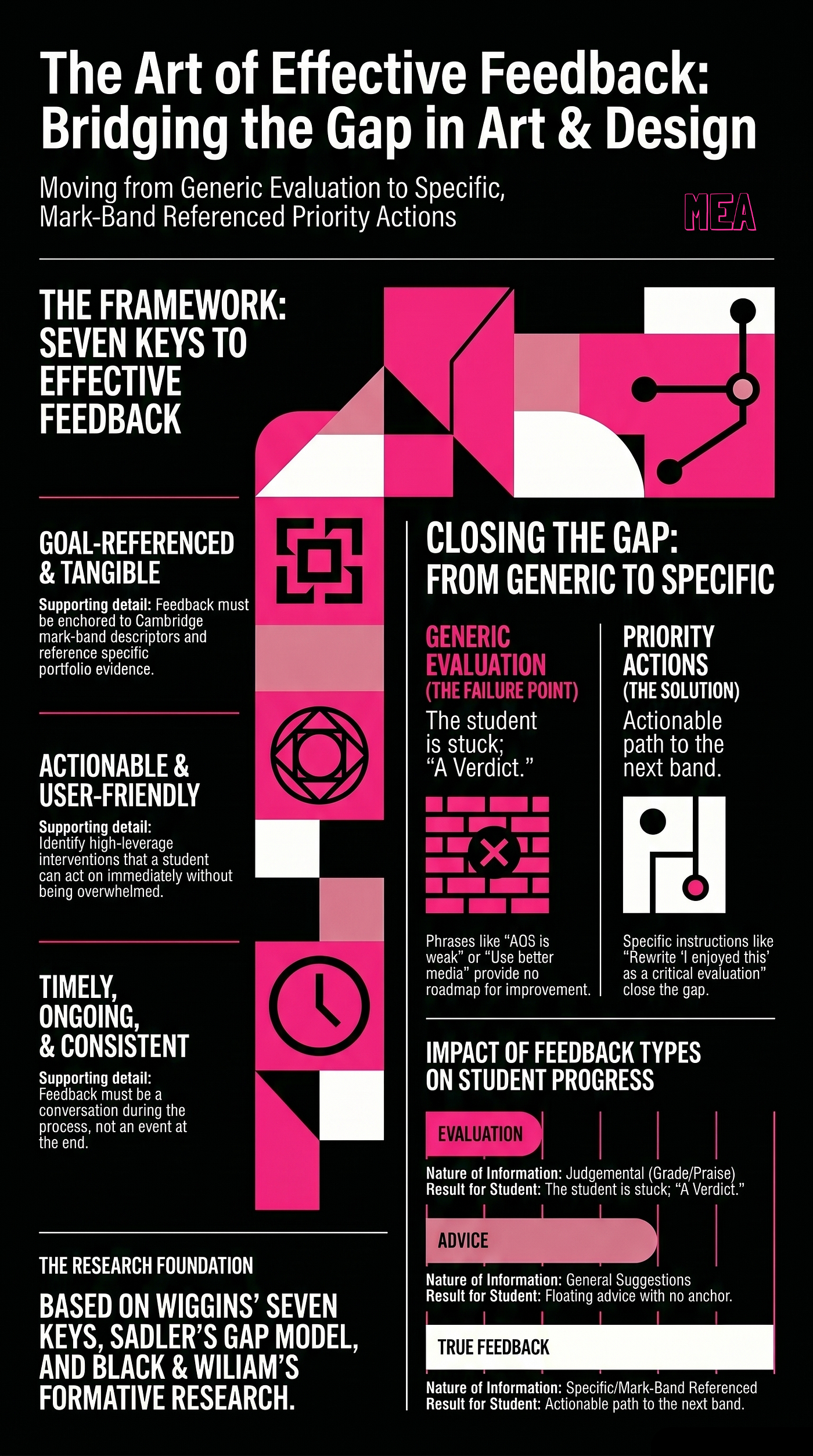
He identified seven characteristics that genuinely effective feedback must have. It must be goal-referenced, tied to a specific standard the student understands. It must be tangible and transparent, pointing to specific evidence rather than abstract qualities. It must be actionable, telling the student exactly what to do rather than describing a position. It must be user-friendly, identifying the one or two highest-leverage interventions rather than listing every problem. It must be timely, arriving when the student can still act on it. It must be ongoing, generating a response rather than being filed and forgotten. And it must be consistent, applying the same standard across students and over time.
Most written feedback in most classrooms fails at least four of those seven. Not because teachers are careless. Because meeting all seven for thirty students, at multiple points across an academic year, while teaching full time, is structurally impossible without better tools.
That is what this is about.
I teach Cambridge IGCSE Art and Design. The portfolios are large, the assessment objectives are complex, and the feedback requirement is unforgiving. A student at the boundary between two mark bands needs feedback that names the band, describes the specific gap, and gives them a concrete action on a specific page. Writing that for thirty students after a marking cycle, at the standard Wiggins describes, used to take most of a weekend. It doesn’t any more.
The system I use now has seven interactive tools built around the Wiggins framework and the Cambridge 0400 assessment objectives. The Student Thread holds a longitudinal record for each student. The Cambridge Gap Map shows the exact gap between where a student is and where they need to be across all four assessment objectives and all five mark bands, using the verbatim 2027 syllabus descriptors. The Priority Action Card produces two-tier, mark-band referenced actions a student can act on immediately. AI generates a first draft of each card in under a minute. The teacher reviews, edits, and makes it theirs.
The example I use when explaining the system is a real one. A student — I’ll call her Amara — was four weeks from submission, sitting at 66 out of 100, needing 70 to reach the next band. Her Priority Action Card had three actions. The first asked her to write five to eight sentences on one of her middle boards explicitly naming the development thread that ran through her work — annotation only, no new artwork, one to two hours. The second asked her to replace every “I enjoyed this” annotation with a specific evaluative statement, because Cambridge awards marks for critical understanding, not enjoyment. The third asked her to produce a single page of figure rework studies addressing the one element in her final piece that was noticeably weaker than everything surrounding it.
Those three actions were specific, mark-band referenced, and actionable. They took under five minutes to produce using the system. Amara acted on all three. Her AO3 mark moved.
The system is available as a complete guide and file pack. If you teach Cambridge IGCSE Art and Design and you want the Wiggins framework made operational for your marking practice, it is at the link below..
meatoolkit.gumroad.com/l/art-of-feedback-igcse
메타데이터
- post_id
- f3afa13cfe23
- slug
- most-of-what-teachers-call-feedback-isnt-feedback-f3afa13cfe23
- url
- https://medium.com/@piranlowe/most-of-what-teachers-call-feedback-isnt-feedback-f3afa13cfe23
- canonical_url
- https://medium.com/@piranlowe/most-of-what-teachers-call-feedback-isnt-feedback-f3afa13cfe23
- author_url
- https://medium.com/@piranlowe
- status
- ok
- fetched_at
- 2026-06-26 03:39:16



