Daylight Saving Time Examined: Does It Still Make Sense?
Daylight Saving Time (DST) is one of those policies that quietly shapes daily life for millions, yet is rarely examined in depth.
Daylight Saving Time Examined: Does It Still Make Sense?
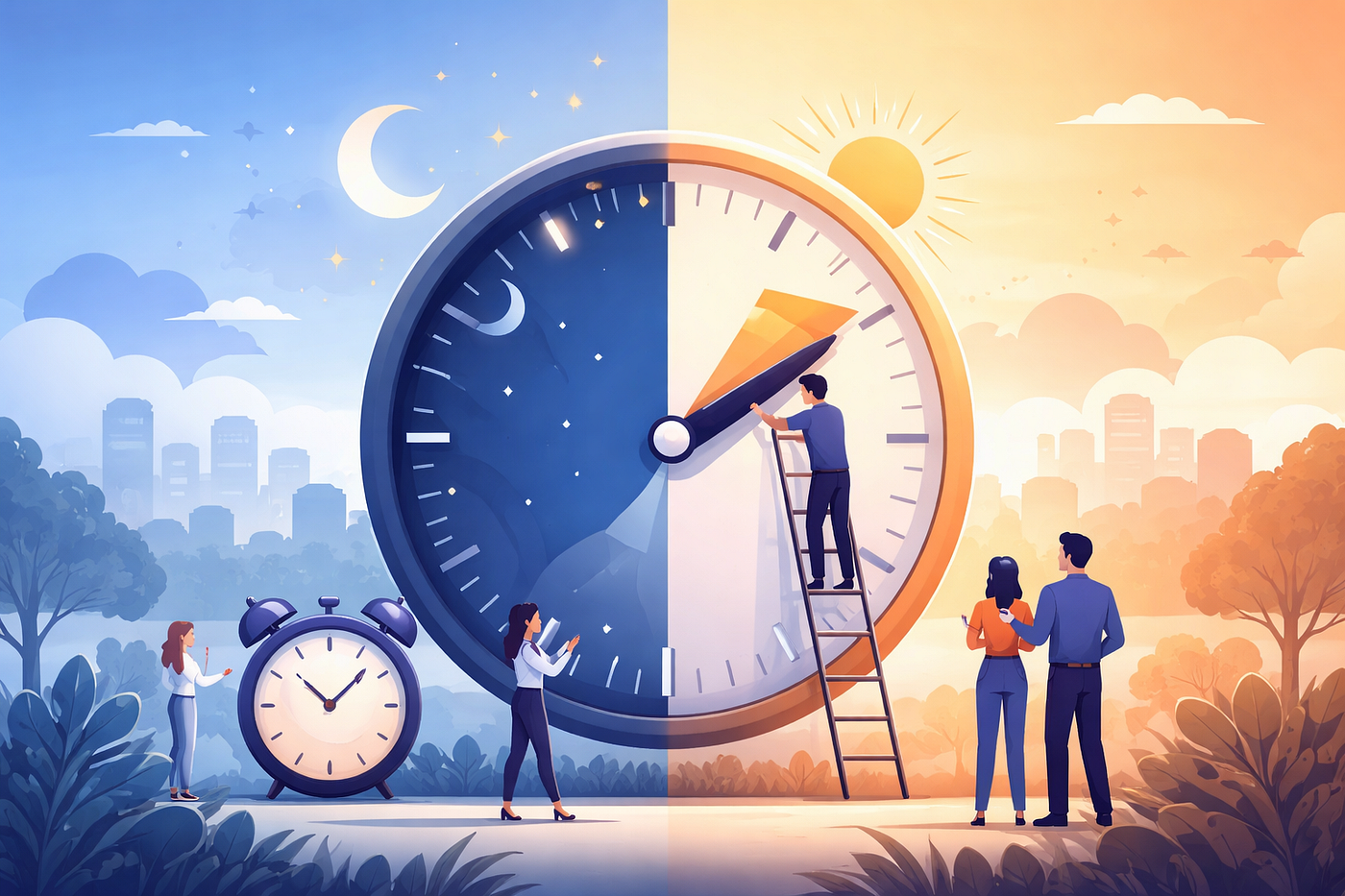
Daylight Saving Time (DST) is one of those policies that quietly shapes daily life for millions, yet is rarely examined in depth.
This article brings together the key arguments both for and against DST, drawing from research, policy discussions, and real-world observations. While it aims to present a balanced overview, the weight of current evidence and experience leans increasingly against the practice, raising valid questions about its continued relevance.
It is written for anyone who is affected by these biannual clock changes, curious about their broader implications, or simply interested in understanding why this long-standing system persists despite growing scrutiny.
The Ritual Nobody Asked For
Twice a year, millions of people adjust their clocks by one hour. Forward in spring, back in autumn. Alarm systems are reprogrammed, sleep is disrupted, and for the following few days, some walk around slightly jet-lagged without having gone anywhere. Daylight Saving Time (DST) is a century-old wartime policy that has far outlived its original purpose, and a growing body of research in medicine, economics, and public policy makes a compelling case that it should simply be abolished.
A Wartime Hack That Never Left
Germany first adopted DST in 1916 to conserve coal by reducing the need for evening artificial lighting. Britain and the United States followed. After both World Wars, many countries abandoned the practice. The United States re-standardised it through the Uniform Time Act of 1966. It was not done as a celebration of DST’s virtues, but as damage control for the chaotic period in which individual cities and states had set their own rules, creating situations where adjacent towns ran on different times.
Example: Three Countries. Six Different Combinations.
As an example, let’s see how DST can make scheduling meetings, calls etc. more complicated.
Consider just three English-speaking countries that observe DST: the United States, the United Kingdom, and Australia. Because all three change their clocks on different dates and because Australia is in the Southern Hemisphere and shifts clocks in the opposite season these three countries alone cycle through six phases of alignment, resulting in four unique time-offset combinations each year. Figure 1 depicts this scenario.
Fig 1: DST windows for the USA, UK, and Australia — producing 6 phases of alignment annually
Now multiply this across the roughly 70 countries that still observe DST, each with their own transition dates. The result is a rolling global patchwork of shifting offsets that changes multiple times a year. In 2007, when the United States extended DST by four weeks, it temporarily diverged from Canada, Europe, and Australia simultaneously, creating weeks of disrupted international coordination and requiring large organisations to spend hundreds of hours updating software and scheduling systems.
The Energy Saving Myth
The foundational justification for DST that says shifting daylight to the evening saves energy has been quietly dismantled by research. A study in Mexico found DST reduced annual energy use by just 0.16%. A natural experiment in Indiana, when the state introduced DST statewide in 2006, found that residential electricity consumption actually increased because the extra hour of evening daylight fell during the hottest part of the day, driving up air conditioning use. Arizona figured this out in 1967 and has never observed DST since. The state’s cooling costs compare favourably to neighbouring states that still shift their clocks.
Modern society runs on servers, industrial machinery, and climate control systems that consume energy regardless of what the clock says. The candle logic of 1916 does not survive contact with the data centre of 2026.
The Hidden Toll: Health Consequences
If the energy argument has collapsed, the health case against DST is only growing stronger. The American Academy of Sleep Medicine (together with 20+ other relevant organizations) with the endorsement of formally called for the permanent abolition of DST in 2020, citing “significant public health and safety risks.” The evidence behind that call is striking.
Fig 2: Documented increases in adverse health and safety event in the week following the spring DST transition
Some studies have found a 24% spike in heart attacks in the week after the spring change, a 30% increase in fatal road accidents on the day clocks spring forward, and an 8.8% rise in hospital medical errors in the following week. These are not marginal effects and they are consistent, replicated findings across different countries and healthcare systems. And it does so for energy savings that are, at best, negligible. Refer Figure 2 for a quick overlook of these numbers.
If We Want Extra Light… Why Not in Winter?
One of the least-discussed absurdities of DST is the season in which it operates. DST gives extra evening light in spring and summer, when days are already longest. It does nothing for winter, when evenings go dark before 4 PM in northern cities and seasonal mood dips are most acute. If the goal were genuinely to improve quality of life through better light, the intervention would logically target winter, not summer.
This effect also scales with latitude. The further from the equator, the more extreme the seasonal mismatch between clock time and sunlight, the more disruptive DST becomes. Countries near the equator, where day length barely varies across the year, have always had the right instinct: virtually all of Africa, South and Southeast Asia, and most of the Middle East do not observe DST, because its rationale barely applies to them. It is most enthusiastically applied in the high-latitude regions where it causes the most disruption.
The World Is Moving On
Russia abolished DST in 2014 after a public backlash. Brazil dropped it in 2019. Argentina abandoned it in 2009, Turkey in 2016. China, India, and Japan, representing over a third of humanity are not using DST. A 2018 EU survey of 4.6 million citizens found that approximately 84% wanted to stop changing their clocks twice a year. At least 550 bills related to ending DST have been introduced in U.S. state legislatures in recent years. The public instinct is sound. The political inertia is the problem.
A Closer Look: What a Small Survey Revealed
A short survey conducted by a group I was familiar with sparked my interest in the topic, prompting me to explore it in greater depth alongside the existing research. Following are some of their key findings.
Overall, how do you feel about DST?
Fig 3: Overall attitude toward DST
Do you believe DST affects public safety (traffic accidents, fatigue, etc.)?
Fig 4: Perceived effect of DST on public safety
Three findings stood out. As per Figures 3 and 4 — First, the largest single group (39.4%) was neutral about DST, suggesting are not questioning a policy that runs in the background of their lives. Second, and most striking: when asked whether DST affects public safety, 54.5% answered “not sure” — despite the research showing consistent spikes in accidents and cardiac events every spring transition.
Third, a meaningful share of respondents believed DST delivers extra light in winter, when in fact it operates exclusively during spring and summer. Which indirectly shows the lack of awareness of the exact mechanism of DST among the general population.
Does DST affect your work or study performance?
Fig 5: Does DST affect work or study performance? 54.5% report at least some effect
In open-ended responses, perceived benefits centred on more evening light for outdoor activities and improved mood, both real effects of longer summer days, though not of clock-shifting per se. Drawbacks centred on sleep disruption, a disturbed biological clock, children going to school in darkness, and the scheduling headache for anyone coordinating across time zones. One respondent captured the passive acceptance perfectly: “With modern electronics automatically adjusting for DST, I don’t have a clue how it affects my life.”
The survey finding that most people are unaware of DST’s health consequences — while still experiencing its effects — may be the most important result of all. A policy whose costs are invisible tends to persist long past its usefulness.
Conclusion: Shouldn’t we just Pick a Time and Leave It as It is?
DST was invented to save energy in a wartime economy. The evidence from research and from ordinary experience now runs firmly against it:
- It saves negligible energy and increases consumption in warm climates.
- It causes documented spikes in heart attacks, road accidents, and medical errors every spring.
- Even in a simple example case, it creates up to four distinct time-offset combinations between just three countries, which occur in 6 different phases per year.
- Most of the world are not using it.
- Its “benefit” of extra evening light occurs in summer, when days are already long. It offers nothing in winter, when light is most needed.
- Most people neither understand its mechanics nor are aware of its health consequences.
The case for retaining DST rests largely on inertia and the economic interests of industries that benefit from longer summer evenings. That is not a sufficient reason to run a policy that is associated with measurable increases in adverse health and safety outcomes.
While the evidence appears to lean in one direction, I remain open to alternative perspectives. If there are compelling arguments in favour of DST that I may have overlooked, I would welcome the opportunity to consider them.
메타데이터
- post_id
- f3afe7ec55ee
- slug
- daylight-saving-time-examined-does-it-still-make-sense-f3afe7ec55ee
- url
- https://medium.com/@tharaka_1672/daylight-saving-time-examined-does-it-still-make-sense-f3afe7ec55ee
- canonical_url
- https://medium.com/@tharaka_1672/daylight-saving-time-examined-does-it-still-make-sense-f3afe7ec55ee
- author_url
- https://medium.com/@tharaka_1672
- status
- ok
- fetched_at
- 2026-06-11 05:11:55