Five Tragedies Caused by Unit Mix-ups
Confusion between miles, mix-up of pounds and newtons, millimeter errors in drawings… The mishmash of units has led to five tragedies, from…
Five Tragedies Caused by Unit Mix-ups
Confusion between miles, mix-up of pounds and newtons, millimeter errors in drawings… The mishmash of units has led to five tragedies, from Columbus’s miscalculation to the loss of a Mars probe, a jet running out of fuel, the sinking of the Vasa, and the Space Mountain derailment. We’ll explore the lessons learned from the intersection of metric and imperial systems.
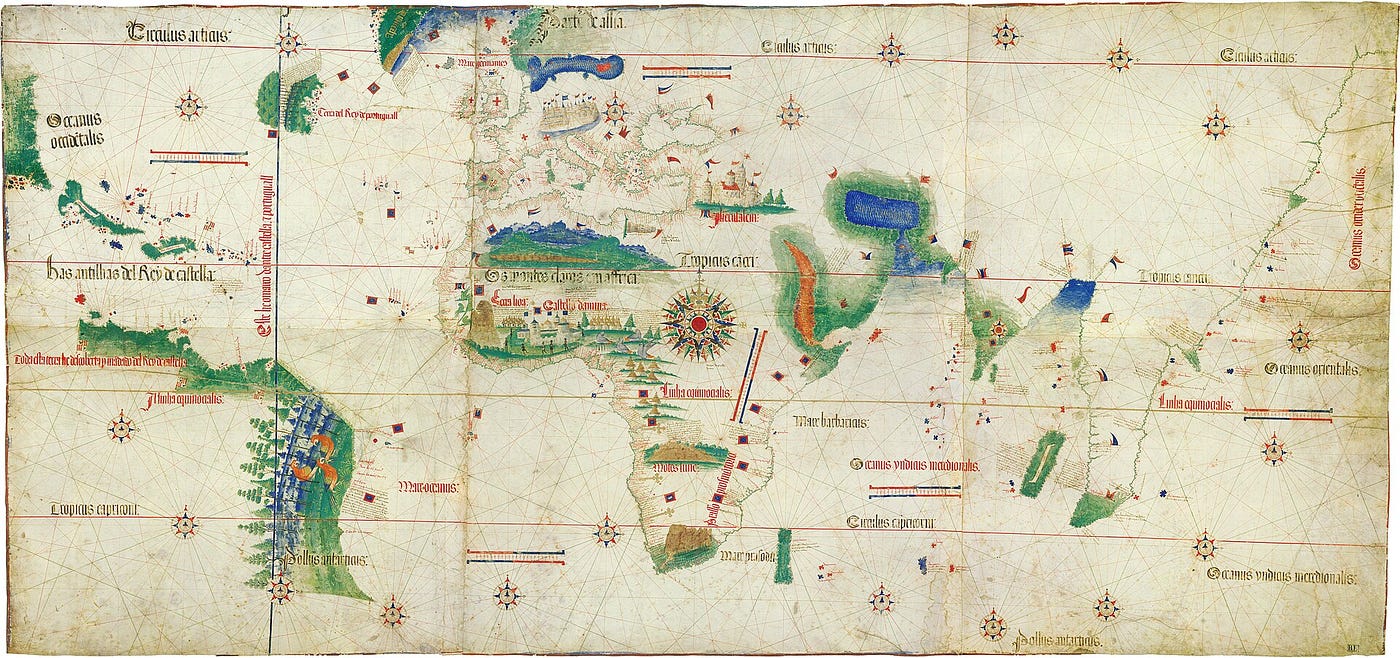
Cantino Planisphere (showing Columbus’s route)
The French Revolution was an opportunity to fundamentally rethink the complicated, region-dependent system of units of the old days. In 1795, the revolutionary government adopted the “metric system” as the official standard, aiming for a fair and universal measurement system. In the past, units varied by country and region, hindering trade and scientific progress. The result was unified units such as the meter and gram — simple, decimal-based standards that underpin today’s International System of Units (SI).
Meanwhile, in the US, the “imperial system” (yard–pound system) is still in widespread use, not only in daily life but also in manufacturing, construction, and even advanced fields like space exploration. While most countries have adopted metric, the US clings to its own units; this difference sometimes brings confusion to international projects.
In this article, I’ll introduce some disasters caused by such confusion — and their lessons.
Columbus’s Big Miscalculation: Mixed-up “Miles” (1492)
Let’s start by digging a bit deeper into the Columbus case, as introduced in “A Story of Spices, Explorers, and Chemistry”.
Columbus believed that if he sailed west from Europe, he would reach Asia (Cipangu/Japan), because he underestimated the size of the Earth by about 25%. One major reason was confusion between the “Arabic mile” and the “Italian mile.”
What Happened
Columbus relied on the calculation of the 9th-century astronomer Al-Farghani (Alfraganus), who said one degree of longitude equals 56⅔ miles.
The Unit Error
Alfraganus used the “Arabic mile” (1 mile = 1,925–1,995 meters), but Columbus mistakenly assumed he was using the “Roman mile” (1 mile ≈ 1,480 meters), the unit he was used to.
Consequences
Because he drastically underestimated the size of the Earth, and overestimated the East-West extent of Asia (as shown on Toscanelli’s map), Columbus believed that sailing 3,000–4,000 km west across the Atlantic would bring him to Asia. In reality, it is about 20,000 km to Japan — which would have meant certain death by starvation and thirst if not for the presence of the American continent.
Postmortem
Columbus never admitted his error, insisting until his death that he’d reached part of Asia. This mix-up and stubbornness influenced the course of the Age of Exploration and, ultimately, led to Europe’s “discovery” of the Americas — forever changing world history.

Mars Climate Orbiter
Mars Climate Orbiter: $125 Million Vanished into Space (1999)
This is the infamous 1999 NASA “Mars Climate Orbiter” tragedy — one of the most (in)famous technical mix-ups of all time, caused by confusion between the imperial and metric systems.
What Happened
Lockheed Martin’s system outputted thrust as “pound-force seconds (lbf·s)” in the imperial system. The NASA team, however, expected input in SI units — “newton-seconds (N·s).”
The Unit Error
1 lbf·s ≈ 4.45 N·s — the values were off by a factor of 4.45.
Consequences
The orbiter got much closer to Mars than planned and was either destroyed by atmospheric friction or flung off into deep space.
Postmortem
The error was due not to a technical glitch, but a disconnect in communication — a case study in project management and the importance of clear protocols (see the TEDx talk at the end).

Gimli Glider
Gimli Glider: The Passenger Plane That Misjudged Fuel Weight (1983)
This is a Canadian aviation accident where a unit mistake led to a “miraculous escape from near-death.”
What Happened
At an altitude of 12,000 meters, the aircraft suffered a total fuel exhaustion — a complete engine shutdown. The captain, drawing on his experience as a former air force pilot, was able to glide the plane and successfully make an emergency landing on the abandoned runway at Gimli Air Force Base. Miraculously, no one was killed, and the plane itself became legendary as the “Gimli Glider.”
Postmortem
The investigation revealed that the cause of the accident was not simply a “unit mix-up,” but rather a combination of human factors, organizational issues, and procedural problems. In particular, the period of transition from imperial to metric units led to the mixed use of both systems; unclear responsibility for fuel calculations and insufficient procedural checks were identified as major underlying factors. The final 1985 report recommended standardizing equipment use at Air Canada, revising education and training for on-site staff, improving refueling procedures, and strengthening independent checks of fuel quantity. It further called for revisions of manuals and log management, as well as improvements in calculation and verification processes. This incident became a powerful lesson for the aviation industry regarding the critical importance of human error prevention, unit management, and organizational verification.

Vasa
The Sinking of the Swedish Warship Vasa: Different “Rulers” Left and Right (1628)
In the 17th century, Sweden’s king commissioned the construction of the lavish warship “Vasa,” which famously sank on her maiden voyage.
What Happened
At the time, there was no international standard for units. Craftsmen used their local “ruler” or measuring stick. The Vasa’s construction team included both Swedish and Dutch craftsmen.
The Unit Error
The Swedish craftsmen used the “Swedish foot” (about 29.7 cm), while the Dutch used the “Amsterdam foot” (about 28.3 cm). These measuring tools got mixed up at the building site. As a result, the hull’s left and right sides differed in thickness and weight balance.
Consequences
During the Vasa’s grand maiden voyage, with crowds looking on, the ship had sailed barely one kilometer from the port when a mild gust caused her to capsize. Water rushed in through the gunports, and the ship quickly sank.
The Vasa Museum later determined that an excess of cannons and a high center of gravity were the main cause, but these unit mix-ups likely contributed to the hull’s imbalance as well.
Postmortem
At the time, the mixed use of unit systems was not seen as a particular problem. Even after the sinking, the investigation did not focus on differences in units. The main blame fell on design and weight imbalance, and the “ruler” issue was only considered a minor background factor. The widespread recognition of the importance of standardized units and strict drafting practices would come much later.
Tokyo Disneyland Space Mountain Derailment (2003)
Unit confusion led to an accident even in Japan.
What Happened
In 2003, during operation of the Space Mountain ride, an axle broke and a car derailed. The cause was a misunderstanding of the units in a revised design specification.
The Unit Error
In 1995, the design specification changed from using inches to millimeters. The axle diameter was increased from 44.14 mm to 45.00 mm to fit domestic bearings. However, due to the presence of old inch-based diagrams, some axles were mistakenly manufactured slightly smaller than required and were used unknowingly.
Consequences
Over years of operation, a gap developed, metal fatigue accumulated, and eventually the axle fractured mid-operation. Miraculously, there were no serious injuries, but the incident forced a lengthy shutdown and a thorough safety review of all rides.
Systema Imperiale Delendum Est (Yard–Pound System Must Be Destroyed)
The metric system unified not just regional units of length but also “big” and “small” lengths into a single scale. For example, we measure walking distances in kilometers and fingernail widths in millimeters — 1 km = 1,000 meters; 1 mm = 1/1,000 meter. In the yard–pound system, however, one mile is 63,360 inches — a messy relationship. That’s because people rarely needed to talk about miles and inches together. Even today, outside of examples, no one says “one mile and one inch.”
Reflecting on all this, let me just say: the yard–Pound system must be destroyed.
TED insights: if you are interested in this article, watch this talk.
[embed]
The surprisingly simple reason teams fail
In 1999, a NASA mission to Mars failed … not from a technical glitch, but because people weren’t talking to each other. Psychology professor Tessa West explores how assumptions, overlooked details and “hidden languages” can quietly sabotage even the smartest teams — and explores the small shifts in communication that can make a big difference in how information lands.
Final Thoughts
The history of science is full of both spectacular triumphs and spectacular blunders. While we celebrate the power of measurement and quantification, it’s unit confusion — the hidden language of numbers — that can topple a warship, derail a rocket, or bring amusement rides to a halt.
Standardization may seem dull, but it is the silent hero behind progress and safety. As technology brings people together from every corner of the world, clear communication — of units, expectations, and intent — is what allows teams (and civilizations) to succeed.
Let’s learn from these stories and strive for clarity, precision, and a bit of humility in our collaborative work.
Thank you for reading!
Ichi
메타데이터
- post_id
- f3b06fe444c2
- slug
- five-tragedies-caused-by-unit-mix-ups-f3b06fe444c2
- url
- https://medium.com/the-steam/five-tragedies-caused-by-unit-mix-ups-f3b06fe444c2
- canonical_url
- https://medium.com/the-steam/five-tragedies-caused-by-unit-mix-ups-f3b06fe444c2
- author_url
- https://medium.com/@kanaya
- status
- ok
- fetched_at
- 2026-07-09 01:49:10