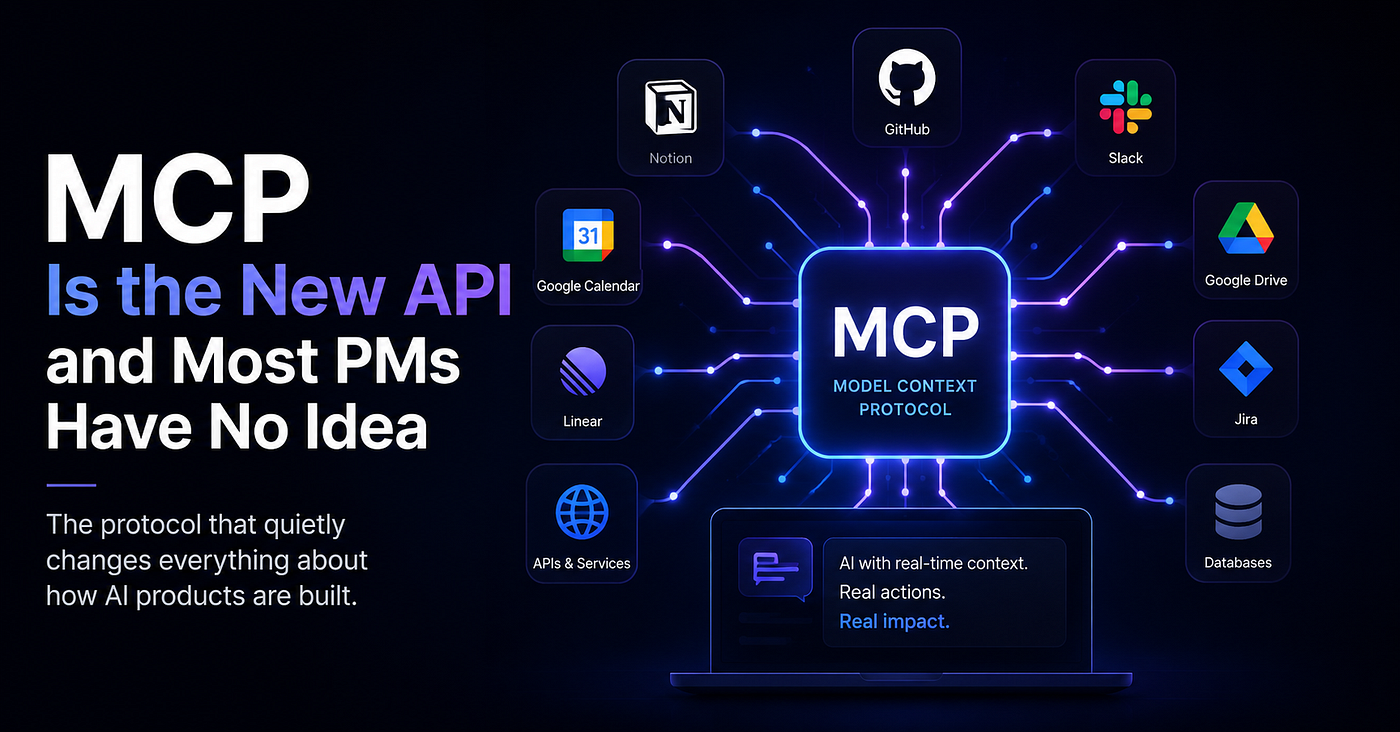
MCP Is the New API and Most PMs Have No Idea
The protocol that quietly changes everything about how AI products are built.
MCP Is the New API and Most PMs Have No Idea
The protocol that quietly changes everything about how AI products are built.
Remember when REST APIs felt like magic?
You could suddenly make your product talk to Stripe, to Twilio, to Google Maps without building any of it yourself. A few HTTP calls, and suddenly your app could take payments, send texts, and pinpoint locations. The whole era of "X meets Y" startups was basically just creative API composition.
That shift did not just change engineering. It changed product thinking entirely.
What you could build stopped being constrained by what your team could code from scratch. It became constrained by what existed as an API and what you could connect together intelligently.
MCP is doing the same thing. Except this time, it is not connecting apps to apps. It is connecting AI to everything
First, What MCP Actually Is
MCP stands for Model Context Protocol. Anthropic released it in late 2024 as an open standard, and the adoption since has been quiet but significant.
Here is the simplest way to understand it.
Before MCP, if you wanted an AI model to do something useful, query your database, read a file, call an internal tool, pull a Jira ticket, you had to build a custom integration every single time. One-off function calls, hardcoded tool definitions, brittle pipelines that broke when anything changed. Every team reinvented the same wheel in slightly different shapes.
MCP standardises that entire layer.
It creates a universal protocol for how AI models communicate with external tools, data sources, and services. Think of it as USB-C, but for AI capabilities. Once a tool exposes an MCP server, any compatible AI client can connect to it. No custom plumbing per integration. No rebuild every time you switch models.
Claude supports it. Cursor supports it. A growing list of enterprise tools are adding MCP servers. The ecosystem is small right now, but the trajectory is familiar -it looks a lot like the early API economy circa 2010.
Why This Is a Product Problem, Not Just an Engineering Problem
Here is where most product managers are sleeping on this.
MCP is not just a developer convenience. It is a capability unlock that changes what AI products can actually do in production.
Right now, most AI features in products are closed loops. The model generates something, a summary, a suggestion, a draft and a human takes it from there. The AI does not act. It advises.
That is not because the models are not capable of more. It is because connecting them to real systems, databases, CRMs, internal tools, and third-party APIs has been expensive, fragile, and hard to maintain.
MCP removes most of that friction.
When your AI can read live context from the tools your users actually work in, not a frozen snapshot, but real-time state, the product changes fundamentally. The AI stops being a chatbot bolted onto your UI and starts being something that actually understands what is happening in your users’ world.
That is not an incremental improvement. That is a different product category.
The API Economy Parallel Is Not a Metaphor. It Is a Roadmap.
Think about what happened after REST APIs became mainstream.
The first wave of products just used APIs to reduce costs, pull in a map instead of building one, and send email through a service instead of running your own servers. Efficiency plays.
The second wave used APIs to build things that were not previously possible at any cost. Uber is not just a taxi app with an API. It is a product that only exists because of real-time location data, payments infrastructure, and communication tools all talking to each other.
MCP is going to follow the same curve.
Right now, early adopters are using it for efficiency, hooking AI into existing tools to save time on repetitive tasks. Connect your AI to your calendar, your Notion, your GitHub, and let it do the grunt work.
Useful. But not the interesting part.
The interesting part is the second wave. Products that can only exist because an AI model can act across multiple live systems simultaneously, with full context, without a human manually retrieving information at every step.
Imagine a recruitment tool where the AI does not just screen a resume in isolation. It cross-references the candidate against the live JD, checks the hiring manager’s calendar, reads the previous interview notes from the ATS, flags a compensation mismatch against current market data, and surfaces a recommendation, all before a recruiter opens the tab.
That is not a chatbot feature. That is a product that could not exist before MCP made plumbing cheap.
What PMs Should Actually Do With This
Stop thinking about AI as a UI layer.
Most product teams add AI to an existing product by putting a chat interface or a “generate with AI” button somewhere in the flow. That is a feature. It is not a product strategy.
The more important question is: what data and tools does your AI need live access to in order to be genuinely useful, not just occasionally impressive?
Answer that honestly, and you will find your MCP integration map.
Audit your tool ecosystem for MCP-ready surfaces.
Check which tools in your stack already have MCP servers. Notion, Linear, GitHub, Slack, Google Workspace, the list is growing fast. Every tool that exposes an MCP server is a context source your AI product can draw from without you building a custom integration.
That is an unfair advantage if you use it early. It is table stakes in two years.
Rethink what “AI-powered” means in your PRD.
If your AI feature requires a user to copy-paste context into a prompt, it is not AI-powered. It is AI-assisted. The user is still doing the integration work.
A genuinely AI-powered feature uses MCP to pull the context automatically, act on it, and surface an output that requires no manual context-gathering from the user. That is the bar worth building toward.
The Uncomfortable Truth for Builders
The products that will define the next wave of AI are not going to be the ones with the best models. Model quality is converging fast, and access is cheap.
The differentiation will be in context quality and tool connectivity.
Which product knows the most about what is actually happening in the user’s world right now? Which product can act on that knowledge across the tools the user already uses? Which product closes the loop without requiring the user to be the integration layer?
That is the MCP question. And most teams are not asking it yet.
Last Words
APIs did not just change what software could do. They changed who could build what, and how fast. They redistributed power toward builders who understood the ecosystem, not just the code.
MCP is doing the same thing for AI products.
The teams that treat it as a developer convenience will get marginal efficiency gains.
The teams that treat it as a product primitive, as the connective tissue that makes genuinely intelligent products possible, will build things that the first group cannot catch up to.
The protocol is open. The ecosystem is early. The roadmap from the API economy is sitting right there.
Most PMs are still figuring out what MCP stands for.
That gap is the opportunity.
메타데이터
- post_id
- f3bd5c8fc21d
- slug
- mcp-is-the-new-api-and-most-pms-have-no-idea-f3bd5c8fc21d
- url
- https://medium.com/@Prathikkshaa/mcp-is-the-new-api-and-most-pms-have-no-idea-f3bd5c8fc21d
- canonical_url
- https://medium.com/@Prathikkshaa/mcp-is-the-new-api-and-most-pms-have-no-idea-f3bd5c8fc21d
- author_url
- https://medium.com/@Prathikkshaa
- status
- ok
- fetched_at
- 2026-06-20 20:29:01