Realistic Advice for International Patients: The “SNS Fantasy” Isn’t Everything
Lately, I’ve noticed a common trend in the inquiries I receive from international patients. Many people send me photos they’ve seen on…
Realistic Advice for International Patients: The “SNS Fantasy” Isn’t Everything
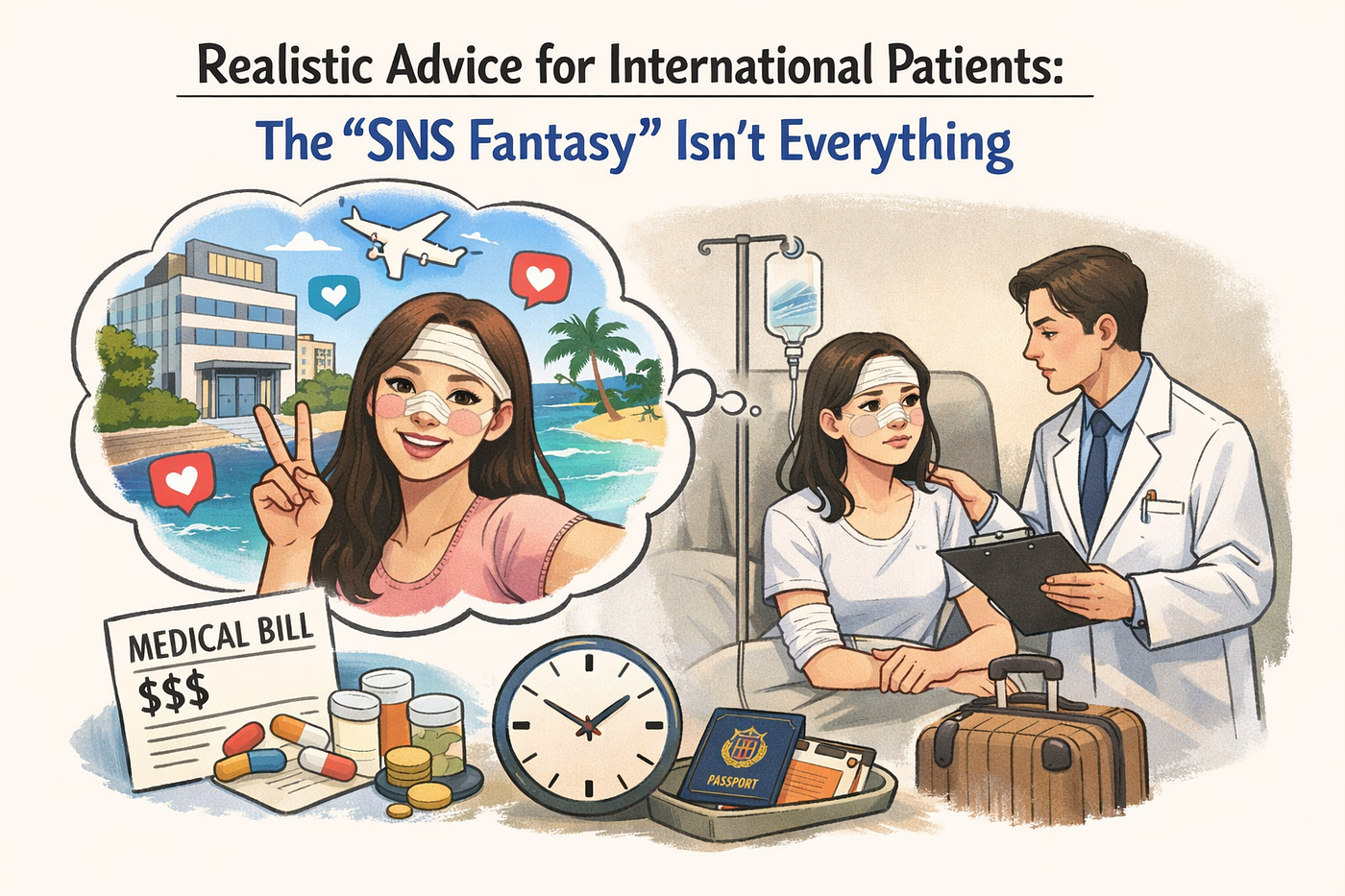
Lately, I’ve noticed a common trend in the inquiries I receive from international patients. Many people send me photos they’ve seen on Instagram or Facebook ads, asking, “Can I look like this?” Social media is overflowing with dramatic before-and-after photos of surgeries. It’s only natural to project ourselves onto those images and hope for similar results.
But there’s a reality we need to address here.
Surgery Is a Process, Not Magic
When many people decide to undergo surgery, they often have a fantasy: “I’ll see the results immediately after surgery, and I’ll look transformed right away.” However, surgical procedures are not that simple.
Most surgical procedures involve incisions. If the incision length exceeds at least 5–10cm, the story changes completely. Unlike gluing two pieces of paper together, our body’s tissue response requires a significant “loading” process to heal.
The Realistic Timeline of Recovery
The recovery period after surgery happens in stages:
For Soft Tissue (skin, muscles, etc.): Typically requires an acute recovery period of 2 weeks. During this time, swelling, bruising, and pain may occur, and careful wound management is essential.
For Bone, Ligaments, or Tendons: Requires a recovery period of 4–8 weeks. This is the acute post-operative phase — a critical time when, as a surgeon, I need to monitor patients quite carefully.
Unless it’s an emergency, surgery is designed to take place in a planned, controlled environment. This is a fundamental principle of modern surgery.
Potential Issues After Surgery
During this period, various problems can arise:
-
Aftereffects of anesthesia
-
Issues related to surgical wounds (infection, bleeding, swelling, etc.)
-
Inflammation due to tissue reaction
-
Unexpected complications
Of course, in most cases, patients who are well-prepared and have maintained relatively good health recover without significant issues. However, the important point is that regardless of the surgeon’s skill, there are inherent risks that come from the “stressful situation of surgery” itself.
These risks must be addressed through cooperation between the patient and the doctor.
The Reality International Patients Must Understand
This is especially important for international patients visiting for a short period. You may receive the surgery or procedure in Korea, but a significant portion of your recovery will take place back in your home country. You must consider that you’ll be recovering without your surgeon by your side.
Of course, these days we can communicate in real-time via SNS messengers. You can stay in touch with your medical team and share your condition after returning home. But the reality remains that during your recovery period, the medical team won’t be physically present with you.
Advice for International Patients
Surgery isn’t just a “procedure” — it’s a “process” that brings significant changes to your body. And that process inevitably requires time for recovery. The dazzling post-surgery photos on SNS show compressed results, but the time in between is always omitted.
For those of you considering surgery from overseas, here’s my advice:
First, plan for sufficient recovery time. Staying in Korea for at least 2–4 weeks to recover under medical supervision is safest. If your surgery involves bones or ligaments, consider an even longer stay.
Second, establish a post-op care plan for your home country. You need a system for ongoing communication with your medical team after returning home. It’s also wise to identify medical facilities you can visit locally if needed.
Third, maintain realistic expectations. Surgery isn’t magic. It’s a journey toward positive change, and that journey requires time and patience. Please understand that you won’t transform “instantly” like the photos on SNS.
Fourth, communicate honestly with your medical team. Be sure to fully disclose your health status, medications you’re taking, and any past surgical history before the procedure. Also, it’s crucial to communicate honestly about any symptoms that arise after surgery.
The risks that come with the stressful situation of surgery are overcome through cooperation between doctor and patient. No matter how skilled the surgeon, perfect results cannot be achieved without the patient’s cooperation. This collaborative relationship is even more critical for international patients facing distance and time constraints.
I hope you will understand the reality behind those fantastic SNS photos and make your surgical decisions only when you are fully prepared. Beautiful transformations are completed only upon a foundation of thorough preparation and realistic understanding.
메타데이터
- post_id
- f3c6db490dc1
- slug
- realistic-advice-for-international-patients-the-sns-fantasy-isnt-everything-f3c6db490dc1
- url
- https://blog.healthmanagement.in/realistic-advice-for-international-patients-the-sns-fantasy-isnt-everything-f3c6db490dc1
- canonical_url
- https://blog.healthmanagement.in/realistic-advice-for-international-patients-the-sns-fantasy-isnt-everything-f3c6db490dc1
- author_url
- https://medium.com/@snuplastic
- status
- ok
- fetched_at
- 2026-06-21 21:05:38