What Is Khmer Speech Processing/Recognition?
From Khmer speech recognition to Voice AI, Text-to-Speech, and voice-based document search
What Is Khmer Speech Processing/Recognition?
From Khmer speech recognition to Voice AI, Text-to-Speech, and voice-based document search
When people talk about AI technology for language, they often think about text: chatbots, translation, search engines, or document summarization. But language is not only written. Language is also spoken.
Every day, Khmer speakers use voice to communicate through phone calls, meetings, interviews, teaching, videos, podcasts, news, and social media. A large amount of knowledge and information exists in spoken form. However, if computers cannot process Khmer speech, much of this information remains difficult to search, analyze, translate, or preserve.
This is why Khmer Speech Processing is important.
Khmer Speech Processing is a research and technology field that enables computers to “listen to,” “understand,” “convert,” “generate,” “translate,” and “analyze” spoken Khmer. It includes Automatic Speech Recognition, Text-to-Speech, Speech Translation, Speaker Recognition, Keyword Spotting, and Voice-based Search.
In simple words:
Khmer Speech Processing helps computers listen to, understand, and generate Khmer speech.
What Is Speech Processing?
Speech Processing is a broad field that works with spoken language signals. It includes several important tasks.
1. Automatic Speech Recognition (ASR)
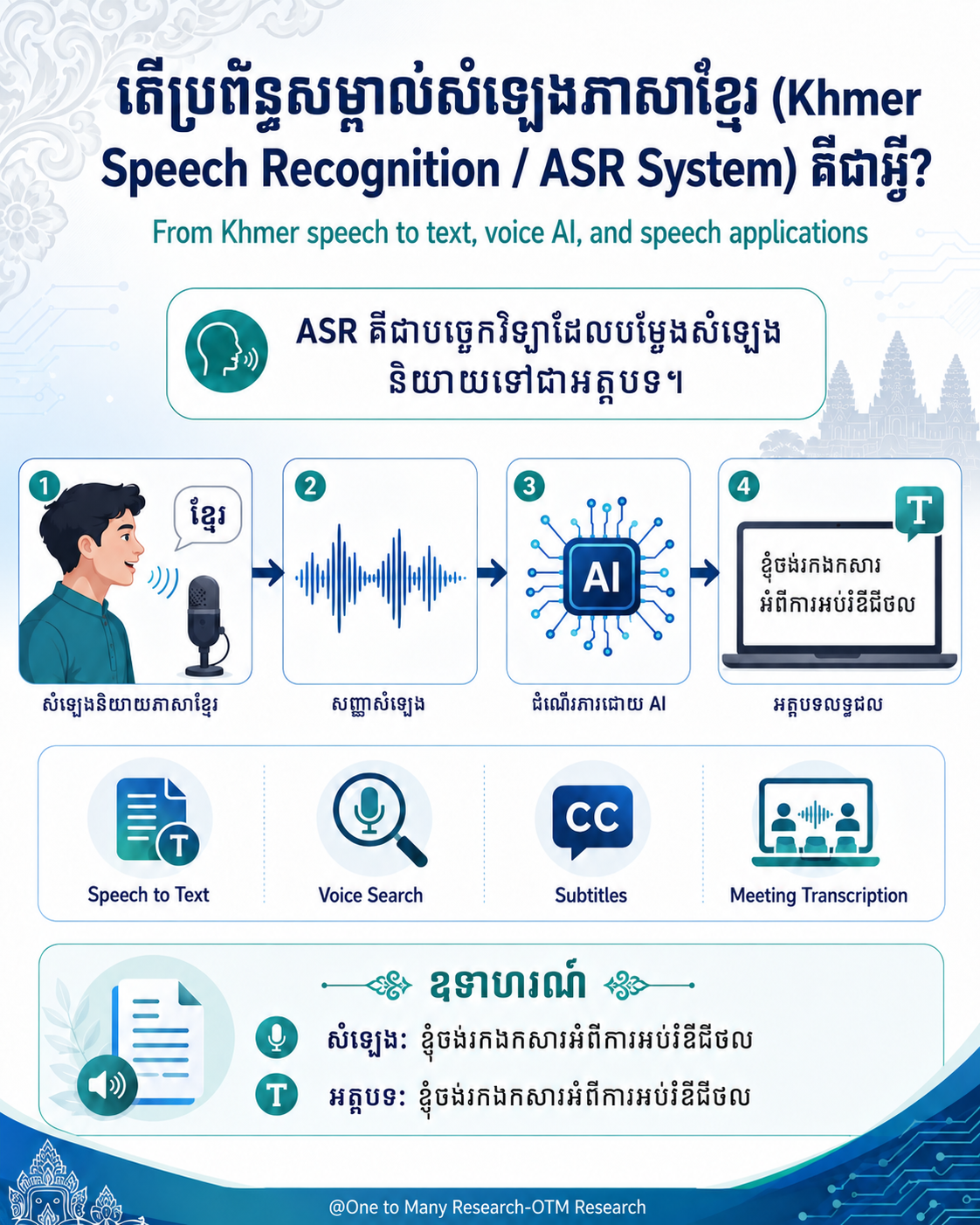
Automatic Speech Recognition, or ASR, is a technology that converts speech into text.
For example, if a speaker says:
“ខ្ញុំចង់រកឯកសារអំពីការអប់រំឌីជីថល”
An ASR system should convert it into text as:
ខ្ញុំចង់រកឯកសារអំពីការអប់រំឌីជីថល
This technology can be used for meeting transcription, subtitles, voice search, call-center analysis, dictation, and accessibility tools.
2. Text-to-Speech (TTS)
Text-to-Speech, or TTS, is a technology that converts written text into spoken voice.
For example, if we have the text:
“សូមស្វាគមន៍មកកាន់ប្រព័ន្ធជំនួយសំឡេងភាសាខ្មែរ”
A TTS system should be able to read this sentence aloud in natural Khmer speech.
TTS is useful for screen readers, voice assistants, educational apps, navigation systems, and assistive tools for people with visual impairments.
3. Speech Translation
Speech Translation is a technology that converts spoken language from one language into text or speech in another language.
For example:
Khmer speech: “ខ្ញុំចង់ដាក់ពាក្យសុំអាហារូបករណ៍”
English translation: “I want to apply for a scholarship.”
This technology can support tourism, education, court interpretation, international meetings, and cross-language communication.
4. Speaker and Audio Understanding
Speech processing can also help identify speakers, detect languages, recognize emotions, separate multiple speakers, and summarize audio.
For example, in a meeting recording, the system may need to know:
- who spoke;
- what was said;
- when each speaker talked;
- what the main topic was;
- which parts are important.
This is the foundation of Khmer Voice AI.
Why Is Khmer Speech Processing Difficult?
Khmer speech processing is more difficult than speech processing for high-resource languages such as English, Chinese, or French. The main reason is not that Khmer cannot be used in AI, but that Khmer has fewer digital resources.
1. Khmer is a low-resource language
ASR and TTS require many hours of high-quality speech data with accurate transcriptions. English has thousands of hours of public speech data, while Khmer has much less.
Because of this, Khmer speech models often need to rely on smaller datasets, multilingual transfer learning, synthetic data, or fine-tuning from pretrained models.
2. Khmer word segmentation affects language modeling
Khmer writing does not always use spaces between words. This affects speech recognition because ASR systems often need to predict the most likely word sequence.
For example:
“ការអប់រំឌីជីថលនៅកម្ពុជា”
The system may need to understand that it can be segmented as:
ការអប់រំ / ឌីជីថល / នៅ / កម្ពុជា
If word segmentation is wrong, the ASR output and search results may also be wrong. Early Khmer ASR research studied whether Khmer ASR should use word, syllable, sub-word, or character-based modeling (Sopheap Seng et al., 2008).
3. Pronunciation and writing do not always match directly
Spelling and pronunciation in Khmer do not always match 100%. Some words may be pronounced differently depending on context. Formal written Khmer and everyday spoken Khmer may also differ.
For example, a system trained only on formal reading speech may not perform well when it encounters natural conversation, fast speech, or slang.
4. Real-world speech contains noise
Khmer speech data may come from phones, classrooms, interviews, markets, meetings, videos, or social media. These recordings may contain:
- background noise;
- music;
- overlapping speakers;
- low microphone quality;
- regional accents;
- fast speech;
- code-switching with English, Chinese, Thai, or French.
A strong Khmer speech system must be able to work under these real-world conditions.
Progress of Khmer Speech Processing
Khmer speech processing has progressed through several stages.
1. Early ASR Research: Word, Sub-word, and Acoustic Modeling
One important early direction was building Khmer Automatic Speech Recognition systems using traditional ASR methods.
Sopheap Seng et al. (2008) studied acoustic and language modeling units for Khmer ASR. Their work discussed the difficulty of building large-vocabulary continuous speech recognition for Khmer, especially because Khmer does not have clear word boundaries and has limited speech and text resources.
This stage was important because researchers needed to answer basic questions such as:
- Should Khmer ASR use words?
- Should it use syllables?
- Should it use characters?
- How should Khmer text be segmented?
- How should a pronunciation model be built?
- How can a model be trained when data is limited?
These questions are still important today. Even modern deep learning ASR systems must decide whether they should predict Khmer characters, subwords, syllables, or words.
2. DNN and End-to-End ASR
After traditional systems, Khmer ASR moved toward deep learning.
Deep Neural Networks can learn acoustic patterns directly from speech features. Instead of designing many rules by hand, the model can learn from audio and transcription pairs.
At this stage, ASR systems began using neural acoustic models and sequence learning methods to improve recognition accuracy and reduce the complexity of older pipelines.
For example, a traditional ASR pipeline may look like this:
audio → feature extraction → acoustic model → pronunciation model → language model → decoded text
A neural ASR model tries to simplify the process:
audio → neural model → text
This shift is important for low-resource languages because it reduces some manual engineering. However, it still requires good data.
3. Transformer-Based Khmer ASR
A major step was Transformer-based end-to-end speech recognition.
Kak Soky et al. (2019) introduced multilingual Transformer training for Khmer Automatic Speech Recognition. Their work addressed important Khmer ASR challenges, such as limited digital language resources, writing without clear word boundaries, and limited pronunciation modeling. They showed that multilingual Transformer-based end-to-end ASR could improve over a DNN-HMM baseline.
This is important because multilingual learning allows Khmer to benefit from data in other languages.
For example, if a model learns general speech patterns from many languages, it may need less Khmer data to adapt to Khmer speech.
This idea has become important in modern speech AI. Models such as wav2vec 2.0, XLSR, Whisper, and MMS use large-scale multilingual or self-supervised learning to support low-resource languages.
4. Khmer Speech Translation and the ECCC Corpus
Another important contribution is the Khmer Speech Translation Corpus based on the Extraordinary Chambers in the Courts of Cambodia, or ECCC.
Kak Soky et al. (2021) created a Khmer speech translation corpus from ECCC court proceedings. This corpus contains approximately 155 hours of Khmer speech and about 1.7 million words of text, with translations into English and French.
It is important for several reasons.
First, it provides real speech from a formal and professional domain.
Second, it includes different speaker roles, such as judges, witnesses, clerks, interpreters, and legal participants.
Third, it supports not only ASR, but also speech translation and multilingual research.
Later, Kak Soky et al. (2022) used simultaneous translation to improve Khmer ASR through a cross-attention mechanism. This showed that translation information can help improve transcription for a low-resource language.
This is a strong example of how Khmer speech processing can connect ASR, machine translation, and multilingual document understanding.
5. DDD Cambodia Khmer Speech Dataset
The release of a Khmer speech dataset by Digital Divide Data Cambodia, or DDD Cambodia, is an important step for Khmer ASR and Khmer speech processing.
The DDD-Cambodia/khmer-speech-dataset contains around 727.94 hours of manually curated speech-text pairs. The data was created by native Khmer speakers and focuses on topics related to Cambodian culture. The dataset card also includes important speaker metadata, such as gender, age group, and origin city.
This dataset is highly important because Khmer ASR needs many hours of speech with accurate transcription. Before a large-scale dataset like this became available, public Khmer speech-text data was very limited.
The DDD Cambodia Khmer Speech Dataset can help researchers and developers train, fine-tune, and evaluate speech-to-text models for Khmer.
For example, an ASR model trained or fine-tuned on this type of dataset can learn to recognize Khmer speech such as:
“ខ្ញុំចង់ស្វែងរកឯកសារអំពីវប្បធម៌ខ្មែរ”
and convert it into text:
ខ្ញុំចង់ស្វែងរកឯកសារអំពីវប្បធម៌ខ្មែរ
This can be used for Khmer voice search, automatic subtitles, meeting transcription, educational audio processing, call-center analysis, and speech-based document retrieval.
6. Khmer TTS and Open Speech Resources
Speech processing is not only about recognizing speech. It also includes generating speech.
Keshan Sodimana et al. (2018) introduced open-source TTS resources and a voice-building process for several low-resource languages, including Khmer. Their work provided audio files, pronunciation lexicons, phonology definitions, and a recipe for building TTS voices.
This is important because Khmer TTS needs more than plain text. It requires:
- clean recorded speech;
- sentence transcripts;
- pronunciation rules;
- text normalization;
- speaker consistency;
- natural prosody;
- Khmer-specific handling of numbers, abbreviations, and symbols.
For example, a Khmer TTS system must know how to read the following correctly:
“២០២៥” “១២,៥០០ រៀល” “ក្រសួងអប់រំ យុវជន និងកីឡា”
If text normalization is wrong, the generated voice may also be wrong.
Today, open resources such as OpenSLR Khmer speech data, the DDD Cambodia Khmer Speech Dataset, and models such as Meta MMS-TTS for Khmer can serve as foundations for building Khmer voice applications.
7. Multilingual Speech Foundation Models
Since 2022, Khmer speech processing has benefited from large multilingual speech models.
FLEURS
Alexis Conneau et al. (2022) introduced FLEURS, a multilingual speech benchmark covering 102 languages, including Khmer. FLEURS provides around 12 hours of speech supervision per language and can be used for ASR, Speech Language Identification, Speech Translation, and Retrieval.
For Khmer, FLEURS is useful because it provides a standardized benchmark. This helps researchers compare models more fairly.
Whisper and Wav2Vec2/XLSR
OpenAI Whisper and Facebook wav2vec 2.0/XLSR have also influenced low-resource ASR. Instead of training a model from zero, developers can fine-tune a pretrained model on Khmer speech data.
For example, a Khmer ASR pipeline may look like this:
pretrained multilingual model → fine-tune on Khmer speech → evaluate using CER/WER → deploy for transcription
Some community models have fine-tuned Whisper or Wav2Vec2 for Khmer using datasets such as FLEURS, OpenSLR, DDD Cambodia, and other Khmer speech corpora.
MMS
Meta’s Massively Multilingual Speech, or MMS, also supports Khmer speech tasks. MMS provides ASR and TTS coverage for many languages and includes a Khmer TTS checkpoint.
This is important because multilingual speech models can reduce barriers for low-resource languages. However, Khmer evaluation remains important because a model that performs well on a global benchmark may not always perform well on real Cambodian audio.
Practical Example: Khmer Speech-to-Search Pipeline
One useful application is Khmer voice search.
Imagine a user speaks into a mobile app:
“រកឯកសារអំពីការបណ្តុះបណ្តាលគ្រូបង្រៀន”
The system can process this in several steps.
Step 1: ASR
Speech is converted into text:
រកឯកសារអំពីការបណ្តុះបណ្តាលគ្រូបង្រៀន
Step 2: Text Normalization
The system cleans the text and removes unnecessary noise.
Step 3: Keyword Extraction
Important keywords may include:
- ឯកសារ
- ការបណ្តុះបណ្តាល
- គ្រូបង្រៀន
Step 4: Semantic Search
The system searches for related documents, even if those documents use slightly different wording, such as:
- ការបណ្តុះបណ្តាលគ្រូ
- វគ្គបណ្តុះបណ្តាល
- ការអភិវឌ្ឍសមត្ថភាពគ្រូ
- teacher training
Step 5: Result
The user receives the most relevant documents.
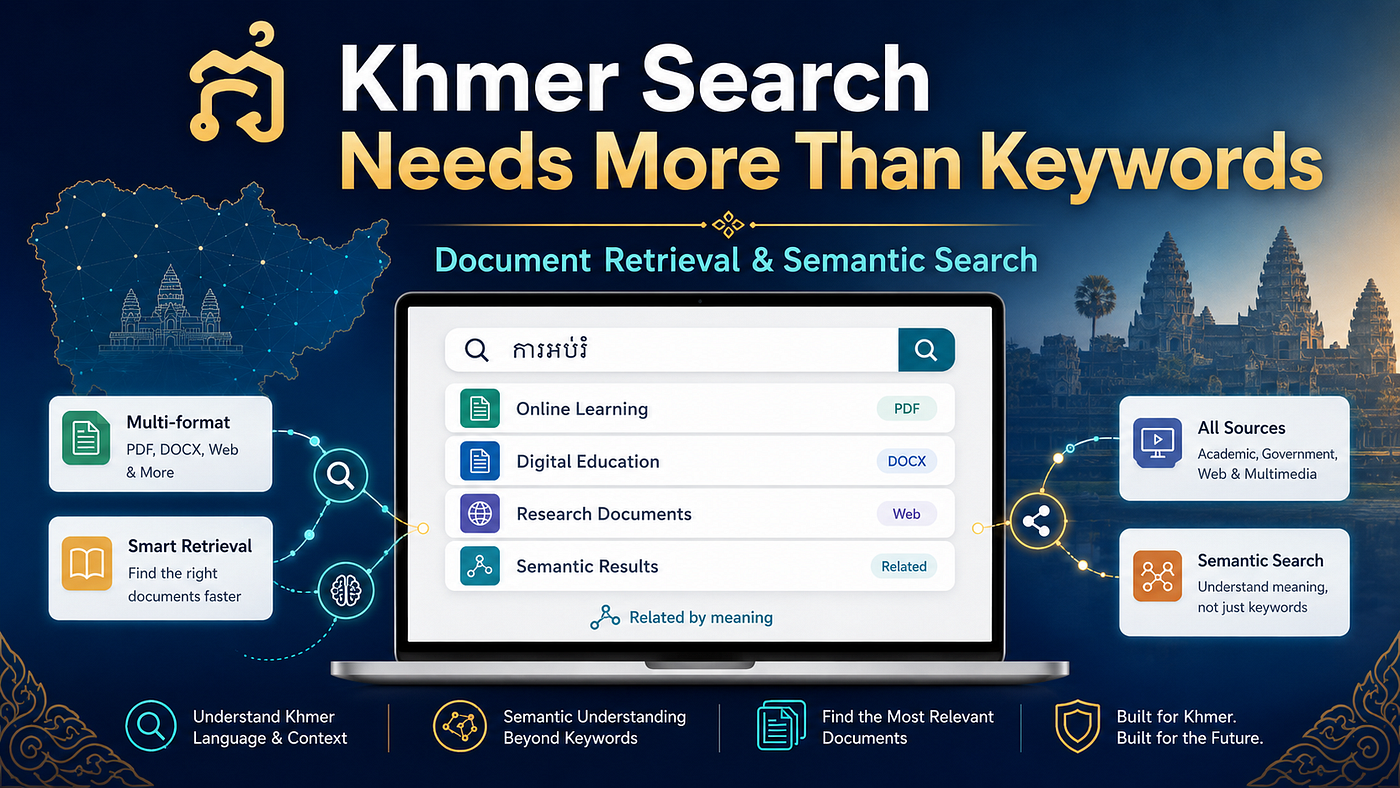
This shows how Khmer speech processing can connect with Khmer document retrieval and search engines.
Practical Example: Khmer Meeting Transcription
Another useful application is meeting transcription.
A meeting recording may include several speakers discussing a project:
Speaker 1: “យើងត្រូវរៀបចំរបាយការណ៍ឱ្យរួចរាល់សប្តាហ៍ក្រោយ។”
Speaker 2: “ខ្ញុំនឹងពិនិត្យឯកសារផ្នែកហិរញ្ញវត្ថុ។”
A good Khmer speech system should be able to:
- transcribe the speech;
- identify speaker turns;
- correct common ASR errors;
- summarize the meeting;
- extract action items.
The output may look like this:
Summary: The team discussed preparing the report by next week. One person will review the financial documents.
Action item: Review the financial documents.
A system like this can support companies, universities, NGOs, and government institutions.
Practical Example: Khmer Text-to-Speech for Education
TTS can support digital learning.
For example, an educational app may contain the sentence:
“សិស្សគួរអានមេរៀននេះម្តងទៀត ហើយឆ្លើយសំណួរខាងក្រោម។”
A Khmer TTS system can read it aloud for students.
It is useful for:
- young learners;
- students with reading difficulties;
- accessibility tools;
- e-learning platforms;
- language learning apps.
A good Khmer TTS system should sound natural, not too robotic. It must handle tone of voice, rhythm, punctuation, numbers, and formal Khmer expressions.
Current Challenges
Although Khmer speech processing has progressed, many challenges remain.
1. Lack of high-quality and diverse datasets
Khmer still needs large and diverse datasets for ASR and TTS. Datasets should include different speakers, regions, ages, speaking styles, and recording conditions.
The DDD Cambodia Khmer Speech Dataset is a major improvement, but Khmer speech processing still needs more data for different domains, such as education, health, law, call centers, business meetings, social media, and informal conversation.
2. Dialect and accent variation
Khmer is spoken differently across regions and communities. A speech system should not work well only for one accent or one recording style.
3. Code-switching
Many Khmer speakers mix Khmer with English, Chinese, Thai, French, or technical terms.
For example:
“ខ្ញុំចង់ upload file ទៅក្នុង system”
A good ASR system should recognize both Khmer and English words correctly.
4. Real-world noise
Models trained on clean speech may perform poorly in markets, classrooms, offices, phone calls, or social media videos.
5. Evaluation standards
Khmer speech systems need standard evaluation methods and benchmarks.
Common metrics include:
- WER: Word Error Rate;
- CER: Character Error Rate;
- SER: Sentence Error Rate;
- MOS: Mean Opinion Score for TTS quality;
- Speaker Diarization Error Rate;
- Speech Translation BLEU or COMET.
For Khmer, CER is often useful because word segmentation is difficult.
Opportunities for Cambodia
Khmer speech processing has strong potential for Cambodia’s digital future.
It can support:
- Khmer voice assistants;
- speech-to-text for meetings;
- automatic subtitles for Khmer videos;
- audio search for archives;
- speech translation for tourism and education;
- Khmer TTS for e-learning;
- accessibility tools for people with disabilities;
- call-center automation;
- government service hotlines;
- voice-based document search;
- preservation of oral history.
For example, Cambodia has many interviews, speeches, radio programs, court recordings, oral histories, and educational videos. If these audio materials can be transcribed and indexed, they become searchable knowledge.
Therefore, Khmer speech processing is not only a technical field. It is part of digital access, cultural preservation, education, and national AI infrastructure.
Future Direction
The next stage of Khmer speech processing may combine several technologies:
- multilingual pretrained speech models;
- Khmer-specific fine-tuning;
- speech data collection from real users;
- robust ASR for noisy environments;
- Khmer TTS with natural voice quality;
- speech translation;
- speaker diarization;
- post-ASR correction using language models;
- voice search connected to Khmer semantic search;
- multimodal systems that connect speech, text, and documents.
In the future, a Khmer AI system may be able to listen to a meeting, transcribe it, summarize it, translate it, search related documents, and answer questions in Khmer.
This is the long-term vision for Khmer Voice AI.
Conclusion
Khmer speech processing is a technology that helps computers listen to, understand, generate, and translate Khmer speech.
It includes ASR, TTS, Speech Translation, Speaker Recognition, Keyword Spotting, and Voice-based Information Retrieval.
Over the years, Khmer speech processing has progressed from early acoustic and language modeling research to DNN systems, Transformer-based ASR, speech translation corpora, open TTS resources, large Khmer speech datasets, and multilingual speech foundation models.
Important works such as Khmer ASR unit modeling by Sopheap Seng et al. (2008), multilingual Transformer ASR by Kak Soky et al. (2019), the ECCC speech translation corpus by Kak Soky et al. (2021), the DDD Cambodia Khmer Speech Dataset with 727.94 hours, open Khmer TTS resources by Keshan Sodimana et al. (2018), FLEURS by Alexis Conneau et al. (2022), and multilingual systems such as MMS by Vineel Pratap et al. (2024) have helped build a stronger foundation for Khmer speech technology.
However, much work remains. Khmer needs larger and more diverse data, better benchmarks, stronger real-world ASR, more natural TTS, support for accents and code-switching, and integration with Khmer document retrieval systems.
The future of Khmer speech processing is not only about converting speech into text.
It is about making spoken Khmer searchable, understandable, translatable, and usable in the AI era.
References
Conneau, Alexis, Min Ma, Simran Khanuja, Yu Zhang, Vera Axelrod, Siddharth Dalmia, Jason Riesa, Clara Rivera, and Ankur Bapna. (2022). FLEURS: Few-shot Learning Evaluation of Universal Representations of Speech.
Digital Divide Data Cambodia. (2024–2026). DDD-Cambodia/khmer-speech-dataset: Khmer ASR Cultural Dataset. Hugging Face. 727.94 hours of manually curated Khmer speech-text pairs.
Pratap, Vineel, Andros Tjandra, Bowen Shi, Paden Tomasello, Arun Babu, Sayani Kundu, Ali Elkahky, Zhaoheng Ni, Apoorv Vyas, Maryam Fazel-Zarandi, Alexei Baevski, Yossi Adi, Xiaohui Zhang, Wei-Ning Hsu, Alexis Conneau, and Michael Auli. (2024). Scaling Speech Technology to 1000+ Languages.
Seng, Sopheap, Sethserey Sam, Viet-Bac Le, Brigitte Bigi, and Laurent Besacier. (2008). Which Units for Acoustic and Language Modeling for Khmer Automatic Speech Recognition?
Sodimana, Keshan, Pasindu De Silva, Supheakmungkol Sarin, Knot Pipatsrisawat, Oddur Kjartansson, Martin Jansche, and Linne Ha. (2018). A Step-by-Step Process for Building TTS Voices Using Open Source Data and Frameworks for Bangla, Javanese, Khmer, Nepali, Sinhala, and Sundanese.
Soky, Kak, Sheng Li, Tatsuya Kawahara, and Sopheap Seng. (2019). Multi-lingual Transformer Training for Khmer Automatic Speech Recognition.
Soky, Kak, Masato Mimura, Tatsuya Kawahara, Sheng Li, Chenchen Ding, Chenhui Chu, and Sethserey Sam. (2021). Khmer Speech Translation Corpus of the Extraordinary Chambers in the Courts of Cambodia.
Soky, Kak, Sheng Li, Masato Mimura, Chenhui Chu, and Tatsuya Kawahara. (2022). Leveraging Simultaneous Translation for Enhancing Transcription of Low-resource Language via Cross Attention Mechanism.
Thuon, Nimol. (2024). Khmer Semantic Search Engine (KSE): Digital Information Access and Document Retrieval.
메타데이터
- post_id
- f3c9fbcd4c6a
- slug
- what-is-khmer-speech-processing-recognition-f3c9fbcd4c6a
- url
- https://medium.com/@otmresearchcambodia/what-is-khmer-speech-processing-recognition-f3c9fbcd4c6a
- canonical_url
- https://medium.com/@otmresearchcambodia/what-is-khmer-speech-processing-recognition-f3c9fbcd4c6a
- author_url
- https://medium.com/@otmresearchcambodia
- status
- ok
- fetched_at
- 2026-07-13 15:25:25