What Does a Performance Marketer Do in 2026? Complete Guide
The digital marketing landscape has evolved dramatically over the past few years. Businesses no longer invest in advertising based on…
What Does a Performance Marketer Do in 2026? Complete Guide
The digital marketing landscape has evolved dramatically over the past few years. Businesses no longer invest in advertising based on assumptions or broad brand awareness alone. Instead, every marketing activity is expected to generate measurable outcomes such as website traffic, qualified leads, app installs, sales, subscriptions, or customer retention. This shift has made performance marketing one of the fastest-growing domains in digital marketing, and the professionals driving these results are known as performance marketers.
In 2026, performance marketers have become indispensable across industries. From startups looking to acquire their first customers to multinational enterprises aiming to maximize return on ad spend, organizations rely on skilled marketers who can optimize campaigns based on real-time data. Unlike traditional marketers, performance marketers focus on measurable business outcomes and continuously improve campaigns to achieve higher returns.
As artificial intelligence, automation, privacy-first advertising, and first-party data reshape digital marketing, the role of a performance marketer has expanded beyond simply running ads. Today’s professionals are expected to understand analytics, customer psychology, attribution, conversion optimization, creative strategy, and business growth.
Whether you’re considering a career in digital marketing, planning to enroll in a **Performance Marketing Course**, or looking to hire a performance marketer for your business, understanding this role is more important than ever.
In this comprehensive guide, you’ll discover who performance marketers are, what they do daily, the skills they need, the tools they use, career opportunities, salary expectations, and how AI is changing the profession in 2026.
If you’re planning to build a career in this field, enrolling in a Performance Marketing Course Online that focuses on hands-on projects, analytics, and real advertising platforms can help you develop practical industry skills. Learning through a trusted institute like **WsCube Tech** can provide structured training and real-world exposure that employers value.
Who Is a Performance Marketer?
A performance marketer is a digital marketing professional responsible for creating, managing, optimizing, and scaling online advertising campaigns that produce measurable business results. Unlike traditional marketing roles that often focus on brand visibility, a performance marketer is accountable for key business metrics such as leads, conversions, purchases, customer acquisition cost, and return on advertising investment.
Simply put, if a business spends money on digital advertising, the performance marketer ensures that every rupee or dollar contributes toward achieving specific business goals.
Performance marketers work across multiple digital channels, including:
- Google Search Ads
- Google Display Network
- YouTube Advertising
- Meta Ads (Facebook and Instagram)
- LinkedIn Ads
- X (Twitter) Ads
- Native Advertising
- Affiliate Marketing
- Email Marketing
- Shopping Campaigns
- App Advertising Platforms
Their decisions are backed by data rather than assumptions. Every campaign is monitored, analyzed, and optimized to improve efficiency and profitability.
Definition of a Performance Marketer
A performance marketer is a specialist who uses paid advertising, analytics, audience insights, and optimization techniques to generate measurable business outcomes while maximizing return on marketing investment.
Their primary objective is simple:
Spend less, acquire more customers, and increase business revenue.
Instead of measuring success through impressions or likes alone, performance marketers focus on metrics such as:
- Conversions
- Sales
- Revenue
- Lead generation
- Customer acquisition
- Return on Ad Spend (ROAS)
- Cost Per Acquisition (CPA)
- Customer Lifetime Value (LTV)
This data-driven mindset makes performance marketing one of the most valuable specializations in modern digital marketing.
How the Role Has Evolved in 2026
The responsibilities of performance marketers have changed significantly over the last decade.
Earlier, marketers mainly created ad campaigns and adjusted bids manually. Today, AI-powered advertising platforms automate many repetitive tasks. However, this doesn’t reduce the importance of performance marketers — it changes what they’re expected to do.
In 2026, performance marketers spend more time on:
Strategic Planning
Instead of manually adjusting every campaign, marketers focus on selecting the right audience, defining campaign objectives, and aligning advertising with business goals.
Data Interpretation
AI generates reports, but marketers analyze patterns, identify opportunities, and make strategic decisions based on performance data.
Creative Testing
Ad creatives have become one of the biggest performance drivers. Performance marketers now collaborate closely with designers and copywriters to test different headlines, visuals, videos, and CTAs.
Customer Journey Optimization
Rather than focusing only on ad clicks, marketers optimize every touchpoint — from landing pages and checkout experiences to email follow-ups and customer retention campaigns.
AI Collaboration
Modern marketers work alongside AI tools to automate bidding, generate creative ideas, forecast campaign performance, and improve targeting while maintaining human oversight.
The result is a more strategic and analytical role than ever before.
Performance Marketer vs Digital Marketer
Although these roles overlap, they are not identical.
A digital marketer typically manages various online marketing activities, including SEO, content marketing, social media, email marketing, branding, and website management.
A performance marketer specializes in activities that directly contribute to measurable business outcomes through paid marketing campaigns.
Digital Marketer
- Focuses on overall online presence
- Builds long-term brand awareness
- Creates content strategies
- Manages organic marketing
- Handles multiple digital channels
Performance Marketer
- Focuses on measurable growth
- Runs paid advertising campaigns
- Optimizes conversions
- Tracks ROI and ROAS
- Makes decisions based on analytics
In many organizations, both professionals work together to achieve overall business objectives.
What Does a Performance Marketer Do?
A performance marketer wears multiple hats throughout the day. Their responsibilities extend far beyond launching advertisements. Every campaign involves research, planning, execution, analysis, optimization, reporting, and continuous experimentation.
Let’s explore these responsibilities in detail.
Plans Paid Marketing Campaigns
Every successful advertising campaign begins with careful planning.
Performance marketers first understand:
- Business objectives
- Target audience
- Customer journey
- Budget limitations
- Marketing channels
- Competition
- Industry trends
Based on these insights, they develop advertising strategies that maximize conversions while minimizing wasted spend.
Campaign planning includes:
- Selecting advertising platforms
- Defining campaign objectives
- Choosing bidding strategies
- Allocating budgets
- Setting timelines
- Identifying target audiences
- Determining creative requirements
Without proper planning, even large advertising budgets can fail to produce meaningful results.
Sets Campaign Goals and KPIs
Before launching any campaign, performance marketers define clear Key Performance Indicators (KPIs).
Common campaign goals include:
- Website traffic
- Lead generation
- Online purchases
- Mobile app installs
- Form submissions
- Product inquiries
- Newsletter subscriptions
Each goal is supported by measurable metrics such as:
- Cost Per Click (CPC)
- Click-Through Rate (CTR)
- Conversion Rate
- Return on Ad Spend (ROAS)
- Cost Per Acquisition (CPA)
Setting KPIs allows marketers to measure campaign success objectively rather than relying on assumptions.
Conducts Audience Research
Understanding the audience is one of the most important responsibilities of a performance marketer.
Before spending advertising budgets, marketers analyze:
- Customer demographics
- Geographic locations
- Interests
- Purchase behavior
- Online activity
- Device usage
- Search intent
- Buying motivations
Audience research helps marketers deliver personalized advertisements to users who are most likely to convert.
Modern advertising platforms also use AI-powered audience segmentation to improve targeting accuracy.
Creates Customer Acquisition Strategies
Advertising isn’t simply about generating clicks.
Performance marketers create complete customer acquisition strategies that move users through the marketing funnel.
These strategies include:
- Awareness campaigns
- Consideration campaigns
- Retargeting campaigns
- Lead nurturing
- Conversion optimization
- Customer retention
The objective is to acquire customers at the lowest possible cost while maximizing lifetime value.
Manages Advertising Budgets
Every advertising campaign operates within a fixed budget.
Performance marketers are responsible for allocating budgets across multiple campaigns and ensuring every investment generates measurable returns.
Budget management includes:
- Daily budget allocation
- Bid adjustments
- Scaling profitable campaigns
- Reducing underperforming spending
- Forecasting future investments
Experienced marketers know that increasing budget without optimization rarely produces proportional growth.
Launches Multi-Channel Campaigns
Customers interact with brands across multiple digital platforms.
Rather than relying on a single advertising channel, performance marketers launch campaigns across various platforms to maximize visibility and conversions.
A typical strategy may include:
- Google Search Ads
- Meta Ads
- YouTube Ads
- LinkedIn Campaigns
- Display Advertising
- Email Automation
- Remarketing Campaigns
Coordinating these channels creates a seamless customer experience and improves overall campaign performance.
Monitors Campaign Performance
Launching a campaign is only the beginning.
Performance marketers monitor campaigns continuously to ensure budgets are being spent effectively.
They regularly review metrics such as:
- Impressions
- Clicks
- CTR
- CPC
- CPA
- ROAS
- Revenue
- Conversion Rate
- Bounce Rate
Daily monitoring helps identify issues before they significantly impact campaign performance.
Optimizes Ads for Better ROI
Optimization is one of the defining characteristics of performance marketing.
Rather than letting campaigns run unchanged, marketers make continuous improvements based on data.
Optimization activities include:
- Adjusting bids
- Refining audience targeting
- Improving ad copy
- Updating creatives
- Testing landing pages
- Excluding irrelevant audiences
- Improving Quality Scores
- Optimizing campaign structures
Small improvements across multiple areas often lead to substantial increases in return on investment.
Performs A/B Testing
No marketer can predict with certainty which advertisement will perform best.
That’s why A/B testing is an essential part of performance marketing.
Marketers test different:
- Headlines
- Images
- Videos
- Calls-to-action
- Landing pages
- Ad formats
- Audience segments
- Offers
Testing eliminates guesswork and helps identify combinations that generate the highest conversions.
Works with Creative Teams
Modern advertising depends heavily on creative quality.
Performance marketers collaborate with graphic designers, video editors, content writers, and brand teams to create compelling advertisements.
They provide insights such as:
- Best-performing headlines
- Winning creatives
- Audience preferences
- Ad fatigue indicators
- Creative testing ideas
This collaboration ensures creative assets align with campaign objectives.
Collaborates with SEO, Content and Product Teams
Performance marketing doesn’t operate in isolation.
Successful marketers work closely with:
- SEO specialists
- Content marketers
- Product managers
- Sales teams
- Developers
- CRM managers
- Data analysts
For example, insights from paid search campaigns can help SEO teams identify high-converting keywords, while product teams can refine offerings based on campaign performance data.
Reports Business Growth and Marketing Performance
One of the most valuable responsibilities of a performance marketer is communicating campaign results to stakeholders.
Regular reports typically include:
- Revenue generated
- Campaign spend
- ROAS
- Conversion growth
- Customer acquisition costs
- Funnel performance
- Audience insights
- Recommendations for improvement
These reports enable businesses to make informed marketing and investment decisions based on real performance data rather than assumptions.
A Day in the Life of a Performance Marketer
Performance marketing is a fast-paced profession where no two days are exactly the same. Campaigns run continuously, consumer behavior changes rapidly, and advertising platforms frequently introduce new features and algorithm updates. As a result, performance marketers spend their day balancing strategy, analysis, optimization, collaboration, and reporting.
Understanding a typical workday can help aspiring professionals know what to expect from this career.
Daily Tasks
A performance marketer usually begins the day by reviewing campaign dashboards to assess how ads performed over the previous 24 hours. Key metrics such as clicks, conversions, CPA, ROAS, CTR, and ad spend are checked to identify opportunities or issues.
Common daily activities include:
- Monitoring campaign performance across platforms
- Reviewing budget utilization
- Checking conversion tracking accuracy
- Pausing underperforming ads
- Scaling high-performing campaigns
- Responding to sudden performance fluctuations
- Communicating updates with team members
- Researching competitor advertising strategies
Daily optimization ensures campaigns remain efficient and continue delivering measurable business results.
A performance marketer’s schedule is not limited to checking advertisements and adjusting budgets. The role requires continuous learning, experimentation, and collaboration because digital platforms, customer behaviour, and market trends change frequently.
Weekly Responsibilities
While daily activities focus on monitoring and optimization, weekly responsibilities involve deeper analysis and strategic improvements.
A performance marketer usually spends time every week on:
Campaign Performance Analysis
Weekly analysis helps marketers understand whether campaigns are moving toward business goals. They compare current performance with previous periods to identify growth opportunities.
Important areas reviewed include:
- Campaign-level performance
- Audience segment performance
- Channel profitability
- Conversion trends
- Customer acquisition cost
- Revenue contribution
This analysis helps determine which campaigns deserve more budget and which require optimization.
Competitor Research
Competition in digital advertising is constantly increasing. Performance marketers regularly analyze competitor campaigns to understand:
- Their messaging approach
- Offers and discounts
- Landing page strategies
- Target audience
- Creative formats
- Customer engagement methods
Competitor research provides valuable insights for improving campaign strategies.
Creative Performance Review
Ad creatives can quickly lose effectiveness due to audience fatigue. Weekly reviews help marketers identify which visuals, videos, and messages are generating the best results.
They analyze:
- Best-performing ad formats
- Engagement rates
- Conversion performance
- Creative fatigue
- Audience response
Based on these insights, new creative concepts are developed.
Testing New Strategies
Successful performance marketers constantly experiment with new approaches.
Weekly testing may include:
- New audience segments
- Different bidding strategies
- Alternative campaign objectives
- New ad formats
- Landing page improvements
Continuous testing is what separates average campaigns from highly profitable campaigns.
Monthly Performance Reviews
Monthly reviews provide a bigger picture of marketing effectiveness.
During monthly analysis, performance marketers evaluate whether campaigns are contributing to overall business growth.
Key activities include:
Reviewing Marketing Goals
Marketers compare actual results with planned objectives.
They analyze:
- Revenue targets
- Lead generation goals
- Customer acquisition goals
- Marketing efficiency
If targets are not achieved, they identify reasons and create improvement strategies.
Budget Planning
Monthly reviews help businesses decide future advertising investments.
Performance marketers analyze:
- Which channels delivered the highest ROI
- Where budget should increase
- Which campaigns should stop
- Future scaling opportunities
Effective budget planning ensures marketing investments remain profitable.
Creating Performance Reports
Detailed reports are shared with managers, clients, or business owners.
Reports usually include:
- Campaign performance
- Spending analysis
- Conversion data
- Growth opportunities
- Future recommendations
These insights help businesses make smarter decisions.
Working with Different Teams
Performance marketers rarely work alone. They collaborate with multiple departments to create campaigns that support business growth.
They commonly work with:
Content Teams
Content teams help create:
- Ad copy
- Landing page content
- Blog content
- Email campaigns
Performance marketers provide data-driven insights about customer interests and messaging that converts.
Design and Creative Teams
Creative teams develop:
- Images
- Videos
- Banner ads
- Social media creatives
Performance marketers guide them using performance data and audience insights.
Sales Teams
Sales teams provide feedback about lead quality and customer objections. This information helps marketers improve targeting and campaign messaging.
Product Teams
Product teams use marketing insights to improve:
- Product positioning
- User experience
- Pricing strategies
- Customer journey
This collaboration allows performance marketing to become a complete growth function rather than just an advertising activity.
Key Skills Every Performance Marketer Needs
Performance marketing requires a combination of technical knowledge, marketing expertise, analytical thinking, and creativity.
A successful performance marketer must understand advertising platforms while also knowing how customers think and make purchasing decisions.
In 2026, companies prefer professionals who can combine data analysis with strategic decision-making.
Technical Skills
Technical skills help performance marketers create, measure, and optimize campaigns effectively.
Google Ads
Google Ads remains one of the most important platforms for performance marketers.
Professionals need to understand:
- Search campaigns
- Display campaigns
- Video advertising
- Shopping campaigns
- Keyword targeting
- Bid strategies
- Conversion tracking
- Quality Score optimization
Google Ads skills help marketers capture users actively searching for products and services.
Meta Ads
Meta advertising platforms, including Facebook and Instagram Ads, are essential for reaching audiences through social media.
Performance marketers need knowledge of:
- Campaign objectives
- Audience targeting
- Custom audiences
- Lookalike audiences
- Creative testing
- Retargeting strategies
- Conversion campaigns
Meta Ads require a strong understanding of user behaviour because most users are not actively searching but can be influenced through relevant content.
GA4 & Analytics
Data analysis is the foundation of performance marketing.
Google Analytics 4 (GA4) helps marketers understand:
- Website visitors
- User behaviour
- Traffic sources
- Conversion paths
- Customer journeys
- Campaign effectiveness
Without analytics knowledge, marketers cannot accurately measure campaign success.
Conversion Tracking
Accurate tracking allows marketers to understand which campaigns generate real business results.
Conversion tracking involves measuring actions such as:
- Purchases
- Form submissions
- Calls
- App downloads
- Sign-ups
- Newsletter registrations
Proper tracking ensures advertising budgets are invested in channels that deliver results.
Google Tag Manager
Google Tag Manager simplifies the process of adding and managing tracking codes.
Performance marketers use it for:
- Installing conversion tags
- Tracking user actions
- Managing pixels
- Implementing analytics solutions
Understanding Tag Manager improves campaign measurement accuracy.
CRM Tools
Customer Relationship Management (CRM) platforms help marketers understand leads and customers beyond the first interaction.
CRM knowledge helps with:
- Lead tracking
- Customer segmentation
- Email automation
- Sales pipeline analysis
- Customer retention campaigns
Connecting advertising data with CRM insights creates a complete view of customer acquisition.
Attribution Models
Attribution helps marketers understand which marketing channels contribute to conversions.
Common attribution models include:
Last-Click Attribution
Credits the final interaction before conversion.
First-Click Attribution
Credits the first channel that introduced the customer.
Data-Driven Attribution
Uses machine learning to distribute credit across multiple touchpoints.
Understanding attribution helps marketers make better budget allocation decisions.
Marketing Skills Required for a Performance Marketer
Technical knowledge alone is not enough. Performance marketers need strong marketing skills to create campaigns that connect with customers.
Funnel Optimization
A marketing funnel represents the journey customers follow before making a purchase.
Performance marketers optimize different stages:
Awareness Stage
Focuses on attracting potential customers.
Consideration Stage
Encourages users to evaluate products or services.
Conversion Stage
Focuses on completing desired actions.
Understanding funnels helps marketers identify where customers drop off and improve conversion rates.
Copywriting
Strong advertising copy directly impacts campaign performance.
Performance marketers need to understand:
- Writing attention-grabbing headlines
- Creating persuasive descriptions
- Highlighting benefits
- Using strong calls-to-action
- Understanding customer pain points
Effective copy encourages users to take action.
Landing Page Optimization
Even successful advertisements can fail if landing pages are poorly optimized.
Performance marketers analyze:
- Page speed
- User experience
- Content structure
- Call-to-action placement
- Mobile responsiveness
- Conversion elements
Landing page optimization improves conversion rates and reduces acquisition costs.
Conversion Rate Optimization (CRO)
CRO focuses on increasing the percentage of visitors who complete desired actions.
Performance marketers use:
- A/B testing
- Heatmaps
- User behaviour analysis
- Funnel analysis
- Website experiments
The goal is to generate more results from existing traffic.
Media Buying
Media buying is the process of purchasing advertising space and managing campaigns across different platforms.
Performance marketers need to understand:
- Audience targeting
- Bid management
- Budget allocation
- Ad placement
- Campaign scaling
Strong media buying skills help businesses achieve better results with their advertising budgets.
Soft Skills Every Performance Marketer Needs
Apart from technical and marketing knowledge, soft skills play an important role in career growth.
Analytical Thinking
Performance marketing involves working with large amounts of data.
Marketers must analyze:
- Campaign trends
- Customer behaviour
- Performance reports
- Market changes
Strong analytical thinking helps identify problems and opportunities.
Problem Solving
Advertising campaigns often face challenges such as:
- Declining conversions
- Increasing costs
- Poor audience response
- Tracking issues
Performance marketers must identify problems quickly and develop effective solutions.
Communication
Performance marketers communicate with:
- Clients
- Managers
- Designers
- Developers
- Sales teams
Clear communication helps teams understand strategies and achieve shared goals.
Time Management
Managing multiple campaigns across different platforms requires excellent organization.
Marketers must prioritize:
- Campaign monitoring
- Reporting
- Testing
- Optimization
- Strategy development
Decision Making
Performance marketing involves making frequent decisions based on data.
Marketers decide:
- Where to invest budgets
- Which campaigns to scale
- Which ads to stop
- Which strategies to test
Strong decision-making skills directly impact campaign profitability.
Performance Marketing Channels They Manage
Performance marketers work across multiple advertising channels to reach customers at different stages of their buying journey.
Choosing the right channel depends on:
- Business goals
- Target audience
- Budget
- Product type
- Customer behaviour
Search Advertising
Search advertising allows businesses to reach users actively looking for solutions.
Platforms like Google Ads help marketers target users based on:
- Keywords
- Search intent
- Location
- Device
- Audience behaviour
Search advertising is highly effective because users already have a specific requirement.
Social Media Advertising
Social media platforms provide powerful targeting options.
Performance marketers use platforms like:
- X
Social advertising helps businesses build awareness, generate leads, and increase sales.
Display Advertising
Display advertising uses visual advertisements across websites and apps.
It is commonly used for:
- Brand awareness
- Retargeting
- Customer re-engagement
Video Advertising
Video advertising has become one of the most effective digital marketing formats.
Performance marketers use video campaigns on platforms like YouTube to:
- Explain products
- Build trust
- Increase conversions
Affiliate Marketing
Affiliate marketing involves partnerships where affiliates promote products and earn commissions for successful conversions.
Performance marketers manage:
- Affiliate partnerships
- Tracking systems
- Commission structures
- Campaign performance
Native Advertising
Native advertising blends promotional content with the platform experience.
It focuses on providing value while promoting products or services.
Shopping Ads
Shopping campaigns help e-commerce businesses showcase products directly in search results.
Performance marketers optimize:
- Product feeds
- Product titles
- Images
- Bidding strategies
Email Performance Campaigns
Email marketing remains valuable for customer retention and repeat purchases.
Performance marketers optimize:
- Email campaigns
- Segmentation
- Automation
- Conversion tracking
App Marketing
Mobile app businesses rely on performance marketers to increase:
- App downloads
- User engagement
- In-app purchases
- Retention rates
What Does a Performance Marketer Do in 2026?
KPIs Every Performance Marketer Tracks
Performance marketing is built around measurable results. Unlike traditional marketing approaches where success can sometimes be difficult to quantify, performance marketing focuses on specific metrics that show whether campaigns are achieving business objectives.
A skilled performance marketer does not simply monitor clicks or impressions. They analyze complete customer journeys and evaluate whether advertising investments are generating profitable outcomes.
Tracking the right Key Performance Indicators (KPIs) helps marketers understand campaign efficiency, identify improvement opportunities, and make data-backed decisions.
Return on Ad Spend (ROAS)
Return on Ad Spend, commonly known as ROAS, is one of the most important metrics in performance marketing.
It measures how much revenue a business generates for every amount spent on advertising.
For example, if a company spends ₹10,000 on ads and generates ₹50,000 in revenue, the ROAS is 5x.
Performance marketers use ROAS to:
- Identify profitable campaigns
- Increase budgets for high-performing ads
- Reduce spending on ineffective campaigns
- Compare different marketing channels
A strong ROAS indicates that advertising investments are generating positive business outcomes.
Return on Investment (ROI)
ROI measures the overall profitability of a marketing campaign after considering all related costs.
Unlike ROAS, which focuses specifically on advertising spend, ROI considers broader expenses such as:
- Advertising costs
- Software costs
- Employee expenses
- Operational costs
Performance marketers use ROI analysis to understand whether marketing activities contribute to long-term business growth.
Cost Per Acquisition (CPA)
Cost Per Acquisition measures how much money is required to acquire one customer or lead.
The formula is:
Total Marketing Spend ÷ Number of Conversions = CPA
Lower CPA usually indicates more efficient campaigns.
Performance marketers improve CPA by:
- Refining audience targeting
- Improving ad creatives
- Optimizing landing pages
- Testing different campaign strategies
Customer Acquisition Cost (CAC)
Customer Acquisition Cost represents the total cost of acquiring a new customer.
It includes:
- Advertising expenses
- Sales costs
- Marketing tools
- Campaign management costs
Understanding CAC helps businesses determine whether customer acquisition strategies are financially sustainable.
A successful performance marketer focuses not only on getting customers but acquiring valuable customers at an efficient cost.
Click-Through Rate (CTR)
Click-Through Rate measures the percentage of users who click on an advertisement after seeing it.
CTR helps marketers evaluate:
- Ad relevance
- Creative quality
- Audience targeting
- Messaging effectiveness
A low CTR may indicate that:
- The advertisement is not engaging
- The audience targeting needs improvement
- The message does not match user intent
Improving CTR can lead to better campaign performance.
Cost Per Click (CPC)
Cost Per Click represents the amount advertisers pay whenever someone clicks their advertisement.
Performance marketers monitor CPC to control advertising costs and improve campaign efficiency.
Factors affecting CPC include:
- Competition
- Audience targeting
- Industry
- Ad quality
- Keyword demand
Reducing CPC while maintaining conversion quality can improve overall profitability.
Cost Per Thousand Impressions (CPM)
CPM measures the cost of displaying an advertisement one thousand times.
It is commonly used in:
- Display advertising
- Video campaigns
- Brand awareness campaigns
Performance marketers analyze CPM alongside other metrics to understand whether they are reaching audiences efficiently.
Conversion Rate
Conversion Rate measures the percentage of users who complete a desired action after interacting with a campaign.
Conversions can include:
- Purchases
- Form submissions
- Sign-ups
- Downloads
- Demo requests
Improving conversion rates helps businesses generate more results without increasing advertising budgets.
Customer Lifetime Value (LTV)
Customer Lifetime Value represents the total revenue a customer is expected to generate throughout their relationship with a business.
Performance marketers use LTV to understand customer quality rather than focusing only on initial purchases.
A customer with high lifetime value may justify a higher acquisition cost because they generate more long-term revenue.
Marketing Efficiency Ratio (MER)
Marketing Efficiency Ratio measures total revenue generated compared to total marketing expenditure.
Unlike ROAS, which often evaluates individual campaigns, MER provides a broader view of overall marketing effectiveness.
Performance marketers use MER to understand whether the entire marketing ecosystem is contributing to business growth.
Essential Tools Used by Performance Marketers
Performance marketers depend on various tools to plan campaigns, analyze data, track conversions, and improve results.
In 2026, successful professionals combine advertising platforms with analytics tools, automation solutions, and AI-powered technologies to make smarter marketing decisions.
Google Ads
Google Ads remains one of the most widely used advertising platforms globally.
Performance marketers use Google Ads for:
- Search campaigns
- Display advertising
- Shopping campaigns
- YouTube advertising
- Performance Max campaigns
The platform provides powerful targeting options that help businesses reach customers based on search intent and online behaviour.
A performance marketer must understand campaign structures, bidding strategies, keyword selection, and conversion optimization to achieve profitable results through Google Ads.
Meta Ads Manager
Meta Ads Manager allows businesses to advertise across Facebook and Instagram.
Performance marketers use this platform to create campaigns focused on:
- Brand awareness
- Lead generation
- Website conversions
- Product sales
- Retargeting
Important skills include:
- Audience creation
- Pixel implementation
- Creative testing
- Budget optimization
- Campaign scaling
Since social media users are not always actively searching for products, performance marketers need strong creative and audience strategies for Meta advertising.
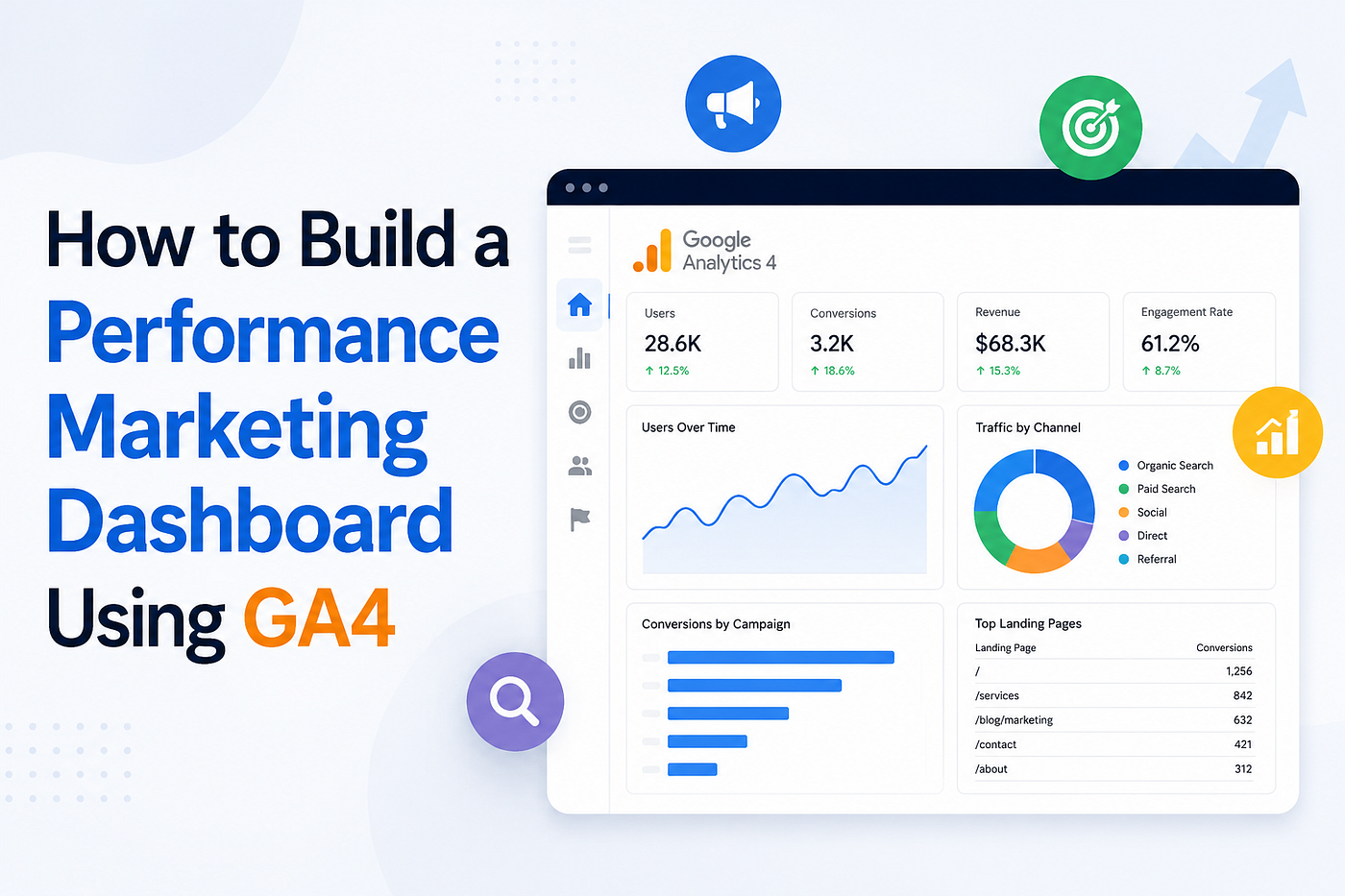
Google Analytics 4 (GA4)
Google Analytics 4 is a critical analytics platform for understanding website and user behaviour.
Performance marketers use GA4 to analyze:
- Traffic sources
- User journeys
- Conversion events
- Campaign performance
- Engagement patterns
GA4 helps marketers identify which campaigns generate valuable users rather than just website visits.
Google Tag Manager
Google Tag Manager simplifies tracking implementation without requiring constant developer support.
Performance marketers use it to manage:
- Conversion tracking tags
- Marketing pixels
- Analytics codes
- Event tracking
Accurate tracking allows marketers to measure campaign effectiveness and optimize advertising strategies.
Looker Studio
Looker Studio helps marketers create visual dashboards and reports.
Performance marketers use it to combine data from different sources, including:
- Google Ads
- GA4
- Search Console
- CRM systems
- Social media platforms
Clear dashboards help teams understand campaign performance quickly.
Semrush
Semrush is a popular digital marketing tool used for competitive analysis and keyword research.
Performance marketers use Semrush for:
- Competitor research
- Keyword analysis
- Advertising insights
- Market research
It helps marketers understand search trends and identify growth opportunities.
Ahrefs
Ahrefs is widely used for SEO research and competitor analysis.
Performance marketers use it to analyze:
- Search visibility
- Competitor strategies
- Backlink profiles
- Keyword opportunities
Although primarily an SEO tool, Ahrefs provides valuable insights for paid search campaigns as well.
Hotjar
Hotjar helps marketers understand how users interact with websites.
It provides insights through:
- Heatmaps
- Session recordings
- User feedback
Performance marketers use these insights to improve landing pages and increase conversion rates.
HubSpot
HubSpot combines marketing automation, CRM, and customer management features.
Performance marketers use HubSpot for:
- Lead management
- Email automation
- Customer segmentation
- Marketing reporting
Connecting advertising data with CRM information helps marketers understand the complete customer journey.
Shopify Analytics
For e-commerce businesses, Shopify Analytics provides valuable sales and customer insights.
Performance marketers analyze:
- Product performance
- Customer behaviour
- Sales trends
- Conversion data
These insights help optimize e-commerce advertising campaigns.
AI Marketing Tools
Artificial intelligence has become an important part of performance marketing workflows.
AI-powered tools help marketers with:
- Ad copy generation
- Creative ideas
- Audience analysis
- Predictive insights
- Campaign automation
- Reporting
However, AI works best as a support system. Human strategy, creativity, and decision-making remain essential for successful performance marketing.
How AI Is Changing the Performance Marketer’s Role
Artificial intelligence has become one of the biggest transformations in digital marketing. In 2026, AI is not replacing performance marketers; instead, it is changing how they work.
Modern performance marketers use AI to automate repetitive tasks, analyze large datasets, improve targeting, and create better customer experiences.
Professionals who understand how to combine AI capabilities with marketing strategy will have a significant advantage.
AI-Powered Campaign Optimization
Advertising platforms now use machine learning to optimize campaigns automatically.
AI systems analyze:
- User behaviour
- Search patterns
- Conversion probability
- Device usage
- Audience interactions
Based on these insights, platforms adjust:
- Bids
- Placements
- Targeting
- Budget distribution
Performance marketers now focus more on strategic direction and less on manual campaign management.
Predictive Analytics
Predictive analytics uses historical data and AI models to forecast future outcomes.
Performance marketers use predictive insights to estimate:
- Customer behaviour
- Campaign performance
- Revenue opportunities
- Potential risks
These predictions help businesses make smarter decisions before investing larger budgets.
AI for Ad Creatives
Creative performance has become a major factor in advertising success.
AI tools help marketers generate:
- Ad copy ideas
- Visual concepts
- Video scripts
- Content variations
However, marketers still need to understand audience psychology and brand messaging to create effective campaigns.
AI can generate options, but human expertise determines which ideas connect with customers.
Smart Bidding
Smart bidding uses machine learning to automatically adjust bids based on conversion likelihood.
Platforms like Google Ads use AI-based bidding strategies to optimize advertising performance.
Performance marketers need to understand:
- When to use automated bidding
- How to evaluate results
- How to provide quality conversion data
Automation works effectively only when campaigns are correctly structured.
Automation vs Human Decision Making
AI has automated many technical processes, but human expertise remains essential.
AI can help with:
- Data analysis
- Reporting
- Optimization suggestions
- Content variations
However, humans are still required for:
- Strategy development
- Customer understanding
- Brand positioning
- Creative direction
- Business decisions
The future belongs to marketers who know how to collaborate with AI rather than compete against it.
Skills That AI Cannot Replace
Even with advanced AI tools, several human skills remain valuable.
These include:
- Strategic thinking
- Creativity
- Emotional understanding
- Problem-solving
- Business understanding
- Communication
Performance marketers who develop these skills will continue to remain valuable in the changing digital landscape.
Industries That Hire Performance Marketers
The demand for performance marketers has increased across almost every industry because businesses are shifting towards measurable and result-driven marketing strategies.
Companies no longer want advertising campaigns that only generate visibility. They need professionals who can acquire customers, increase revenue, optimize marketing budgets, and prove the impact of every campaign.
A performance marketer can find opportunities in industries ranging from e-commerce and technology to education, healthcare, finance, and startups.
Let’s explore the major industries hiring performance marketing professionals in 2026.
E-commerce
E-commerce is one of the biggest industries where performance marketers play a crucial role.
Online businesses depend heavily on paid advertising to attract customers, increase product sales, and improve customer retention.
Performance marketers in e-commerce manage:
- Google Shopping Ads
- Meta product campaigns
- Retargeting campaigns
- Product-based advertising
- Customer acquisition strategies
- Conversion optimization
They analyze customer behaviour, identify profitable products, and optimize campaigns to increase sales while maintaining healthy profit margins.
With increasing competition among online brands, companies need skilled professionals who can efficiently manage advertising budgets and generate consistent revenue.
SaaS (Software as a Service)
SaaS companies rely on performance marketing to generate leads, increase product trials, and acquire paying customers.
Performance marketers working in SaaS focus on:
- Lead generation campaigns
- Free trial acquisition
- Demo bookings
- Subscription growth
- Customer acquisition cost optimization
Since SaaS businesses often have longer customer journeys, marketers need to understand:
- Funnel optimization
- Lead nurturing
- Retargeting
- Customer lifetime value
Performance marketing plays an important role in scaling SaaS products efficiently.
EdTech
The education technology industry has experienced significant growth, creating strong demand for performance marketers.
EdTech companies use paid marketing to attract:
- Students
- Working professionals
- Career switchers
- Course buyers
Performance marketers manage campaigns for:
- Course registrations
- Webinar sign-ups
- Lead generation
- Online learning subscriptions
They optimize campaigns based on student interests, career goals, and learning behaviour.
Professionals looking to enter this field often choose a structured **Online Performance Marketing Course** to understand paid advertising, analytics, conversion optimization, and campaign management practically.
Healthcare
Healthcare organizations increasingly use digital marketing to connect with patients and promote healthcare services.
Performance marketers in healthcare manage campaigns related to:
- Appointment bookings
- Healthcare consultations
- Awareness campaigns
- Medical services
Because healthcare advertising requires accuracy and trust, marketers must understand industry regulations while creating effective campaigns.
Finance
Financial companies such as banks, insurance providers, fintech companies, and investment platforms rely on performance marketing for customer acquisition.
Marketers help promote:
- Banking products
- Credit services
- Insurance plans
- Investment platforms
- Financial applications
Performance marketing in finance requires strong understanding of:
- Customer trust
- Compliance requirements
- Lead quality
- Conversion optimization
Real Estate
Real estate businesses use performance marketing to generate high-quality leads.
Performance marketers create campaigns for:
- Property inquiries
- Site visits
- Broker connections
- Project registrations
Since real estate purchases involve significant investment, marketers focus on attracting users with genuine buying intent.
Travel Industry
Travel companies use performance marketing to increase bookings and customer engagement.
Campaigns may focus on:
- Hotel bookings
- Flight searches
- Holiday packages
- Travel experiences
Performance marketers optimize campaigns based on:
- Seasonal demand
- Customer preferences
- Destination trends
D2C Brands
Direct-to-consumer brands depend heavily on performance marketing for growth.
These businesses sell products directly through digital channels and require marketers who can:
- Acquire customers profitably
- Scale advertising campaigns
- Improve conversion rates
- Increase repeat purchases
Performance marketers help D2C brands compete with larger companies by using data-driven advertising strategies.
Agencies
Digital marketing agencies hire performance marketers to manage campaigns for multiple clients.
Agency-based performance marketers work across different industries and gain experience in:
- Paid advertising
- Reporting
- Strategy creation
- Client communication
- Campaign optimization
Agencies are often a good starting point for beginners because they provide exposure to multiple marketing challenges.
Startups
Startups require fast growth with limited resources, making performance marketing extremely valuable.
Performance marketers help startups:
- Generate early customers
- Test market demand
- Improve acquisition strategies
- Scale successful campaigns
Because startups focus heavily on measurable growth, skilled performance marketers are highly valued.
Career Path of a Performance Marketer
Performance marketing offers multiple career growth opportunities. As businesses continue investing in digital advertising, professionals can progress from entry-level roles to leadership positions.
A typical career journey depends on:
- Technical skills
- Campaign experience
- Analytical ability
- Industry knowledge
- Business understanding
Let’s understand the common career progression.
Performance Marketing Executive
This is usually an entry-level position for beginners.
A performance marketing executive assists with:
- Campaign setup
- Keyword research
- Ad monitoring
- Reporting
- Basic optimization
Professionals at this stage focus on learning advertising platforms and understanding campaign fundamentals.
Skills required:
- Basic digital marketing knowledge
- Google Ads understanding
- Meta Ads basics
- Analytics fundamentals
Performance Marketing Specialist
After gaining practical experience, professionals move into specialist roles.
A performance marketing specialist independently manages campaigns and makes optimization decisions.
Responsibilities include:
- Managing advertising budgets
- Creating campaign strategies
- Analyzing performance data
- Improving conversions
- Testing new approaches
At this stage, professionals develop deeper expertise in paid marketing channels.
Senior Performance Marketer
Senior performance marketers handle larger budgets and more complex campaigns.
Their responsibilities include:
- Developing growth strategies
- Managing multiple channels
- Mentoring junior marketers
- Improving ROI
- Scaling profitable campaigns
They focus more on strategic decisions rather than daily campaign execution.
Growth Marketer
Many experienced performance marketers transition into growth marketing roles.
Growth marketers focus on complete business growth, including:
- Customer acquisition
- Retention strategies
- Product improvements
- Revenue growth
They combine performance marketing with analytics, product thinking, and customer research.
Performance Marketing Manager
Performance marketing managers lead teams and manage overall advertising strategies.
Their responsibilities include:
- Planning marketing budgets
- Managing teams
- Setting campaign goals
- Creating growth strategies
- Reporting business outcomes
They work closely with leadership teams to align marketing activities with company objectives.
Head of Performance Marketing
This is a senior leadership position responsible for the entire performance marketing function.
A Head of Performance Marketing manages:
- Large advertising budgets
- Multiple teams
- Marketing strategies
- Revenue targets
They focus on scaling growth and building long-term marketing systems.
Growth Marketing Lead
Growth marketing leads combine marketing, analytics, and business strategy.
They focus on:
- Experimentation
- Customer acquisition
- Revenue optimization
- Market expansion
This role requires strong understanding of both marketing and business operations.
Salary of a Performance Marketer
Performance marketing salaries vary depending on:
- Experience level
- Location
- Industry
- Technical skills
- Company size
- Campaign management experience
As demand for digital advertising experts continues to increase, performance marketing has become a financially rewarding career option.
Average Salary in India
The average salary of a performance marketer in India depends significantly on experience.
Entry-level professionals may start with roles focused on campaign execution and reporting, while experienced marketers managing large budgets can earn significantly higher compensation.
Professionals with expertise in:
- Google Ads
- Meta Ads
- Analytics
- Conversion optimization
- Marketing automation
often receive better career opportunities.
Salary Based on Experience
Beginner Level
Professionals with limited experience generally work on:
- Campaign setup
- Reporting
- Basic optimization
- Keyword research
Their focus is developing practical skills.
Mid-Level Experience
Professionals with a few years of experience usually handle:
- Complete campaigns
- Budget management
- Strategy development
- Performance analysis
They are responsible for improving business outcomes.
Senior Level
Experienced professionals manage:
- Large advertising budgets
- Marketing teams
- Growth strategies
- Business performance
Their compensation increases with their ability to generate profitable growth.
Salary by Company Type
Performance marketers work in various environments, including:
- Startups
- Digital agencies
- E-commerce companies
- Technology companies
- Large enterprises
Companies offering performance-driven roles often reward professionals who can directly impact revenue growth.
Freelancing Opportunities
Performance marketing also provides strong freelancing opportunities.
Many businesses hire freelance performance marketers for:
- Google Ads management
- Meta Ads campaigns
- Lead generation
- Conversion optimization
- Marketing consulting
Freelancers can work with multiple clients and build specialized expertise across industries.
How to Become a Performance Marketer
Becoming a successful performance marketer requires a combination of theoretical knowledge and practical experience.
The field does not require only academic qualifications. Many professionals enter performance marketing by developing skills through courses, certifications, internships, and real-world projects.
A structured Performance Marketing Course can help beginners understand advertising platforms, analytics, campaign optimization, and industry practices.
Learn Digital Marketing Fundamentals
Start by understanding the basics of digital marketing.
Important concepts include:
- Search engine marketing
- Social media marketing
- Content marketing
- Email marketing
- Customer funnels
- Online advertising
A strong foundation makes it easier to specialize in performance marketing.
Master Paid Advertising Platforms
Performance marketers must become comfortable with major advertising platforms.
Essential platforms include:
- Google Ads
- Meta Ads Manager
- LinkedIn Ads
- YouTube Ads
Practical knowledge is more valuable than only theoretical understanding.
Understand Analytics
Data is the backbone of performance marketing.
Learn:
- Google Analytics 4
- Conversion tracking
- Campaign reporting
- Attribution models
- User behaviour analysis
Analytics skills help marketers make better decisions.
Build Real Campaign Experience
Practical experience is extremely important.
Beginners can gain experience by:
- Creating practice campaigns
- Working on internships
- Managing small business campaigns
- Building marketing projects
Real-world experience improves confidence and employability.
Earn Certifications
Certifications can strengthen your professional profile.
Useful certifications include:
- Google Ads Certifications
- Google Analytics Certifications
- Meta Blueprint Certifications
- Marketing platform certifications
These validate your knowledge and improve career opportunities.
Create a Portfolio
A portfolio demonstrates practical skills.
Include:
- Campaign examples
- Performance improvements
- Analytics reports
- Case studies
- Marketing strategies
A strong portfolio helps candidates stand out during job applications.
Apply for Internships and Jobs
The final step is gaining professional experience.
Beginners can apply for:
- Performance marketing internships
- Digital marketing executive roles
- Paid advertising positions
Continuous learning and experimentation help professionals grow quickly.
Common Challenges Performance Marketers Face
Although performance marketing offers exciting career opportunities and measurable results, it also comes with several challenges. The digital advertising ecosystem changes constantly, and marketers must continuously adapt to new technologies, consumer behaviours, and platform updates.
A successful performance marketer is not someone who only knows how to launch campaigns. They are professionals who can identify problems, analyze data, test solutions, and improve results consistently.
Let’s explore the major challenges performance marketers face in 2026.
Attribution Issues
Attribution is one of the biggest challenges in modern performance marketing.
Customers rarely purchase a product after interacting with only one advertisement. Their journey may include:
- Watching a YouTube video
- Searching on Google
- Visiting a website
- Seeing a social media advertisement
- Receiving an email
- Returning later to complete a purchase
Determining which channel deserves credit for the conversion can be difficult.
Performance marketers use attribution models to understand the contribution of different marketing touchpoints.
Common attribution challenges include:
- Multiple customer interactions
- Cross-device tracking limitations
- Privacy restrictions
- Incomplete customer journey data
In 2026, marketers need strong analytics knowledge to make accurate decisions despite attribution complexity.
Creative Fatigue
Creative fatigue occurs when audiences repeatedly see the same advertisements and stop engaging with them.
This can lead to:
- Lower click-through rates
- Higher advertising costs
- Reduced conversions
- Poor audience response
Performance marketers solve creative fatigue by continuously testing new ideas.
Strategies include:
- Creating fresh ad designs
- Testing different messages
- Exploring new video formats
- Updating offers
- Understanding changing customer preferences
Creative testing has become one of the most important parts of successful performance marketing.
Rising Ad Costs
Digital advertising platforms have become increasingly competitive.
More businesses are investing in:
- Google Ads
- Meta Ads
- YouTube Ads
- LinkedIn Advertising
As competition increases, advertising costs also rise.
Performance marketers must focus on improving efficiency by:
- Targeting better audiences
- Improving conversion rates
- Creating stronger creatives
- Reducing wasted spending
- Increasing customer lifetime value
The goal is not simply spending more money but generating better results from existing budgets.
Privacy and Cookie Restrictions
Privacy changes have significantly affected digital advertising.
Restrictions on third-party cookies and tracking technologies have made audience targeting more challenging.
Performance marketers now focus more on:
- First-party data
- Customer relationship management
- Consent-based tracking
- Privacy-friendly analytics
Businesses are increasingly collecting and using their own customer data to create personalized marketing experiences.
Understanding privacy regulations and ethical data usage has become an essential skill for modern marketers.
Budget Constraints
Many businesses expect maximum results with limited advertising budgets.
Performance marketers must decide:
- Which channels deserve investment
- Which campaigns should be scaled
- Where spending should be reduced
- Which audiences provide the best returns
Budget optimization requires strong analytical skills and business understanding.
A skilled marketer knows that effective strategy matters more than simply increasing advertising spend.
Platform Algorithm Changes
Advertising platforms frequently update their algorithms, features, and policies.
Changes in platforms such as Google Ads and Meta Ads can impact:
- Campaign performance
- Audience targeting
- Bidding strategies
- Reporting methods
Performance marketers must stay updated and quickly adapt their strategies.
Continuous learning is necessary because techniques that work today may become less effective tomorrow.
Scaling Campaigns Profitably
Growing a successful campaign is often more difficult than creating one.
When increasing budgets, marketers may experience:
- Higher acquisition costs
- Audience saturation
- Reduced conversion rates
- Lower profitability
Performance marketers need to scale carefully by:
- Expanding audiences
- Testing new channels
- Improving creatives
- Optimizing funnels
Successful scaling requires both data analysis and strategic thinking.
Future of Performance Marketing Beyond 2026
The future of performance marketing will be shaped by artificial intelligence, automation, privacy-focused advertising, and deeper customer understanding.
While technology will continue changing how campaigns are managed, the core objective will remain the same:
Generate measurable business growth through effective marketing strategies.
Performance marketers who adapt to new tools and develop strategic skills will continue to remain valuable.
Let’s explore the major trends shaping the future of this field.
AI-First Advertising
Artificial intelligence will become an even bigger part of advertising workflows.
Future performance marketers will use AI for:
- Campaign predictions
- Audience analysis
- Creative generation
- Budget optimization
- Automated reporting
AI will help marketers make faster decisions by analyzing massive amounts of data.
However, human expertise will remain necessary for strategy, creativity, and understanding customer emotions.
First-Party Data Strategies
With increasing privacy restrictions, first-party data will become extremely valuable.
Businesses will focus on collecting customer information through:
- Websites
- Apps
- CRM systems
- Email subscribers
- Customer accounts
Performance marketers will use this data to create:
- Personalized campaigns
- Better audience segments
- Improved customer experiences
Understanding data management will become an important skill for future marketers.
Automation and Machine Learning
Automation will continue improving campaign efficiency.
Advertising platforms will increasingly use machine learning for:
- Smart bidding
- Audience targeting
- Campaign optimization
- Performance forecasting
Instead of manually managing every campaign element, marketers will focus more on:
- Strategy
- Experimentation
- Business growth
The role will shift from campaign operators to growth-focused decision-makers.
Creative-Led Performance Marketing
Creativity will become even more important as advertising platforms become more automated.
When targeting becomes less dependent on manual audience selection, creative quality becomes a major competitive advantage.
Future performance marketers will need to understand:
- Consumer psychology
- Storytelling
- Video marketing
- Brand messaging
- Creative testing
The combination of creativity and analytics will define successful campaigns.
Omnichannel Attribution
Customers interact with brands through multiple channels.
Future marketing strategies will focus on understanding complete customer journeys across:
- Search engines
- Social media
- Websites
- Mobile applications
- Offline interactions
Advanced attribution systems will help marketers understand how different channels contribute to business growth.
Skills That Will Stay in Demand
Even as technology changes, several performance marketing skills will remain highly valuable.
These include:
- Data analysis
- Strategic thinking
- Customer psychology
- Creative problem-solving
- Conversion optimization
- Marketing analytics
- Business understanding
Professionals who continuously upgrade their skills will have better opportunities in the future.
Is Performance Marketing a Good Career in 2026?
Performance marketing has become one of the most promising career choices in digital marketing.
As businesses continue shifting their budgets toward online advertising, the demand for professionals who can generate measurable growth continues to increase.
Unlike traditional marketing roles, performance marketing provides professionals with clear performance indicators and opportunities to directly impact business revenue.
Career Opportunities
Performance marketers can work in various roles, including:
- Performance Marketing Executive
- Paid Media Specialist
- Digital Advertising Specialist
- Growth Marketer
- Performance Marketing Manager
- Marketing Analyst
- Freelance Consultant
Opportunities exist across industries such as:
- E-commerce
- Technology
- Education
- Healthcare
- Finance
- SaaS
- Startups
Job Demand
Businesses increasingly require professionals who can manage advertising budgets effectively and generate measurable returns.
Companies are looking for marketers who understand:
- Paid advertising platforms
- Analytics
- Customer acquisition
- Conversion optimization
- Marketing automation
This growing demand makes performance marketing a valuable career option.
Growth Potential
Performance marketing offers strong career growth because professionals can develop both technical and strategic skills.
With experience, marketers can move into leadership positions such as:
- Performance Marketing Manager
- Growth Marketing Lead
- Head of Digital Marketing
- Marketing Director
Professionals can also explore freelancing, consulting, or building their own marketing agencies.
Who Should Choose This Career?
Performance marketing is suitable for individuals who enjoy:
- Working with data
- Solving problems
- Testing new ideas
- Understanding customer behaviour
- Learning new technologies
It is a good career choice for:
- Digital marketing beginners
- Marketing professionals
- Entrepreneurs
- Business owners
- Analytics enthusiasts
Individuals who enjoy combining creativity with numbers can build successful careers in this field.
For beginners looking for structured learning, a Performance Marketing Course Online can provide the right foundation by covering advertising platforms, analytics, campaign optimization, and real-world strategies.
Frequently Asked Questions (FAQs)
1. What does a performance marketer do?
A performance marketer creates, manages, and optimizes digital advertising campaigns to generate measurable results such as leads, sales, and revenue.
2. Is performance marketing a good career in 2026?
Yes, performance marketing offers strong career opportunities because businesses increasingly depend on digital advertising and measurable growth strategies.
3. What skills are required to become a performance marketer?
A performance marketer needs skills in paid advertising, analytics, conversion optimization, data analysis, copywriting, and campaign strategy.
4. Is coding required for performance marketing?
Coding is not mandatory, but basic technical knowledge of tracking systems, analytics tools, and website optimization can be helpful.
5. Which tools do performance marketers use?
Common tools include Google Ads, Meta Ads Manager, Google Analytics 4, Google Tag Manager, Looker Studio, CRM platforms, and AI marketing tools.
6. How much does a performance marketer earn?
Salary depends on experience, skills, location, and company type. Professionals with strong campaign management and analytics skills usually have better earning opportunities.
7. Is performance marketing difficult to learn?
Performance marketing requires learning multiple tools and concepts, but with consistent practice and practical training, beginners can develop strong skills.
8. What is the difference between a digital marketer and a performance marketer?
A digital marketer manages broader online marketing activities, while a performance marketer focuses specifically on measurable outcomes like conversions, revenue, and ROI.
9. Can beginners become performance marketers?
Yes, beginners can enter performance marketing by learning advertising platforms, analytics, and gaining practical experience through projects or internships.
10. Does AI replace performance marketers?
AI will automate many tasks, but it will not replace skilled performance marketers because strategy, creativity, decision-making, and customer understanding still require human expertise.
Conclusion
Performance marketing has transformed into one of the most important areas of digital marketing in 2026. Businesses today require professionals who can do more than create advertisements — they need experts who can understand customers, analyze data, optimize campaigns, and generate measurable growth.
A performance marketer manages multiple responsibilities, including campaign planning, audience research, paid advertising, conversion optimization, analytics tracking, and business reporting. Their role combines creativity, technology, and strategic thinking.
With the rise of AI, automation, privacy-focused advertising, and data-driven decision-making, performance marketers must continuously upgrade their skills. The professionals who understand both marketing fundamentals and modern technologies will have the strongest career opportunities.
For anyone planning to enter this field, gaining practical knowledge through an **Online Performance Marketing Course** can help build the required skills to work with real advertising platforms and industry strategies. Learning from a structured program like WsCube Tech can help aspiring marketers develop practical expertise and confidence.
Performance marketing is not just about running ads — it is about creating profitable growth systems. As businesses continue investing in measurable digital strategies, skilled performance marketers will remain in high demand beyond 2026.
메타데이터
- post_id
- f3cb490a5635
- slug
- what-does-performance-marketer-do-f3cb490a5635
- url
- https://medium.com/@pranjalmehta183/what-does-performance-marketer-do-f3cb490a5635
- canonical_url
- https://medium.com/@pranjalmehta183/what-does-performance-marketer-do-f3cb490a5635
- author_url
- https://medium.com/@pranjalmehta183
- status
- ok
- fetched_at
- 2026-08-07 01:41:52