PLAYS FOR BRITAIN (1976)
Producer Barry Hanson’s six television plays — featuring writers Stephen Poliakoff, Roy Minton and Howard Brenton and directors Alan…
PLAYS FOR BRITAIN (1976)
Producer Barry Hanson’s six television plays — featuring writers Stephen Poliakoff, Roy Minton and Howard Brenton and directors Alan Clarke and Michael Apted — ‘have a go at knocking the valves out of the set.’

Plays For Britain: Carole Nimmons, Bill Buffery and Paul Davis, Network DVD cover, Sheila Gish and Sonny Caldinez © 1976 Thames Television / Fremantle / ITV Studios
The six-play drama anthology Plays for Britain (Thames Television, TX: 6 April 1976–11 May 1976) was produced by Barry Hanson. Hanson’s professional career began in theatre in the late 1960s. Born in 1943, he attended Bradford’s Swain House Junior School and took up drumming and performing, appearing in Hamlet and the King at the Bradford Civic Playhouse. At Bradford’s Bellevue Grammar School, “he began, along with his fellow pupil the future actor Edward Peel, to take an interest in theatre there.” (1) Hanson then studied English at Newcastle University, but he also found time to run a student arts festival in co-operation with the City Council. For a year he taught at Bradford Grammar School before becoming a publicist at Harrogate Theatre.
In love with the theatre, he became production assistant to director Peter Gill at the Royal Court in 1965 during artistic director William Gaskill’s tenure when radical, new plays challenged the boundaries of what was possible or acceptable, leading to frequent censorship battles with the Lord Chamberlain’s Office. The controversy over Edward Bond’s Saved and the Royal Court’s defence of theatrical freedom, insisting that it was the theatre’s role to address current problems, including violence, spearheaded the abolition of theatre censorship in 1968. By 1967, Hanson became assistant director at the Royal Court and at the end of the decade had become the first artistic director of the Hull Arts Centre, working closely with its founder Alan Plater.


Princess Ann opens BBC Pebble Mill studios in 1971 (courtesy of Birmingham Live) and BBC Pebble Mill Studios (courtesy of the Pebble Mill photographic archive)
In 1971 television producer David Rose was invited to Hull Arts Centre by Plater to see his play directed by Hanson. Rose, who had been appointed Head of English Regions Drama at the BBC’s £7 million Pebble Mill complex in Birmingham when it opened on 10 November 1971, later invited Hanson to become his script editor. Director Stephen Frears recalled of Hanson: “he came from the Royal Court where the writing was new, lively and serious and continued to put writing in the foreground when he went on to work in television. I made four films with him, all provocative and full of vitality, all about the new Britain that had emerged after the war, all serious but drenched in popular culture.” (2) It was a Britain that Hanson continued to reflect in Plays For Britain when he moved to Thames Television.
Given Rose’s brief was “to commission and produce regional television drama for the national network”, Hanson developed the drama output at Pebble Mill, using his numerous connections to regional repertory theatres and writers to fulfill this ambition and to specifically commission those writers who lived in and had a focus on the regions. (3) “It was the first time that the regions had gained complete autonomy from the ‘Centre’ ’’, according to Hanson, and was a reflection of the process set in motion by the BBC’s consultation paper Broadcasting in the 1970s where editorial control of drama production was devolved back to the regions. He was looking for regional writers who could reflect an aspect of community, identity, or the current social and political zeitgeist. Though not necessarily of the region itself, Hanson also saw that “important drama of the day was political (with a big or a small ‘P’) whether it liked it or not.” (4)
‘I didn’t think television was theatre, shouldn’t be…’
Hanson script edited Pebble Mill’s contribution of 14 original half-hour plays to the long-running Thirty-Minute Theatre (BBC, 1965–1973) an anthology series created to nurture new television writing and directing talent. Here, he first worked with many writers and directors he’d later commission and work with as a producer — Alan Clarke, Michael Apted, Howard Brenton, Alan Plater, David Mercer, Jack Rosenthal, John Hopkins, Brian Glover and David Rudkin. Drama at Pebble Mill was responsible for a number of acclaimed entries in the series and notable Pebble Mill productions that survived junking/wiping include Ted Whitehead’s Under the Age (TX: 20/03/1972), set in a Liverpool bar run by a gay landlord and directed by Alan Clarke; Scarborough (TX: 12/10/72) about the interconnected desires of three fruit-pickers sleeping in a barn, and the striking and innovative That Quiet Earth (TX: 28/02/1972) by John Hopkins.
Rose objected to the umbrella title of Thirty-Minute Theatre, arguing that “I didn’t think television was theatre, shouldn’t be…”, and by its 1973 run of plays the title was dropped. There was a natural transition into Second City Firsts (BBC, 1973–1978), the anthology that would replace it in October 1973. (5). For Second City Firsts Hanson directed Rudkin’s Atrocity (TX: 15/03/73) and David Mercer’s highly regarded You and Me and Him (TX: 22/02/73), a studio-only drama using three sets, a single actor and innovative editing (three hundred very expensive manual video edits were employed) to convey a conversation between the multiple personalities of the main character. Rose also saw location filming as an opportunity to create ‘regionality’ in television drama, a quality first explored in the Birmingham set A Touch of Eastern Promise (TX: 08/02/1973). It was also, as noted by its writer Tara Prem, “the first thing on British television ever to have an entirely Asian cast.” (6) A half-Indian familiar with Birmingham’s Asian community, she also came up with the name Second City Firsts for the new anthology.

Spencer Banks and Geoffrey Staines in David Rudkin’s Penda’s Fen © BBC Studios 1974
The production experiments of Thirty-Minute Theatre and Second City Firsts certainly paved the way for Rose’s shift to film with Pebble Mill’s editions of Play for Today (BBC, 1970–1984), seven of which were all shot on film. Birmingham as city location and cultural melting-pot would, for example, become integral to Hanson’s all-film production of Philip Martin’s Gangsters (TX: 09/01/1975). Other plays from Pebble Mill included Peter Terson’s The Fishing Party (TX: 01/06/1972) and David Rudkin’s Penda’s Fen (TX: 21/03/74) directed by Alan Clarke. Rudkin had already contributed Bypass (TX: 27/03/1972) and Atrocity to the Thirty-Minute Theatre strand and, with Penda’s Fen, Rose and Hanson encouraged his ambitions to create a longer piece of television drama. Hanson believed he was initially responsible for the inception of Penda’s Fen: “I wasn’t credited, but I set up Penda’s Fen and got Alan and David Rudkin together. If you’re talking about writers who are distinctive, in a way there isn’t anyone quite like Rudkin, and Alan appreciated that.”(7) David Hare considered the play as the synthesis of the pioneering culture in drama at BBC Pebble Mill that saw the flowering of both Rudkin and Clarke’s talent.
Plays for Britain “was meant to try and force the pace towards certain grittier things…”
Meanwhile, Hanson continued to script-edit, produce and direct on the second and third series of Second City Firsts until 1976. It continued to match writers new to television drama, including Tom Pickard, Willy Russell, Alan Bleasdale, and new commissions from Brian Glover and Arthur Hopcraft, with directors such as Les Blair, Stephen Frears, Mike Leigh and Philip Saville. His production of James Robson’s Girl (TX: 25/02/1974), from the second series, is often regarded as a milestone in television, depicting the first on screen kiss between two women, a young recruit who meets and falls in love with her superior on a provincial army base.
It was something of a precursor to Hanson’s involvement with Philip Mackie’s six-year attempt to get an adaptation of Quentin Crisp’s The Naked Civil Servant (Thames, TX: 17/12/1975) to the screen, its gay subject matter having been originally rejected several times at the BBC, and which would eventually find a home at Thames Television. Hanson was appointed by Thames in November 1974 whilst overseeing the production of Philip Martin’s celebrated Gangsters and three further plays for the fourth series of *Second City Firsts. The Naked Civil Servant* was his first production for their drama department after Thames’ Controller of Programmes Jeremy Isaacs agreed to support the play.


Mike Leigh’s title sequence, featuring Tim Stern and Theresa Watson, to Plays for Britain © 1976 Thames Television / Fremantle / ITV Studios
Hanson’s drama ethos, an authorial vision developed with Rose at BBC Pebble Mill, and experience with writers and directors, often with strong regional and political voices and convention-defying attitudes to the production of television drama, is reflected in Plays for Britain, the strand of six dramas transmitted by Thames in April and May 1976. It was Hanson’s attempt to maintain the production of single plays at ITV, which had been the province of Armchair Theatre since 1956. As Dave Rolinson notes, “ITV sought to redress the negative signals sent out by their cancellation of Armchair Theatre with advertisements that proclaimed this strand its ‘successor’. ”(8) Gathering together a number of single-minded writers and directors — Howard Brenton, Roy Minton, Stephen Poliakoff, Alan Clarke, Michael Apted, Les Blair among them — he felt Plays for Britain “was meant to try and force the pace towards certain grittier things which hadn’t been done on Thames — it had been a bit middle class and fancy.” (9)
Certainly TV Times saw the plays in this light, where Barry Hanson underlined the suggestion that not only was *Plays for Britain intended to be the single play’s home in ITV’s schedule but that he’d been specifically chosen by Thames in November 1974, just as the “too comfortable” Armchair Theatre* ended after an 18-year run, to deliver drama that “would have a go at knocking the valves out of the set.” Verity Lambert, who had recently joined Thames in 1974 (as Controller of Drama), reflecting on the single play’s year-long absence at ITV, “felt that the single play on TV was such an important event that I wanted to give a producer time to think, to talk to writers and commission scripts. We wanted to bring back the single play in a new form.” (10) The opening titles are unusual and, directed by Mike Leigh and featuring Tim Stern and Theresa Watson, declare the strand’s intentions to connect with the concerns of the day voiced by the general public. As the couple negotiate their domestic lives they offer a ‘vox pop’ view of long-haired youth, unemployment, people who “ought to be strung up”, the rubbish on television, the cost of living and that “the British Empire stood for something.” It’s a distillation of Britain’s anxieties in the early 1970s and the six plays are poised as a response or analysis, counter-argument or agreement, with these views. As Hanson declared in TV Times: “My job is to encourage writers to make a comment on life today… there is a new sense of urgency and new plays must reflect this.” (11)
The Paradise Run (TX: 06/04/1976)

Title card: The Paradise Run © 1976 Thames Television / Fremantle / ITV Studios
Howard Brenton’s The Paradise Run opened the season, his first television play commission fresh from the success of his ‘state of the nation’ works Brassneck and The Churchill Play at the Nottingham Playhouse. He’d previously contributed Lushly to Thirty-Minute Theatre and 1975’s Centre Play strand (BBC, 1973–1976) had then presented a television version of The Saliva Milkshake, which originated at the Soho Poly Lunchtime Theatre. One of the writer’s ‘Plays for the Poor Theatre’, it was designed to bring political themes to the fore and had described the fate of a pair of revolutionary socialists oppressed by a ‘Big Brother’ state. Similarly, many of Brenton’s recurring themes about terrorism, power politics and Situationist intervention into bourgeois and consumerist public life are present in The Paradise Run. It also foreshadows the critique of British and Irish struggles for nationality and identity, the dissolution of empire and male violence that would come to dominate his 1980 cause célèbre The Romans in Britain.
The Paradise Run tells the “story of a man who wanted to find paradise” and follows the transformation of naïve, inept, rather virginal, young soldier Johnny Glass (an early television appearance by a young Kevin McNally), who cannot get to grips with his army service in Northern Ireland, into a ‘terrorist’ who sells out his bullying company for the elusive and illusory paradise of the title. The play was transmitted six months after the Guildford and Birmingham pub bombings were attributed to the IRA. Those arrested and imprisoned protested their innocence and were eventually exonerated and released when the convictions were overturned almost twenty years later. An opening sequence, of troops patrolling a street at night, not only illustrates the inexperience of young British men like Johnny but also shows families caught in the cross fire between the British and the IRA. In an ordinary terraced street we get ‘normalised’ glimpses of children playing in living rooms or as victims of parental discipline as the soldiers patrol.
McNally, in voice over, provides Johnny’s interior monologue about his desire to escape from this reality into his own fantasy. His inability to grasp that reality (“I don’t know what I’m doing here” he shouts through a window to a partially disrobed young woman) perhaps echoed the sentiments of the British public and army alike at a time when the power sharing in Ireland had collapsed in 1974 under pressure from strikes, violence and Unionist opposition. Johnny’s accidental smashing of the woman’s living room window is the catalyst to the wounding of a fellow soldier, Corporal Brown, by hidden snipers.
Running in parallel is the story of Captain Henry Blake (a striking Ian Charleson) who meets Mrs. Brown, the mother (Daphne Heard) of the wounded Corporal, and begins to contemplate the army’s use and misuse of young men in the Northern Ireland campaign. He’s left to try and understand what exactly is the point of the job when innocent people are killed or wounded, when young soldiers are deserted by the service and, as this extreme violence escalates, his bourgeois girlfriend and her friends ‘discuss’ politics in middle class comfort over pudding and coffee. Again, the play communicates these feelings through Blake’s inner monologue.


Johnny is ill-equipped to be a soldier during the British Army’s conflict with the IRA in The Paradise Run © 1976 Thames Television / ITV Studios / Fremantle
“one man’s beauty is another man’s mutilation”
Blake and Johnny’s fates intersect along lines of class distinction and gender conformity. Blake reveals his own desire to see ‘paradise’ by joining the army to cross the Sahara desert but we’re later shown, that just like Johnny’s own disillusionment with the service, Blake’s encounter with the Sahara was a nightmarish punishment at the hands of Arab soldiers, being buried up to his neck in sand. When Johnny still declares he does not understand why he is in the army, Blake explains to Johnny that he has free will even though by joining the army he still needs to follow orders.
Brenton raises both the spectre of empire and privilege, where Johnny believes Churchill is still alive and giving him his orders and that Prince Phillip is the Foreign Secretary, and suggests Johnny is not intellectually equipped to be serving in the armed forces. It raises the question of how many young men are similarly unable to process the reality of their situation, “to understand the world about you”. Johnny, seen as a weak, ignorant young man, is contrasted with the well-educated but cynical Blake but both are looking for the exit they desperately need. Johnny is bullied by the other members of the regiment and told to “get in harmony with your mates”, to conform and be good enough to serve. Cag (Maurice O’Connell), his superior officer, thinks getting a tattoo will help him “make his mark”.
But as the tattooist Scabby (Dickie Arnold) declares, offering us an analogy to Johnny and Blake’s roles, “one man’s beauty is another man’s mutilation.” Johnny asks for a picture of paradise “all over” and when the tattooist questions what paradise looks like we’re left with the assumption that the concept of paradise is unique to each individual and one can neither capture its image nor commodify it. The scene in the tattoo parlour also underscores how the male body often becomes spectacle in the play. The body is a landscape for public and private personas, representations of institution and masculinity — the military — and personal inner demons — male stupidity, frustrated desire, alcoholism. Johnny’s tattoo doesn’t enhance his masculinity, merely subtracts it, feminises it and exposes his apparent foolishness. Later, director Michael Apted cuts to a shot of Blake as he wakes up from his drunken nightmare showing him trouser-less and in his underpants before his girlfriend Carol (Sarah Porter) arrives and declares “there’s a rind all over you, like an old man”. His male identity and sanity is similarly poisoned.
When Johnny returns to the tattooist so begins a spiral into terrorism. He discovers Scabby dead, murdered as a collaborator, and is captured by a terrorist group. While they demand Johnny give up Cag to them, in exchange for money, a passport and freedom, they also articulate many of Brenton’s themes about how “we’re all a mangled lot our generation, both sides” and that the search for ‘paradise’ remains illusory, a coin wedged in a slot in a phone box as Johnny tries to call it into existence.
“Who deserted who and what deserted what?”


Blake (Ian Charleson) faces a remorseless reality in The Paradise Run © 1976 Thames Television / ITV Studios / Fremantle
By contrast, Blake is plagued by alcohol-fuelled nightmares. Abandoned in the desert, he’s prophetically haunted by Johnny attempting to stamp on him and Mrs. Brown dragging her wounded, bedridden son across the dunes. The sequence opts for an ‘out of body’ vision in Apted’s use of wide angle lenses and forced perspectives that’s in contrast to the clinical realism of other scenes. It also precipitates the collapse of Blake’s relationship with girlfriend Carol during the aforementioned dinner party. Amid the chatter about “sincere fascism” and “Durham miners”, Blake’s voice over cynically mocks the party guests with a withering “my generation”. The conversation of the chattering classes drops in and out of the soundtrack, alternating with Blake’s silent reception of it where “he doesn’t understand a word”. He hallucinates about them as versions of the tube-fed wounded Brown, perhaps interpreting them as victims of the war of consumerism and media, and, snapping out of his vision, disrupts the conversation with talk of the reality of army service — Bren guns, a 17 year-old shot in the eye, dead men in the street.
As Brenton has noted: “Reality is remorseless. No one can leave. If you’re going to change the world, well there’s only one set of tools, and they’re bloody and stained but realistic.” (12) Brenton aligns with the Situationist desire to break the spell of consumption and media saturation, using Blake to question political belief systems and to link with the drama’s other exploration of what’s a terrorist act and what’s just an attempt to non-violently disrupt. Blake and Johnny begin to share the same reality, recognise their “ghastly conspiracy of obedience” and opt out, finding refuge in an alternative ideology, one enshrined in a false paradise of their own making. The officer and the private are left unsure of their ranks, their class differences, their masculinities and their society. “Who deserted who and what deserted what?” asks Johnny in the end, pondering the contrast between counter-cultural optimism and the new reality served up when you attempt to discredit the establishment’s hegemony.
As James Penner notes of Brenton’s plays of the 1970s: “[they] contain terrorists [who] believe that society is controlled by elite sectors of society who continually impose their repressive view of the world through the promotion and exaltation of the commodity”. Brenton suggests their deconstruction by “working within ‘the system’ is utterly futile” and an alternative way to disrupt this ideology is in “contestation through ‘magnificent gestures’ ’’. Like much of his work of the period, The Paradise Run also asks “whether this strategy of disruption actually produces any meaningful results at all.” (13)
The Lifeswappers (TX: 13/04/1976)

Title card: The Lifeswappers © 1976 Thames Television / Fremantle / ITV Studios
In complete contrast, Roger McGough’s first television play The Lifeswappers is full of his trademark stylistic wit and word play and focuses on the 1970s obsessions with identity, the atomisation of traditional male and female roles, class distinctions and the commodification of work, home and sex. It’s clearly a nod and a wink to the scandalous stories about wife-swapping which troubled editors of the News of the World and the Daily Mail in the 1970s and suggested a dark and subversive undercurrent to the seemingly innocent lives lived in suburbia. But it’s cleverer than that.
Like Johnny Glass’s search for paradise, each of the men and women in McGough’s story are, whether they are initially aware of it or not, discontent with their roles at home, at work, as citizens in wider society, and are looking for an alternative. Despite its often surreal and satirical tone, McGough’s play seems to embrace the tenets of what would become the rise of ‘queer theory’ in the 1980s. The characters all eventually realise and happily accept that identity is not fixed, that gender is a performance often deliberately chosen and reinforced through repetition, that changing your identity and gender should be embraced, and male and female roles are constructions which can be challenged and disrupted
The play features two couples, Trevor and Dinah and Bunny and Miriam. Trevor (Anthony Douse) is somewhat downtrodden, looking for work and is merely tolerated by his wife Dinah (Sheila Gish). She seems to exist in a different world to him. A blonde haired, self-centred siren, replicating the seedier Hollywood glamour of Caroll Baker, she drifts around in a modernist, Biba inspired bedroom, rejects the role of house-proud, nurturing wife/cook and is defined by her affair with CEO Mr. Nigel (Donald Burton).
Director Jim Goddard underlines these themes with visual jokes. The opening shot includes a video effect of a white dotted line cleaving the marital bed shared by Trevor and Dinah. By her bed is a chilled bottle of champage, by his a simple china mug. His desire for sex is met with her hostility and a suggestion he can be fulfilled, “Maybe next year.” “Thank you darling that’ll be something to look forward to”, he offers.
“your dinner has gone to the hairdressers. I am in the oven”


Top left: Trevor and Dinah (Anthony Douse and Sheila Gish), Top right and bottom left: Mr. Nigel (Donald Burton) and Trevor becoming secretary ‘Miss Trevor’, Bottom right: Bunny (Peter Egan) and Miriam (Miriam Margoyles) in Lifeswappers © 1976 Thames Television / Fremantle / ITV Studios
Mr. Nigel, whose job seems to consist of sorting paper clips, playing table football and seducing his secretaries, is sent a new secretary by an agency. This is Trevor, who is rejected on the grounds that he is a) a man and b) not a woman with a “short skirt and big knockers”. Trevor leaves but within a few minutes returns, in drag, as the requested female secretary. The performance is not perfect, as Trevor displays a flash of hairy leg and oscillates between falsetto and male baritone. But in McGough’s surreal world Mr. Nigel completely accepts his role play as ‘Miss Trevor’ without reservation and as the play progresses ‘Miss Trevor’ evolves, with Peter Egan and Gish also later switching into the role. Trevor discovers Dinah’s affair with Mr. Nigel when he is asked to take a letter to his own wife. These scenes play with the caricatures and cliches of the British sex farce, hyperbolising and mocking the form.
Returning home, Trevor is informed by a note “your dinner has gone to the hairdressers. I am in the oven” and this malapropism is gilded by the surreal sight of Dinah momentarily shown sitting naked in the oven, turning to gaze at Trevor. It is a curious image and one which is repeated at the end of the play when Dinah is ‘recreated’ by Bunny and seems to suggest a number of themes: rigid gender binaries and roles can be an isolating trap and yet our desires and fantasies, if acted out, may or may not be the solution to an identity crisis.
There’s also a deliberate contrast between the modernist space in which Trevor and Dinah live with the rustic charms of an Elizabeth David styled farmhouse kitchen in which Miriam and Bunny function. The glamourous, silk underwear-wearing, mink stoled Dinah is also in direct contrast to this plumper, ‘Mrs Bridges’ mob-capped figure played by Miriam Margolyes. Bunny (Peter Egan, who completely steals the play) is a health fiend, a jogging vegan who exists on “yoghurt, wheatgerm and honey” and his wife Miriam is a hearty, passionate woman who only wants to nurture her husband and cook delicious food for him to eat. She is frustrated by his diet (“vegetables… in the raw”) and his lack of attention.
Goddard’s stylistic touches enrich their debate about vegans versus meat-eaters. Miriam’s diatribe about vegetables suffering just as much as animals in the production of food is accompanied by editing that mirrors her rapid chopping up of celery, carrots and tomatoes while Bunny’s press-ups on the kitchen floor are followed by a dizzying rise and fall of the camera matching Bunny’s bobbing face. The latter is visually repeated later in the play when ‘old’ Bunny becomes the ‘new’ Trevor living with Dinah. The set, like many of the others in the play, is highly stylised and there are expressionistic touches throughout the production.
“I’ve worked for the CIA, IRA, Tesco’s and Baader-Meinhof… I’ve seen all and learned nothing”


Surrealism in set design, video effects and fantasy sequences in Lifeswappers © 1976 Thames Television / Fremantle / ITV Studios
Change comes in the form of Trevor’s response to Bunny’s advert, a request placed in the newspaper to swap lives for three months. His angry demolition of a china Alsatian, which Goddard brilliantly freezes in mid air to dissolve to an actual Alsatian running through a park, where Dinah meets Nigel, leads him to the advert and he responds. The scenes in the park are heightened by video effects, placing a sun above the two lovers meeting before a large chess-board amidst stylised gardens. Perhaps McGough and Goddard were nodding gently at the atmosphere and manipulation of space and time in Resnais’s Last Year At Marienbad (1961).
After Bunny and Trevor meet and agree to the swap, identities and desires shift completely. Bunny becomes Trevor and ‘Miss Trevor’ (Egan’s ease with female drag is one of the pleasures of the play) and Trevor becomes ‘Bunny’. The destabilisation of identity, gender and desire offers Dinah a ‘new’ Trevor and Miriam a ‘new’ Bunny. ‘Old’ Trevor suggests to Dinah that she “may get on” with her new husband to which she responds “and pigs might fly”. McGough’s humour makes this literal when the drama is interrupted by an advert for Porkair, using an unconvincing model of a plane to introduce us to a company where the pilots and stewards are all human sized pigs in uniforms flying planes and serving drinks to human passengers. The pig masks are disturbing and the advert is a nightmarish reimagining of those sugary 1970s British Airways ads wherein they promise, “we’ll take more care of you.” Again, identity is blurred between human and animal.
These fantasy sequences enhance a play which consciously uses the television form to disrupt reality, to posit a world where identity, gender and desire can shatter and reform at will and for any purpose. In the park, there are archers seen in silhouette as Trevor and Bunny meet to agree their swap; the ‘new’ Bunny and Miriam’s picnic is a soft-focus, ‘food porn’ homage to Manet; a game of table football cuts to footage of a real match; Miriam and ‘new’ Bunny are shown in a song and dance routine, equating Fred and Ginger, expressing their new found love through the consuming pleasures of food using McGough’s signature word play; Mr Nigel’s vocal rejection of Dinah is punctuated by comedy noises.

Bunny ‘becomes’ Dinah (Peter Egan) in Lifeswappers © 1976 Thames Television / Fremantle / ITV Studios
When ‘old’ Bunny is revealed to be a serial swapper the play takes a darker turn, revealing his constant altering of identity and gender is a rampant search for individuality. As Miriam finds happiness with the ‘new’ Bunny, Dinah struggles to understand how she can exist in the midst of this freewheeling series of transformations. However, she inadvertently stumbles upon the dark secret at the heart of Bunny’s life.
Egan’s long scene where he reveals his multiple impersonations and performances as “a homosexual, bisexual, transsexual, pederast and chiropodist; I’ve been an airline pilot, a bishop, a lead guitarist… I’ve worked for the CIA, IRA, Tesco’s and Baader-Meinhof… I’ve seen all and learned nothing” is a perfect summation of the restless desire to be someone and no one. Only a final transformation leaves Bunny with the one identity he has never experienced before and his final grin and wink, ‘performed’ as Dinah from inside the oven, is a black conclusion to a strange fantasy where one identity is no more authentic than another and gender can be turned into anything we want it to be, parodied and repeated ad infinitum.
Sunshine in Brixton (TX: 20/04/1976)

Title card: Sunshine in Brixton © 1976 Thames Television / Fremantle / ITV Studios
The idea for Brian Glover’s Sunshine in Brixton was, according to the TV Times interview with the actor, writer and professional heavyweight wrestler, generated by a visit to the police. “I didn’t have any ideas for a plot, so I went to a police station at Brixton, an area of London I know well, and asked them if there was anything happening. While I was there, a woman came in and said, ‘Someone’s pinched my front door.’ Well that was it. My play starts with a West Indian boy stealing a front door. This boy is rejected at school and the only thing he’s good at is football — but in the end, he even drops out of that.”(14)
As Otis, the front door-stealing schoolboy, Glover’s play features Elvis Payne, from director-writer-producer Roger Price’s fondly remembered slapstick and satire comedy sketch show for kids You Must Be Joking! (Thames, 1974–1976). ‘Supervised’ by Bullseye legend Jim Bowen, Price’s show gave the likes of Pauline Quirke, Ray Burdis and fellow performers from Anna Scher Children’s Theatre their first television exposure. Quirke and Sylvestra Le Touzel (another of You Must Be Joking!’s cast), also briefly feature in the play, during the football match which leads to Otis’s rejection of the game.
Glover was no stranger to writing and performing in plays for Hanson, having completed several plays for Second City Firsts, as writer of If A Man Answers (TX: 29/10/73) and Pig Bin (TX: 28/10/74) and co-star in The Fishing Party. Glover’s background, his career as a wrestler, and his father’s influence as wrestler The Red Devil, “a grand man [who] died in his 70s lifting weights”, informs the domestic set-up of Sunshine in Brixton. Otis and his mother Marion (an excellent Jill Gascoine) are scraping a living together after the death of Otis’s father, apparently from a heart attack on a post-match football special. Marion is also in a relationship with wrestler John ‘The Negative’ (Sonny Caldinez — Trinidadian actor and professional wrestler familiar to many Doctor Who fans), so called because of the Trinidadian’s distinctive bleached white hair. Caldinez, who moved to Britain when he was 20 and started with manual work on the railways before training as professional wrestler, is apt casting and offers a convincing and rather sweet performance.
… perfectly captures the milieu of late 1970s school education


Elvis Payne and Jill Gascoine, Richard Ireson and Sonny Caldinez in Sunshine In Brixton © 1976 Thames Television / Fremantle / ITV Studios
The play examines the impact of absent fathers on wayward teenage sons and the contradictions of British black identity as Marion attempts to position John as a fatherly influence on Otis, who struggles with discipline at home and in school. Payne is rather good as Otis, his naturalism being of great benefit to the play. Much of the play is also concerned with the institutional racism of the teaching staff at Otis’s school. This again touches on Glover’s own background and all of the scenes at the school, shot on film and reflecting David Rose’s idea of how film, rather than studio VT, could install realism about community and regionality, are written and performed with wonderful detail. It perfectly captures the milieu of late 1970s school education system and how the wilder pupils behaved towards staff and disregarded their own education.
Glover partly abandoned his own wrestling career to go to Sheffield University and on to a teaching job at a Barnsley school. Much of that experience influences the play and he told TV Times: “Schools have changed a lot since my teaching days. When I was researching for my play I visited some South London schools and was amazed to see teachers with long hair wearing jeans. When I was teaching you weren’t even allowed to grow a beard.” (15) What also strikes the contemporary viewer is how much attitudes have changed in schools, the sector having since abandoned the abrasive mix of corporal punishment, politics of teaching and blatant post-colonialist racism of 1976.
Otis attempts to develop a career as a professional footballer and he encounters the brusque trainer Mr. Fewkes (Richard Ireson). His scenes putting the school football team through their paces are highly reminiscent of Glover’s first acting job, playing PE teacher Mr. Sugden in Ken Loach’s powerful social realist film ***Kes*** (1969). During a match, Otis injures the opposition’s goalkeeper because he thinks taking his opponent out by headbutting him is the appropriate strategy to win the game. Even though Otis’s behaviour does reflect the misconduct in professional football of the period, Fewkes rebuffs him with a racist insult that today would be unthinkable for a teacher or a referee to use and lead to dismissal from those professions. In 1976, sadly, casual racism was everywhere and accepted as part of day to day life: the head master addresses a black teacher with the question, “natives restless this morning?” and the teacher is seen walking down the corridor with a ‘General Amin’ sign stuck on his back.
Although Sunshine in Brixton doesn’t unpack all the issues about black pupils’ problematic integration into the British education system, where underachievement was seen to lead to alienation, militancy and rebellion, it does reflect on many themes about the failure of reforms in education which would find a much stronger challenge within the work of David Leland and his plays featured in ***Tales Out of School* **(Central, 1983). Otis rejects professional football and, potentially, an encounter with the sport’s own well-documented problems with racial integration in the 1970s, a taste of which Fewkes provides when he fails to instill the correct and appropriate discipline and instead uses insults. Otis eventually joins John ‘The Negative’ as a tag wrestler, sporting the same blonde-white hair, a crude and ironic symbol of assimilation where, being truly a ‘negative’ of themselves, these two men would be white skinned with black hair.
The filmed sequences at school are the play’s strength, certainly as an exercise in realism, and director Les Blair makes a virtue of the classroom antagonism between pupils, teacher and head master and the excellent ensemble playing. The pupils include a young Ray Winstone, prior to his defining role in the BBC’s Scum (completed in 1977 for Play for Today but not aired until 27/07/91), and various alumni of the Scher stage school. The studio sequences are mounted in a fashion typical of the era but they are carried by strong playing from Gascoine, Payne and Caldinez and Brian Glover’s acute observational dialogue.
Hitting Town (TX: 27/04/1976)

Title card: Hitting Town © 1976 Thames Television / Fremantle / ITV Studios
Hitting Town heralded Stephen Poliakoff’s early television career and his London Evening Standard Drama Award as 1975’s most promising playwright at the age of 23. The play was first staged at the Bush Theatre in April 1975 and, like much of his early theatre work (The Carnation Gang, City Sugar and Strawberry Fields) written when he was writer-in-residence at the National Theatre, it focused on urban alienation and decay in British cities. Poliakoff was ‘talent-spotted’ by the Royal Court’s resident dramatist Christopher Hampton at the tender age of 17. Although Poliakoff was commissioned for a play, it was eventually passed over by the Royal Court. Even at that early age Hampton recalled his “distinctive writing personality. Like everyone’s first plays, it was unsophisticated and ragged round the edges — but it had a real intensity. And then, as now, he seemed to be slightly off the rhythm in that the work is sort of jazzy, you don’t get quite what you expect.” (16)
His distinctiveness emerged after his participation in 1971’s controversial Lay-By, an experimental theatre project about rape and its consequences, where he worked with Howard Brenton, Brian Clark, Trevor Griffiths, David Hare, Hugh Stoddart and Snoo Wilson. He noted: “I was very much the baby of the pack and only actually contributed a few lines, but it did have an interesting effect. Naturalism was frowned upon at the time, and the sort of heightened realism I felt I was gravitating towards wasn’t part of their world. The others weren’t terribly interested in evoking time and place or psychological character development, and that helped to define me, albeit in a negative way, because at least I realised what I was not.”(17)
This also defined the expressive realism of his early writing, with Hitting Town eschewing the optimism of the 1960s for a setting that saw its conflicted characters, a brother and sister, retreat into an incestuous one-night stand away from the 1970s “brutal rebuilding of Britain [which] coincided with a tottering minority Labour government held up with IMF loans, huge industrial unrest and bombs going off in Northern Ireland” (18) In the TV adaptation director Peter Gill, one of Barry Hanson’s early theatre connections, emphasises this harsh environment by shooting the entire production on video, lending the deserted shopping mall and hamburger restaurant locations an appropriately bleak and unforgiving aesthetic.
“a social fabric so bland that it perhaps demands rebellion”


Mick Ford and Deborah Norton in Hitting Town © 1976 Thames Television / Fremantle / ITV Studios
This also defined the expressive realism of his early writing, with Hitting Town eschewing the optimism of the 1960s for a setting that saw its conflicted characters, a brother and sister, retreat into an incestuous one-night stand away from the 1970s “brutal rebuilding of Britain [which] coincided with a tottering minority Labour government held up with IMF loans, huge industrial unrest and bombs going off in Northern Ireland” (18) In the TV adaptation director Peter Gill, one of Barry Hanson’s early theatre connections, emphasises this harsh environment by shooting the entire production on video, lending the deserted shopping mall and hamburger restaurant locations an appropriately bleak and unforgiving aesthetic.
Ralph (an intense performance from Mick Ford), a student who has dropped out of Birmingham University, descends upon his sister Clare (an equally electric Deborah Norton) in her tower block flat. Over the course of the evening, Ralph attempts to draw Clare out of her shell by taking her out on the town. She has become withdrawn and isolated after a disastrous relationship with her last boyfriend. The key concept which keeps cropping up during the play is how the characters seek out and flirt with danger to check their status as vital human beings.
A flagrant practical joker, Ralph constantly tests the breaking point of people around him. He is determined to make, what Howard Brenton previously referred to as a ‘magnificent gesture’ — an unorthodox, Situationist action to challenge and conquer the rot of urban life, symbolised in a critique of post-war architecture, and revitalise his and Clare’s dulled senses. Throughout the play he confronts and mocks neighbours, radio DJs, the waitress Nicola, his own mother, the tower block and the shopping mall. He then dares Clare into sex with him and carries out a hoax bomb call. Breaking social taboos and ‘terrorist’ gestures are equated. His unorthodox actions foment a sexual attraction between him and Clare, one eventually drawing them into incest. The relationship develops and concludes unconventionally, is one Clare initially wishes to forget ever happened and, then later, reconsiders continuing when she understands that it has, like the milieu of the Birmingham and London IRA bombings referred to in the play, provided an emotional explosion at the centre of “a social fabric so bland that it perhaps demands rebellion.” (19)


Evolving out of the ruins: Lynne Miller, Mick Ford and Deborah Norton in Hitting Town © 1976 Thames Television / Fremantle / ITV Studios
This ‘hitting the town’, in all of its many meanings, is also signified by the similarly repressed figure of Nicola (Lynne Miller), the fast-food waitress whom Ralph and Clare become acquainted with as they explore the ugly, neon-lit, almost post-apocalyptic concrete landscape of the city. Nicola’s desire is simply to voice her frustrations through karaoke, then virtually unknown as a leisure pursuit in 1970s Britain, at a local disco where her rendition of ‘This Wheel’s on Fire’, at first an irony in itself before the blank faced Nicola concludes her performance with an horrific scream, is literally a cry for help. This also heightens the viewer’s constant awareness of noise and music during the play.
George Fenton’s own score merges with the muffled heavy rock blaring through the walls of Clare’s flat, the irritating spiel and play list of Midland Sound’s DJ Leonard Brazil and the dull pop music of the disco. At many points in the play, the distinction between Fenton’s actual score and the rest of the material vanishes and it all becomes a soundtrack. A lyrical theme plays over the first teasing moments of growing affection between Ralph and Clare as they navigate their concrete and fluorescent-lit environment and it concludes the first act. The second act opens with the couple in a hamburger bar but this time the ‘romantic’ theme is a passage of syrupy muzak playing in the restaurant. Clare even observes: “They probably think we’re here for the music” and in some respects they are as the muzak offers a backdrop to a first furtive kiss. This fake glamour also matches Nicola’s desperate fantasy in the disco, making her face up with sequins in preparation for her personal appearance, and her brief burst of fame and ‘magnificent gesture’ of protest.
This layered and dense use of sound abruptly drops into silence in Ralph and Clare’s post-coital cross-examination the morning after. Again, Poliakoff uses the aftermath of this taboo-busting sexual encounter as an analogy, suggesting the eerie silence after a huge explosion has gone off. Ralph notes: “You know it was really quiet like this when the bomb went off last weekend… I expected every car I passed to go off. I was sweating just walking along.” Again, there is a sense of imminent danger, of approaching an explosive situation but also being excited and revitalised by it.
A highlight of Plays for Britain*, Hitting Town depicts a world growing smaller, shrinking under the vast weight of bland modernity, concrete, constant noise, anonymous telephone calls, surveillance and desperate glamour. Ralph and Clare attempt to evolve within this dystopian environment, to control, modify and extend their inner lives. Many of these themes would be developed in Poliakoff’s companion piece City Sugar (a stage play adapted for TV in 1978), the television film Bloody Kids* (ATV, 1980), and cinema releases Runners (1983) and Close My Eyes (1991).
Fast Hands (TX: 04/05/76)

Title card: Fast Hands © 1976 Thames Television / Fremantle / ITV Studios
Another highlight is Roy Minton’s Fast Hands (TX: 04/05/76), probably the most overtly realistic drama, in terms of subject matter and form, in the series and impeccably directed by Alan Clarke. Minton and Clarke had already worked together on Play for Today, Clarke having directed Minton’s Horace (TX: 21/03/72) and Funny Farm (TX: 27/02/1975). Clarke’s signature had been developing for some time and Fast Hands is another extension of themes Dave Rolinson identified in his work in the 1970s where “his thematic concerns are individuality, authority and institutionalisation and an interest in incarceration in both literal and figurative terms.” (20) These are coupled with a distinct visual style; his constantly moving camera, specific framing and interspersed close ups.
For the central character Jimmy Handbury (Bill Buffery), a young market labourer, it is his ambition and dedication to training as a winning professional boxer which will lift him from entrapment in a low paid job and out of a poor working class background. Success at this, he believes, will provide life’s bounty for him and his fiancée Maureen (Gillian Taylforth). However, she is unhappy with how his boxing training is estranging him from the relationship and continually tries to persuade him to abandon it. Jimmy is caught between this relationship and life with his parents and his individuality is expressed through sport. Various male and female hierarchies operate throughout.
Boxing brings him into contact with a number of authority figures and institutions: his trainer Eggie (Ernie Claydon), the predatory boxing promoter Ray Prince (Peter Spraggon) as representatives of the sport, and the doctors and consultants who then have to pick up the pieces after a disastrous fight. At home is an easily manipulated mother, intent on buying a new three piece suite with the prize money, who then all but abandons Jimmy after the fight has left him with brain damage, as does his girlfriend Maureen. His father seems to care even less. Only Jimmy’s brother Geoff (Stephen Bill) and trainer Eggie initially demonstrate outrage at Jimmy’s fate at the hands of Prince. But Eggie moves on and trains other boxers and Geoff is left to keep an eye on Jimmy, a young man who slowly drifts to the periphery of life, his prospects completely destroyed.
According to Barry Hanson, Clarke completed Fast Hands “in about five days, ten minutes a day. It wasn’t possibly among the prime pieces in Roy Minton’s oeuvre… but it was very good, very raw.” (21). At the centre of the story of Jimmy Handbury’s brief rise and fall as a boxer is a very impressive performance from Buffery as Jimmy. The undergraduate Buffery had been spotted in a play about boxing at the National Youth Theatre and was subsequently cast in his first professional acting role. He was then assigned a trainer, ex-bantam weight champion Johnny Clark, for six weeks. Alan Clarke’s dogged pursuit of realism for Buffery’s role culminates in a visceral eight minute sequence at the centre of the play as a deliberately mismatched Jimmy fights his opponent Warboys (Paul Davis).
“You don’t fight your way up, son. It’s whether certain doors open.”


Bill Buffery, Ernie Claydon, Peter Spraggon and Maria Charles in Fast Hands © 1976 Thames Television / Fremantle / ITV Studios
Visually, Fast Hands offers a primer in Clarke’s signature use of the silhouette, the camera tracking the backs of characters as they roam through corridors and hallways, use of repeated sequences and rapid editing, close ups and long shots to position characters in their environment. The play opens with Jimmy training, a body moving through space, becoming abstract in the process, a hand held camera swinging with a punch bag or watching him through the arm of his trainer. It’s a sequence that Clarke returns to as Jimmy prepares for the fight, suggesting the “structural circularity”, noted by Dave Rolinson, “ which marks Clarke’s later work” amid the strictures of the institutional regime of the boxing club, the repetitive regimen Jimmy demands of himself. (22)
These framing structures are emphasised throughout: Clarke’s long shot of Jimmy in his dressing room places the character in a box, delineating the extent of his ambition. We see Prince arrive and his offer of celebrating Jimmy’s victory rejected by Eggie. This matches some earlier shots of Jimmy training, framed in front of a mirror. Later, as he leaves for work in the morning, he walks in silhouette to, and is framed by, his front door and this is repeated when, post-fight, Jimmy comes home. His discussion with Maureen about his career is dominated by a television set showing a football match, a framed example of sporting prowess and success. In another training sequence, Clarke has windows and doors directly in frame as Jimmy trains, signifying entrances and exits to and from a promising career. Through these doors the brain damaged Jimmy will later see Eggie training other boxers and will turn away.
Prince is literally a ‘prince of darkness’, a dark coated, very tall and imposing figure. When he calls on the family home he looms over the diminutive figure of Jimmy’s mother (Maria Charles). Visiting the boxing club as Jimmy trains, followed by Clarke’s hand-held camera, we see him framed in a doorway, dominating the young boxer in the background. Once there, Prince underlines all that we have seen and will see when he invites Jimmy to fight Warboys: “Do you know how many people decide whether you fight or not? At the top, I mean. Ever? Three. That’s all. Nothing to do with talent. There’s many a champion never had a match. You don’t fight your way up, son. It’s whether certain doors open.”

Paul Davis and Bill Buffery in the visceral fight sequence at the heart of Fast Hands © 1976 Thames Television / Fremantle / ITV Studios
Buffery’s dedication to the role, an example of method acting long before Robert De Niro suffered for his art in the role of Jake LaMotta in Raging Bull (1980), can be found in the stunning fight sequence that takes up a major section of the play. It was staged in a public hall in South London in front of a 300-strong audience and Buffery actually went eight-and-a-half rounds with professional boxer Paul Davis, playing Warboys. To all extents and purposes, the fight was real even though it was carefully staged. Clarke’s camera is an active participant in the sequence, bumping into both boxers, going in for close ups, rendering the bodies into abstraction, crushing down time with further rapid cuts and edits. As Hanson told the TV Times: “It shows, by means of a camera actually inside the ring, exactly what the experience of a fight, or being hurt, is. It is unique. Bill Buffery was hit — badly. But everyone involved in the play was committed to the importance of making this crucial scene real. It was real. I think it is something that has never successfully been faked.” (23)
Even Roy Minton felt that the dividing line between acting and a push for realism had gone too far after Buffery was knocked to the floor and stayed there for more than ten minutes: “It got out of hand because I quickly realised that this actor was going to be knocked out. Clarkey was a bit remiss with that one. Maybe because it was such a slender piece, he went to the actuality to try and find a nucleus for it, a gut in the middle of it. But it wasn’t necessary. And by then, the make-believe had gone.” (24) The fight sequence is primal, violent and almost hallucinatory and Clarke’s push for realistic violence in drama would provide further heated debate when it came to directing Minton’s Scum a year later for Play for Today.
The final ten minutes of the play essay Jimmy’s decline and Buffery accomplishes this well through body language, gesture and facial expression while Clarke repeats his use of tracking camera and long shots to generate a sense of Jimmy’s isolation and redundancy. When he comes home late at night, his defeat at the fight is palpably felt as, in silhouette, he weeps. When his mother and Maureen finally convince him to leave the three week exile in his room, he collapses in the street and the structures of family, work and boxing are replaced by medical expertise, hospital corridors and rooms and the stripping away of verbal and physical communication. It’s a bitter, harsh and sad conclusion.
Shuttlecock (TX: 11/05/76)

Title card: Shuttlecock © 1976 Thames Television / Fremantle / ITV Studios
Shuttlecock takes the controversial subject of child abuse and delivers a deeply disturbing critique of upper-middle class values when caught in the penetrating, or not so penetrating, glare of social services, the police and the NSPCC. Director Philip Saville handles the material with great economy and cleverly uses subjectivity to make the audience become complicit spectators as domestic violence unravels a family’s good intentions. Much of the focus is on the bullying, aggressive, self-centred stepfather Sam and Saville uses camera and an address to the audience to analyse this man’s appalling behaviour and attitudes.
Its writer Henry Livings, who trained as an actor for two years with the Joan Littlewood Theatre Workshop, was described by Oberon Modern Playwrights as a “one-off with a startlingly individual voice, an anarchic sense of humour and a fierce and loving commitment to his working-class anti-heroes”. His first play, Stop It Whoever You Are, was performed in 1961. A career as a playwright of thirty-two stage plays, including Kelly’s Eye, EH?, and The Little Mrs Foster Show, and a sequence of fourteen ‘scenarios with fictions’ entitled The Pongo Plays was supplemented by a television career as actor and writer. He contributed several plays to ITV Playhouse (1967–1983) and ITV Sunday Night Theatre (1969–1974) and You’re Free (TX: 16/11/72) to Hanson’s tenure as Thirty-Minute Theatre’s script editor. He eventually went on to write episodes of Juliet Bravo (BBC, 1980–1985) and Bulman (Granada, 1985–1987).
Livings’ use of farce, certainly an undercurrent in Dinsdale Landen’s performance, bubbles away under the surface in Shuttlecock as an emotionally vulnerable boy, Harry (David Max Vaughan), happily living with his foster parents Jacky (a sensitive performance from Carole Nimmons) and Bill Ogden, is returned by social services to his birth mother Bobby (Ann Pennington) and her husband Sam Malkyn (Dinsdale Landen). Harry struggles to settle in with his mother and stepfather and engage with a middle class milieu of boating clubs, private schools, fine wines and pâté.
Playing with Harry in this strange ‘game’ is Sam, described by Landen in the TV Times as “paranoid, for a start, married to a woman with a child that is not his, with all the sexual implications that involves. He has come from the lower orders and worked his way up to executive middle class… and he has become arrogant, expecting everyone to come to heel like a dog.” (24) The game or sport analogy runs throughout the drama, including some interesting symbolism about sailing and boats, as emblems of masculine, father-son bonding. The play also opens with Harry’s arrival at the Malkyns in the middle of a game of badminton being played by the neighbour’s children. The shuttlecock lands in the undergrowth and, while the children anxiously look for it, Saville’s camera closes in on Harry’s hands, behind his back, holding the recovered shuttlecock. “I told you not to hit it too hard,” says one of the children. The emotional and violent game is already underway and this opening scene is later bookended by the play’s closing titles, the sound of a shuttlecock being sent back and forth. Harry is that shuttlecock, hit too hard in a particularly cruel game.
“I’ve got to prove I’m a fit person in the opinion of the magistrate.”


Dinsdale Landen, Ann Pennington and David Max Vaughan in Shuttlecock © 1976 Thames Television / Fremantle / ITV Studios
Differences in parenting skills come sharply into focus as the bullying, brusque Sam attempts to mould Harry in his own image. Sam seems to find great amusement in the philosophy he spouts, guffawing at every opportunity to underline that each crisis is best defused with some pretense at a joke. Landen is perfect casting, turning the self-centred company executive into a monstrous figure. The relationship between Harry and foster mum Jacky is entirely different. Gentle, caring and supporting, the mother-son bond is strongly visualised — Harry cheers up as Jacky arrives to pick him up from a weekend visit and we see him greeting her with a smile and a kiss and there’s a moving scene where Jacky has to say goodbye to Harry as he moves back permanently to the Malkyns. A wrecked toy boat symbolises the emotional destruction wrought by social services and a silent close up of Jacky’s crying face is then matched with a close up of Harry grasping her hand.
Sam resents all forms of state intervention. Social workers, police, the NSPCC and an Asian GP (who provokes a series of racist insults from him) all arrive to assess the damage he’s inflicted upon Harry throughout the drama. As an executive he simply views their work as “forms to fill in” or as the inconvenience of an ambulance disturbing the neighbours when his child has been diagnosed with multiple fractures. He exclaims “I’m not the sort who gets prickly heat when he sees OHMSS” to social worker Miss Ede (Holly Palance) but his guffaw suggests the opposite when he declares his executive class is above mixing with the “unwashed” in a magistrate’s court.
Harry, unable to connect to the Malkyns, becomes their prisoner after several attempts to run away. They keep him locked in a room, a nine-year old boy incarcerated simply because he isn’t yet the adult that Sam is more comfortable dealing with. “It’s not a jail here you know, old chap”, he offers, ironically, to an injured Harry after the police bring him back from a ten mile walk in the middle of the night. Saville’s use of the close up, on eyes which gaze down the lens or verbal addresses to the audience, offers direct connection to interior thoughts. A close up of Bobby, after the police drop Harry back home, captures her anxious state as a mother learning to cope with a child she hardly knows. Saville repeats this close up several times. He has Bobby appeal directly to the audience, asking for their help, when she cries: “I’ve got to prove I’m a fit person in the opinion of the magistrate.”
The audience has in effect become the magistrate as Sam rants in the background about saving face with colleagues and neighbours, whether people will look up to them after they discover social workers have been prying into their suitability as parents. A close up of Harry in bed at night shows his eyes responding to Sam’s ranting downstairs and they momentarily stare right down the lens, dragging the audience further into the emotional turmoil. The confessional mode is used again when Bobby has a meeting with Miss Ede. She is talking to Miss Ede but she’s also talking to us and we learn why Harry was fostered out. “I was trapped,” declares Bobby. It begs the question of why she and Miss Ede don’t recognise that this is exactly how Harry feels too.
“even the most secure of us needs supervision”


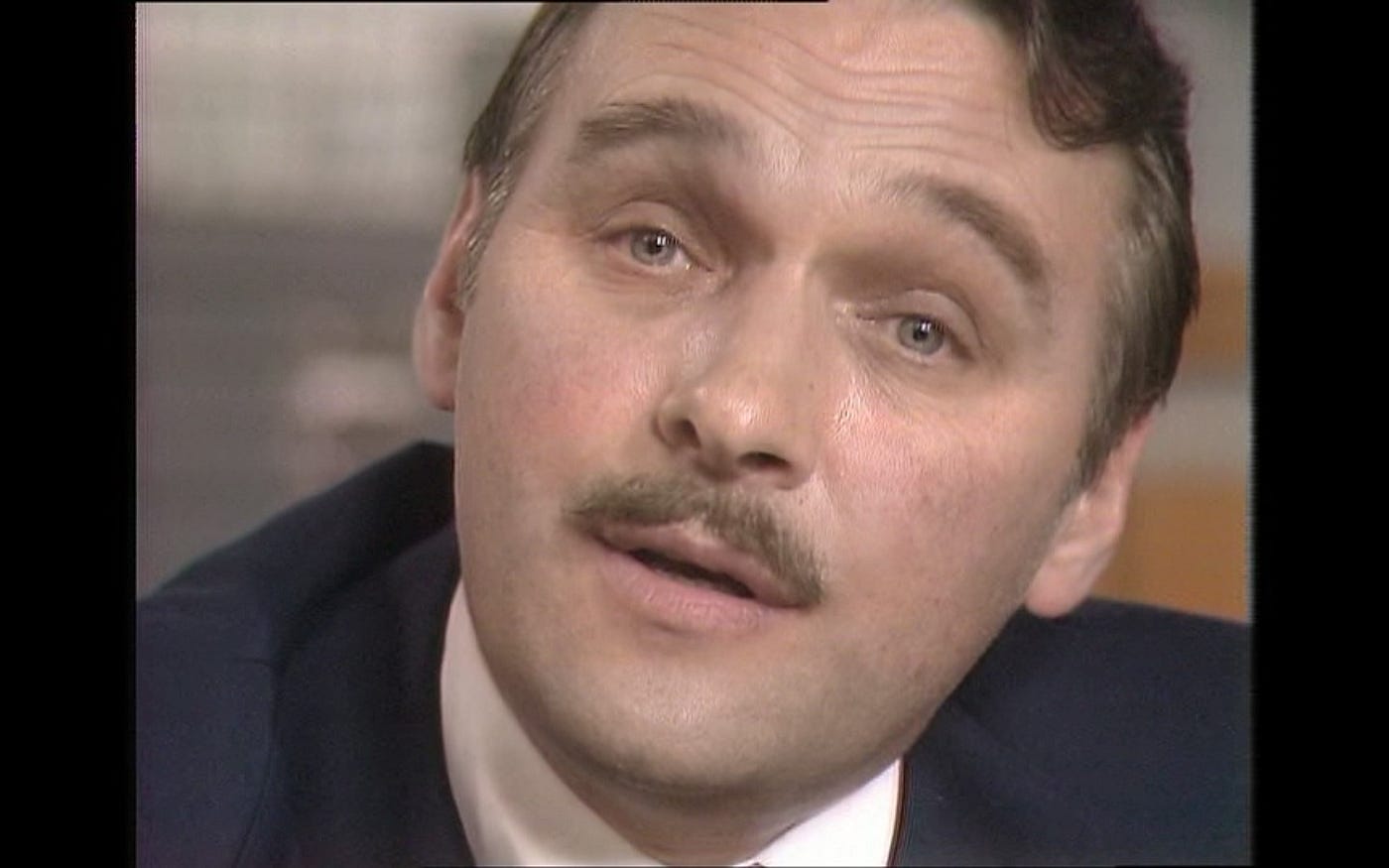
Dinsdale Landen, Ann Pennington, David Max Vaughan and Tony Steedman in Shuttlecock © 1976 Thames Television / Fremantle / ITV Studios
Harry causes an accident and receives the first beating, off screen, from Sam. “Nothing wrong with a good wallop. My father would have left me unable to walk after such an exploit,” he rants, underlining how he sees his punishments for bad behaviour sanctioned by the rule of male generations in his family. This generational knowledge is also trotted out to an older friend, George, at the boat club. Sam regards Harry only as “a rational human being. He’s going to see it’s in his interest to behave within the bounds of reason” or someone he does “not want to grow up to be a softie.”
Writer Irvings places Sam’s parenting skills as analogous to the training of a dog who refuses to walk to heel as George (Tony Steedman) explains how in a dog-handling crisis “I thought I’d have to break the poor brute’s neck” to get the animal to behave. Sam is waiting for Harry to give in and come to heel. Saville frames this conversation with a two shot and far in the background, through a window, we see Bobby arrive with Harry and help him prepare for sailing with Sam. The two male figures dominate until Saville zooms in on mother and son and we hear George, now out of focus and at the edge of the screen, describe the difficult relationship with his dog as “having been to hell and back.” That hell is symbolised by Saville in Harry’s concentrated stare at an orange wind sock, screaming and howling in the gale, as he stands at the harbour, dressed in a matching orange life jacket, waiting for Sam.
It’s an appropriate analogy because, as the drama offers, if a child is treated like a animal then animalistic behaviour will follow. Harry, now withdrawn and unhappy, employs Howard Brenton’s ‘magnificent gesture’ to affect the situation. He defecates into a chest of drawers, a ‘dirty protest’ not too dissimilar to behaviour political prisoners resorted to in the Maze prison at the time of broadcast. Like Alan Clarke’s incarcerated figures, Harry rejects the institutionalisation of the Malkyns home with its locked doors and forced feeding but then pays the price. The relationship between Sam and Harry breaks down and a severe beating, brutally suggested by Landen’s punch almost directly into Saville’s camera, is what follows.
Saville’s use of the close up provokes a particularly interesting effect at the end of the play when Miss Ede cross examines the Malkyns after Harry’s admission to hospital. Landen and Saville turn Sam’s effrontery at the suggestion the Malkyns see a family psychiatrist into an aside right down the camera, a direct address to the audience where Sam confides “even the most secure of us needs supervision” and “people don’t know how to carry on any more” and which sheds some light on Sam’s own insecurities and behaviour. The final shot is a close up of Sam, reflecting on the social worker’s suggestion that therapy might reveal to him the reasons why he assaulted a child. He nervously addresses us: “I’m sure it’ll be very interesting.”
The subject matter in each of the Plays for Britain is as relevant as ever and they emphasise how dramas and the single play were used as social and political commentary, of a biased intention or not, in the 1970s. They may look, in terms of their production processes, anachronistic today but the power of the storytelling is undiminished despite their outdated social and institutional attitudes and behaviours.
The fantasy-tinged The Lifeswappers and The Paradise Run show dramatists and directors unafraid to use satire, dream sequences, flash backs and video effects to tell their stories and Alan Clarke’s direction on Fast Hands was rather innovative at the time, its documentary verisimilitude incongruous but exciting in the middle of five other plays where the mix of film and studio VT was standard for the industry. However, even within those standards there is, for want of a better word, an auterism visible in the plays directed by Jim Goddard, Philip Saville, Michael Apted, Les Blair and Peter Gill. Saville and Gill seemed keen to push the use of OB and studio VT recording and used little or no film inserts in their plays, something perhaps demanded by budget. Blair excels in his use of film, something that he would capitalise on with Law and Order (BBC, 1978) and ***The Nation’s Health*** (C4, 1983).
Sources:
- ‘Barry Hanson: August 1943 — June 2016’, What Was Pebble Mill? accessed 02/09/2025.
- ‘Barry Hanson: August 1943 — June 2016’, What Was Pebble Mill?
- Cooke, Les, ‘BBC English Regions Drama — Second City Firsts’, in Re-viewing Television History: Critical Issues in Television Historiography, ed. Helen Wheatley (Bloomsbury Academic, 2007).
- Hanson, Barry, ‘The 1970s: Regional Variations’, in British Television Drama: Past, Present and Future, eds. Jonathan Bignell, Stephen Lacey and Madeleine MacMurraugh-Kavanagh (Palgrave, 2nd edition 2014).
- Cooke, ‘BBC English Regions Drama — Second City Firsts’.
- Prem Tara, ‘A Touch of Eastern Promise — 1973’, *What Was Pebble Mill?* accessed 02/09/2025.
- Hanson quoted in ‘Angels and incubi: BBC Birmingham and Penda’s Fen’, Alan Clarke, ed. Richard Kelly (Faber, 1998).
- Rolinson, Dave, The Television Series: Alan Clarke, (Manchester University Press, 2005).
- Hanson quoted in ‘A Few Scrapes 1975–1976’, Alan Clarke, ed. Kelly.
- Knowles, Stewart, ‘Inside TV: Out of the armchair into the realism’, TV Times (Volume 83, №15, cover date April 3–9 1976, Independent Television Publications).
- Ibid
- Patterson, Michael, Strategies of Political Theatre: Post-War British Playwrights, (Cambridge University Press, 2003).
- Penner, James, ‘Spectacular Disruptions — Situationism and the Terrorist Gesture in Howard Brenton’s ‘Skin Flicker’ and ‘Magnificence’ ’, in Spectator (Volume 21, №2, Spring 2001).
- Ennis, Jane, ‘It’s grunts, groans and grammar now for the son of the Red Devil’, TV Times (Volume 83, №17, cover date April 17–23 1976, Independent Television Publications).
- Ibid.
- Christopher Hampton quoted in ‘A life in drama: Stephen Poliakoff’, interview with Nicholas Wroe in The Guardian 28/11/2009.
- Wroe, ‘A life in drama: Stephen Poliakoff’.
- Ibid.
- Nelson, Robin Nelson, Stephen Poliakoff on Stage and Screen (A&C Black, 2014).
- Rolinson, The Television Series: Alan Clarke.
- Hanson quoted in ‘A Few Scrapes 1975–1976’, Alan Clarke, ed. Kelly.
- Rolinson, The Television Series: Alan Clarke.
- Hill, Dermod, ‘Where He Went Wrong Was Having A Big Tea Before The Fight…’, TV Times (Volume 83, №17, cover date May 1–7 1976, Independent Television Publications).
- Roy Minton quoted in ‘A Few Scrapes 1975–1976’, Alan Clarke, ed. Kelly.
- Passingham, Kenneth, ‘Comedy and Violence Make Up Dinsdale’s Balancing Act’, TV Times (Volume 83, №20, cover date May 8–14 1976, Independent Television Publications).
Originally published at https://www.cathoderaytube.co.uk. Revised from an original 2013 review. Screen captures taken from the Network ‘Plays For Britain’ Region 2 DVD. All written material by Frank Collins (the author) is © 2025 and is licensed under a Creative Commons Attribution-NonCommercial-NoDerivatives 4.0 International License. Please seek permission from the author if you would like to quote or re-use any of the author’s own written material.
Reproduction, quotation and use of text, images, audio and video material in the author’s work published on Medium is for the purposes of non-commercial criticism, comment, education, scholarship and research only. This text-audio-visual material may be original content that may not be authorised for use by the author. The author is legally using this original content under the ‘fair use’ principles as defined in: Section 107 of the Copyright Act 1976 (US) and by Sections 29 and 30 of the Copyright, Designs and Patents Act 1988 (UK). All rights and credits go directly to the rightful owners. No copyright infringement is intended.
메타데이터
- post_id
- f3cf06c08f9b
- slug
- plays-for-britain-1976-f3cf06c08f9b
- url
- https://medium.com/cathode-ray-tube/plays-for-britain-1976-f3cf06c08f9b
- canonical_url
- https://medium.com/cathode-ray-tube/plays-for-britain-1976-f3cf06c08f9b
- author_url
- https://medium.com/@frank_c_collins
- status
- ok
- fetched_at
- 2026-06-16 19:09:56