Six Minutes With a Bird
What research on brief bird encounters is telling us about the smallest doses of nature.
Six Minutes With a Bird
What research on brief bird encounters is telling us about the smallest doses of nature.
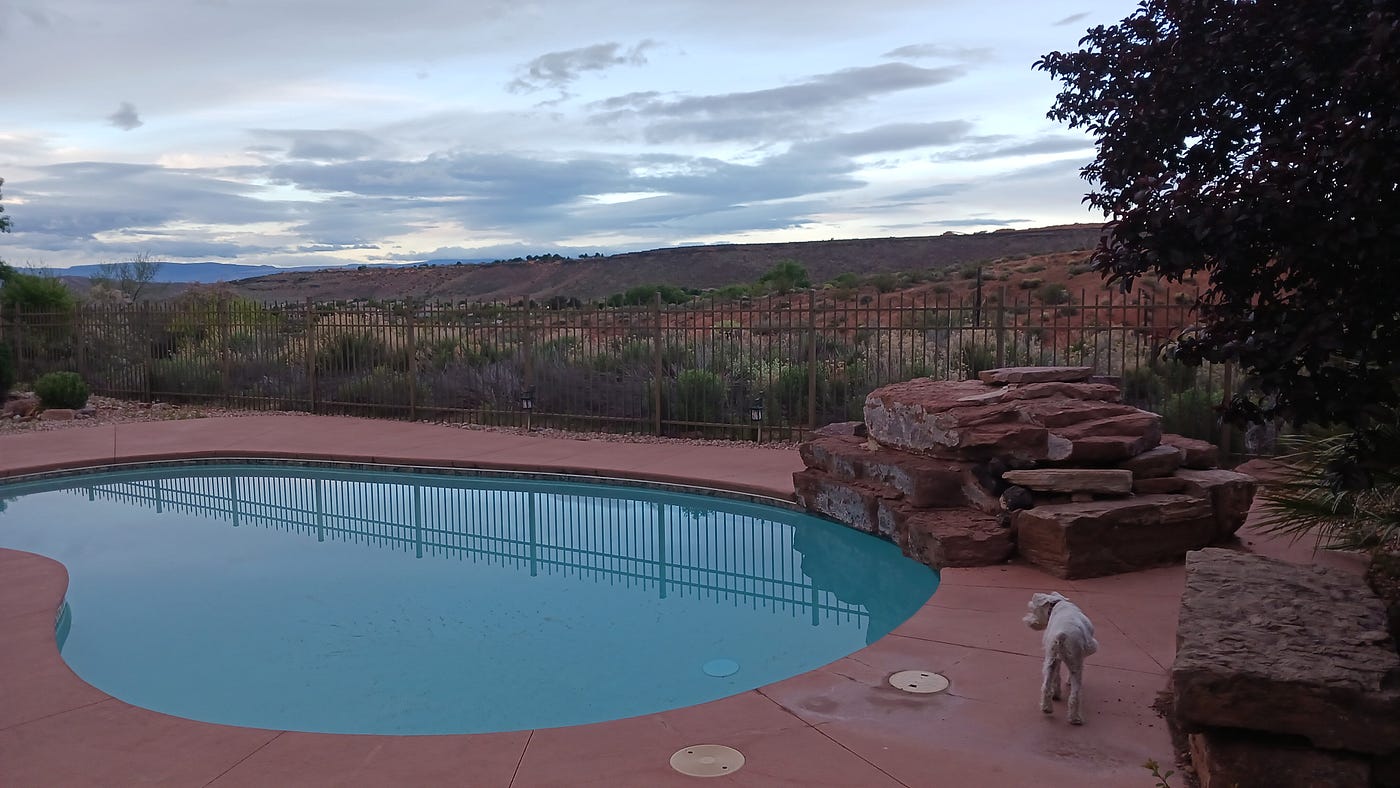
Photo by the Author: Backyard view of the desert, where the quail play
The desert landscape of southern Utah was warming with the rising sun. Sagebrush and prickly pear cactus stood illuminated against rust-red dirt. I watched five quail chicks bob along behind their parents, weaving between the lavender and the boulders that decorated the yard.
One chick got sidetracked following his own trail and fell behind. Mom quickly circled back and ushered him into line.
I watched the family of seven cross the yard and disappear into the brush. A few minutes total. Maybe six. I went on with my morning, and the morning felt better for it.
Same bird, different yard
A few weeks later — different country, different climate — I cradled a hot coffee mug between my hands on the porch of an Airbnb in British Columbia. The Okanagan Lake stretched out beyond the cedars, the sun just rising over the mountains and burning off the last bits of fog hanging in the air. I watched a trio of quail chatter and explore the trees, looking, by all appearances, like distant cousins of the Utah birds I’d been visiting with more than a thousand miles to the south.
It surprised me. I hadn’t realized the same family of birds carried across that much terrain. Different country, different vegetation, very different temperature. Same small bobbing heads.
My husband Steve and I have been on a nomadic journey for a while now — a month or so at each stop, sometimes longer. We’ve slept in cabins and rentals and the kind of house that comes with a view nobody we know has earned. The places change. The common thread we’ve found, place to place, is some version of this: a quiet morning, a hot drink, and whatever piece of the local wildlife shows up to share the yard for a few minutes.
It turns out that it may be doing more than I’d realized.

Photo by the Author: Looking over Okanagan Lake
What a bird encounter does to a mood
In 2022, a team of researchers at King’s College London, led by Ryan Hammoud and Andrea Mechelli, published a study in Scientific Reports that I’d missed when it came out and have been thinking about since. They used a smartphone app called Urban Mind, which prompts participants three times a day to report on their immediate surroundings (Do you see trees? Hear water? See or hear birds?) and on how they’re feeling in the moment.
The headline finding was simple. Seeing or hearing birds was associated with measurable improvements in mental well-being. The improvement showed up not just in the moment, but in self-reports as much as eight hours later. The effect held in participants with diagnosed depression as well as in those without.
The interesting wrinkle, statistically speaking, is that the researchers controlled for whether participants were also near trees, plants, water, or open green space. Birds had an independent effect. Even in dense urban environments, even when no other piece of the natural environment was visible, an encounter with a bird left a residue.
We don’t know with certainty what mechanism is doing the work. A few candidates have been around in the environmental-psychology literature for decades. Attention Restoration Theory, developed by Rachel and Stephen Kaplan in the 1980s, argues that natural stimuli engage the brain in a way that lets directed attention recover from urban or task-driven fatigue. Stress Reduction Theory, from Roger Ulrich’s work on hospital recovery rooms with tree views, points to a faster physiological calming response to natural scenes. The biophilia hypothesis, from E. O. Wilson, suggests that the human nervous system evolved alongside other living systems and is configured to register their presence as information about whether a place is safe.
Whichever framework you reach for, the practical implication is the same. Even a brief encounter is registering.
More birds, more confirmations
A 2017 study by Daniel Cox and colleagues, working across three English suburbs, found that people who lived in areas with more afternoon bird activity reported less depression, less anxiety, and less stress. Afternoons specifically — when work fatigue tends to peak, and when birds are quietly active in residential yards.
A 2021 study by Joel Methorst and colleagues, looking across 26 European countries, found that every 10% increase in bird species diversity in a region correlated with as much life satisfaction as a 10% increase in personal income. That comparison is striking and worth holding carefully — correlation isn’t causation, and life satisfaction is shaped by many overlapping factors. But the magnitude is hard to dismiss.
What I do know is that the trio of quail in Kelowna brightened my spirits and reminded me of similar quail chattering and playing in St. George, Utah.
A portable form of nature
What’s been quietly on my mind, watching the same family of birds appear in two places I never expected to find them in, is something like this. When you’re living a nomadic life — or just a life in which the landscape outside your window keeps changing — you start paying attention to what’s actually portable.
Birds are portable. Not the specific birds, necessarily, although in our case the cousins of the Utah quail showed up in two very different yards. But the category of encounter — small, free, frequent, available across most environments where humans are — turns out to be one of the most reliably restorative experiences the mental-health literature has identified.
You don’t need a mountain view. You don’t need to set aside an hour. You don’t even, the Hammoud study suggests, need the rest of the natural environment to cooperate. A few minutes with a bird, in whatever yard you have, seems to leave something behind for the rest of the day.
This is consistent with what I’ve come to understand about my own mental health across this stretch of moving. The big things — relationship, sleep, a quiet workspace — matter. So do the small things that show up unbidden. The quail at the lavender. The trio in the cedars. The few minutes I spent each morning, in two countries, with a coffee mug and whatever happened to be passing through.
Photo by Erik Mooiman on Unsplash
The porch, again
This morning the sun is up. The fog is gone. The quail are back. Steve is still asleep. Pearl is somewhere in the house, being a Dalmatian.
I’m not measuring anything. I’m just watching.
If the research is right, that’s enough.
메타데이터
- post_id
- f3fd8d41c4bc
- slug
- six-minutes-with-a-bird-f3fd8d41c4bc
- url
- https://medium.com/the-neurowellness-review/six-minutes-with-a-bird-f3fd8d41c4bc
- canonical_url
- https://medium.com/the-neurowellness-review/six-minutes-with-a-bird-f3fd8d41c4bc
- author_url
- https://medium.com/@rcoop801
- status
- ok
- fetched_at
- 2026-06-26 12:24:55