THE FORUM AND THE STAKE
Third in a series. “Architecture of an Actual AI Kill Switch” (April 20, 2026) described the control regime that should exist. “The Switch…
THE FORUM AND THE STAKE
Third in a series. **“Architecture of an Actual AI Kill Switch” (April 20, 2026) described the control regime that should exist. [“The Switch That Fired Without the Architecture”](https://medium.com/@patrickgros/the-ai-killswitch-that-misfired-86a0e1af84e5) **(July 1, 2026) documented what happened when Washington reached for the switch without it. This piece examines what is now being proposed in the aftermath: a US-led governance forum and a government equity stake in the leading lab, announced within a single news cycle. The equilibrium is consolidating, and it is consolidating in the wrong configuration.
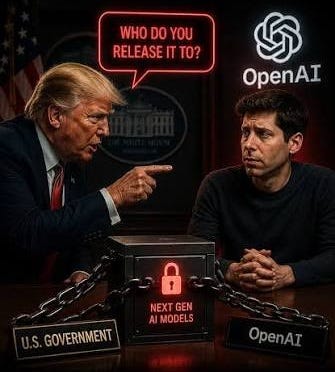
Two Proposals, One Move In the first days of July, two proposals surfaced from OpenAI within twenty-four hours of each other. The first, an op-ed by Sam Altman in the Financial Times, calls for a US-led international forum that would establish accepted safety standards, provide expert analysis of capabilities and risks, and make the technology available to nations and companies that participate and follow the rules. The models cited are aviation safety, global financial standards, and the IAEA. The second, reported by the Financial Times from early conversations, is a proposal to hand the US government a five percent equity stake in OpenAI, structured through public investment vehicles on the Alaska Permanent Fund model, with the arrangement contingent on other major American labs doing the same. Altman has discussed the stake directly with the President, the Commerce Secretary, and the Treasury Secretary.
These read as separate stories. They are one strategy, and the timeline makes the logic legible. On June 12 the Commerce Department pulled a competitor’s two most capable models off the world market with a Friday letter. Within two weeks the administration asked OpenAI to restrict its own next model to a government-approved customer list before release, the first preemptive gate on an American model in history. OpenAI has now watched the crude switch fire at a rival and felt it pointed at itself. Its response is not to contest the arrangement. It is to institutionalize it, on terms the leading lab helps write, with equity as the bonding agent between the industry and the administration.
This is a rational corporate response to the June demonstration. It is also, measured against any serious design standard for a control regime, the consolidation of the wrong architecture.
The Forum: A Governance Spine, Inverted The forum Altman describes performs the same functions as the chartered authority in my April framework: it sets conformance standards, analyzes capabilities and risks, and conditions access on compliance. The resemblance is structural, and so is the inversion. My April design held that the authority must be statutorily chartered rather than executively convened, politically insulated rather than administration-aligned, and independent of the labs it governs, because a revocation authority that is seen to be controlled by any single government or any single company earns neither international trust nor domestic acceptance. Every one of those requirements is reversed in the proposal on the table. The forum is US-led by definition, convened through the executive relationship formed at the G7, and proposed by the dominant commercial lab, whose access to markets it would help administer.
The second inversion is more consequential and easier to miss. The forum has a governance layer and nothing underneath it. There is no attestation, no sealed-weights custody, no endpoint-level enforcement, no receipt or audit substrate… none of the technical layers that would let a restriction be narrow, verifiable, and proportional. Enforcement is by withholding: participants who follow the rules get the technology, and the sanction for everyone else is denial of access. That is precisely the mechanism that fired on June 12, and it preserves the June 12 failure mode by design. A regime that can only grant or deny access wholesale will, under pressure, produce all-or-nothing outcomes, because that is the only output it has. The forum does not fix the crude switch. It gives the crude switch a secretariat.
The Stake: Insurance That Poisons the Well The equity proposal is best understood as political-risk insurance purchased before an IPO. A government that owns five percent of a company is structurally less likely to switch that company off, and a pre-listing resolution of regulatory overhang has obvious value to underwriters. Read narrowly, from inside OpenAI, the logic is sound. There is even a defensible public-interest gloss: the Alaska-fund structure, the conversations with Senator Sanders, and the earlier public-wealth-fund proposal all speak to a real problem, which is that the public bears the disruption of this technology without holding any of its equity.
Read from anywhere outside the United States, the proposal does the opposite of what the moment requires. The June episode taught allied governments that American frontier AI carries a switch operated in Washington on process the customer cannot see. The single most damaging follow-on to that lesson would be evidence that Washington also holds a financial interest in the commercial outcomes of the companies attached to the switch. A regulator that is also a shareholder is a regulator with a profit motive in how access is allocated, whose restrictions on foreign availability are no longer distinguishable from protectionism, and whose safety determinations carry a permanent suspicion of book-talking. The proposal generalizes badly by its own terms: it invites every other government to demand equivalent stakes in exchange for market access, which is the mercantilist end-state, a world where frontier AI access is allocated jurisdiction by jurisdiction through sovereign shareholding. That is not a safety regime. It is a spheres-of-influence regime with safety language on the letterhead.
What the Pairing Reveals Put the two proposals together and the shape of the emerging settlement is visible. The executive holds the switch and has now demonstrated it. The leading labs, rather than building the technical layers that would make restrictions narrow and the governance structures that would make them legitimate, are negotiating their individual positions relative to the switch: a secret remediation deal in one case, a preemptive approved-customer list in another, and now a proposed equity bond and a lab-sponsored forum in a third. Each accommodation is individually rational. Collectively they harden an arrangement with three defining properties: discretionary access control, executive entanglement, and no technical enforcement layer that would permit anything other than all-or-nothing action.
My April document argued that the four-layer regime does not exist because no one had done the political work of aligning four constituencies. That diagnosis needs one amendment in light of July. The political work is now being done, at speed, by the actor with the strongest commercial incentive, and it is aligning the constituencies around the wrong architecture. The window identified after June 12… the moment when the commercial case and the safety case for real technical and governance layers had finally converged… is being spent. Not on attestation, custody, and a chartered authority, but on equity transfers and a forum whose independence is nominal and whose enforcement instrument is the same blunt denial that produced a nineteen-day global outage.
The Test That Sorts Proposals There will be more proposals. The G7 framework process has a September meeting date, a cyber executive order framework is being negotiated, and every lab now has reason to put forward its preferred settlement. A simple three-part test, drawn directly from the April architecture, sorts them:
• Independence. Is the standards-and-revocation function statutorily chartered, with staggered appointments, defined predicates, and an auditable process, or is it convened by and answerable to the executive of one government and shaped by the labs it governs? A forum that fails this test is an access cartel, whatever it is called.
• Granularity. Does the proposal build or require the technical layers… attestation, sealed weights, endpoint controls, receipts… that make narrow restrictions technically possible? A regime whose only instrument is wholesale denial will keep producing June 12s, because proportionality is an engineering property before it is a policy one.
• Disentanglement. Does the arrangement separate the government’s regulatory interest from any financial interest in the regulated companies? Public benefit-sharing is a legitimate goal with legitimate instruments: taxation, the digital-dividend concept, a sovereign fund holding broad market exposure rather than direct stakes in the firms the same government licenses and restricts. Direct equity in the specific companies attached to the switch fails the test regardless of how the proceeds are distributed.
The Altman proposals fail all three. That does not make them cynical; it makes them a faithful expression of what the current equilibrium rewards. The point of naming the tests is that the next proposals need not fail them, and the actors who will draft those proposals… in the September process, in the executive-order framework, in the legislation that the June episode has made inevitable… are choosing between architectures right now, whether they know it or not.
Closing I warned twice earlier, that if the regime were not built deliberately, it would be built in haste after a forcing event, and built badly. The refinement July requires is that haste is not the only way a regime gets built badly. It can also be built badly at leisure, by accretion, one bilateral accommodation at a time, each announced as pragmatism, until the discretionary arrangement is load-bearing and no one can afford to replace it. That process is underway. The forum and the stake are its most articulate expression so far. The alternative architecture exists on paper and its primitives exist in production. What it does not yet have is a sponsor with the standing to put it on the table before the September meeting convenes. That is the open position.
메타데이터
- post_id
- f4028d7af419
- slug
- the-forum-and-the-stake-f4028d7af419
- url
- https://medium.com/@patrickgros/the-forum-and-the-stake-f4028d7af419
- canonical_url
- https://medium.com/@patrickgros/the-forum-and-the-stake-f4028d7af419
- author_url
- https://medium.com/@patrickgros
- status
- ok
- fetched_at
- 2026-08-03 02:39:07